Market Summary
Executive Summary and Global Market Analysis
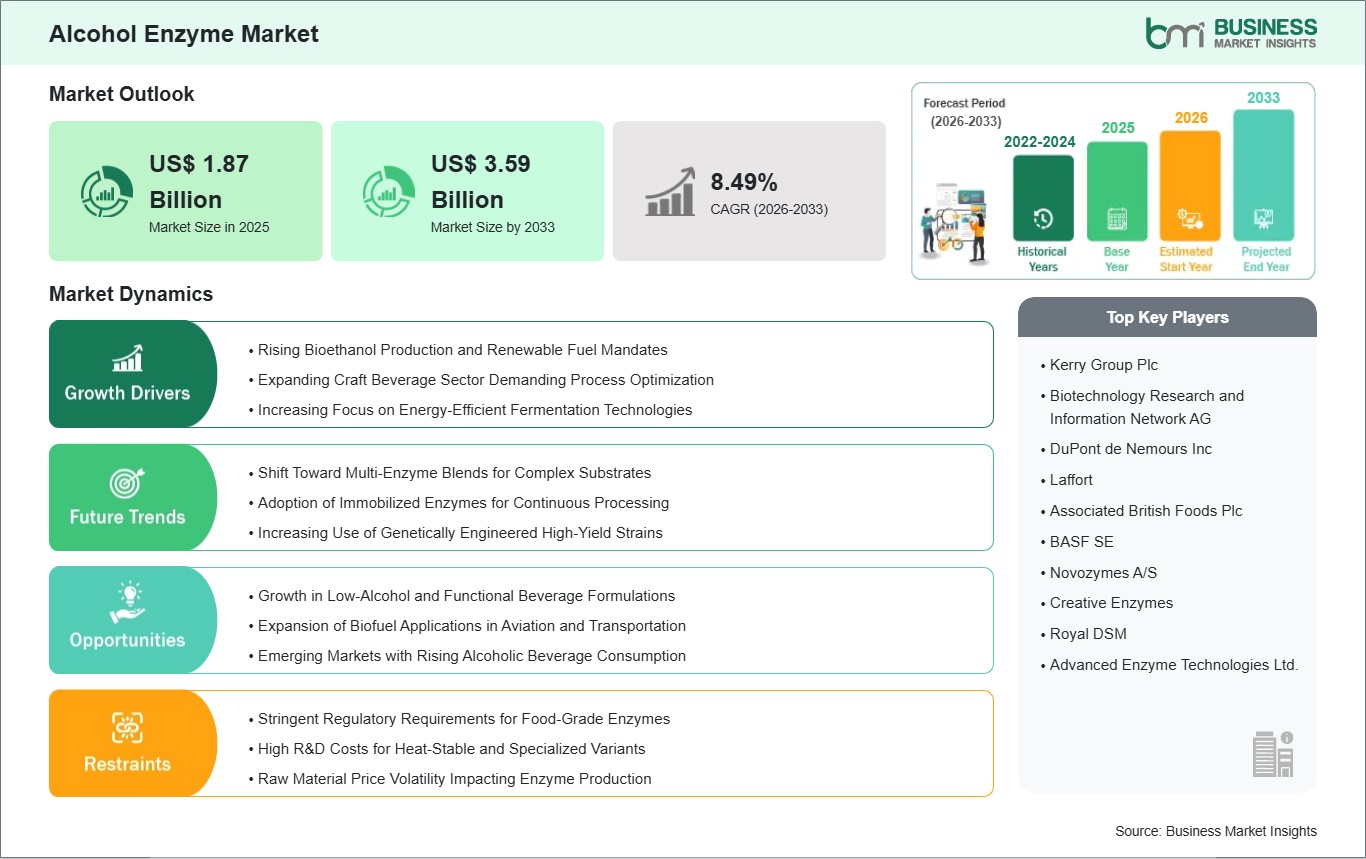
Alcohol enzymes are highly specialized proteins that serve as indispensable biocatalysts in the sustainable production of biofuels, beverages, and a wide range of chemical intermediates. They facilitate the efficient conversion of starches and cellulosic biomass into fermentable sugars, ultimately enabling ethanol synthesis. Ethanol remains a cornerstone of renewable energy strategies and is vital to numerous industrial applications. The alcohol enzyme market is expanding rapidly, driven by the global transition toward bio‑based economies, increasingly stringent environmental regulations that encourage green manufacturing, and rising demand across the food & beverages and pharmaceutical industries. Continuous advancements in enzyme engineering, protein design, and fermentation technologies are further boosting performance—improving yield, specificity, operational stability, and cost-efficiency. As a result, these enzymes have become essential components of modern, sustainable industrial processes.
Despite this momentum, the market still encounters notable challenges. Enzyme development and large‑scale production remain costly, and many enzymes exhibit sensitivity to temperature, pH, and other industrial process variables. The presence of well‑established chemical synthesis methods, along with regulatory complexities and the requirement for consistent performance at commercial scale, also poses barriers. However, the landscape is rich with opportunity. Breakthroughs in synthetic biology and metabolic engineering are enabling the creation of more robust, efficient, and tailor-made enzyme systems. These innovations are opening new pathways for integrating alcohol enzymes into circular economy models, waste‑to‑value technologies, and next‑generation bio‑refineries. Ultimately, the future of the alcohol enzyme market will be shaped by the world’s accelerating shift from petrochemical processes to sustainable, bio‑based production solutions.
Segment Analysis
Alcohol Enzyme Market Segmentation
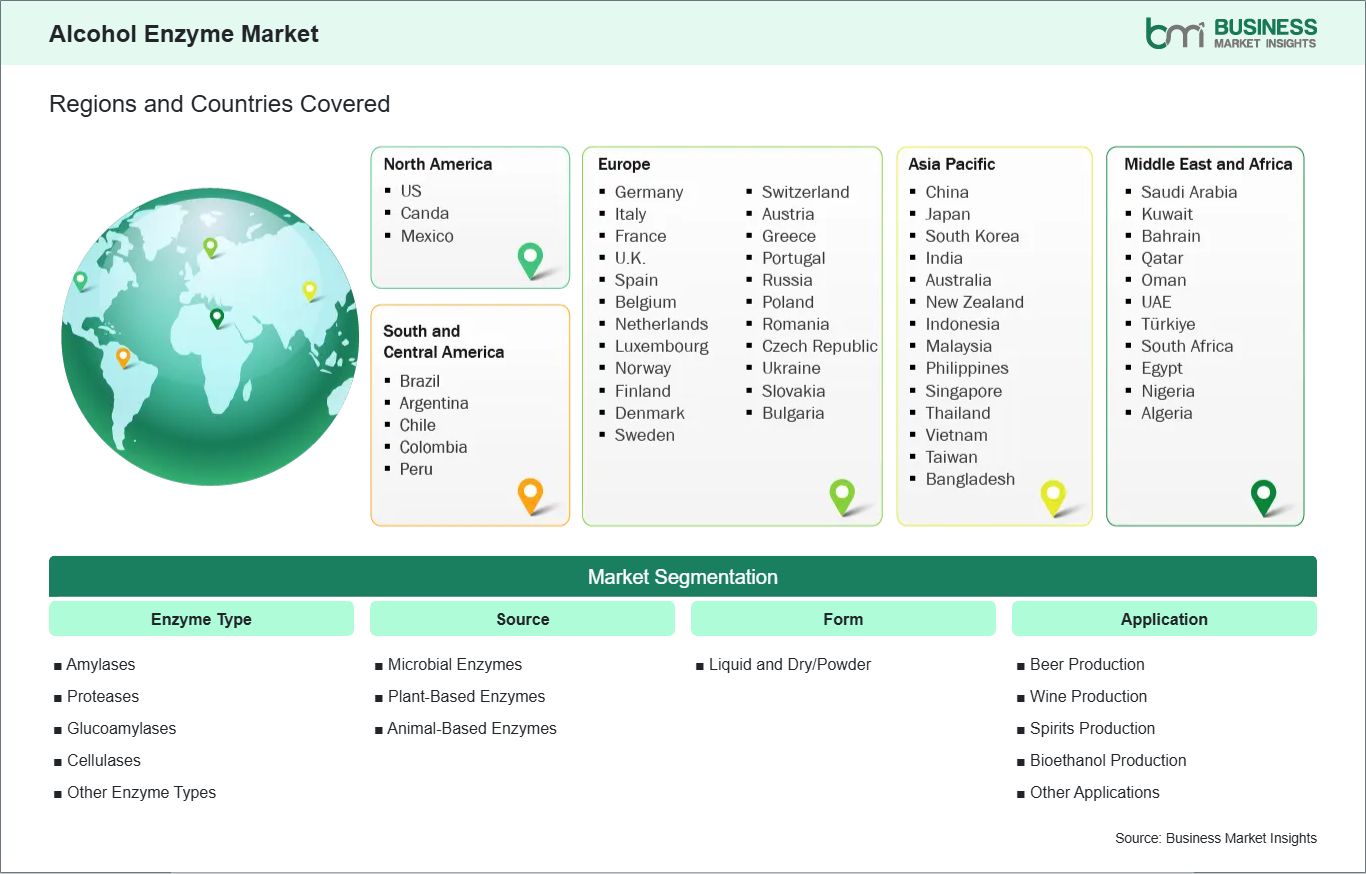
Key segments that contributed to the derivation of the alcohol enzyme market analysis are enzyme type, source, form, and application.
- By enzyme type, the alcohol enzyme market is segmented into amylases, proteases, glucoamylases, cellulases, and other enzyme types. The amylases segment dominated the market in 2025.
- By source, the market is segmented into microbial enzymes, plant-based enzymes, and animal-based enzymes. The microbial enzymes segment dominated the market in 2025.
- By form, the alcohol enzyme market is divided into liquid and dry/powder. The liquid segment held the largest share of the market in 2025.
- By application, the market is segmented into beer production, wine production, spirits production, bioethanol production, and other applications. The beer production segment dominated the market in 2025.
Market Forces
Alcohol Enzyme Market Drivers and Opportunities
Rising Demand in Biofuels and Industrial Ethanol Production
The global drive for energy security and deep decarbonization is significantly increasing the demand for alcohol enzymes within the biofuel sector, particularly for large-scale bioethanol production. As countries adopt stricter renewable fuel standards, carbon‑reduction targets, and mandatory ethanol‑blending policies, industries are increasingly relying on high‑performance enzymatic hydrolysis and fermentation technologies. These enzyme-driven processes enable the efficient breakdown of agricultural feedstocks, lignocellulosic biomass, and various waste materials into fermentable sugars, which are then converted into ethanol with greater speed, consistency, and sustainability than traditional chemical methods. Simultaneously, the industrial ethanol market—essential for manufacturing chemicals, pharmaceuticals, sanitizers, and a variety of industrial solvents—requires enzymes that can consistently deliver high yields, superior purity levels, and cost‑effective production cycles. This dual demand from both renewable energy and industrial segments is encouraging manufacturers to adopt advanced enzymatic solutions that optimize throughput and reduce operational bottlenecks. By enhancing process efficiency, lowering energy consumption, and supporting greener manufacturing, these enzyme innovations are not only improving profitability but also contributing to the rapid expansion and modernization of the alcohol enzyme market.
Innovation in Enzyme Engineering and Waste-to-Value Processes
Traditional enzymatic processes often face limitations related to cost, operational stability, and substrate specificity, particularly when exposed to harsh industrial conditions. These constraints can reduce efficiency and hinder large‑scale commercial deployment. In response, major advances in protein engineering, synthetic biology, and directed evolution are transforming the capabilities of alcohol enzymes. These cutting‑edge technologies enable the creation of tailored biocatalysts with significantly enhanced performance, including improved thermostability, higher catalytic efficiency, and greater tolerance to inhibitors commonly found in lignocellulosic and waste‑derived feedstocks. Such innovations are proving critical for accelerating the commercialization of advanced biofuel pathways and strengthening the economic viability of second‑generation ethanol production.
Further, the rising emphasis on circular bioeconomy models is opening new opportunities for enzymes capable of converting non‑food biomass, industrial residues, and even carbon monoxide or syngas into value‑added alcohols. Companies investing in these next‑generation biocatalysts are well positioned to serve premium markets, comply with increasingly stringent sustainability targets, and transform waste streams into renewable fuels and chemicals. This strategic focus not only supports long‑term competitiveness but also drives broader adoption of environmentally responsible production systems.
Size and Share Analysis
Alcohol Enzyme Market Size and Share Analysis
The Alcohol Enzyme market demonstrates steady growth, with size and share analysis revealing evolving trends and competitive positioning among key players. The report further examines subsegments categorized within enzyme type, source, form, and application, offering insights into their contribution to overall market performance.
Based on enzyme type, the amylases segment dominates the alcohol enzyme market. Amylases provide great flexibility, affordability, and efficiency in breaking down starches into fermentable sugars. This makes them essential for producing biofuels, industrial ethanol, and alcoholic drinks. Their proven ability to work with various feedstocks and their established role in large-scale industrial fermentation processes have made them the top choice for manufacturers in the biofuel, beverage, and pharmaceutical industries.
Report Coverage
Alcohol Enzyme Market Report Coverage and Deliverables
The " Alcohol Enzyme Market Size and Forecast (2022–2033)" report provides a detailed analysis of the market covering below areas:
- Alcohol Enzyme market size and forecast at global, regional, and country levels for all the key market segments covered under the scope
- Alcohol Enzyme market trends, as well as market dynamics such as drivers, restraints, and key opportunities
- Alcohol Enzyme market analysis covering key market trends, global and regional framework, major players, regulations, and recent market developments
- Industry landscape and competition analysis covering market concentration, heat map analysis, prominent players, and recent developments for the alcohol enzyme market
- Detailed company profiles, including SWOT analysis
Geographic Insights
Alcohol Enzyme Market Geographic Insights
The geographical scope of the Alcohol Enzyme market report is divided into five regions: North America, Asia Pacific, Europe, Middle East & Africa, and South & Central America. The North America Alcohol Enzyme Market is segmented into the US, Canada, and Mexico. North America is a leader in technology and has a strong demand in the global alcohol enzyme market. This status comes from a well-established industrial biotechnology sector, strict regulations that support sustainable production, and major investments in biofuel and pharmaceutical manufacturing. The region's emphasis on innovation in enzyme engineering and synthetic biology ensures a steady supply of high-performance, next-generation biocatalysts.
Additionally, a strong industrial base for bioethanol, supported by renewable fuel standards, and high-value uses in pharmaceuticals and specialty chemicals, creates significant demand. The presence of major companies and research institutions reinforces North America's position as a key center for innovation, establishing global benchmarks for efficiency and scalability in enzymatic processes across important industries.
Industry Activity
Recent Developments
The Alcohol Enzyme market is evaluated by gathering qualitative and quantitative data post-primary and secondary research, which includes important corporate publications, association data, and databases. A few of the key developments in the alcohol enzyme market are:
- In July 2025, Voodoo Scientific collaborated with Ginkgo Bioworks to develop an enzymatic solution aimed at producing smoother alcoholic spirits. Ginkgo will utilize its protein discovery and design expertise to optimize the enzyme for various manufacturing conditions. This partnership addresses the harsh sensations often associated with distilled beverages, allowing distillers to enhance the quality of their products and create smoother spirits.
- In September 2024, IFF introduced Diazyme Nolo, a new enzyme that enhances the taste and production efficiency of no- and low-alcohol beverages. This innovation responds to the increasing consumer demand for healthier lifestyle options, as the nolo segment has grown by 6.5% over the past year, becoming the fastest-growing category in the beverage industry. Diazyme Nolo improves mouthfeel and flavor without requiring extensive investment in new equipment, enabling breweries to adapt their existing processes.
Trust & Transparency
Research Methodology
The market analysis combines proprietary research with secondary data from government agencies, company disclosures, regulatory filings, industry databases and expert interviews. Market estimates are validated through data triangulation, cross-market benchmarking and analyst
review.
View Full Research Methodology
Key Sources Referred:
World Bank – Global Trade IndicatorsEuropean Chemicals AgencyInternational Council of Chemical AssociationsInternational Monetary Fund (IMF)World Trade Organization (WTO)International Trade Administration (ITA)Company WebsitesCompany Annual ReportsCompany Investor Presentations