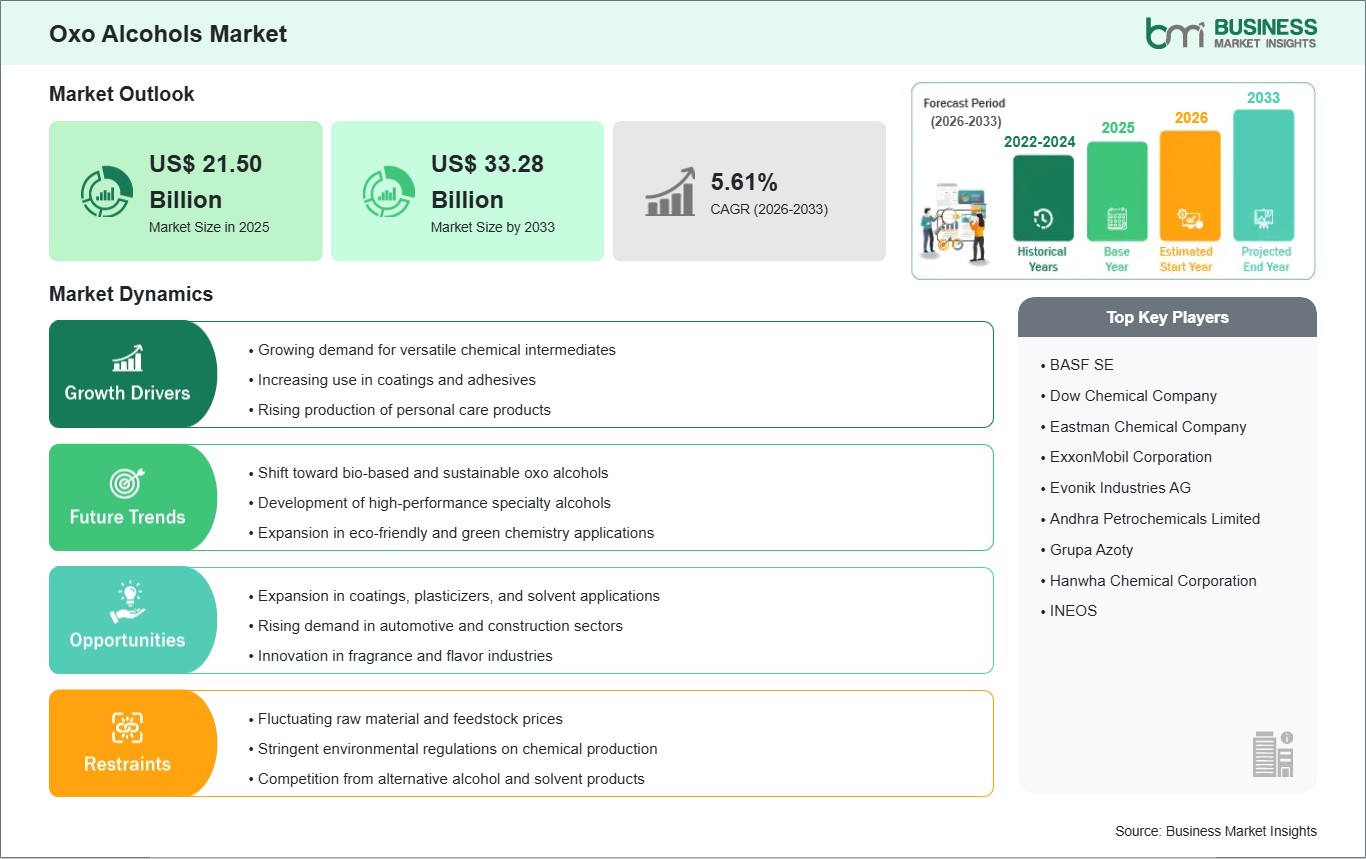
The Oxo Alcohols Market size is expected to reach US$ 33.28 Billion by 2033 from US$ 21.50 Billion in 2025. The market is estimated to record a CAGR of 5.61% from 2026 to 2033.
The oxo alcohols market is witnessing steady growth driven by increasing demand from downstream industries, including paints & coatings, plasticizers, solvents, and personal care products. Oxo alcohols, synthesized through the hydroformylation of olefins followed by hydrogenation, are valued for their versatility, high solvency, and ability to serve as intermediates in producing esters, plasticizers, and specialty chemicals. Rising construction and automotive activities are stimulating demand in the coatings and plasticizer segments, while expanding consumer goods production supports applications in personal care and household products.
Additionally, the shift toward environmentally friendly and low-VOC formulations is driving adoption of oxo alcohols that enable compliant solvent systems. Market dynamics are shaped by technological innovations in process efficiency, such as catalytic advancements that enhance yield and reduce energy consumption. Manufacturers are increasingly investing in integrated production facilities to optimize supply chains and ensure consistent quality. Strategic collaborations with downstream chemical producers enable faster formulation development and market penetration. However, challenges persist, including feedstock price volatility, regulatory pressures related to chemical safety, and competition from bio-based alternatives in select applications. Despite these factors, long-term growth is underpinned by rising industrial activity, expanding end-use sectors, and increasing preference for high-performance intermediates that enhance product quality and environmental compliance.

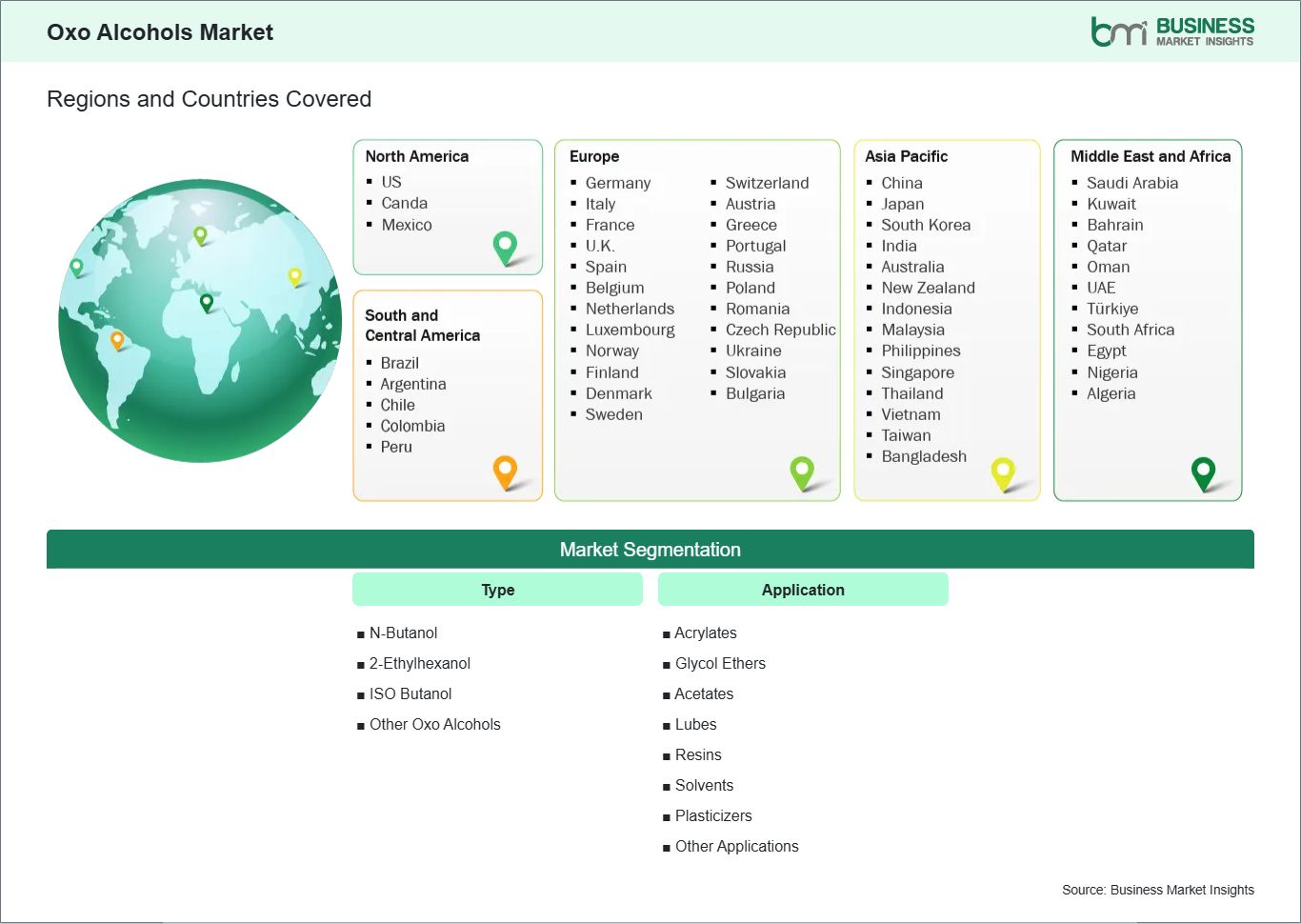
Key segments that contributed to the derivation of the oxo alcohols market analysis are type and application.
The growing need for versatile chemical intermediates is one of the primary factors driving the oxo alcohols market forward. Oxo alcohols have a broad scope for use as a chemical intermediate in the development of plasticizers, solvents, coatings, and detergents. This makes oxo alcohols a crucial element in many different industries. The chemical inertness, solubility, and compatibility of oxo alcohols with many different formulations have made them extremely valuable for many different industries that require efficient chemical intermediates for their manufacturing processes.
The sustainable benefits that oxo alcohols have to offer have also become a driving factor for the oxo alcohols market. Oxo alcohols have become a crucial element in the development of eco-friendly plasticizers, coatings, and solvents that help many different industries meet their sustainable requirements. The ability that oxo alcohols have to adapt to many different chemical formulations has helped them remain a valuable element in many different industries.
Innovation in production technologies, for example, hydroformylation and improvements in catalytic processes, has improved the efficiency, yield, and selectivity of oxo alcohol synthesis. These technologies lower production costs and energy consumption, making the products highly pure for use in niche markets. As industries continue to demand versatile, high-performance, and sustainable chemicals, the demand for oxo alcohols will continue to rise steadily.
The market for oxo alcohols is growing due to their increased use in coatings, plasticizers, and solvents. Oxo alcohols find their main application in coatings. Oxo alcohols are used to manufacture resins, paints, and varnishes. They improve flow, gloss, and durability. Oxo alcohols find their main use in improving performance while maintaining compatibility with various formulations. Oxo alcohols are an integral part of coatings.
In plasticizers, oxo alcohols find their main use. Oxo alcohols manufacture esters to improve flexibility and workability of plastics. Oxo alcohols find their main use in plastics and PVC. Oxo alcohols have shown their efficiency and stability in manufacturing quality products. Oxo alcohols find their main use as solvents in industrial cleaning agents and adhesives. Oxo alcohols improve efficiency while maintaining quality.
Ongoing advancements in synthesis and processing technologies have allowed for higher yields, lower energy consumption, and reduced waste generation. These improvements make oxo alcohols more cost-effective and environmentally sustainable, encouraging broader adoption across multiple sectors. As demand grows for flexible, efficient, and high-performance chemicals, oxo alcohols are expected to maintain a strong position in coatings, plasticizers, solvents, and other industrial applications worldwide.

The oxo alcohols market demonstrates steady growth, with size and share analysis highlighting evolving trends and competitive dynamics among key players. The report examines subsegments categorized within type and application, offering insights into their contribution to overall market performance.
By Type, the 2‑Ethylhexanol subsegment dominated the market in 2025, driven by its extensive use as a precursor for plasticizers and other high‑value derivatives.
Based on Application, the plasticizers subsegment dominated the market in 2025, owing to significant demand from PVC and flexible polymer industries across construction, automotive, and consumer goods sectors.
| Report Attribute | Details |
|---|---|
| Market size in 2025 | US$ 21.50 Billion |
| Market Size by 2033 | US$ 33.28 Billion |
| Global CAGR (2026 - 2033) | 5.61% |
| Historical Data | 2022-2024 |
| Forecast period | 2026-2033 |
| Segments Covered | By Type
|
|
Regions and Countries Covered
| |
| North America | US, Canada, Mexico |
| Europe | Belgium, Austria, Finland, Denmark, Greece, Poland, Romania, Russia, Ukraine, Czech Republic, Slovakia, Bulgaria, Italy, Luxembourg, Germany, Switzerland, France, Netherlands, Norway, Portugal, Spain, Sweden, United Kingdom |
| Asia-Pacific | Australia, China, India, Japan, South Korea, Indonesia, Malaysia, Philippines, Singapore, Thailand, Vietnam, Bangladesh, New Zealand, Taiwan |
| South and Central America | Brazil, Argentina, Peru, Chile, Colombia |
| Middle East and Africa | Bahrain, Kuwait, Oman, Qatar, Saudi Arabia, United Arab Emirates, Turkiye, South Africa, Egypt, Algeria, Nigeria |
| Market leaders and key company profiles |
|
The "Oxo Alcohols Market Size and Forecast (2022 - 2033)" report provides a detailed analysis of the market covering below areas:
The geographical scope of the Oxo Alcohols Market report is divided into North America, Asia Pacific, Europe, Middle East & Africa, and South & Central America. North America held the largest share in 2025.
The oxo alcohols market exhibits varied growth patterns influenced by industrial activity, chemical manufacturing capacity, and regulatory frameworks. North America dominates, driven by strong demand from the U.S. and Canada’s coatings, automotive, and personal care industries. High adoption of environmentally compliant solvents, well-established chemical production infrastructure, and regulatory incentives for low-VOC products reinforce regional leadership.
Europe demonstrates steady growth, particularly in Germany, France, and the U.K., where industrial chemical production, stringent environmental regulations, and high demand for performance coatings and plasticizers drive market adoption.
Asia Pacific is the fastest-growing region, led by China, India, and Southeast Asian countries. Rapid industrialization, increased automotive and construction industry growth, and increased demand for consumer products are driving growth in the market. Investments in local manufacturing capacity and upgrading technology are also driving growth in the market.
The Middle East & Africa market is growing moderately, with the GCC countries and South Africa using oxo alcohols for coatings, industrial solvents, and chemical intermediates due to growth in infrastructure development and petrochemical industry activities.
The South & Central America market is growing gradually, with Brazil and Argentina driving demand due to growth in construction industry activities, automotive industry growth, and growth in the industrial chemical industry. Focus on product quality and regulatory requirements is driving growth in the use of oxo alcohol-based intermediates.

The Oxo Alcohols Market is evaluated by gathering qualitative and quantitative data post primary and secondary research, which includes important corporate publications, association data, and databases. A few of the key developments in the oxo alcohols market are:
The Oxo Alcohols Market is valued at US$ 21.50 Billion in 2025, it is projected to reach US$ 33.28 Billion by 2033.
As per our report Oxo Alcohols Market, the market size is valued at US$ 21.50 Billion in 2025, projecting it to reach US$ 33.28 Billion by 2033. This translates to a CAGR of approximately 5.61% during the forecast period.
The Oxo Alcohols Market report typically cover these key segments-
The historic period, base year, and forecast period can vary slightly depending on the specific market research report. However, for the Oxo Alcohols Market report:
The Oxo Alcohols Market is populated by several key players, each contributing to its growth and innovation. Some of the major players include:
The Oxo Alcohols Market report is valuable for diverse stakeholders, including:
Essentially, anyone involved in or considering involvement in the Oxo Alcohols Market value chain can benefit from the information contained in a comprehensive market report.
Please tell us your area of interest
(Market Segments/ Regions and Countries/ Companies)