
Extended Reality Market Outlook: Size, Share, Trends, Growth Analysis, Competitive Landscape & Forecast, 2026-2033

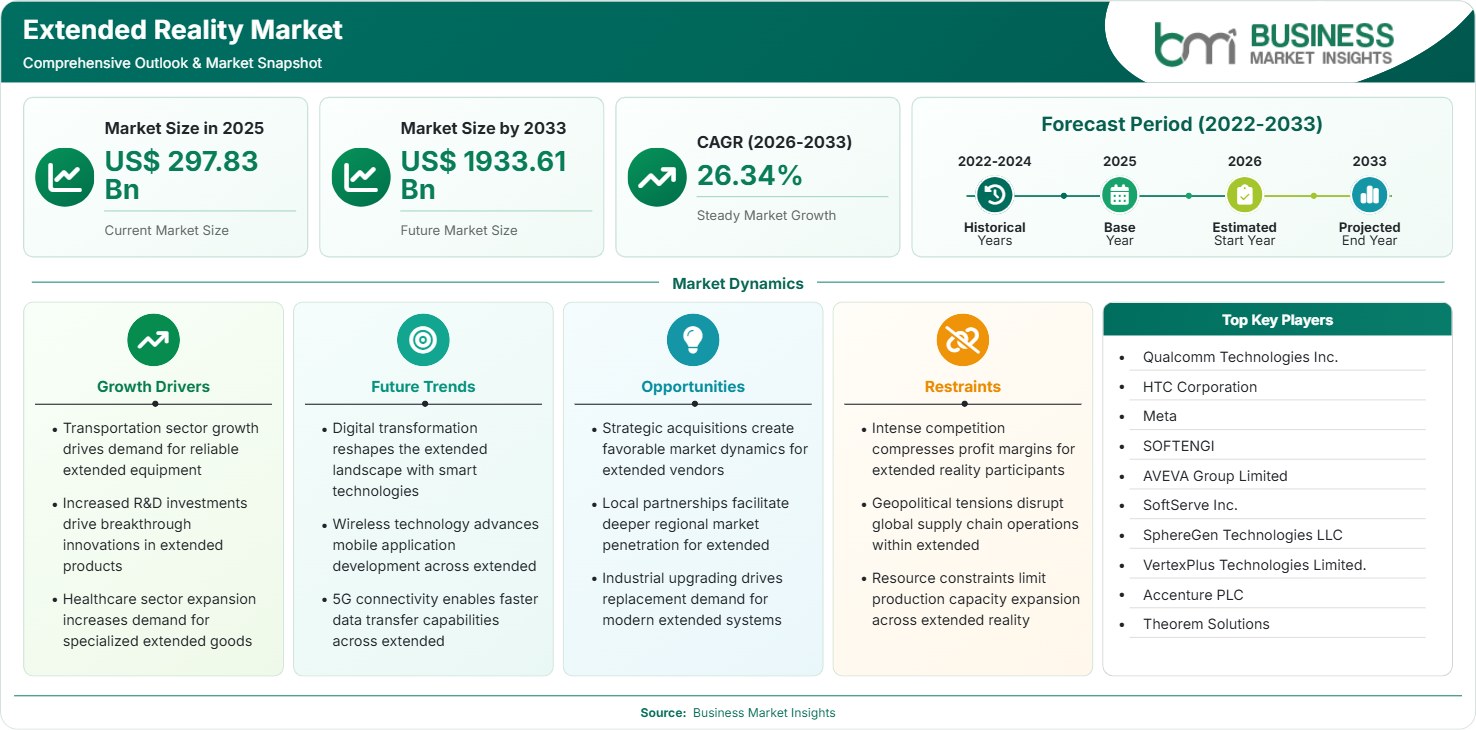
The Extended Reality Market size was valued at US$ 297.83 Billion in 2025 and is projected to reach US$ 1933.61 Billion by 2033, growing at a CAGR of 26.34% during 2026–2033. Growth is driven by enterprise digitalization, spatial computing adoption, AI-powered immersive experiences, industrial training demand, healthcare simulation expansion, and increasing investments in next-generation human-machine interfaces.

Report Coverage
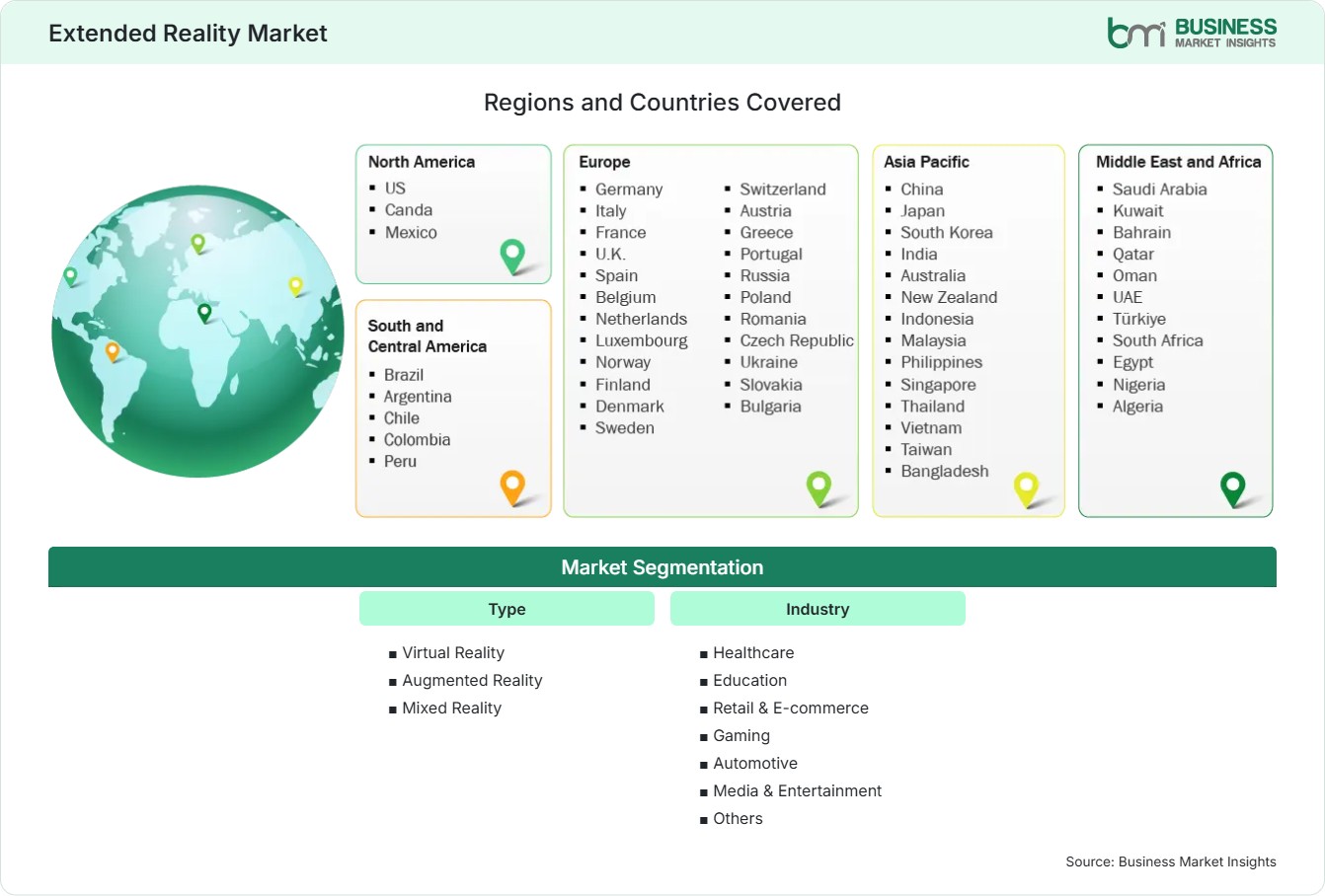
  • Type: Virtual Reality, Augmented Reality, Mixed Reality
  • Industry: Healthcare, Education, Retail & E-commerce, Gaming, Automotive, Media & Entertainment, Others
US$ 297.83 Bn Market size in 2025
US$ 1933.61 Bn Market Size by 2033
26.34% CAGR, 2026 - 2033
2026-2033 Forecast Period

AI Overview

Extended Reality Market Summary

  • North America Region: North America holds a 34%–37% share in 2025 and is forecast to grow at a CAGR of 24.0%–25.5% during 2026–2033. Demand is supported by enterprise XR deployment, defense simulation programs, digital twins, metaverse investments, AI integration, immersive collaboration, and advanced hardware ecosystems. The U.S. accounts for 81%–85% of regional demand and is projected to grow at a CAGR of 24.5%–26.0%.
  • Fastest Growing Region: Asia Pacific holds a 27%–31% share in 2025 and is expected to expand at a CAGR of 28.5%–30.0%. Smart manufacturing, gaming adoption, government digital transformation initiatives, 5G deployment, and expanding consumer electronics ecosystems drive demand.
  • Leading Segment: Augmented Reality represents 42%–46% share in 2025 and is expected to grow at a CAGR of 26.0%–27.5%. Enterprise productivity tools, retail visualization, industrial maintenance applications, and mobile-based deployments support segment leadership.
  • High Growth Segment: Healthcare accounts for 13%–17% share in 2025 and is projected to grow at a CAGR of 30.5%–32.0%. Surgical planning, medical education, remote assistance, patient rehabilitation, and immersive clinical simulations fuel adoption.
  • Key Market Opportunity: Convergence of artificial intelligence, cloud infrastructure, wearable computing, and digital twins creates transformative opportunities for scalable immersive applications across industrial, commercial, and consumer environments globally.
  • Major Market Players: Microsoft Corporation, Meta Platforms, Inc., Apple Inc., Alphabet Inc., Sony Group Corporation, HTC Corporation, Samsung Electronics Co., Ltd., NVIDIA Corporation, Qualcomm Incorporated, and Unity Software Inc.
Strategic Insights

Extended Reality Market: Strategic Insights

Extended Reality Market Strategic Framework
FREE PDF
Request your free sample
Request free sample
Stakeholder View

Key Takeaways

  • Ecosystem value increasingly depends on integrated hardware, software, cloud platforms, and content development capabilities.
  • Healthcare and industrial training applications offer the highest monetization potential due to measurable productivity and outcomes improvements.
  • AI-powered immersive content creation is reducing development complexity and improving scalability.
  • Asia Pacific presents the strongest expansion opportunity because of digital infrastructure growth and consumer technology adoption.
  • Strategic partnerships between semiconductor companies, software vendors, and device manufacturers are shaping competitive dynamics.
  • Enterprise-focused deployments are generating more stable revenue streams than purely consumer-oriented applications.
Geographic Outlook

Extended Reality Market Regional Highlights

North America Extended Reality Market

The North American region accounts for 34%-37% of global demand in 2025 and is expected to grow at a CAGR of 24.0%-25.5%. Robust technology infrastructure, innovation ecosystems, and enterprise digital transformation drive the growth in adoption. The Extended Reality Market share is dominated by enterprise, health care, defense, and education verticals, with immersive technologies providing tangible benefits.

  • Defense and aerospace organizations continue investing in advanced simulation and training environments.
  • Enterprise collaboration tools are driving increasing adoption of immersive workplace solutions.
  • Venture capital activity supports innovation in spatial computing and immersive software.
  • Healthcare institutions increasingly deploy visualization and training platforms.
  • Strong cloud infrastructure accelerates large-scale XR deployment strategies.

US Extended Reality Market

The United States represents 81%–85% of regional consumption and is expected to grow at a CAGR of 24.5%–26.0%. Leadership is supported by advanced technology companies, enterprise software providers, semiconductor innovation, and high digital adoption rates.

  • Enterprise deployments continue expanding across manufacturing and logistics sectors.
  • Technology firms drive innovation through ecosystems and developer platforms.
  • Medical simulation adoption improves workforce readiness and training outcomes.
  • Digital twin implementation supports industrial optimization initiatives.

Europe Extended Reality Market

Europe captures a market share of 24% to 27%, with an expected CAGR of 25.0% to 26.5%. The lead country in regional demand is Germany, while the fast adopters in the region include Nordic countries and the Netherlands.

  • Manufacturing digitization supports industrial immersive technology implementation.
  • Educational institutions increasingly adopt virtual and mixed reality learning.
  • Automotive companies invest in immersive product design environments.
  • Sustainability initiatives encourage digital prototyping over physical models.
  • Public-sector innovation programs support ecosystem development.

Asia Pacific Extended Reality Market

The Asia-Pacific region accounts for 27%–31% market share and is anticipated to register the highest CAGR of 28.5%–30.0%. In terms of adoption, China dominates the Asia-Pacific region, while India is highly promising owing to its digital transformation and large pool of developers.

  • 5G expansion enhances immersive experience quality and accessibility.
  • Gaming and entertainment remain major commercial adoption drivers.
  • Smart manufacturing programs accelerate industrial deployment.
  • Consumer electronics leadership supports ecosystem scalability.
  • Education modernization initiatives increase immersive learning adoption.

Rest of World Extended Reality Market

Rest of World accounts for a 9%-12% share and is projected to grow at a CAGR of 26.5%-28.0%. Smart city ventures in the Middle East region and digitalization in Latin America support increasing adoption across commercial and public-sector environments.

  • Smart-city investments create opportunities for immersive planning tools.
  • Tourism and cultural institutions adopt virtual experiences for engagement.
  • Energy companies deploy remote collaboration and visualization platforms.
  • Government digital transformation programs strengthen market penetration.
  • Infrastructure modernization supports enterprise technology investment.
Global Market Geography
FREE PDF
Request your free sample
Request free sample
Segment Analysis

Extended Reality Market Segmentation

Type

The type market represents about 48% – 52% of market volume and is expected to expand at 26.0% – 27.5% in the future. The market scope continues to broaden through innovations in hardware, the software ecosystem, and more commercial applications with operational value.

  • Virtual Reality: Widely adopted across gaming, workforce training, simulation environments, and education programs requiring immersive engagement and interactive visualization experiences.
  • Augmented Reality: Enables digital information overlays for industrial maintenance, retail visualization, healthcare guidance, and enterprise productivity enhancement initiatives.
  • Mixed Reality: Combines physical and virtual environments, supporting advanced collaboration, engineering design, remote assistance, and interactive enterprise workflows.

Industry

The industry segment accounts for around 43%-47% of market share and is forecast to grow by 27.0%-28.5%. Extended Reality Market trends indicate growth driven by penetration into the industry's specialized environments seeking efficiency, engagement, and digital transformation benefits.

  • Healthcare: Supports surgical simulation, medical visualization, rehabilitation, and physician training applications.
  • Education: Delivers interactive learning experiences and practical skills development.
  • Retail & E-commerce: Improves virtual product visualization and customer engagement.
  • Gaming: Remains a major driver of consumer adoption and ecosystem expansion.
  • Automotive: Enables design validation, manufacturing optimization, and immersive training.
  • Media & Entertainment: Enhances content creation, storytelling, and immersive audience experiences.
Market Forces

Extended Reality Market Dynamics

Key Market Drivers

Enterprise Digital Transformation Initiatives

Many organizations across sectors are embracing immersive technology as part of a broader digital transformation strategy to increase productivity, efficiency, workforce training, and collaboration. Manufacturers are using immersive technologies for equipment maintenance, digital instructions, and operational assistance, whereas professional services firms are using them for improved communication and project execution. Increased investment in enterprise software integrations, cloud platforms, and connected digital ecosystems is also facilitating the scalable adoption of immersive technologies, thereby fostering their application across business processes globally.

Advancements in Hardware and Semiconductor Technologies

Continuous advancements in hardware and semiconductor technologies are significantly improving the performance, usability, and commercial viability of immersive devices. Advanced processing, improved graphics, high-definition displays, and energy-saving battery systems have made the user experience easier and more realistic without increasing device size or weight. With advances in chip design and efficient computing processes, latency has decreased, and processing speeds have improved, enabling immersive platforms to support advanced application development. Technology advancements are making it possible to expand applications to other industries, including manufacturing, healthcare, education, retail, and enterprise collaboration.

Expansion of 5G and Edge Computing Infrastructure

The ongoing expansion of 5G networks and edge computing facilities is laying a strong foundation for the emergence of immersive technology. Fast connectivity, improved network stability, and low latency enable the delivery of a real-time XR experience. Edge computing is making it easier to process data near end users, thereby improving performance. It enables advanced functions such as real-time rendering, remote assistance, and digital twins, thereby allowing the large-scale implementation of immersive technology solutions across industrial, healthcare, education, retail, and consumer applications.

Key Market Opportunities

AI-Driven Content Generation and Spatial Computing

AI is revolutionizing content creation, simulation development, and user experience models. Extended Reality Market Forecasts have begun to reflect possibilities offered by AI-created immersive environments. This cuts down creation costs and enhances scalability and personalization capabilities. Moreover, AI-powered analytics enable real-time adaptation of virtual environments based on user behavior and preferences, improving engagement and retention. Automated asset generation, natural language interaction, intelligent avatars, and advanced computer vision technologies are accelerating innovation across gaming, education, healthcare, retail, and enterprise training applications, driving broader adoption of extended reality solutions worldwide.

Healthcare Transformation Through Immersive Technologies

Healthcare facilities are increasing their funding for diagnostic tools, surgery, rehabilitation, and training using virtual technology. The digitization of healthcare facilities creates opportunities for companies to offer services to hospitals, laboratories, and educational institutions. Furthermore, extended reality solutions enable remote consultations, medical visualization, patient engagement, and collaborative treatment planning. The integration of artificial intelligence, cloud computing, and real-time data analytics enhances clinical decision-making and operational efficiency. Growing demand for cost-effective training simulations and improved patient outcomes is expected to support sustained adoption of virtual technologies across the healthcare sector.

Industrial Metaverse and Digital Twin Ecosystems

Manufacturing companies are increasingly combining immersive visualization with operational data. This enables improvements in predictive maintenance, process optimization, workforce training, and collaborative engineering, all of which are major opportunities for business growth. The use of digital twins, real-time monitoring systems, and augmented reality applications allows organizations to simulate scenarios, identify inefficiencies, and reduce operational risks. Enhanced collaboration between geographically dispersed teams, faster product development cycles, improved asset management, and greater production flexibility are further driving the adoption of immersive technologies across industrial environments, supporting long-term market expansion.

Market Restraints and Challenges

High Implementation Costs and Slower Adoption

Factor: The adoption of immersive technologies requires substantial upfront investments in enterprise-grade devices, software integration, content development, network infrastructure, and ongoing technical support, creating significant cost barriers for many organizations. Impact: These high implementation costs can slow market adoption, particularly among small and medium-sized enterprises with limited financial resources. Organizations may defer deployment until technology costs decline or return-on-investment benefits become more clearly demonstrated, reducing the pace of near-term market expansion despite the strong long-term value proposition of immersive solutions

Factor: Privacy and Data Security Concerns; Impact: Deployment Risks

Factor: Immersive systems collect and process large volumes of user, behavioral, spatial, and operational data, requiring robust cybersecurity measures and compliance with evolving data protection regulations. Impact: Organizations face heightened concerns regarding data privacy, regulatory compliance, cybersecurity threats, and user trust, which can complicate deployment decisions and increase implementation requirements. As a result, companies often need to invest in additional governance frameworks, security controls, and risk management processes, potentially extending deployment timelines and slowing broader adoption.

Company Analysis

Competitive Landscape

Extended Reality Market analysis highlights intense competition among technology leaders focused on hardware innovation, software ecosystems, AI integration, and enterprise partnerships.

Company Name

Overview

Products and Services relevant to this market

Microsoft Corporation

Technology leader with strong enterprise and mixed reality capabilities.

HoloLens, cloud integration, enterprise XR platforms, collaboration tools.

Meta Platforms, Inc.

Major immersive ecosystem provider focused on consumer and enterprise applications.

Quest headsets, XR operating platforms, immersive software services.

Apple Inc.

Premium technology company advancing spatial computing experiences.

Vision Pro ecosystem, immersive interfaces, developer platforms.

Alphabet Inc.

Global technology company supporting XR software and platform development.

AR software frameworks, cloud technologies, immersive services.

Sony Group Corporation

Entertainment and electronics leader serving gaming and XR markets.

PlayStation VR, immersive content, gaming technologies.

HTC Corporation

Established provider of virtual reality hardware and platforms.

Vive headsets, enterprise XR solutions, immersive software.

Samsung Electronics Co., Ltd.

Consumer electronics leader expanding immersive technologies.

XR hardware components, displays, wearable technologies.

NVIDIA Corporation

Semiconductor and AI leader enabling advanced immersive computing.

GPUs, digital twins, AI platforms, rendering technologies.

Qualcomm Incorporated

Chipset provider supporting XR device performance and connectivity.

XR processors, connectivity platforms, mobile computing solutions.

Unity Software Inc.

Leading developer platform for immersive content creation.

Real-time 3D development tools, XR software engines.

Trust & Transparency

Research Methodology

The market analysis combines proprietary research with secondary data from government agencies, company disclosures, regulatory filings, industry databases and expert interviews. Market estimates are validated through data triangulation, cross-market benchmarking and analyst review.

View Full Research Methodology

Questions Answered

Frequently Asked Questions

What does an Extended Reality Market Report typically include?

A Market Report typically covers market size, technology evolution, competitive positioning, segment performance, regional outlook, adoption drivers, investment trends, and future commercialization opportunities.

What is the biggest opportunity for solution providers?

AI-powered spatial computing, digital twins, and enterprise metaverse applications present substantial opportunities due to their scalability and measurable business impact.

What industries are adopting XR most rapidly?

Healthcare, manufacturing, education, retail, automotive, and entertainment industries are deploying immersive technologies to improve training, engagement, collaboration, and operational efficiency.

Why is augmented reality the leading type segment?

Augmented reality delivers measurable productivity benefits across industrial, retail, healthcare, and enterprise environments without requiring fully immersive experiences, supporting broader commercial deployment.

Which region leads the Extended Reality Market?

North America leads the market due to strong enterprise adoption, advanced technology ecosystems, major platform providers, and significant investments in immersive application development.

Access the Full Extended Reality Market Report

Get segment-level forecasts, regional estimates, competitive benchmarking, company profiles and downloadable Excel datasets.

Access the full Extended Reality Market Report
350 pages PDF & Excel | 2026-08-21
Similar Research

Related Market Reports