
Ethylene Glycol Market Outlook: Size, Share, Trends, Growth Analysis, Competitive Landscape & Forecast, 2026-2033

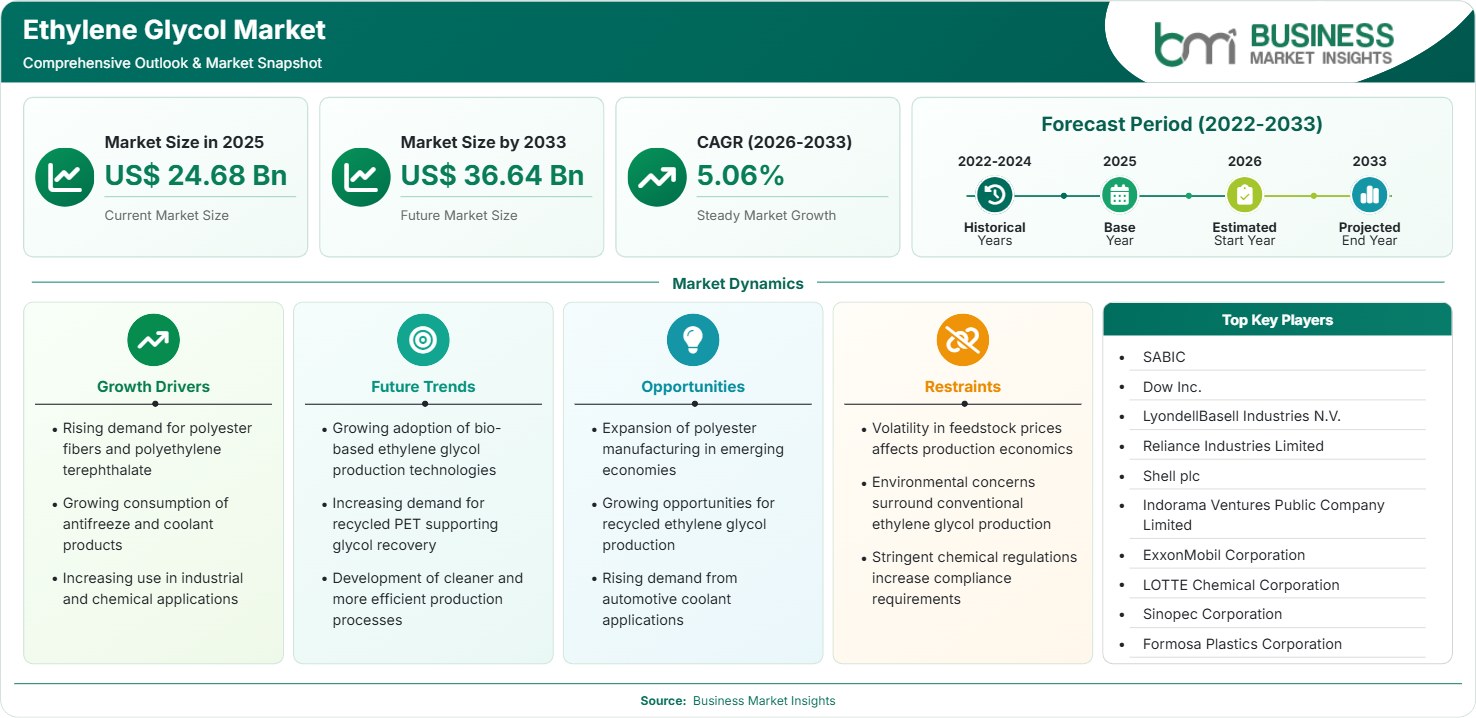
The Ethylene Glycol Market size was valued at US$ 24.68 Billion in 2025 and is projected to reach US$ 36.64 Billion by 2033, growing at a CAGR of 5.06% during 2026–2033. Rising demand from polyester fiber production, increasing PET packaging consumption, growing automotive antifreeze requirements, expanding textile manufacturing activities, and increasing industrial applications are driving market growth globally.

Report Coverage
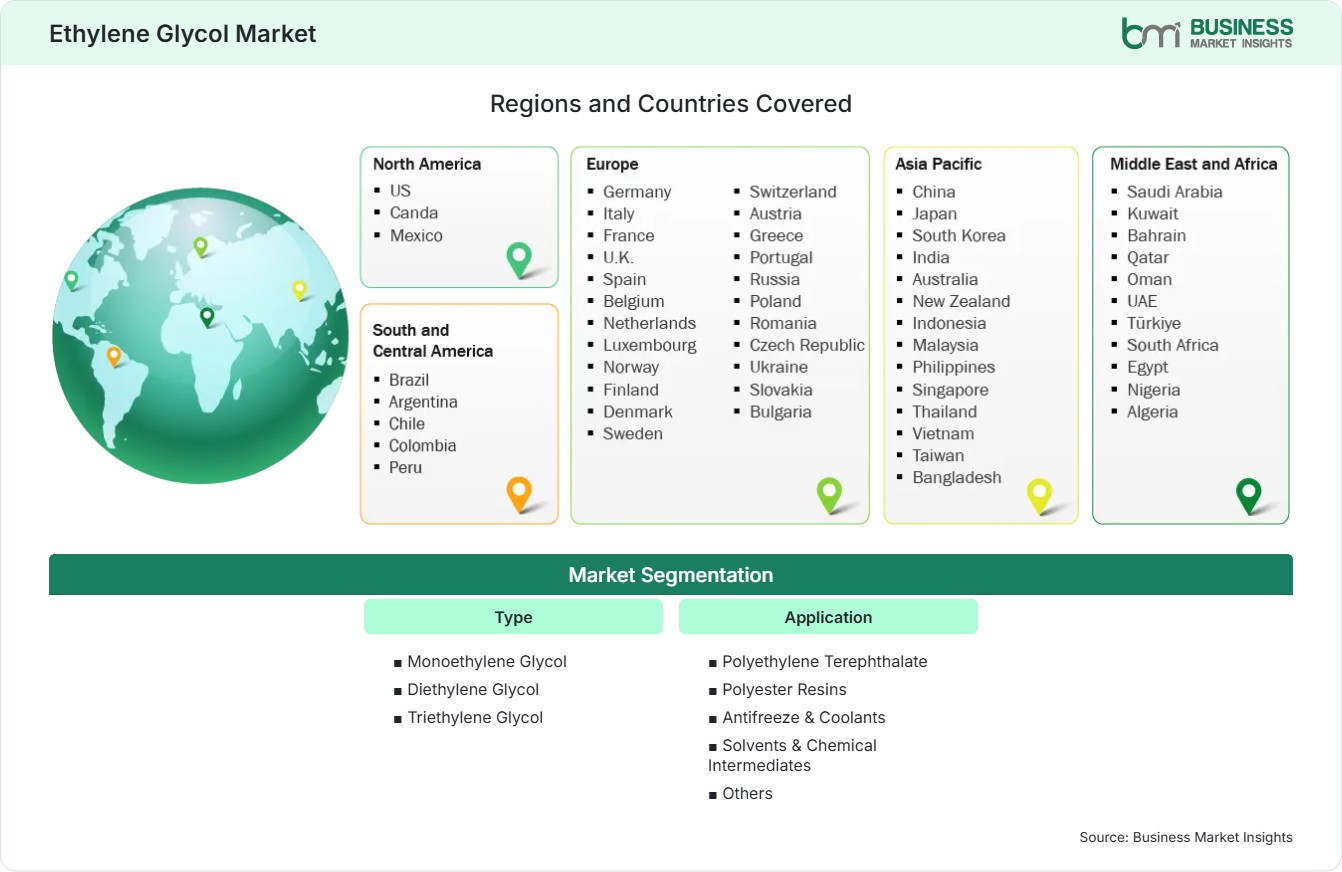
  • Type: Monoethylene Glycol , Diethylene Glycol , Triethylene Glycol
  • Application: Polyethylene Terephthalate , Polyester Resins, Antifreeze & Coolants, Solvents & Chemical Intermediates, Others
US$ 24.68 Bn Market size in 2025
US$ 36.64 Bn Market Size by 2033
5.06% CAGR, 2026 - 2033
2026-2033 Forecast Period

AI Overview

Ethylene Glycol Market Summary

  • North America Region: North America holds a ethylene glycol market share of 20%–24% in 2025 and is projected to grow at a CAGR of 4.6%–5.2% during 2026–2033. Growth is supported by steady demand from packaging industries, automotive manufacturing, industrial chemical production, and expanding PET applications. The U.S. remains the dominant market, advancing at a CAGR of 4.7%–5.3%.
  • Fastest Growing Region: Asia Pacific accounts for 46%–50% share in 2025 and is expected to register a CAGR of 5.8%–6.5% through 2033. Growth is fueled by expanding polyester fiber manufacturing, increasing textile production, rapid industrialization, growing packaging demand, and rising automotive production.
  • Leading Segment: Monoethylene Glycol (MEG) represents 72%–76% share in 2025 and is anticipated to grow at a CAGR of 5.2%–5.8% through 2033. Demand is supported by widespread use in PET production, polyester fiber manufacturing, antifreeze formulations, and industrial applications.
  • High Growth Segment: Polyethylene Terephthalate (PET) captures 38%–42% share in 2025 and is forecast to expand at a CAGR of 5.6%–6.2% during 2026–2033. Growth is driven by increasing bottled beverage consumption, food packaging demand, recyclable packaging initiatives, and expanding consumer goods industries.
  • Key Market Opportunity: Growing adoption of sustainable packaging solutions, bio-based ethylene glycol production technologies, and increasing demand for recycled PET materials is creating significant opportunities across the market.
  • Major Market Players: SABIC, Dow Inc., LyondellBasell Industries N.V., Reliance Industries Limited, Shell plc, Indorama Ventures Public Company Limited, ExxonMobil Corporation, LOTTE Chemical Corporation, Sinopec Corporation, and Formosa Plastics Corporation.
Strategic Insights

Ethylene Glycol Market: Strategic Insights

Ethylene Glycol Market Strategic Framework
FREE PDF
Request your free sample
Request free sample
Stakeholder View

Key Takeaways

  • The ethylene glycol market continues to expand due to rising demand from polyester fiber manufacturing, PET packaging production, automotive antifreeze applications, and industrial chemical processing.
  • Monoethylene Glycol (MEG) remains the dominant product segment owing to its extensive use in PET resins, polyester fibers, coolants, and industrial applications.
  • PET applications account for the largest share as demand for packaged beverages, consumer goods, and recyclable plastic packaging continues to increase globally.
  • Asia Pacific remains the leading and fastest-growing regional market due to strong textile production, expanding packaging industries, and growing manufacturing activities.
  • Sustainability initiatives are accelerating investments in bio-based ethylene glycol production and recycled PET value chains.
  • Growing industrialization, urbanization, and consumer goods consumption continue creating long-term growth opportunities for market participants.
Geographic Outlook

Ethylene Glycol Market Regional Highlights

North America Ethylene Glycol Market

North America accounted for 20%–24% of global revenue in 2025 and is projected to grow at a CAGR of 4.6%–5.2% through 2033. The region benefits from strong packaging demand, stable automotive production, established chemical manufacturing infrastructure, and increasing adoption of recyclable materials. The Ethylene Glycol Market share remains significant due to widespread industrial utilization and sustained demand from polyester and PET applications.

  • Strong PET packaging demand continues supporting ethylene glycol consumption across food and beverage industries.
  • Automotive manufacturers use ethylene glycol-based coolants and antifreeze products to improve vehicle performance and maintain efficient engine temperature control.
  • Chemical producers are investing in sustainable production technologies and recycling initiatives to improve resource efficiency and reduce environmental impact.
  • Expanding industrial activities support demand for solvents and chemical intermediates used across resins, coatings, plastics, and manufacturing processes.
  • Growing emphasis on circular economy initiatives is encouraging recycled PET adoption, supporting ethylene glycol demand through improved material recovery and reduced reliance on virgin feedstocks.

US Ethylene Glycol Market

The United States represents 82%–86% of North American demand and is expected to grow at a CAGR of 4.7%–5.3% through 2033. Growth is supported by advanced chemical manufacturing capabilities, packaging demand, and expanding industrial applications.

  • PET resin demand continues increasing across food packaging and consumer goods sectors, supporting ethylene glycol consumption for producing bottles, containers, films, and other packaging materials.
  • Automotive and industrial applications remain important consumers of ethylene glycol-based products, particularly coolants, antifreeze solutions, heat-transfer fluids, and other specialized applications.
  • Investments in sustainable packaging technologies are creating new opportunities across the value chain by encouraging recycled materials, lightweight packaging solutions, and improved resource efficiency.
  • Petrochemical industry expansion supports domestic production capacity and supply stability by strengthening feedstock availability, manufacturing infrastructure, and distribution networks for ethylene glycol products.

Europe Ethylene Glycol Market

Europe held 21%–25% of global revenue in 2025 and is expected to register a CAGR of 4.8%–5.4% through 2033. Strong sustainability initiatives, growing recycled plastic adoption, and stable industrial demand continue supporting regional growth. Germany remains the leading market, while Poland represents a strong growth market with a CAGR of 5.5%–6.1%.

  • Sustainability regulations are encouraging investment in recycled PET and environmentally responsible chemical production, supporting resource efficiency and lower environmental impact.
  • Packaging industries continue driving demand for PET-based materials across food, beverage, and consumer goods applications, supporting steady ethylene glycol consumption.
  • Automotive manufacturing remains an important consumption sector for antifreeze and coolant products, helping maintain engine performance and temperature control.
  • Industrial users increasingly adopt advanced materials to improve operational efficiency, product durability, and performance across manufacturing applications.
  • Ongoing investments in chemical innovation continue supporting market development through improved production processes, material efficiency, and application opportunities.

Asia Pacific Ethylene Glycol Market

Asia Pacific accounted for 46%–50% of global revenue in 2025 and is expected to record the fastest CAGR of 5.8%–6.5% through 2033. Rapid industrialization, textile manufacturing expansion, increasing PET packaging demand, and strong economic growth are driving regional expansion. China and India remain the largest markets, while Vietnam is projected to register a CAGR of 6.6%–7.2%.

  • Polyester fiber manufacturing remains the largest demand source for ethylene glycol across the region, supported by expanding textile production and rising demand for synthetic fibers.
  • Increasing consumption of packaged food and beverages is supporting PET resin production growth, strengthening demand for bottles, containers, and other packaging applications.
  • Expanding automotive production is driving demand for coolant and antifreeze applications, particularly as vehicle manufacturing and ownership continue increasing across major markets.
  • Industrial development and urbanization continue creating strong demand across downstream industries, including plastics, coatings, resins, and chemical manufacturing.
  • Investments in petrochemical capacity expansion are strengthening regional production capabilities by improving feedstock availability, manufacturing infrastructure, and supply reliability.

Rest of World Ethylene Glycol Market

Rest of World accounted for 5%–9% of global revenue in 2025 and is forecast to grow at a CAGR of 4.7%–5.3% through 2033. Market growth is supported by industrial expansion, packaging demand, infrastructure development, and increasing chemical manufacturing activities.

  • Growing consumer markets are increasing demand for PET packaging products across food, beverages, and household goods, supporting ethylene glycol consumption.
  • Industrial growth continues supporting ethylene glycol use in chemical processing applications, including resins, solvents, coatings, and other downstream products.
  • Automotive sector development is generating demand for antifreeze and coolant formulations as vehicle production and ownership continue expanding.
  • Investments in petrochemical infrastructure are improving regional production capabilities by strengthening manufacturing capacity, feedstock availability, and supply networks.
  • Rising urbanization and economic development continue supporting long-term market growth by expanding industrial activity, consumer spending, and demand for packaged products.
Global Market Geography
FREE PDF
Request your free sample
Request free sample
Segment Analysis

Ethylene Glycol Market Segmentation

Type

Monoethylene Glycol (MEG) accounts for 72%–76% share in 2025 and is expected to grow at a CAGR of 5.2%–5.8% through 2033. The segment dominates due to its extensive application in polyester fiber production, PET resin manufacturing, antifreeze formulations, and industrial chemical processing. The Ethylene Glycol Market scope continues to expand as MEG consumption rises across packaging, textile, automotive, and industrial sectors driven by growing global manufacturing activities and consumer demand.

  • Monoethylene Glycol (MEG): Widely utilized in PET production, polyester fibers, coolants, antifreeze products, and industrial intermediates.
  • Diethylene Glycol (DEG): Used in resins, plasticizers, solvents, lubricants, and specialty industrial formulations.
  • Triethylene Glycol (TEG): Primarily utilized in natural gas dehydration, industrial solvents, and specialty chemical applications.

Application

Polyethylene Terephthalate (PET) accounts for 38%–42% share in 2025 and is projected to grow at a CAGR of 5.6%–6.2% through 2033. Growth is driven by increasing bottled beverage consumption, expanding food packaging demand, rising use of recyclable plastic materials, and growing consumer goods production. Current Ethylene Glycol Market trends indicate increasing utilization of ethylene glycol in sustainable PET packaging applications as manufacturers focus on recyclable and circular economy solutions.

  • Polyethylene Terephthalate (PET): Leads the market due to widespread usage in beverage bottles, food containers, and packaging materials.
  • Polyester Resins: Supported by growing textile manufacturing, apparel production, industrial fabrics, and home furnishing applications.
  • Antifreeze & Coolants: Benefit from increasing automotive production and growing demand for thermal management solutions.
  • Solvents & Chemical Intermediates: Widely used in paints, coatings, pharmaceuticals, and industrial chemical manufacturing.
  • Others: Include deicing fluids, heat transfer fluids, adhesives, and specialty industrial applications.
Market Forces

Ethylene Glycol Market Dynamics

Key Market Drivers

Growing Demand from Polyester Fiber Manufacturing

Polyester fiber production remains a major demand driver for ethylene glycol globally, as polyester is widely used in apparel, sportswear, home textiles, carpets, furnishings, and industrial fabrics. Rising population, urbanization, and increasing consumer spending are supporting textile consumption across developed and emerging markets. Ethylene glycol is an essential raw material in polyester production, making demand closely connected with growth in fiber manufacturing capacity. Expanding textile industries in emerging economies are encouraging investments in polyester production facilities and supporting regional consumption. In addition, increasing demand for durable, lightweight, and cost-effective synthetic fibers is strengthening polyester adoption across multiple applications. These factors are expected to sustain ethylene glycol demand throughout the forecast period.

Expanding PET Packaging Industry

The expanding use of PET packaging across food, beverage, personal care, and consumer goods industries is supporting ethylene glycol market growth. PET is widely preferred because of its lightweight structure, durability, transparency, recyclability, and cost-effectiveness. Rising consumption of bottled beverages, packaged foods, and convenience products is increasing demand for PET bottles, containers, and packaging materials. Ethylene glycol is a key raw material used in PET resin production, creating a direct relationship between packaging demand and consumption. Manufacturers are also investing in packaging capacity, recycling infrastructure, and improved material efficiency to address sustainability requirements. The continued expansion of packaged consumer products, particularly in emerging markets, is expected to support steady demand for ethylene glycol during the forecast period.

Increasing Automotive Demand for Antifreeze and Coolants

Ethylene glycol is widely used in automotive antifreeze and coolant formulations because of its effective heat transfer and freeze protection properties. Growing vehicle production, expanding commercial transportation, and increasing vehicle ownership are supporting demand for engine cooling solutions. Ethylene glycol-based coolants help maintain suitable engine operating temperatures and protect cooling systems from freezing and overheating. Rising demand for reliable thermal management is further supporting their use across passenger vehicles, commercial vehicles, and industrial equipment. Automotive manufacturing growth in emerging economies is creating additional consumption opportunities as production capacity and vehicle fleets expand. Furthermore, continued focus on vehicle performance, durability, and efficient engine operation is expected to sustain demand for ethylene glycol-based cooling products over the forecast period.

Key Market Opportunities

Growing Adoption of Bio-Based Ethylene Glycol Technologies

Sustainability objectives are encouraging manufacturers to explore bio-based ethylene glycol production technologies using renewable feedstocks. Growing concerns about fossil resource consumption and greenhouse gas emissions are increasing interest in alternative production pathways with improved environmental performance. Bio-based ethylene glycol can potentially support sustainability targets while maintaining compatibility with established downstream applications, including polyester and PET production. Companies are investing in research, process development, and renewable feedstock integration to improve the commercial viability of these technologies. Increasing corporate commitments toward carbon reduction and responsible manufacturing are creating opportunities for suppliers developing lower-impact ethylene glycol solutions. Continued advances in bio-based chemistry, feedstock availability, and production efficiency are expected to strengthen adoption over the forecast period.

Expansion of Recycled PET and Circular Economy Initiatives

Governments, brand owners, packaging manufacturers, and recyclers are increasingly promoting recycled PET to reduce plastic waste and improve material utilization. Growing investments in collection systems, recycling facilities, and advanced processing technologies are supporting the expansion of circular packaging value chains. As recycled PET adoption increases, demand for efficient material recovery and chemical recycling processes is creating opportunities across the ethylene glycol value chain. Producers can strengthen their market position by developing technologies that support recycling, improve resource efficiency, and integrate recovered materials into downstream production. Increasing sustainability commitments and regulatory pressure are encouraging packaging companies to incorporate recycled content into products. These developments are expected to support circular economy initiatives and create additional growth opportunities.

Rising Demand from Emerging Economies

Rapid industrialization, urbanization, and consumer market expansion across emerging economies are creating substantial growth opportunities. Expanding textile manufacturing, infrastructure development, packaging demand, and automotive production are increasing consumption of ethylene glycol across multiple end-use sectors. Ethylene Glycol Market Forecast analysis indicates that strong economic growth, rising industrial output, and increasing downstream manufacturing activities across emerging markets will create significant opportunities for market participants throughout the forecast period.

Market Restraints and Challenges

Volatility in Feedstock Prices

Factor: Ethylene glycol production is heavily dependent on petrochemical feedstocks whose prices fluctuate due to crude oil market movements, supply-demand imbalances, and geopolitical developments.

Impact: Raw material price volatility can increase production costs, pressure manufacturer margins, and create uncertainty regarding investment and procurement decisions. Prolonged feedstock fluctuations may also affect downstream pricing and overall market profitability.

Environmental and Regulatory Concerns

Factor: Increasing environmental scrutiny surrounding petrochemical production, emissions management, and chemical handling practices is leading to stricter regulatory requirements across many regions.

Impact: Compliance with evolving regulations can increase operational costs, require additional investments in sustainability initiatives, and impact manufacturing processes. Companies may need to adopt cleaner production technologies and enhance environmental performance to maintain competitiveness and regulatory compliance.

Company Analysis

Competitive Landscape

The Ethylene Glycol Market analysis highlights strong competition among global petrochemical manufacturers, integrated chemical producers, and specialty materials companies. Market participants are focusing on production capacity expansion, sustainable manufacturing technologies, bio-based ethylene glycol development, and integration with polyester and PET value chains to strengthen their market positions and address evolving industry requirements.

Company Name

Overview

Products and Services Relevant to this Market

SABIC

Global diversified chemicals and petrochemicals manufacturer.

Monoethylene glycol, petrochemical feedstocks, industrial chemicals, and polymer materials.

Dow Inc.

Global materials science and chemical company.

Ethylene glycol products, industrial intermediates, packaging materials, and specialty chemicals.

LyondellBasell Industries N.V.

International chemical and refining company.

Ethylene glycol, petrochemical products, polymers, and industrial materials.

Reliance Industries Limited

Integrated energy and petrochemical producer.

Ethylene glycol, polyester feedstocks, PET materials, and petrochemical solutions.

Shell plc

Energy and chemical company with global petrochemical operations.

Ethylene glycol, chemical intermediates, specialty products, and industrial chemicals.

Indorama Ventures Public Company Limited

Global producer of PET and integrated chemical products.

Ethylene glycol, PET resins, polyester feedstocks, and packaging materials.

ExxonMobil Corporation

Energy and petrochemical manufacturer.

Ethylene glycol, chemical intermediates, industrial chemicals, and specialty products.

LOTTE Chemical Corporation

Chemical producer serving global manufacturing industries.

Monoethylene glycol, petrochemical derivatives, polyester materials, and industrial chemicals.

Sinopec Corporation

Integrated petrochemical and refining company.

Ethylene glycol, chemical feedstocks, polymers, and industrial chemical solutions.

Formosa Plastics Corporation

Chemical and materials manufacturing company.

Ethylene glycol, petrochemical products, plastics, and industrial materials.

Trust & Transparency

Research Methodology

The market analysis combines proprietary research with secondary data from government agencies, company disclosures, regulatory filings, industry databases and expert interviews. Market estimates are validated through data triangulation, cross-market benchmarking and analyst review.

View Full Research Methodology

Questions Answered

Frequently Asked Questions

What does this Ethylene Glycol Market Report evaluate?

The market report evaluates type trends, application analysis, regional opportunities, competitive developments, growth drivers, market opportunities, and industry challenges through 2033.

Which application segment leads the market?

Polyethylene Terephthalate (PET) leads the market owing to increasing demand for beverage bottles, food packaging solutions, consumer goods packaging, and recyclable materials.

Why is Asia Pacific the fastest-growing region?

Asia Pacific benefits from strong textile manufacturing activity, expanding packaging industries, increasing automotive production, rapid industrialization, and growing petrochemical investments.

Which type segment dominates the market?

Monoethylene Glycol (MEG) dominates the market due to its extensive use in polyester fibers, PET resin production, automotive coolants, and industrial applications.

What is driving growth in the Ethylene Glycol Market?

Growth is driven by increasing demand from polyester fiber manufacturing, PET packaging production, automotive antifreeze applications, expanding textile industries, and growing industrial chemical consumption.

Access the Full Ethylene Glycol Market Report

Get segment-level forecasts, regional estimates, competitive benchmarking, company profiles and downloadable Excel datasets.

Access the full Ethylene Glycol Market Report
350 pages PDF & Excel | 2026-09-22
Similar Research

Related Market Reports