Market Summary
Executive Summary and Global Market Analysis
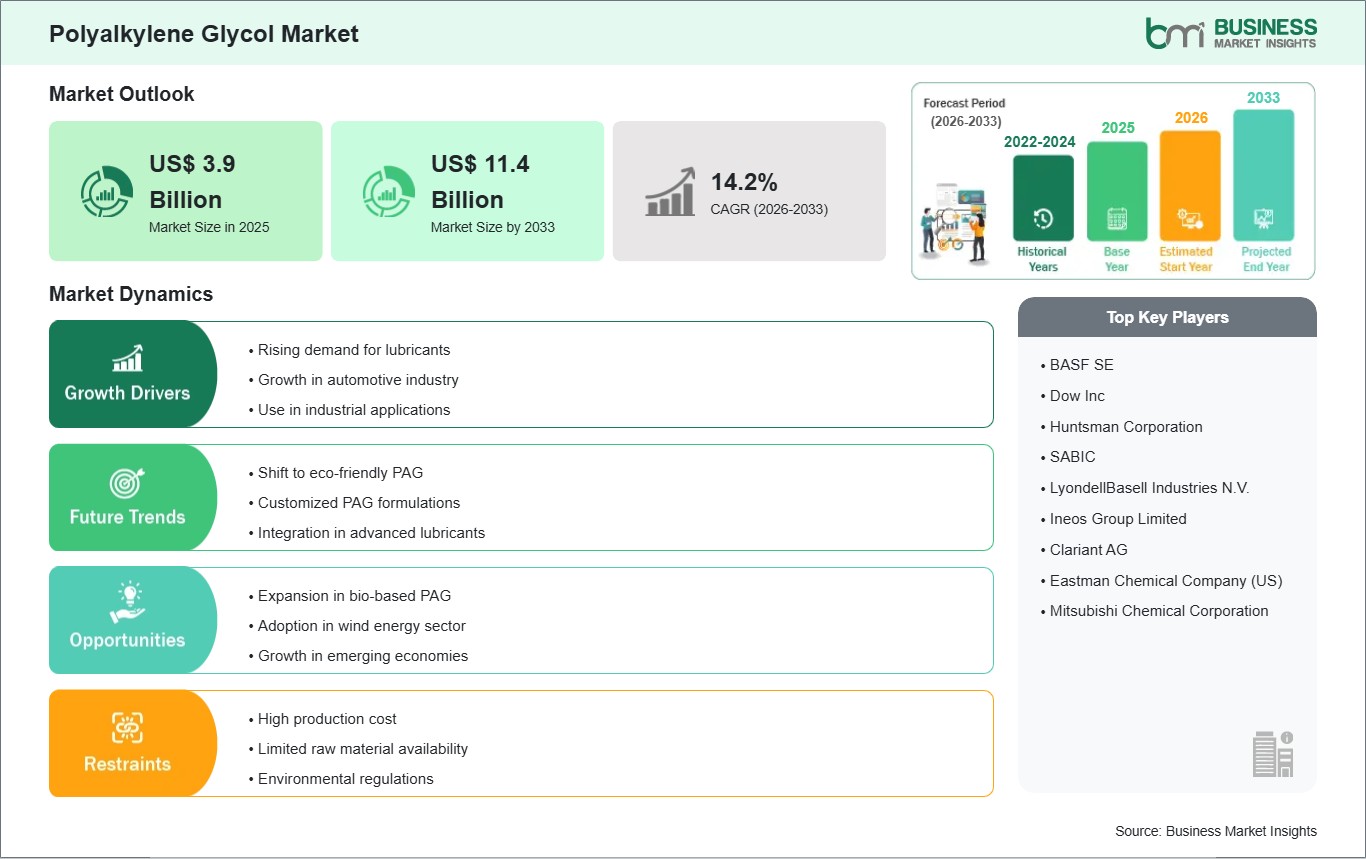
Polyalkylene Glycols (PAGs) are a class of synthetic polymers widely recognized for their excellent lubricating properties, superior thermal stability, low volatility, and low toxicity. These characteristics make them versatile materials used extensively across numerous industries. PAGs include major types such as Polyethylene Glycol (PEG) and Polypropylene Glycol (PPG), and they are utilized in applications ranging from high-performance synthetic lubricants to pharmaceutical and personal care product formulations.
The Polyalkylene Glycol market is experiencing robust growth driven by the escalating demand for high-performance synthetic lubricants in industries like automotive and aerospace, the expansion of the pharmaceutical sector, and the rising consumer preference for bio-based and environmentally friendly chemical compounds. The superior properties of PAGs, which include excellent viscosity index and compatibility with high-temperature, high-load environments, position them as preferred alternatives to conventional mineral oils.
Segment Analysis
Polyalkylene Glycol Market Segmentation
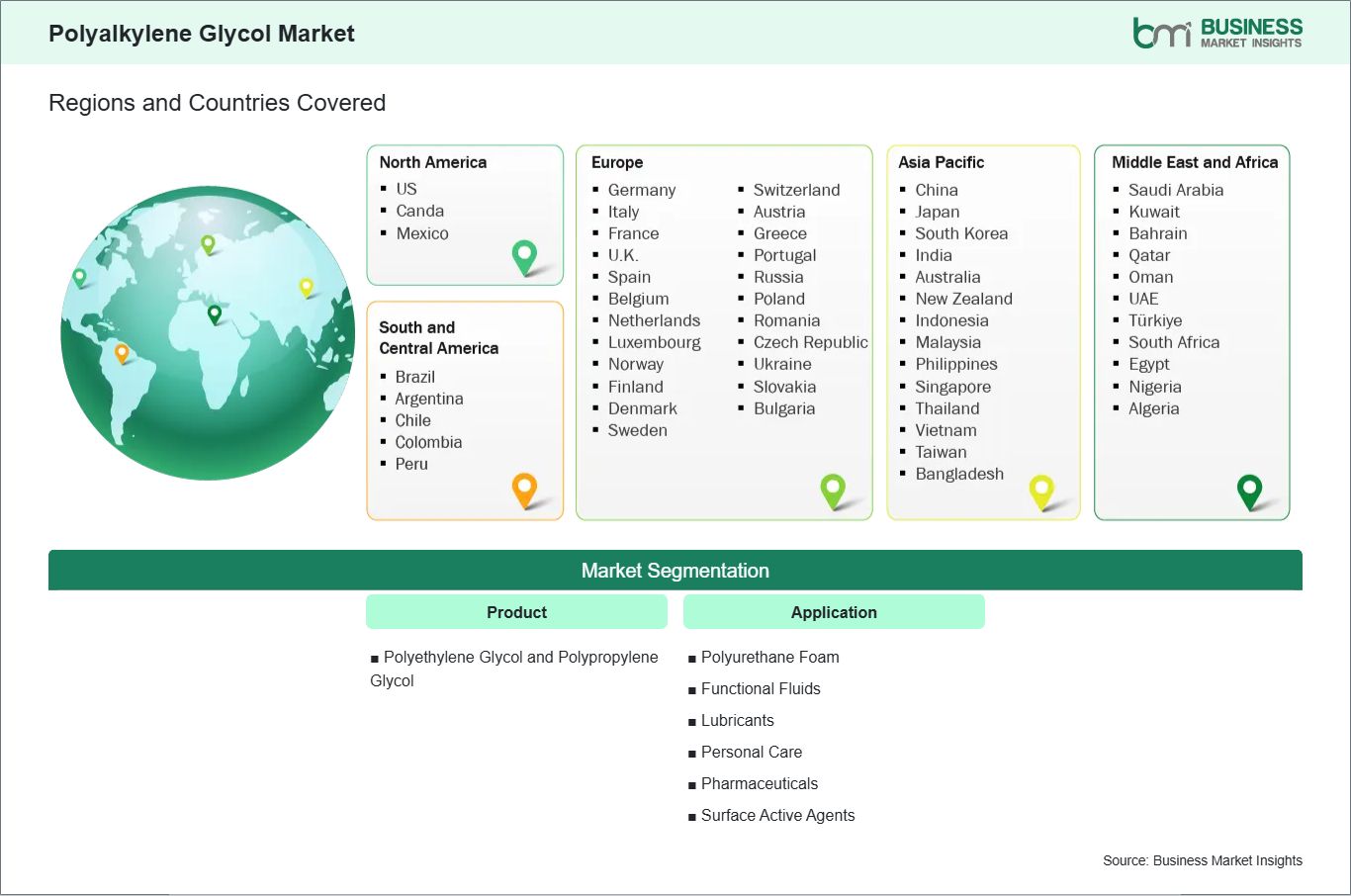
Key segments that contributed to the derivation of the Polyalkylene Glycols market analysis are product and application.
- By Product, the market is bifurcated into Polyethylene Glycol and Polypropylene Glycol.
- By Application, the market is segmented into Polyurethane Foam, Functional Fluids, Lubricants, Personal Care, Pharmaceuticals, and Surface Active Agents.
Market Forces
Polyalkylene Glycol Market Drivers and Opportunities
Rising Demand for High-Performance Synthetic Lubricants
The global machinery and automotive industries, particularly the shift toward advanced manufacturing and higher efficiency standards, require lubricants that can perform reliably under extreme operating conditions. PAG-based synthetic lubricants offer superior performance characteristics, such as exceptional thermal stability, a high viscosity index, and low sludge formation compared to mineral-oil-based lubricants. This makes them ideal for critical applications like industrial gear oils, air compressor fluids, and metalworking fluids where equipment operates at higher temperatures and pressures.
Furthermore, the growing adoption of electric vehicles (EVs) is a significant driver. EVs require specialized thermal management fluids and lubricants that are non-conductive, thermally stable, and chemically compatible with electric motors and high-voltage systems. PAGs are highly favored for these next-generation EV fluids, directly linking the growth of the electric vehicle market to the demand for Polyalkylene Glycols. The need to reduce machinery downtime and extend equipment life across the industrial and automotive sectors fundamentally drives the market toward high-quality, PAG-based solutions.
Growing Adoption of PAGs in Electric Vehicle Fluids
The transition from traditional Internal Combustion Engine (ICE) vehicles to Electric Vehicles (EVs) presents a major, structural opportunity for the Polyalkylene Glycol market. Unlike traditional automotive lubricants, the fluids required for EVs (referred to as e-fluids) must meet new, stringent requirements, including electrical insulation, thermal management, and material compatibility.
PAGs are inherently superior to mineral oils in this context because of their dielectric properties and excellent heat transfer capabilities. This makes them the preferred base oil for EV transmission fluids and battery coolants. The rapid, worldwide growth in EV production, fueled by government mandates and consumer demand for sustainable transport, translates directly into a surge in demand for specialized PAG formulations. This segment represents a high-growth, high-value opportunity for manufacturers to innovate specialized PAG derivatives that meet the precise performance demands of complex EV thermal and lubrication systems.
Size and Share Analysis
Polyalkylene Glycol Market Size and Share Analysis
The polyalkylene glycols market demonstrates steady growth, with size and share analysis revealing evolving trends and competitive positioning among key players. The report further examines subsegments categorized within product and application, offering insights into their contribution to overall market performance.
For instance, Polyethylene Glycol (PEG) dominates the market by product due to its excellent water solubility, low toxicity, and FDA approval for many applications. It is essential for high-purity applications.
The Lubricants subsegment leads the market by application. Lubricants provide superior thermal and oxidative stability, high viscosity index, and anti-wear properties for automotive (especially EV fluids), industrial gear oils, and compressor lubricants.
Report Coverage
Polyalkylene Glycol Market Report Coverage and Deliverables
The "Polyalkylene Glycols Market Size and Forecast (2022 - 2033)" report provides a detailed analysis of the market covering below areas:
- Polyalkylene Glycols market size and forecast at global, regional, and country levels for all the key market segments covered under the scope
- Polyalkylene Glycols market trends, as well as market dynamics such as drivers, restraints, and key opportunities
- Polyalkylene Glycols market analysis covering key market trends, global and regional framework, major players, regulations, and recent market developments
- Industry landscape and competition analysis covering market concentration, heat map analysis, prominent players, and recent developments for the Polyalkylene Glycols market
- Detailed company profiles, including SWOT analysis
Geographic Insights
Polyalkylene Glycol Market Geographic Insights
The geographical scope of the Polyalkylene Glycols market report is divided into five regions: North America, Asia Pacific, Europe, Middle East & Africa, and South & Central America.
The Asia-Pacific Polyalkylene Glycol market is driven by rapid urbanization, leading to robust growth in major consuming sectors like construction, automotive manufacturing, and industrial production. Countries like China and India are key drivers, fueled by increasing disposable income, boosting demand for personal care and pharmaceutical products, alongside massive expansion in the automotive and construction sectors, which rely heavily on PAGs for polyurethane foams and high-performance lubricants.
North America and Europe together hold a significant portion. These regions are mature but are driven by high-value applications, including pharmaceutical-grade PEG and the critical shift toward PAG-based e-fluids for Electric Vehicles (EVs). European growth is uniquely reinforced by stringent environmental regulations that favor biodegradable PAG over mineral oils, ensuring sustained, high-specification demand across developed economies.
Industry Activity
Recent Developments
The Polyalkylene Glycols market is evaluated by gathering qualitative and quantitative data post-primary and secondary research, which includes important corporate publications, association data, and databases. A few of the key developments in the Polyalkylene Glycols market are:
- In May 2025, BASF Industrial Formulators introduced a new product—Pluriol® A 2400 I—to its reactive polyethylene glycol portfolio for polycarboxylate ethers (PCE) in the construction industry in Europe.
- In March 2025, Dow announced the opening of its Propylene Glycol (PG) manufacturing facility in Map Ta Phut, Rayong, Thailand. It has earned the International Sustainability and Carbon Certification (ISCC) PLUS. This certification reinforces Dow’s ongoing commitment to advancing sustainable production and offering circular and bio-circular products to customers in Asia Pacific.
- In March 2025, LyondellBasell announced an investment to expand propylene production capacity at its Channelview Complex near?Houston.?
Trust & Transparency
Research Methodology
The market analysis combines proprietary research with secondary data from government agencies, company disclosures, regulatory filings, industry databases and expert interviews. Market estimates are validated through data triangulation, cross-market benchmarking and analyst
review.
View Full Research Methodology
Key Sources Referred:
World Bank - Global Trade IndicatorsWorld Trade Organization (WTO)International Monetary Fund (IMF)International Trade Administration (ITA)Company WebsitesCompany Annual ReportsCompany Investor Presentations