
Ethylene Copolymer Market Outlook: Size, Share, Trends, Growth Analysis, Competitive Landscape & Forecast, 2026-2033

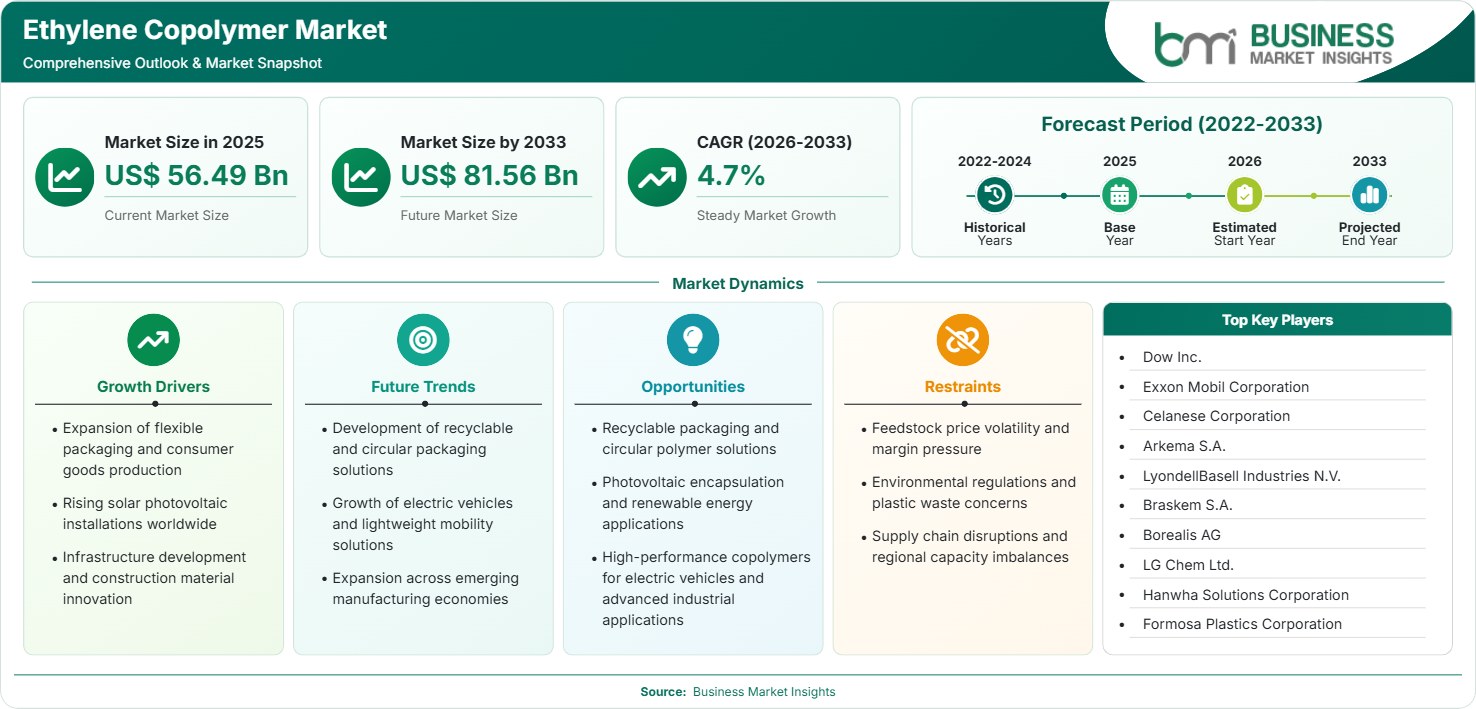
The Ethylene Copolymer Market size was valued at US$ 56.49 Billion in 2025 and is projected to reach US$ 81.56 Billion by 2033, growing at a CAGR of 4.7% during 2026–2033. Rising demand from packaging, automotive lightweighting, photovoltaic encapsulation, and advanced adhesive applications is strengthening consumption, while bio-circular materials and high-performance copolymer innovation create new opportunities.

Report Coverage
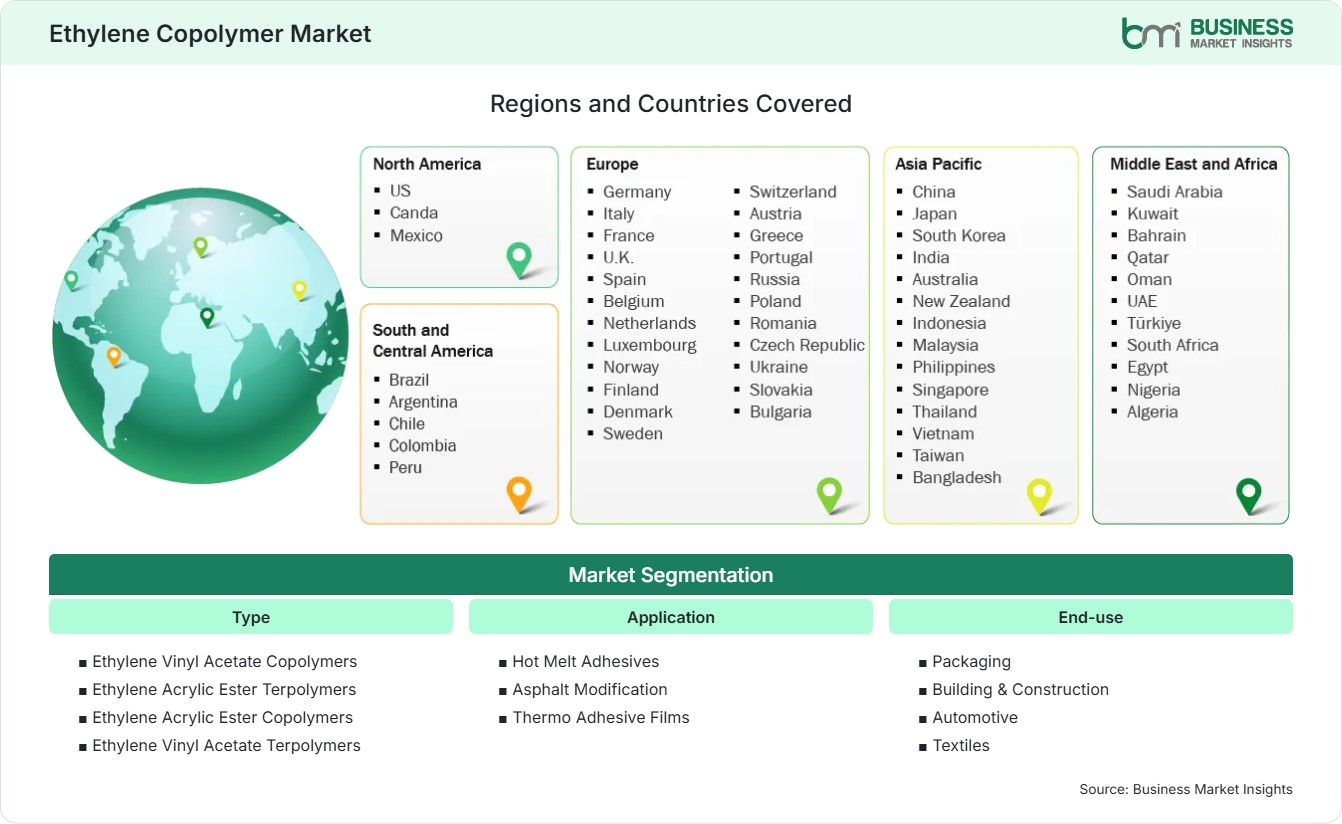
  • Type: Ethylene Vinyl Acetate Copolymers, Ethylene Acrylic Ester Terpolymers, Ethylene Acrylic Ester Copolymers, Ethylene Vinyl Acetate Terpolymers
  • Application: Hot Melt Adhesives, Asphalt Modification, Thermo Adhesive Films
  • End-use: Packaging, Building & Construction, Automotive, Textiles
US$ 56.49 Bn Market size in 2025
US$ 81.56 Bn Market Size by 2033
4.7% CAGR, 2026 - 2033
2026-2033 Forecast Period

AI Overview

Ethylene Copolymer Market Summary

  • North America Region: Holds a market share of 33%–36% in 2025, growing at a CAGR of 4.1%–4.4% during 2026–2033. Growth is supported by integrated petrochemical capacity, advanced packaging demand, renewable energy projects, specialty adhesive applications, infrastructure rehabilitation investments, and increasing adoption of durable polymer formulations across industries. US market benefits from packaging innovations, solar manufacturing expansion, and automotive material substitution, advancing at 4.2%–4.5% CAGR.
  • Fastest Growing Region: Asia Pacific holds a market share of 29%–32% in 2025, growing at a CAGR of 5.5%–5.9% during 2026–2033. Expanding industrial production, construction activity, consumer goods manufacturing, solar module installations, flexible packaging consumption, and regional manufacturing investments continue accelerating demand across multiple downstream sectors.
  • Leading Segment: Packaging accounts for 32%–35% share in 2025 and grows at a CAGR of 4.5%–4.9%. Demand stems from sealability requirements, multilayer film structures, food protection standards, lightweight packaging formats, logistics expansion, and increasing preference for durable flexible materials worldwide.
  • High Growth Segment: Hot Melt Adhesives hold 28%–31% share in 2025 and grow at a CAGR of 5.2%–5.6%. Expansion of e-commerce packaging, hygiene products, furniture manufacturing, bookbinding operations, and industrial assembly applications drives sustained consumption of advanced adhesive formulations.
  • Key Market Opportunity: Increasing deployment of photovoltaic modules, recyclable packaging designs, electric vehicle components, and bio-based feedstock integration creates opportunities for producers to develop differentiated, sustainable, and higher-margin material portfolios globally.
  • Major Market Players: Dow Inc., Exxon Mobil Corporation, Celanese Corporation, Arkema S.A., LyondellBasell Industries N.V., Braskem S.A., Borealis AG, LG Chem Ltd., Hanwha Solutions Corporation, Formosa Plastics Corporation.
Strategic Insights

Ethylene Copolymer Market: Strategic Insights

Ethylene Copolymer Market Strategic Framework
FREE PDF
Request your free sample
Request free sample
Stakeholder View

Key Takeaways

  • The industry benefits from highly integrated value chains linking ethylene production, copolymer manufacturing, compounding, conversion, and downstream processing, enabling major suppliers to manage costs and supply stability effectively.
  • Packaging, hot melt adhesives, and photovoltaic encapsulation applications offer the strongest volume upside as e-commerce, food preservation requirements, and renewable energy investments continue expanding globally.
  • Research activity increasingly focuses on recyclable multilayer structures, enhanced seal-performance materials, bio-attributed feedstocks, and specialty formulations that improve processability and reduce lifecycle emissions.
  • India, Southeast Asia, and Gulf manufacturing hubs present compelling investment opportunities due to industrial expansion, infrastructure spending, and growing domestic consumption of polymer-intensive products.
  • Strategic acquisitions increasingly target adhesive technologies, specialty materials, and downstream processing capabilities as producers seek higher-value portfolios and differentiated market positions.
  • Long-term competitiveness will depend on feedstock flexibility, sustainability credentials, regional production capabilities, and the ability to serve niche high-performance applications efficiently.
Geographic Outlook

Ethylene Copolymer Market Regional Highlights

North America Ethylene Copolymer Market

North America accounts for 33%–36% of global demand in 2025 and is projected to expand at a CAGR of 4.1%–4.4% through 2033. The region benefits from abundant ethylene feedstocks, advanced conversion industries, and strong demand from packaging and infrastructure sectors. The Ethylene Copolymer Market share remains supported by extensive manufacturing networks, while investments in solar supply chains and high-performance construction materials broaden consumption. Regional suppliers continue emphasizing specialty grades, sustainability initiatives, and improved recycling compatibility across industrial applications.

  • Strong flexible packaging demand driven by food preservation requirements, retail logistics growth, and premium packaging innovations supports consistent consumption across industrial and consumer markets.
  • Infrastructure rehabilitation programs increase utilization in asphalt modification, sealants, and durable construction materials requiring enhanced flexibility and weather resistance.
  • Renewable energy manufacturing expansion supports growing demand for encapsulation materials used in photovoltaic modules and related electrical applications.
  • Major integrated chemical producers leverage feedstock advantages and technical expertise to strengthen regional competitiveness and export capabilities.

US Ethylene Copolymer Market

The United States represents 78%–82% of the North American Ethylene Copolymer Market demand and advances at a CAGR of 4.2%–4.5% through 2033. Strong packaging conversion activity, growing renewable energy manufacturing, and automotive material substitution support sustained demand. Domestic producers benefit from competitive feedstocks, established infrastructure, and substantial innovation capabilities. Specialty applications in adhesives, medical packaging, and photovoltaic materials continue attracting investment while supporting higher-margin product development across key industrial value chains.

  • Expanding domestic manufacturing initiatives encourage demand for advanced polymer materials across industrial and consumer applications.
  • Solar module production growth supports greater consumption of EVA-related encapsulation materials and specialty film applications.
  • E-commerce growth sustains adhesive and packaging material demand, strengthening downstream conversion activities nationwide.
  • Continued R&D investment enables differentiated grades tailored for automotive, electronics, and healthcare markets.

Europe Ethylene Copolymer Market

Europe holds 24%–27% of demand in 2025 and is expected to grow at a CAGR of 3.9%–4.3% through 2033. Sustainability regulations, advanced packaging technologies, and circular economy initiatives are shaping purchasing behavior. Germany remains the leading national market, while Eastern European manufacturing centers display faster expansion. Producers emphasize recyclable material compatibility and lower-carbon production pathways. Automotive lightweighting, infrastructure modernization, and specialty adhesive consumption contribute to resilient regional demand despite mature industrial conditions.

  • Germany leads regional consumption through automotive production, industrial manufacturing, and packaging conversion activities.
  • Poland and selected Eastern European economies record faster expansion, supported by manufacturing investment and industrial relocation trends.
  • Circular economy policies encourage development of recyclable packaging structures and advanced material recovery systems.
  • Construction efficiency targets support demand for insulation, sealants, and durable polymer-enhanced building materials.

Asia Pacific Ethylene Copolymer Market

Asia Pacific accounts for 29%–32% of global demand in 2025 and records the fastest expansion, with CAGR reaching 5.5%–5.9% through 2033. The Ethylene Copolymer Market growth is driven by industrialization, infrastructure investment, solar manufacturing leadership, and substantial packaging demand. China remains the largest market, while India demonstrates the highest growth trajectory. Rising consumer goods production, urbanization, and expanding manufacturing ecosystems continue strengthening regional consumption across packaging, construction, electronics, and transportation sectors.

  • China leads regional volume demand through large-scale manufacturing, packaging production, and photovoltaic supply chain dominance.
  • India records among the fastest growth rates owing to infrastructure spending, industrial expansion, and consumer market development.
  • Southeast Asia attracts polymer investments as manufacturers diversify production footprints and strengthen regional supply chains.
  • Expanding renewable energy deployments support increasing demand for photovoltaic encapsulation and related specialty material applications.

Rest of World Ethylene Copolymer Market

The Rest of World region represents 10%–13% of global demand in 2025 and is forecast to expand at a CAGR of 4.8%–5.2% through 2033. South and Central America benefit from packaging growth and consumer goods manufacturing, while Middle Eastern and African markets gain momentum from infrastructure projects and industrial diversification strategies. Brazil remains the leading Latin American market, whereas Saudi Arabia shows stronger growth potential. Increasing urbanization and investment in industrial supply chains support broader material adoption.

  • Brazil benefits from domestic packaging demand, agricultural applications, and regional manufacturing activities.
  • Saudi Arabia accelerates petrochemical diversification initiatives and downstream materials manufacturing investments.
  • Infrastructure projects across Gulf economies increase demand for construction-related polymer formulations.
  • Consumer goods and retail expansion support flexible packaging consumption across emerging economies.
Global Market Geography
FREE PDF
Request your free sample
Request free sample
Segment Analysis

Ethylene Copolymer Market Segmentation

Type

Type accounted for the broadest product differentiation landscape, with Ethylene Vinyl Acetate Copolymers holding approximately 38%–41% market share in 2025 and advancing at a CAGR of 4.8%–5.2%. The Ethylene Copolymer Market scope continues expanding through performance-enhancing formulations, specialized adhesive requirements, renewable energy applications, and industrial packaging demand. Product innovation remains central to differentiation.

  • Ethylene Vinyl Acetate Copolymers: Widely utilized in films, footwear, adhesives, and photovoltaic encapsulation due to flexibility, transparency, and processing advantages across diverse industrial and consumer applications.
  • Ethylene Acrylic Ester Terpolymers: Preferred for impact modification and durable performance requirements where toughness, weatherability, and compatibility with engineering materials are critical.
  • Ethylene Acrylic Ester Copolymers: Used extensively in packaging and industrial applications requiring flexibility, adhesion, processability, and balanced mechanical performance.
  • Ethylene Vinyl Acetate Terpolymers: Support specialty adhesive systems, coatings, and advanced industrial formulations demanding enhanced functionality and application-specific performance characteristics.

Application

Applications are increasingly influenced by packaging modernization and industrial assembly requirements. Hot Melt Adhesives represented 28%–31% share in 2025 and are projected to grow at a CAGR of 5.2%–5.6%. Expanding logistics activity, hygiene products manufacturing, and consumer goods production continue supporting high-volume demand across regional markets.

  • Hot Melt Adhesives: Extensively used in packaging, bookbinding, furniture manufacturing, and hygiene products requiring reliable bonding performance and efficient processing characteristics.
  • Asphalt Modification: Supports road durability, flexibility, crack resistance, and lifecycle improvements across transportation infrastructure development projects.
  • Thermo Adhesive Films: Increasingly adopted in automotive interiors, textiles, electronics, and multilayer composite structures requiring controlled bonding behavior.

End-use

End-use demand remains concentrated in packaging, which commanded 32%–35% market share during 2025 and is anticipated to grow at a CAGR of 4.5%–4.9%. The paragraph reflects ongoing Ethylene Copolymer Market trends toward lightweight materials, enhanced barrier properties, and sustainable packaging solutions supporting food safety, distribution efficiency, and product protection objectives.

  • Packaging: Flexible films, sealant layers, and protective packaging formats rely on copolymers for durability, processability, and sealing effectiveness.
  • Building & Construction: Applications include insulation materials, sealants, roofing systems, and modified construction products designed for durability and efficiency.
  • Automotive: Lightweight components, interior assemblies, and specialty adhesive systems benefit from flexibility, durability, and processing advantages.
  • Textiles: Utilized in bonding technologies, performance fabrics, laminations, and specialty textile finishing applications requiring improved functionality.
Market Forces

Ethylene Copolymer Market Dynamics

Key Market Drivers

Expansion of Flexible Packaging and Consumer Goods Production

Global packaging demand remains a fundamental consumption driver. The UN projects continued urbanization growth, while international retail and e-commerce activity sustain flexible packaging requirements. Ethylene copolymers provide heat-sealing performance, toughness, and processability essential for food, consumer goods, and industrial packaging. The ethylene copolymer market growth is positively influenced by growing distribution channels of packaged foods and higher demand for lightweight materials to cut down transportation costs. Packaging manufacturers will remain focused on performance packaging, which extends the life of their products. Such trends will ensure sustained material demand irrespective of economic cycles in the manufacturing industry.

Rising Solar Photovoltaic Installations Worldwide

Renewable energy deployment is generating sustained demand for EVA-based and related encapsulation materials. According to the International Energy Agency, solar PV remains among the fastest-growing power generation technologies globally. The encapsulant films need to be durable, transparent, and environmentally resistant, thus making the case for the use of high-performance copolymers. Further addition of utility-scale and distributed solar capacities will ensure higher demand in Asia, North America, and Europe. The industry players are meeting this challenge by formulating specialized grades for improved module efficiency. The increasing investments in photovoltaics are creating further opportunities within the renewable energy supply chain.

Infrastructure Development and Construction Material Innovation

Construction sectors increasingly utilize advanced polymer formulations in sealants, roofing systems, insulation components, and asphalt modification. The pace of urbanization in emerging economies continues to drive significant infrastructure needs. Increased durability, weather resistance, and flexibility have resulted in copolymers being used more frequently as suitable substitutes. Suppliers have begun offering copolymer materials suited to infrastructure development in the transportation, business, and domestic sectors. Government-led infrastructure modernization has indirectly increased demand across all areas of construction. Copolymers that offer lifecycle savings and superior performance characteristics are likely to remain an appealing area for suppliers.

Key Market Opportunities

Development of Recyclable and Circular Packaging Solutions

Brand owners, retailers, and regulatory authorities are becoming interested in packages that conform to circular economy principles. This opens up avenues for polymer producers to come up with better grades of polymers for mono-material constructions. Ethylene Copolymer Market Forecasts indicate that there is an increase in demand for sustainable packages due to the growing importance of environmental objectives within firms. Investments in sealants compatible with the environmental objectives, improvement in processing technology, and reduced carbon footprint feedstock could provide market leadership. There would be competitive advantage for those companies that are able to integrate performance and environmental objectives.

Growth of Electric Vehicles and Lightweight Mobility Solutions

Electric vehicle production continues increasing demand for lightweight materials, specialty adhesives, insulation systems, and protective components. Copolymers are increasingly used in mobility applications where toughness, designability, and processing improvements are necessary. Auto-makers look for materials that enable efficiency but also last and are safe. Those formulators who develop specific formulas for these applications can tap into ever-growing value pools linked to electric vehicles. Manufacturing investments in Asia, Europe, and North America make it even easier to lock in long-term supply agreements and collaboration on future transport technology innovations.

Expansion Across Emerging Manufacturing Economies

Industrial growth in India, Southeast Asia, the Middle East, and selected African economies is broadening downstream demand. The growth of packaging, construction, consumer goods, and manufacturing operations enables the growing demand for specialty polymers. Investments made to produce locally and improvements in logistical infrastructure enable overcoming any supply chain bottlenecks and ensuring greater access to markets. Companies that create their logistics and technical assistance in rapidly growing regions will be able to gain considerable advantages. The growing manufacturing operations, favorable demographics, and increased disposable income ensure sustainable use by various end-use segments.

Market Restraints and Challenges

Feedstock Price Volatility and Margin Pressure

Factor: Ethylene and related petrochemical feedstock prices remain sensitive to energy markets, trade flows, and regional supply-demand imbalances. Impact: There could be significant variations in production economics, which would affect the manufacturer's profit margins and pricing policies. Any sharp rise in prices of raw materials is not necessarily passed to the consumers, especially when there is a period of low demand in industry. Small-scale manufacturers may experience additional stress compared to integrated chemical firms, which have an advantage in accessing raw materials.

Environmental Regulations and Plastic Waste Concerns

Factor: Governments worldwide continue implementing stricter requirements concerning packaging waste, recyclability, and environmental impacts associated with polymers. Impact: Compliance costs may rise as specific application types come under greater scrutiny from regulators and customers. Innovations are necessary for producers to stay competitive through sustainable technology, materials, and recycling-friendly innovations. While these trends open up new avenues for innovation, they also create technical, economic, and organizational problems. Businesses that cannot respond by modifying their product ranges will become uncompetitive as environmental performance becomes an important factor in purchasing decisions.

Company Analysis

Competitive Landscape

The competitive environment reflects continuous product differentiation, integration strategies, and capacity optimization. Ethylene Copolymer Market analysis indicates strong competition among multinational chemical producers focusing on specialty grades, sustainability initiatives, and high-value industrial applications.

Company Name

Overview

Products and Services relevant to this market

Dow Inc.

Global materials science company with extensive polymer production capabilities and broad packaging industry presence.

EVA materials, adhesive resins, specialty packaging polymers, performance materials, and industrial solutions.

Exxon Mobil Corporation

Integrated energy and chemical producer with strong EVA manufacturing capabilities and global distribution reach.

EVA copolymers, packaging polymers, photovoltaic encapsulation materials, and specialty industrial resins.

Celanese Corporation

Specialty materials producer known for advanced EVA product portfolios serving diversified industries.

Ateva EVA polymers, medical-grade EVA, packaging materials, adhesives, and industrial formulations.

Arkema S.A.

Global specialty chemicals company focused on advanced materials and performance solutions.

Specialty copolymers, adhesive technologies, packaging materials, and construction-related polymer solutions.

LyondellBasell Industries N.V.

Major polyolefins producer serving industrial, packaging, and automotive value chains globally.

EVA-related materials, polyolefins, specialty compounds, and industrial polymer solutions.

Braskem S.A.

Leading petrochemical producer with growing emphasis on sustainable and bio-based materials.

Copolymer materials, packaging resins, industrial polymers, and renewable-content solutions.

Borealis AG

European polymer leader emphasizing innovation, circularity, and advanced material development.

Packaging polymers, specialty materials, infrastructure solutions, and performance copolymers.

LG Chem Ltd.

Diversified chemical company with strong regional manufacturing footprint and materials expertise.

EVA products, industrial polymers, packaging materials, and specialty chemical solutions.

Hanwha Solutions Corporation

Significant supplier to photovoltaic and industrial material markets across Asia.

EVA resins, solar encapsulation materials, industrial films, and specialty polymer products.

Formosa Plastics Corporation

Major petrochemical company supplying a broad portfolio of polymer materials globally.

EVA grades, packaging polymers, industrial materials, and downstream conversion products.

Trust & Transparency

Research Methodology

The market analysis combines proprietary research with secondary data from government agencies, company disclosures, regulatory filings, industry databases and expert interviews. Market estimates are validated through data triangulation, cross-market benchmarking and analyst review.

View Full Research Methodology

Questions Answered

Frequently Asked Questions

Which companies are among the leading industry participants?

Major participants include Dow Inc., Exxon Mobil Corporation, Celanese Corporation, Arkema S.A., LyondellBasell Industries N.V., Braskem S.A., Borealis AG, LG Chem Ltd., Hanwha Solutions Corporation, and Formosa Plastics Corporation.

How does this Ethylene Copolymer Market Report help stakeholders?

The report provides insights into regional demand patterns, competitive positioning, growth segments, investment opportunities, technology trends, and risk factors supporting strategic business decision-making.

What factors are supporting future demand in Asia Pacific?

Industrialization, urbanization, consumer goods manufacturing, renewable energy deployment, infrastructure development, and expanding packaging industries are collectively increasing material consumption throughout the region.

Why are ethylene copolymers important in solar energy applications?

These materials are widely used in photovoltaic encapsulation films due to their transparency, flexibility, weather resistance, and ability to protect solar cells over long operating lifecycles.

Which end-use industry generates the largest demand for ethylene copolymers?

Packaging remains the largest end-use category because of extensive use in flexible films, sealant layers, protective packaging structures, and food preservation applications requiring strong processing and performance characteristics.

Access the Full Ethylene Copolymer Market Report

Get segment-level forecasts, regional estimates, competitive benchmarking, company profiles and downloadable Excel datasets.

Access the full Ethylene Copolymer Market Report
350 pages PDF & Excel | 2026-08-27