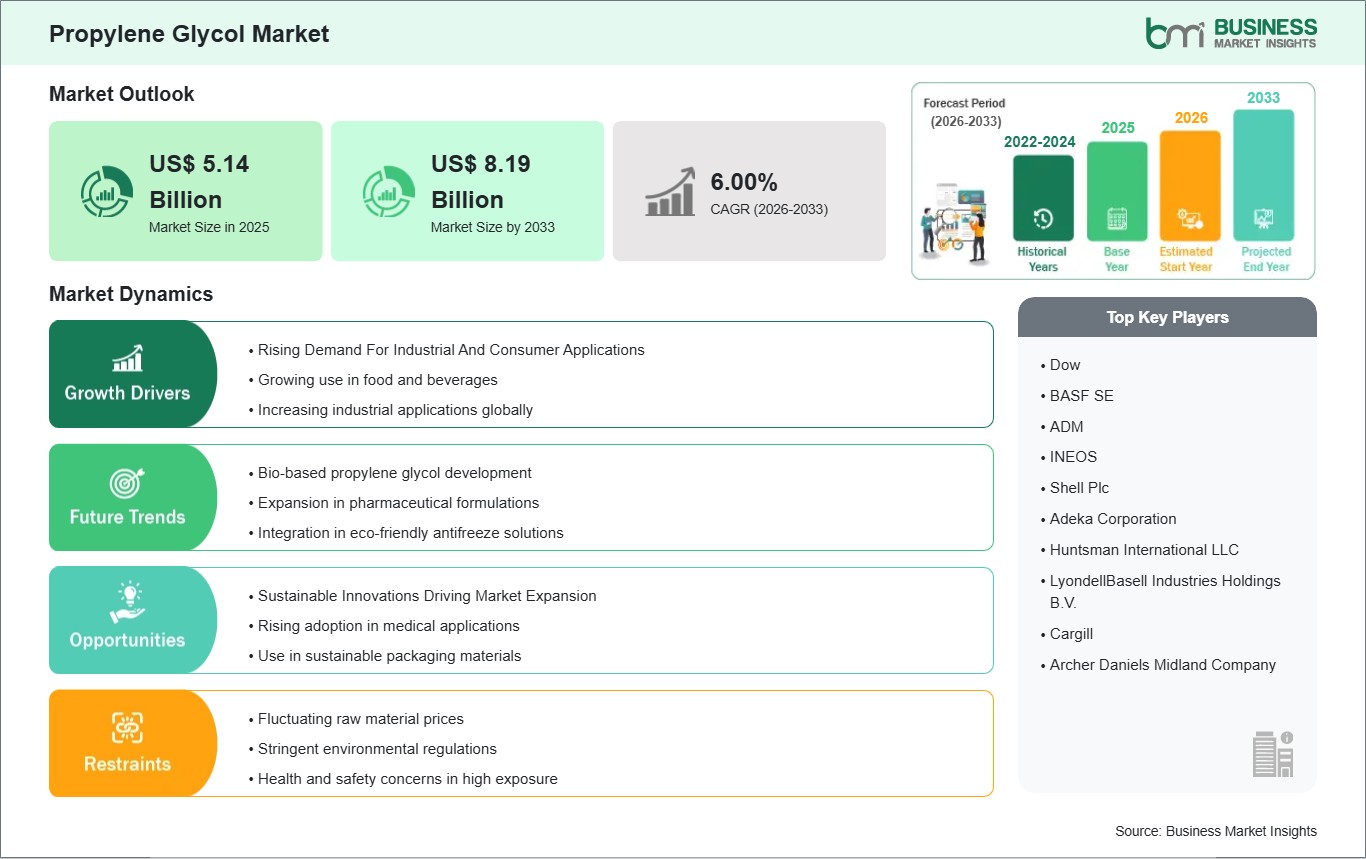
The Propylene Glycol Market size is expected to reach US$ 8.19 billion by 2033 from US$ 5.14 billion in 2025. The market is estimated to record a CAGR of 6.00% from 2026 to 2033.
The global propylene glycol market is witnessing a smooth growth trajectory, primarily fueled by the diverse uses of this compound in various personal care products, pharmaceuticals, food and beverages, and industrial applications. The compound, referred to as PG, enjoys a significant advantage in terms of low toxicity, hygroscopicity, and versatility as a humectant, solvent, and heat transfer agent. The increase in consumer demands for safe and premium products in developed countries has further strengthened the position of high-grade PG products in the personal care industry, syrups, and e-liquid products.
The industrial segment, including HVAC, refrigeration, and renewable energy-based heat transfer fluids, also contributes to the growth of this industry, thus establishing the significance of this compound. The industry structure of this market involves integrated oil companies and specialized chemical companies. Volatility in propylene feedstock costs, primarily derived from crude oil and natural gas liquids, remains a critical factor affecting pricing and profitability. Manufacturers are increasingly exploring forward integration, long-term contracts, and decentralized production to secure feedstock supply and mitigate disruption risks.
Regulatory trends emphasizing safety, environmental compliance, and biodegradability are guiding innovation toward bio-based PG and enhanced purification processes. While competition from alternative green solvents and cost pressures present challenges, the sustained need for PG in essential applications, coupled with growing demand in emerging economies, supports long-term growth. Product innovation targeting enhanced performance, lower carbon footprints, and alignment with sustainable manufacturing practices is becoming a key differentiator, positioning PG as a resilient and strategically significant polymer intermediate in global chemical markets.

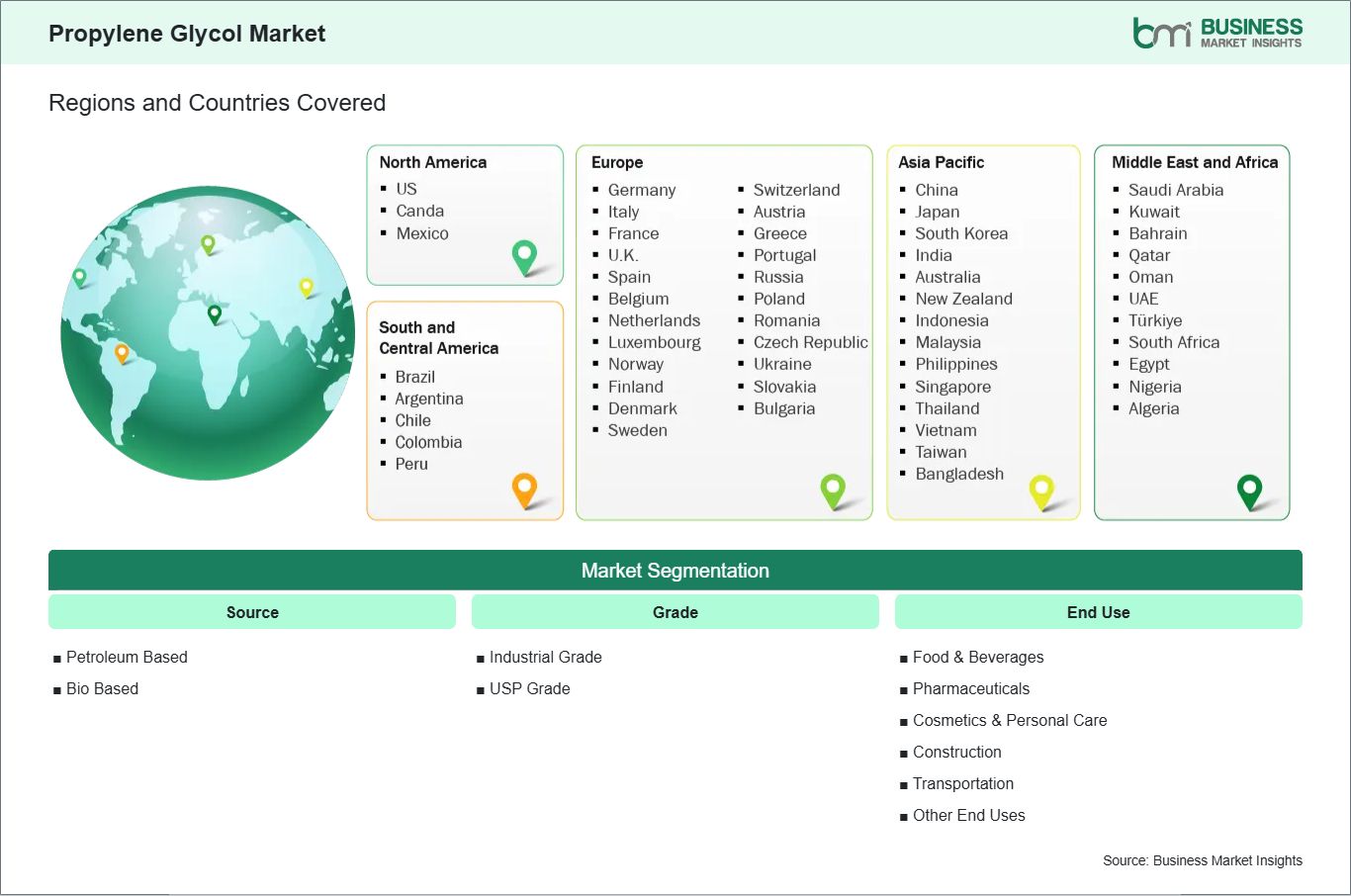
Key segments that contributed to the derivation of the propylene glycol market analysis are source, grade, and end use.
By Source, the propylene glycol market is segmented into petroleum based and bio based. The petroleum-based segment dominated the market in 2025.
Based on Grade, the propylene glycol market is classified into industrial grade and USP grade. The industrial grade segment dominated the market in 2025.
On the Basis of End Use, the propylene glycol market is segmented into food & beverages, pharmaceuticals, cosmetics & personal care, construction, transportation, and others. The food & beverages segment dominated the market in 2025.
The global propylene glycol market is witnessing a steady growth rate, and this can be attributed to the wide range of applications of this compound. Propylene glycol is considered a very important compound as a solvent, a humectant, and a carrier for a number of products, including pharmaceutical products, personal care products, food and beverages, and a number of chemical products. The miscibility of this compound with water, along with its chemical stability and low toxicity, makes it a very useful compound for a number of products, ensuring safety and reliability.
In the personal care and cosmetic industry, propylene glycol helps in retaining moisture, texture, and performance of a number of products, including skin and hair care products. In the pharmaceutical industry, this compound works as a solvent and a stabilizer for a number of products, including oral, topical, and injectable products. In the food and beverage industry, this compound works as a flavoring agent, emulsifier, and preservative.
Industrial uses also increase demand for propylene glycol since it is used in antifreeze, heat transfer mediums, de-icing solutions, and in making polymers. The stability of propylene glycol at high temperatures and low freezing points makes it more suitable for harsh conditions. The increasing demand for effective chemical intermediates with multiple uses in industrial and consumer markets is also contributing to the growth of propylene glycol. The multiple uses of propylene glycol in meeting the requirements of diverse functions make it more in demand, thereby making it an essential chemical intermediate.
Innovation and sustainability are key trends affecting the global propylene glycol market. Producers are increasingly developing bio-based and renewable source alternatives to conventional products. These eco-friendly products are becoming increasingly popular in personal care products, pharmaceuticals, food products, and industrial applications due to the importance of sustainability and regulatory demands.
Advances in manufacturing processes have also led to improvements in purity, functionality, and consistency of propylene glycol. This has allowed for its safe and effective use in applications such as injectable pharmaceuticals, infant formulas, and cosmetics. Specialty products with unique properties such as low viscosity, low odor, and excellent moisture retention are also being used to customize applications. This customization is highly beneficial in terms of optimization of products and processes.
The industrial segment is also opting for eco-friendly solutions. Propylene glycol is used in non-toxic antifreeze, de-icing compounds, and heat transfer fluids. This helps in achieving a balance between performance, safety, and sustainability. The multifunctionality, performance, and eco-friendly nature of propylene glycol make it an essential intermediate in the world of chemicals. The innovation, sustainability, and growth in propylene glycol applications in various industries will result in tremendous growth in the propylene glycol market in the coming years.

The propylene glycol market demonstrates steady growth, with size and share analysis highlighting evolving trends and competitive dynamics among key players. The report examines subsegments categorized within source, grade, and end use, offering insights into their contribution to overall market performance.
By Source, the petroleum based subsegment dominated the market in 2025, driven by its wide availability and cost-effectiveness for industrial applications.
Based on Grade, the industrial grade subsegment dominated the market in 2025, owing to its extensive usage in large-scale manufacturing and formulation processes.
On the Basis of End Use, the food & beverages subsegment dominated the market in 2025, propelled by increasing demand for processed foods, beverages, and flavoring agents.
| Report Attribute | Details |
|---|---|
| Market size in 2025 | US$ 5.14 Billion |
| Market Size by 2033 | US$ 8.19 Billion |
| Global CAGR (2026 - 2033) | 6.00% |
| Historical Data | 2022-2024 |
| Forecast period | 2026-2033 |
| Segments Covered | By Source
|
|
Regions and Countries Covered
| |
| North America | US, Canada, Mexico |
| Europe | Belgium, Austria, Finland, Denmark, Greece, Poland, Romania, Russia, Ukraine, Czech Republic, Slovakia, Bulgaria, Italy, Luxembourg, Germany, Switzerland, France, Netherlands, Norway, Portugal, Spain, Sweden, United Kingdom |
| Asia-Pacific | Australia, China, India, Japan, South Korea, Indonesia, Malaysia, Philippines, Singapore, Thailand, Vietnam, Bangladesh, New Zealand, Taiwan |
| South and Central America | Brazil, Argentina, Peru, Chile, Colombia |
| Middle East and Africa | Bahrain, Kuwait, Oman, Qatar, Saudi Arabia, United Arab Emirates, Turkiye, South Africa, Egypt, Algeria, Nigeria |
| Market leaders and key company profiles |
|
The "Propylene Glycol Market Size and Forecast (2022 - 2033)" report provides a detailed analysis of the market covering below areas:
The geographical scope of the Propylene Glycol Market report is divided into North America, Asia Pacific, Europe, Middle East & Africa, and South & Central America. North America held the largest share in 2025.
Regional-level dynamics in the propylene glycol market reflect variations in industrial maturity, regulatory frameworks, and application focus. North America dominates, driven by strong demand from personal care, pharmaceuticals, and industrial fluids.
The United States and Canada benefit from advanced manufacturing infrastructure, regulatory emphasis on product safety, and adoption of high-purity PG in critical formulations. Industrial growth in HVAC and renewable energy systems further supports regional consumption.
Europe shows steady demand, with Germany, France, and the UK leading consumption. Strict cosmetic and food safety regulations and environmental mandates encourage use of high-quality PG, while investment in bio-based and sustainable glycol technologies supports regulatory alignment.
Asia Pacific is the fastest-growing market, led by China, India, Japan, and South Korea. Urbanization, rising consumer spending on personal care, and expansion of pharmaceutical manufacturing drive strong adoption. Growing industrial activity and HVAC infrastructure also elevate demand, prompting regional producers to expand capacity.
In Middle East & Africa, Saudi Arabia, UAE, and South Africa show emerging demand tied to industrial fluids and petrochemical growth, though adoption is constrained by infrastructure variability. South & Central America, primarily Brazil and Mexico, shows moderate growth fueled by pharmaceuticals, personal care, and seasonal industrial applications. Currency fluctuations and regulatory variability influence procurement strategies, underscoring the need for agile supply chains. Collectively, these regional dynamics demonstrate a mix of mature, high-demand markets and rapidly growing regions that shape the global propylene glycol landscape.

The Propylene Glycol Market is evaluated by gathering qualitative and quantitative data post primary and secondary research, which includes important corporate publications, association data, and databases. A few of the key developments in the propylene glycol market are:
The Propylene Glycol Market is valued at US$ 5.14 Billion in 2025, it is projected to reach US$ 8.19 Billion by 2033.
As per our report Propylene Glycol Market, the market size is valued at US$ 5.14 Billion in 2025, projecting it to reach US$ 8.19 Billion by 2033. This translates to a CAGR of approximately 6.00% during the forecast period.
The Propylene Glycol Market report typically cover these key segments-
The historic period, base year, and forecast period can vary slightly depending on the specific market research report. However, for the Propylene Glycol Market report:
The Propylene Glycol Market is populated by several key players, each contributing to its growth and innovation. Some of the major players include:
The Propylene Glycol Market report is valuable for diverse stakeholders, including:
Essentially, anyone involved in or considering involvement in the Propylene Glycol Market value chain can benefit from the information contained in a comprehensive market report.
Please tell us your area of interest
(Market Segments/ Regions and Countries/ Companies)