
Energy Management System Market Outlook: Size, Share, Trends, Growth Analysis, Competitive Landscape & Forecast, 2026-2033

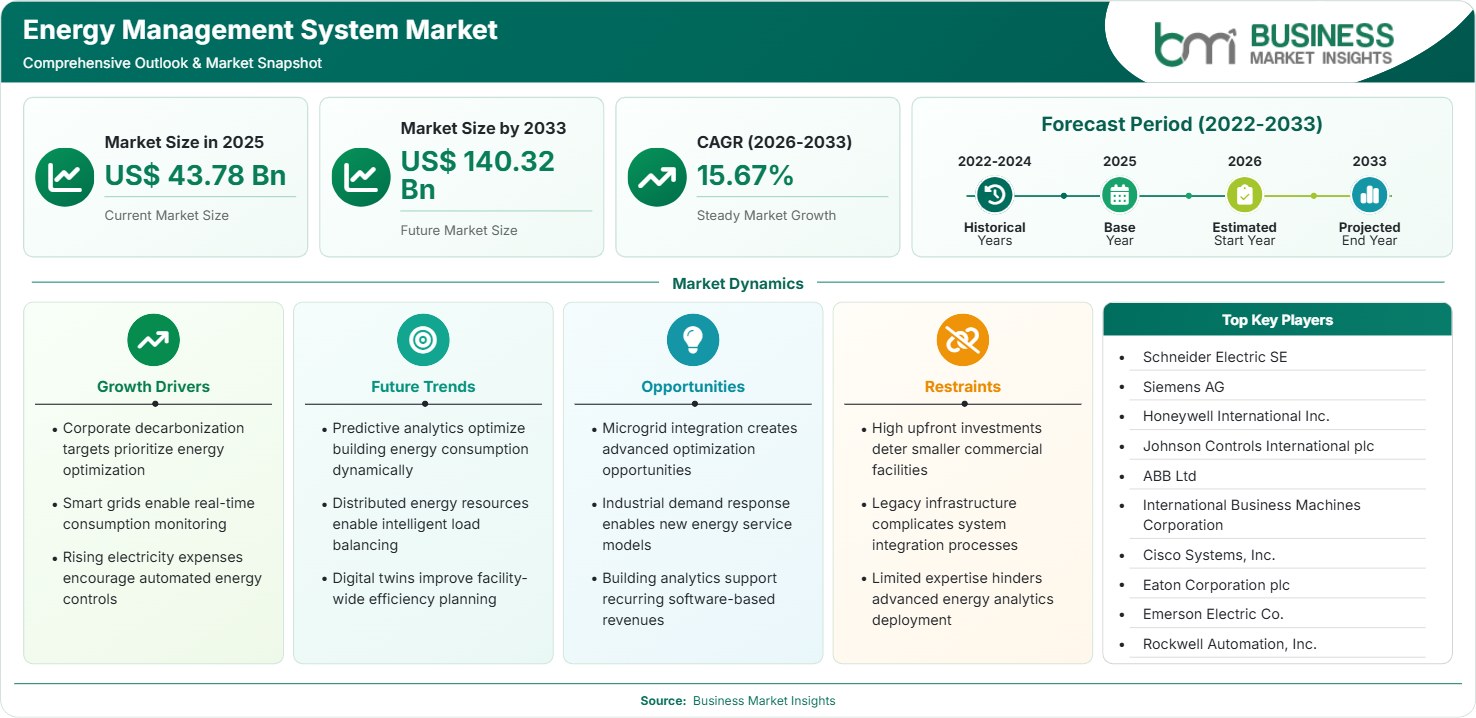
The Energy Management System Market size was valued at US$ 43.78 Billion in 2025 and is projected to reach US$ 140.32 Billion by 2033, growing at a CAGR of 15.67% during 2026–2033, driven by digitalization, energy-cost optimization, decarbonization, smart infrastructure, distributed energy resources, electrification, and growing demand for automated energy monitoring.

Report Coverage
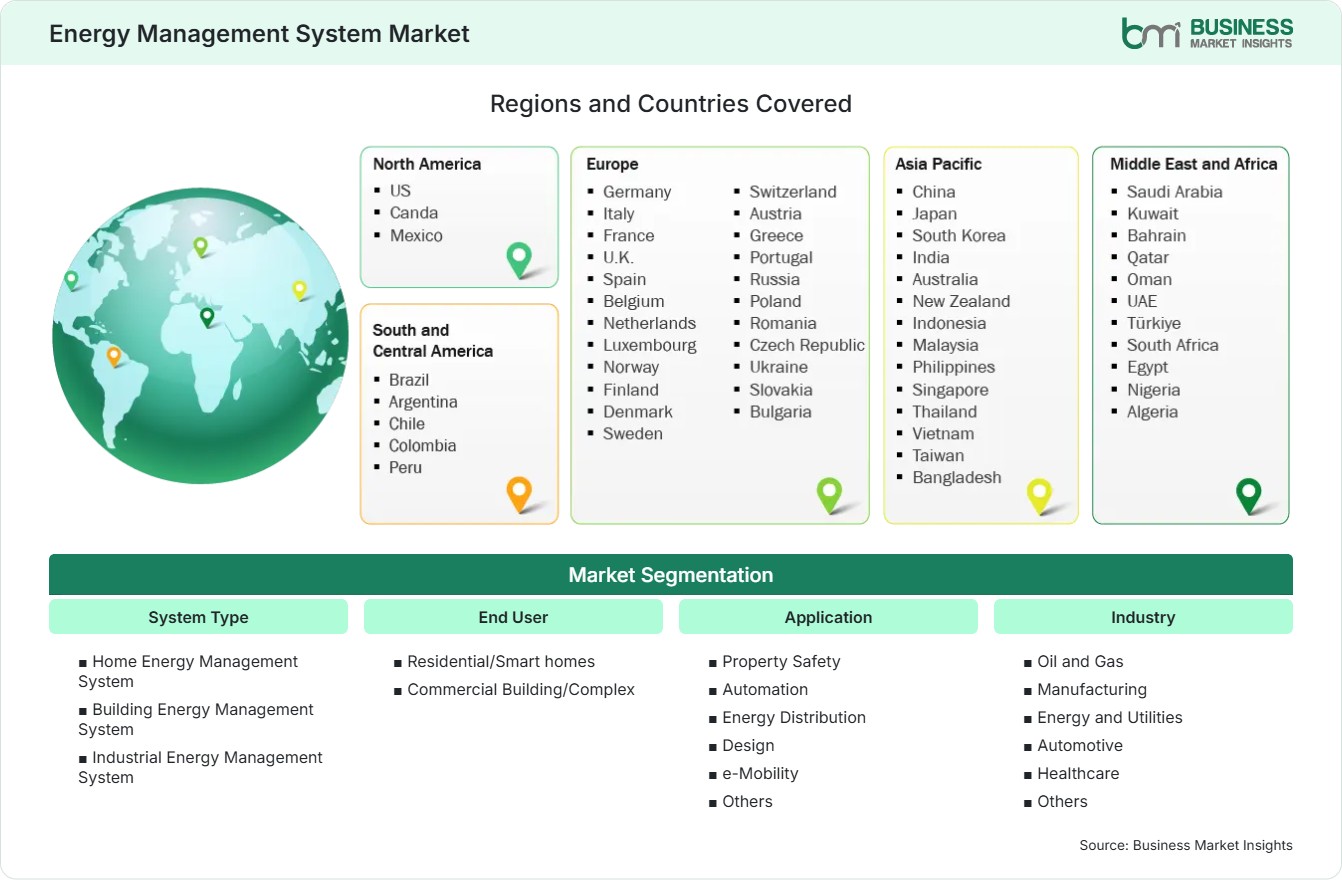
  • System Type: Home Energy Management System, Building Energy Management System, Industrial Energy Management System
  • End User: Residential/Smart homes, Commercial Building/Complex
  • Application: Property Safety, Automation, Energy Distribution, Design, e-Mobility, Others
  • Industry: Oil and Gas, Manufacturing, Energy and Utilities, Automotive, Healthcare, Others
US$ 43.78 Bn Market size in 2025
US$ 140.32 Bn Market Size by 2033
15.67% CAGR, 2026 - 2033
2026-2033 Forecast Period

AI Overview

Energy Management System Market Summary

  • North America Region: North America holds a 32%–35% Energy Management System Market share in 2025, growing with a 14.2%–15.0% CAGR influenced by smart-building deployment, grid modernization, data-center expansion, industrial automation, and decarbonization investments. The US accounts for 78%–82% of North American demand, supported by data-center power requirements, corporate sustainability programs, utility modernization, distributed energy resources, and advanced building controls. The region also benefits from mature automation ecosystems and established energy-management software adoption.
  • Fastest Growing Region: Asia Pacific holds a 25%–28% share in 2025, expanding at a 17.0%–18.0% CAGR as industrialization, urbanization, renewable integration, electrification, smart-city programs, and efficiency policies accelerate deployments across China, India, Japan, South Korea, and Southeast Asia.
  • Leading Segment: Building Energy Management System (BEMS) holds a 43%–47% share in 2025, growing at a 15.2%–16.0% CAGR as commercial buildings deploy connected HVAC controls, occupancy analytics, automated lighting, submetering, predictive maintenance, and carbon-monitoring platforms.
  • High Growth Segment: Industrial Energy Management System (IEMS) holds a 30%–34% Energy Management System Market share in 2025, expanding at a 16.8%–17.8% CAGR as manufacturers prioritize energy productivity, process optimization, predictive analytics, renewable integration, peak-demand management, and measurable decarbonization.
  • Key Market Opportunity: Integration of AI, digital twins, distributed energy resources, batteries, electric vehicles, renewable generation, and dynamic tariffs creates scalable opportunities for intelligent platforms that optimize energy consumption across buildings, factories, homes, and mobility networks.
  • Major Market Players: Schneider Electric SE, Siemens AG, Honeywell International Inc., Johnson Controls International plc, ABB Ltd, International Business Machines Corporation, Cisco Systems, Inc., Eaton Corporation plc, Emerson Electric Co., and Rockwell Automation, Inc.
Strategic Insights

Energy Management System Market: Strategic Insights

Energy Management System Market Strategic Framework
FREE PDF
Request your free sample
Request free sample
Stakeholder View

Key Takeaways

  • Market structure insight: The value chain is moving toward integrated platforms linking meters, sensors, building automation, industrial controls, cloud infrastructure, analytics, storage, renewable generation, and customer-facing dashboards. This favors suppliers capable of combining operational technology with information technology rather than vendors focused on isolated monitoring devices.
  • Growth opportunity insight: BEMS offers the broadest near-term deployment base because commercial portfolios contain large numbers of HVAC, lighting, cooling, and occupancy-related loads. IEMS provides a particularly strong upside where energy-intensive production can be optimized against output, equipment condition, electricity tariffs, and carbon objectives.
  • Innovation trend: Artificial intelligence is becoming an optimization layer rather than a standalone reporting function. Vendors are developing anomaly detection, automated recommendations, forecasting, digital twins, predictive control, and autonomous energy actions that can respond to changing loads and renewable availability.
  • Regional opportunity: Asia Pacific provides an attractive expansion environment because industrial capacity, urban construction, renewable generation, and electricity consumption are increasing simultaneously. India and China offer especially broad opportunities across manufacturing, commercial infrastructure, utilities, and electrified transport.
  • Investment and M&A trend: Competitive positioning increasingly depends on software capabilities, connectivity, and energy infrastructure integration. Recent product initiatives from major automation companies demonstrate increasing convergence between energy management, storage, grid controls, and intelligent building platforms.
  • Strategic differentiation: Cybersecurity, interoperability, measurement accuracy, implementation expertise, and integration with existing automation infrastructure will increasingly influence purchasing decisions as energy-management platforms become connected to operationally critical systems.
Geographic Outlook

Energy Management System Market Regional Highlights

North America Energy Management System Market

The North America region is expected to capture an Energy Management System market share of 32% - 35% in 2025 and to grow at a CAGR of 14.2% - 15.0% through 2033. The region has advantages such as well-established automation systems, corporate sustainability initiatives, data center development, grid modernization, and the digitalization of commercial buildings. The US accounts for 78%-82% of demand in the regional market. Canada and Mexico offer further growth opportunities in industrial modernization and efficiency initiatives.

  • Data-center development is increasing demand for integrated power monitoring, cooling optimization, backup-power coordination, and automated energy controls as operators seek greater resilience and improved utilization of constrained electrical infrastructure.
  • Industrial customers increasingly connect production systems with energy analytics to evaluate energy intensity, optimize equipment operation, manage peak loads, and identify efficiency opportunities without disrupting manufacturing throughput.
  • Corporate decarbonization programs support demand for platforms capable of tracking consumption, renewable electricity, emissions, and energy-performance indicators across geographically distributed facilities and operational portfolios.
  • Utility modernization encourages integration between customer energy-management platforms and distributed energy resources, creating opportunities for demand response, load flexibility, battery coordination, and grid-interactive building applications.

US Energy Management System Market

The US accounts for 78%-82% of demand in North America in 2025 and is estimated to record a 14.5%-15.2% CAGR during the Energy Management System Market forecast period through 2033. Deployment will be driven by improvements in commercial buildings, industrial automation, data center growth, electrification, and company-specific energy goals. There is an increased need for portfolio visibility in large companies, and utilities are looking for digital infrastructure that will allow distributed energy sources.

  • Data centers represent an important demand catalyst because rising computing requirements increase the value of real-time monitoring, cooling optimization, power-quality management, battery coordination, and automated load-management capabilities.
  • Commercial property owners are adopting energy analytics to improve operating-cost visibility and support retrofit decisions, particularly across large portfolios containing variable occupancy patterns and aging mechanical infrastructure.
  • Industrial facilities increasingly connect energy systems with manufacturing execution and automation platforms, enabling energy-performance analysis alongside production metrics, equipment condition, maintenance schedules, and operational targets.

Europe Energy Management System Market

Europe holds a 27%–30% share in 2025 and is forecast to register a 15.0%–15.8% CAGR through 2033 in the Energy Management System Market. Germany remains a leading market because of its industrial base, automation capabilities, and energy-transition priorities. The UK, France, Italy, and Spain provide additional demand through building modernization and renewable integration. Germany is estimated to grow within the regional range, while Spain represents a high-growth opportunity because commercial construction, electrification, solar deployment, and digital energy management are expanding together.

  • European building-efficiency requirements encourage investment in automated controls, energy monitoring, retrofit optimization, and digital reporting as property owners face increasing pressure to improve operational performance.
  • Germany's manufacturing ecosystem supports IEMS adoption because energy-intensive producers require detailed visibility into production-related consumption, equipment performance, process efficiency, and electricity procurement.
  • Spain offers strong growth potential through solar generation, electrification, storage deployment, and increasing demand for intelligent coordination between distributed energy assets and commercial or residential loads.
  • The European market increasingly emphasizes cybersecurity and data governance because connected energy systems exchange operational information across buildings, industrial facilities, cloud platforms, and external energy services.

Asia Pacific Energy Management System Market

The Asia Pacific accounts for 25% - 28% market share in 2025 and is one of the fastest-growing regions, with a CAGR of 17.0% - 18.0% in the Energy Management System Market until 2033. China dominates regional demand via its application in industrial automation, smart infrastructure, renewable energy, and electrification. India is another emerging growth region owing to growing manufacturing capabilities, commercial construction, and renewable energy. Japan and South Korea constitute mature technology demand, whereas Southeast Asia offers further possibilities.

  • China benefits from extensive industrial energy consumption and large-scale digital infrastructure investment, creating demand for platforms that connect production equipment, power systems, renewable assets, storage, and analytics.
  • India provides strong opportunities because industrial expansion and renewable deployment are occurring alongside increasing emphasis on energy efficiency and digital grid management. The IEA estimated energy-intensity progress above 4% in India during 2025.
  • Japan and South Korea support advanced applications involving industrial automation, smart buildings, storage, electric mobility, and high-reliability energy infrastructure requiring sophisticated control and analytics.
  • Southeast Asian markets offer greenfield opportunities because new industrial parks, commercial complexes, data centers, and urban infrastructure can incorporate connected energy controls during initial design rather than requiring extensive retrofit programs.

Rest of World Energy Management System Market

South and Central America provide expanding opportunities for the Energy Management System Market through renewable generation, industrial modernization, commercial construction, and electrification. Brazil represents the largest opportunity in the subregion because of its industrial scale, distributed solar growth, and electricity-system complexity. Mexico also provides demand through manufacturing and commercial development. The Middle East and Africa are supported by large infrastructure projects, smart-city programs, industrial diversification, and solar deployment. Gulf markets increasingly require centralized energy visibility across large commercial, hospitality, and infrastructure portfolios.

  • Brazil offers demand for industrial and commercial energy optimization as distributed renewable generation increases the need for coordinated monitoring, storage management, and flexible load operation.
  • Gulf countries are deploying smart infrastructure at scale, creating opportunities to integrate energy management with building automation, district cooling, renewable generation, storage, and advanced facility management.
  • South Africa presents opportunities in commercial and industrial environments where customers require improved visibility, load optimization, backup-power coordination, and integration of distributed energy resources.
  • Mexico benefits from manufacturing investment and increasingly digital industrial facilities, supporting adoption of energy analytics, automated controls, predictive maintenance, and production-linked energy monitoring.
Global Market Geography
FREE PDF
Request your free sample
Request free sample
Segment Analysis

Energy Management System Market Segmentation

System Type

System Type is an important aspect of competition owing to differences in customers’ demands across residential, commercial, and industrial buildings. BEMS has the leading market share, ranging from 43% to 47%, and a Compound Annual Growth Rate ranging from 15.2% to 16.0% in 2025. The Energy Management System Market scope now includes connected control, analytics, automation, storage, generation, and optimization.

  • Home Energy Management System (HEMS): HEMS connects appliances, smart meters, solar systems, batteries, EV chargers, and thermostats, enabling households to optimize consumption around tariffs, renewable generation, comfort requirements, and available storage.
  • Building Energy Management System (BEMS): BEMS integrates HVAC, lighting, occupancy, meters, equipment, and environmental data, enabling commercial operators to automate energy decisions, identify inefficiencies, improve comfort, and manage operating costs.
  • Industrial Energy Management System (IEMS): IEMS connects industrial processes, machinery, meters, automation platforms, and energy analytics, supporting production-aware optimization, peak-demand control, predictive maintenance, and measurable energy-performance improvement.

End User

The end-user demand varies across energy needs, complexity, and investment. Commercial Building/Complex is the major market segment, holding an Energy Management System market share of 52%-56% in 2025, with a CAGR of 15.8%-16.6%. Residential applications are driven by networked appliances and distributed energy.

  • Residential/Smart homes: Smart-home users increasingly connect energy-consuming appliances, solar generation, batteries, EV chargers, and HVAC systems, creating demand for intuitive platforms that automate energy decisions without complex manual intervention.
  • Commercial Building/Complex: Commercial facilities deploy centralized monitoring, HVAC optimization, lighting controls, occupancy analytics, and energy-performance dashboards to reduce operating costs while maintaining occupant comfort and meeting sustainability objectives.

Application

The diversity of applications broadens the customer base, as energy management becomes intertwined with facility management, power distribution, mobility, and even building management. The Energy Distribution segment is one of the areas where the technology can be used extensively, while e-Mobility is becoming increasingly strategic as EV charging loads are integrated into broader energy strategies.

  • Property Safety: Connected energy platforms support equipment monitoring, abnormal-load detection, alarm management, and operational visibility, helping facility teams identify conditions that may precede equipment failures or unsafe operating events.
  • Automation: Automated controls translate energy data into operational actions, enabling dynamic HVAC, lighting, equipment, storage, and load-management responses based on occupancy, demand, weather, tariffs, and production requirements.
  • Energy Distribution: Distribution applications coordinate electricity flows across generation, storage, buildings, and industrial loads, supporting demand management, power-quality monitoring, renewable integration, and more responsive infrastructure operation.
  • Design: Energy-management data increasingly informs building and infrastructure design by allowing engineers to model loads, evaluate equipment performance, assess energy scenarios, and establish efficiency targets before commissioning.
  • e-Mobility: EV charging creates flexible electricity demand that can be coordinated with tariffs, solar generation, batteries, and building loads, positioning energy-management platforms as important infrastructure for fleet and charging optimization.

Industry

Industry verticals are classified according to differences in energy intensity, asset criticality, and regulatory sensitivity. Energy & Utilities and Manufacturing remain important deployment verticals, whereas Automotive and Healthcare are niche verticals that depend on operational reliability and energy performance.

  • Oil and Gas: Energy management supports optimization of pumps, compressors, processing equipment, utilities, and distributed generation while helping operators improve energy intensity and monitor performance across geographically dispersed assets.
  • Manufacturing: Manufacturers use energy analytics alongside production information to identify inefficient equipment, optimize operating schedules, control peak demand, and improve energy productivity without compromising throughput.
  • Energy and Utilities: Utilities deploy energy-management capabilities to monitor distributed resources, forecast demand, coordinate storage, improve grid visibility, and support increasingly decentralized electricity systems.
  • Automotive: Automotive plants require energy-intensive painting, welding, stamping, heating, cooling, and compressed-air systems, creating opportunities for process-level monitoring and production-linked energy optimization.
  • Healthcare: Hospitals and healthcare complexes require continuous operation of HVAC, refrigeration, medical equipment, lighting, and backup systems, making reliable energy monitoring and automated control strategically important.
Market Forces

Energy Management System Market Dynamics

Key Market Drivers

Rising Energy Costs and Demand for Operational Efficiency

Operating margins are directly affected by energy costs across industrial facilities, commercial buildings, data centers, hospitals, and other assets. This means that the Energy Management System Market trends will be driven by demand for measurable reductions in energy consumption, peak load management, and improved asset utilization. According to estimates from the International Energy Agency, buildings account for up to 30% of global energy consumption; however, commercial and public buildings account for about 30% of that energy. The use of digital optimization can reduce energy costs, depending on the building's features and the technology deployed. This translates into adopting software systems that automatically convert energy data into actions.

Expansion of Smart Buildings and Connected Industrial Infrastructure

There has been increased development of IoT sensors, smart meters, control devices, industrial automation systems, and cloud platforms to create an advanced technological base necessary for energy management. Building managers will be able to integrate occupancy details, weather conditions, HVAC efficiency, electricity prices, and machinery details into a common software environment. In industrial settings, automation systems are connected to energy meters to link energy usage to production processes. The Energy Management System Market benefits from reduced costs of integrating operational details through connectivity. For instance, Siemens Building X offers multi-site monitoring, energy efficiency, machine-learning-based anomaly detection, consumption prediction, and carbon footprint monitoring.

Accelerating Decarbonization and Renewable Energy Integration

Decarbonization targets increasingly require organizations to understand when, where, and how energy is consumed rather than simply purchasing renewable electricity. Energy Management Systems (EMS) will provide visibility into managing energy from the sun, batteries, flexible loads, EV charging systems, and traditional power sources. According to the IEA forecast, energy-efficiency technology investment will reach $800 billion by 2025, driven by a conducive capital investment climate for these technologies. There is also the problem of variability in the renewable system due to generation fluctuations related to weather and time of day. Energy management systems enable predicting demand, dispatching stored energy, and consuming flexible loads at times of low cost or higher renewable generation. This capability expands Energy Management System Market growth beyond conventional efficiency applications into distributed energy coordination, microgrids, and grid-interactive buildings.

Key Market Opportunities

AI-Enabled Autonomous Energy Optimization

The application of artificial intelligence could help make energy management a fully autonomous optimization system. Machine learning could detect unusual usage, predict loads, forecast machine performance, and provide recommendations based on historical data and experience. In 2025, Schneider Electric announced its multi-year program to create an AI-native ecosystem for sustainability and energy management that included agentic AI applications aimed at helping make adaptive energy decisions. Vendors can expand these opportunities across portfolios of buildings, industrial facilities, data centers, and distributed energy resources. This approach looks especially promising in cases where energy infrastructure generates large volumes of data that facility managers cannot analyze due to a lack of resources. AI-based Energy Management System Market Forecasts can therefore support investment in automated optimization, predictive controls, and intelligent energy orchestration.

Integration of Energy Management With Storage and Microgrids

Battery storage, solar generation, backup generation, and microgrids are increasing the number of controllable energy assets at customer sites. This creates an opportunity for energy-management providers to become the coordination layer connecting generation, storage, loads, tariffs, and grid signals. Honeywell's Ionic Control and Energy Management platform, for example, integrates monitoring and control of energy generation and storage assets and supports predictive analytics, demand management, and peak shaving. Such integration can create recurring software and services revenue in addition to hardware sales. Commercial campuses, industrial complexes, data centers, hospitals, and remote facilities can leverage integrated control systems to enhance resilience and reduce energy costs. The best solutions will be vendor-neutral, offering interoperability among various energy storage and production options.

Energy Management for Electric Mobility Infrastructure

The rapid deployment of EV charging infrastructure creates a new class of flexible electricity loads that can be coordinated with buildings, renewable generation, storage, and utility tariffs. Energy management platforms can schedule charging based on car availability, energy constraints, electricity costs, and renewable energy production. Enphase introduced the IQ Energy Management platform in France in May 2025 to enable the use of solar energy, batteries, EV charging, heat pumps, and electric water heating through artificial intelligence. It is an example of how energy management at home could be taken to energy orchestration at home. Commercial fleet management and similar solutions have been applied in other business models such as logistics, workplaces, and public charging.

Market Restraints and Challenges

High Integration Complexity and Upfront Deployment Costs

Factor: Energy-management solutions are often complex because they involve integrating older-generation meters, building management systems, industrial controls, communications infrastructure, enterprise software, and other energy assets that may be outside the customer's control. Impact: This complexity increases the project's cost and commissioning time, making adoption by small organizations unlikely. The old equipment in existing buildings often includes hardware from different generations and manufacturers, further complicating interoperability. Manufacturing operations may experience production-related challenges while integrating new metering and control devices into the plant. Vendors have been trying to remove such barriers through open interfaces, cloud computing, modular implementation, remote commissioning, and software-as-a-service. But customers will still need qualified integrators and energy experts to measure savings and manage the connected infrastructure.

Cybersecurity and Data Governance Risks

Factor: Energy-management systems will expand to incorporate greater interconnections among operational technology, Internet of Things (IoT) devices, cloud-based services, enterprise network connections, and external energy sources. Impact: An attack on such a system could damage operational data and control systems, or create cyber risks throughout an interconnected facility. Siemens, in particular, says that increased interconnectivity among HVAC, energy platforms, access control, and IoT devices might increase cyber risks in buildings. As such, customers will require cybersecurity measures such as encryption, identity management, network segmentation, secure updates, monitoring, and energy data governance. Compliance requirements will differ from place to place and sector to sector, thus posing additional difficulties to multinational firms. The vendors will have to prove their cybersecurity credentials without complicating the implementation process.

Company Analysis

Competitive Landscape

The Energy Management System Market analysis indicates that competition is concentrated among automation, electrification, building technology, industrial control, and enterprise software providers. Leading vendors increasingly differentiate through integrated hardware-software architectures, cloud platforms, AI analytics, digital twins, energy storage controls, and ecosystem partnerships.

Company Name

Overview

Products and Services relevant to this market

Schneider Electric SE

Global energy-management and automation provider with extensive exposure across buildings, infrastructure, industry, and distributed energy environments.

EcoStruxure platforms, energy-management software, power monitoring, building management, industrial automation, sustainability analytics, and grid solutions.

Siemens AG

Diversified technology company combining electrification, automation, building technologies, industrial software, and digital infrastructure capabilities.

Building X, Energy Manager, industrial automation, digital twins, grid software, energy analytics, and integrated building-management solutions.

Honeywell International Inc.

Technology and automation provider serving buildings, industrial facilities, utilities, and distributed energy applications.

Honeywell Forge, Ionic Control and Energy Management, building automation, energy monitoring, predictive analytics, storage controls, and utility software.

Johnson Controls International plc

Building-technology specialist providing integrated controls, HVAC optimization, automation, and sustainability solutions.

OpenBlue, building management systems, HVAC controls, energy analytics, digital services, and smart-building optimization.

ABB Ltd

Electrification and automation company supporting energy-intensive industries, buildings, utilities, and infrastructure operators.

ABB Ability, energy monitoring, electrification systems, automation, power management, industrial analytics, and digital energy solutions.

International Business Machines Corporation

Enterprise technology provider applying cloud computing, AI, analytics, and data-management capabilities to energy and operational environments.

AI and analytics platforms, hybrid cloud, asset management, sustainability software, data integration, and energy-related optimization solutions.

Cisco Systems, Inc.

Networking and cybersecurity company enabling connected building, industrial, and energy-management architectures.

Secure networking, IoT connectivity, industrial networking, cybersecurity, analytics infrastructure, and smart-building technology integrations.

Eaton Corporation plc

Power-management company supplying electrical infrastructure, controls, energy storage, and digital power-management technologies.

Intelligent power distribution, energy storage, electrical monitoring, microgrid controls, power-quality management, and energy-management software.

Emerson Electric Co.

Industrial automation and process technology company serving energy-intensive production environments and infrastructure operators.

Industrial automation, control systems, energy optimization, measurement technologies, asset performance management, and operational analytics.

Rockwell Automation, Inc.

Industrial automation and digital-transformation provider focused on connected manufacturing and operational intelligence.

FactoryTalk software, industrial control, energy monitoring, analytics, automation, production data integration, and manufacturing optimization.

Trust & Transparency

Research Methodology

The market analysis combines proprietary research with secondary data from government agencies, company disclosures, regulatory filings, industry databases and expert interviews. Market estimates are validated through data triangulation, cross-market benchmarking and analyst review.

View Full Research Methodology

Questions Answered

Frequently Asked Questions

How does EV charging affect energy-management requirements?

EV charging introduces significant and flexible electricity demand. Energy-management platforms can coordinate charging with building loads, renewable generation, batteries, tariffs, and grid constraints, reducing infrastructure stress while improving charging economics and renewable-energy utilization.

What does an Energy Management System Market Report help decision-makers assess?

A Market Report helps organizations evaluate system types, end users, applications, industries, regional opportunities, competitive positioning, technology trends, investment priorities, and factors influencing adoption across buildings, homes, industrial sites, and energy infrastructure.

Why are batteries becoming important to energy-management solutions?

Batteries provide flexible energy capacity that can absorb renewable generation, reduce peak demand, provide backup power, and shift electricity consumption. Energy-management software determines when storage should charge or discharge according to operational and economic conditions.

How can companies evaluate the return on an energy-management investment?

Companies should establish an energy baseline, identify controllable loads, quantify tariff exposure, estimate efficiency opportunities, and measure post-deployment performance. Track savings against production, occupancy, weather, and operating conditions to avoid overstating benefits.

What technologies are most important for modern energy-management platforms?

AI, IoT sensors, smart meters, cloud analytics, digital twins, distributed-energy controls, and cybersecurity are increasingly important. Their combined value comes from connecting energy data with operational systems and converting insights into automated actions.

Access the Full Energy Management System Market Report

Get segment-level forecasts, regional estimates, competitive benchmarking, company profiles and downloadable Excel datasets.

Access the full Energy Management System Market Report
350 pages PDF & Excel | 2026-09-21
Similar Research

Related Market Reports