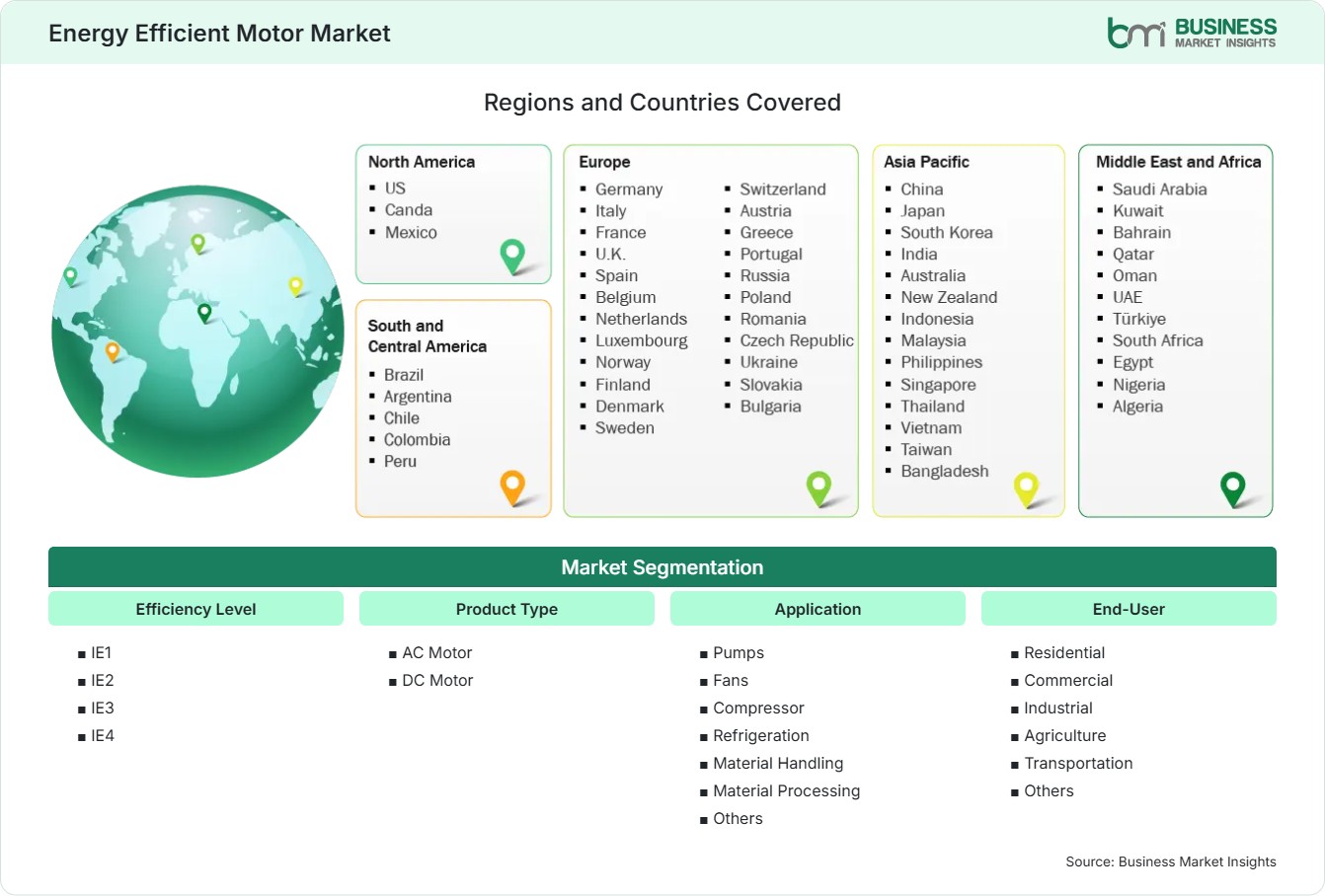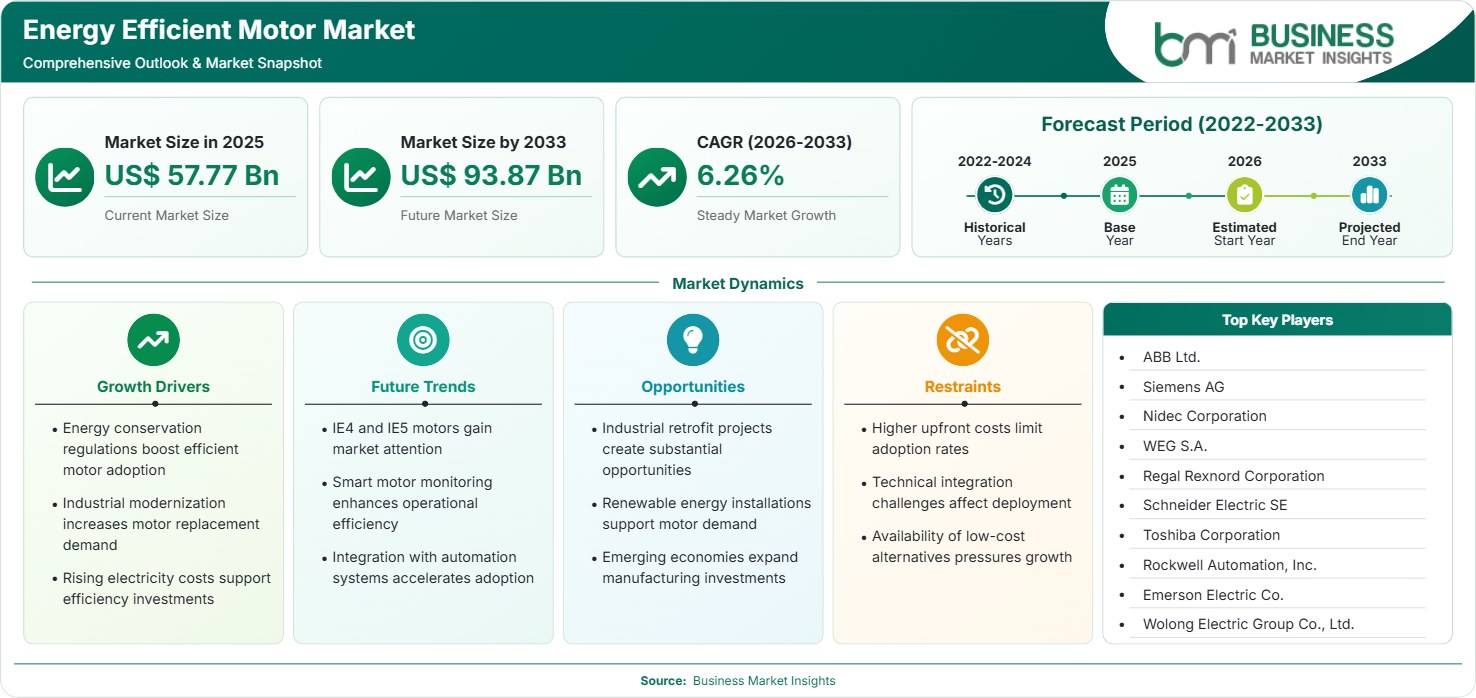
Energy Efficient Motor Market Regional Highlights
North America Energy Efficient Motor Market
North America accounted for approximately 31%–34% of global revenue in 2025 and is expected to expand at a CAGR of 5.6%–6.0% through 2033. The region benefits from mature industrial infrastructure, strong energy-efficiency standards, and extensive modernization activities across manufacturing facilities. Utility rebate schemes encourage replacement of aging motors with premium-efficiency alternatives. The Energy Efficient Motor Market share in North America remains supported by continuous investments in automation, data centers, commercial buildings, and water-treatment infrastructure. Advanced industrial users increasingly prioritize lifecycle-cost optimization over upfront equipment expenditure.
- Industrial operators are accelerating retrofits to reduce electricity consumption, particularly across oil and gas, food processing, chemicals, and mining applications where motor-driven systems represent major energy loads.
- Utility-sponsored efficiency programs continue improving adoption economics by reducing payback periods for premium-efficiency motors and associated control systems, supporting broader deployment among mid-sized industrial enterprises.
- Smart manufacturing initiatives are integrating sensors, analytics, and predictive maintenance technologies, improving operational reliability while creating additional value beyond energy savings for plant operators.
- Data-center expansion across the United States and Canada is increasing demand for efficient cooling, ventilation, and power-management equipment supported by high-performance motor technologies.
- Growing environmental reporting requirements are encouraging organizations to quantify energy reduction outcomes, stimulating further investment in advanced motor replacement projects across commercial and industrial sectors.
US Energy Efficient Motor Market
The United States represents roughly 72%–76% of North American Energy Efficient Motor Market demand and is projected to record a CAGR of 5.7%–6.1% through 2033. Federal efficiency standards, extensive industrial activity, and widespread automation adoption continue supporting market expansion. Manufacturing modernization initiatives across automotive, semiconductor, chemical, and food-processing industries strengthen equipment replacement activity. Increasing investments in industrial resilience, productivity enhancement, and sustainability targets further reinforce long-term demand for premium-efficiency and digitally enabled motor systems across diverse application environments.
- Manufacturing expansion associated with advanced technology industries is driving procurement of motors designed to maximize efficiency and maintain operational reliability under continuous-duty conditions.
- Energy management programs increasingly incorporate connected motors capable of supporting predictive maintenance and real-time performance optimization across complex industrial facilities.
- Commercial infrastructure upgrades, particularly within healthcare, education, and logistics sectors, continue generating replacement demand for efficient HVAC and pumping systems.
- Rising electricity costs encourage operators to prioritize lifecycle savings, resulting in faster adoption of higher-efficiency motor classes despite elevated initial capital expenditure.
Europe Energy Efficient Motor Market
Europe held approximately 26%–29% of global Energy Efficient Motor Market revenue during 2025 and is forecast to expand at a CAGR of 5.8%–6.2% through 2033. The region benefits from stringent environmental regulations, advanced industrial automation adoption, and ambitious decarbonization objectives. Germany remains the leading national market, supported by extensive manufacturing activity, while Eastern European economies are generating faster demand expansion. Industrial users increasingly adopt premium-efficiency motors to comply with evolving efficiency frameworks and improve competitiveness through lower operating expenditure and enhanced sustainability performance.
- Germany maintains market leadership due to sophisticated industrial infrastructure and widespread deployment of automation systems across automotive, machinery, and engineering sectors.
- Poland and Romania demonstrate stronger growth momentum, supported by industrial investments, modernization programs, and growing integration into European manufacturing supply chains.
- Regulatory measures promoting decarbonization and energy performance continue encouraging replacement of legacy equipment throughout industrial and commercial facilities.
- Food processing, chemicals, pharmaceuticals, and water-treatment industries remain key sources of demand for premium-efficiency motor technologies.
- Digitalization initiatives support broader deployment of intelligent motor solutions capable of enhancing asset utilization and improving predictive maintenance programs.
Asia Pacific Energy Efficient Motor Market
Asia Pacific represented approximately 28%–31% of global revenue in 2025 and is anticipated to achieve the fastest CAGR of 7.2%–7.8% through 2033. Industrialization, infrastructure investment, urban expansion, and manufacturing relocation continue supporting demand growth. China remains the largest regional market due to its extensive industrial base, while India is emerging as the fastest-growing country market. The region contributes significantly to overall Energy Efficient Motor Market growth because of increasing energy-efficiency mandates and modernization efforts throughout manufacturing industries.
- China accounts for the largest regional demand base owing to massive manufacturing capacity and accelerating adoption of higher-efficiency industrial equipment.
- India records notable growth supported by industrial corridors, infrastructure expansion, and government initiatives promoting energy conservation within manufacturing sectors.
- Southeast Asian economies are experiencing rising demand as multinational companies diversify production networks and establish new industrial facilities.
- Commercial buildings and transportation infrastructure projects create substantial opportunities for efficient motor deployment across HVAC and material-handling applications.
- Investments in renewable energy, water management, and industrial automation support increasing adoption of digitally connected high-efficiency motor solutions.
Rest of World Energy Efficient Motor Market
The Rest of World region accounted for approximately 10%–13% of global Energy Efficient Motor Market revenue in 2025 and is expected to expand at a CAGR of 6.3%–6.8% through 2033. South and Central America benefit from mining, agriculture, and industrial modernization investments. Meanwhile, the Middle East and Africa are supported by infrastructure development, water-management projects, and industrial diversification strategies.
Countries including Brazil and Saudi Arabia lead regional adoption, while nations such as the United Arab Emirates and South Africa exhibit stronger growth prospects due to ongoing industrial development and energy-efficiency initiatives.
- Brazil remains the largest South and Central American market owing to broad industrial operations and increasing focus on energy-cost management strategies.
- Mining, agriculture, and food-processing applications generate substantial demand for durable, efficient motor technologies throughout Latin American markets.
- Saudi Arabia and the United Arab Emirates continue investing in industrial diversification, creating increased requirements for energy-efficient equipment solutions.
- Water-treatment, desalination, and infrastructure projects across Middle Eastern markets support sustained demand for advanced pump and motor systems.
- African industrial modernization efforts and improving electricity-management practices are contributing to gradual adoption of premium-efficiency technologies across key sectors.