
Energy Efficient Materials Market Outlook: Size, Share, Trends, Growth Analysis, Competitive Landscape & Forecast, 2026-2033

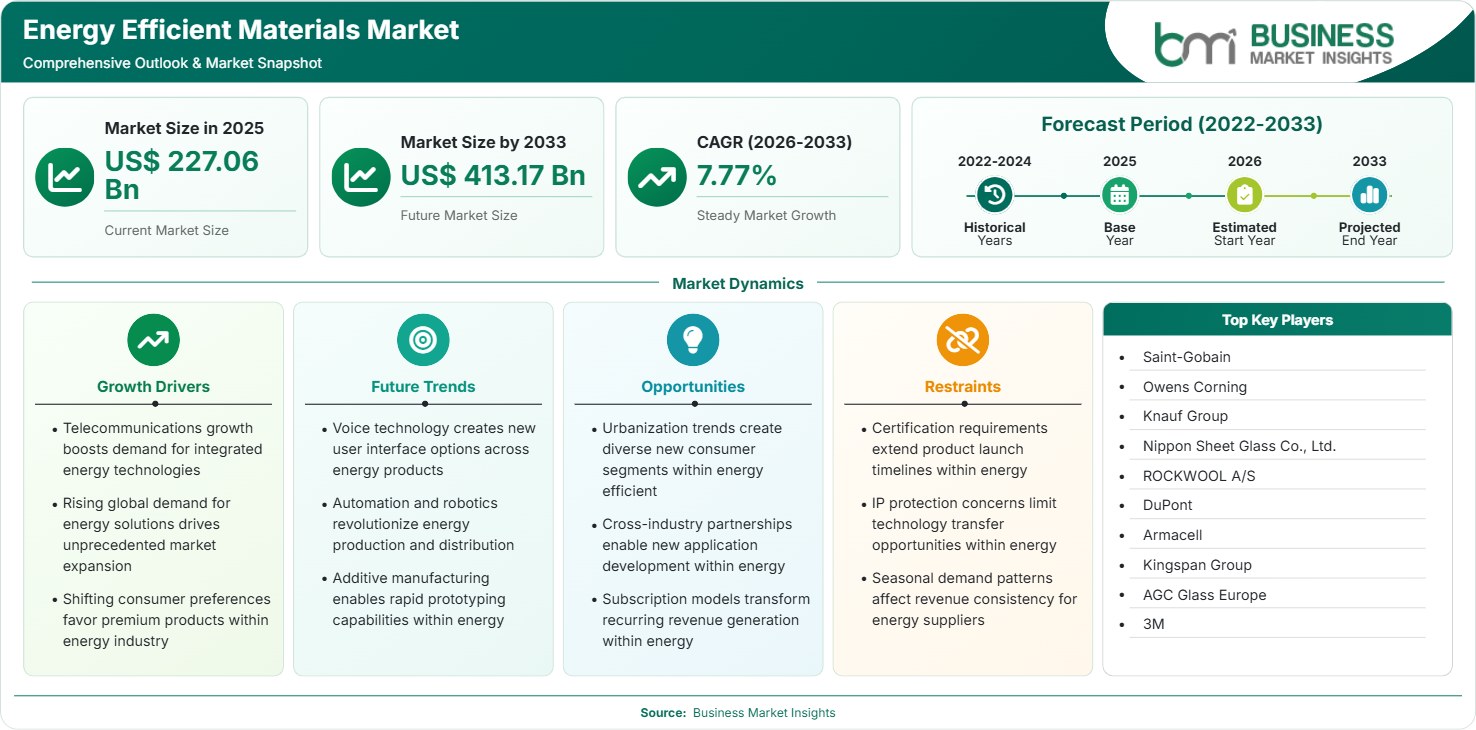
The Energy Efficient Materials Market size was valued at US$ 227.06 Billion in 2025 and is projected to reach US$ 413.17 Billion by 2033, growing at a CAGR of 7.77% during 2026–2033. Rising green building mandates, stricter energy codes, net-zero construction targets, infrastructure modernization, and industrial decarbonization initiatives are accelerating adoption, while retrofit investments and advanced material innovation create substantial opportunities.

Report Coverage
  • Material Type: Insulation Materials, Energy-efficient Glass & Glazing Materials, Energy-efficient Coatings, Sustainable Building Materials, Reflective & Cool Roofing Materials, Others
  • Application: Building & Construction, Automotive & Transportation, HVAC Systems, Energy & Power, Industrial Equipment & Appliances
US$ 227.06 Bn Market size in 2025
US$ 413.17 Bn Market Size by 2033
7.77% CAGR, 2026 - 2033
2026-2033 Forecast Period

AI Overview

Energy Efficient Materials Market Summary

  • North America Region: North America holds a market share of 34%–37% in 2025, growing with a CAGR of 7.0%–7.4% during 2026–2033. Demand is supported by building retrofits, energy regulations, insulation upgrades, commercial renovations, sustainability mandates, and smart infrastructure investments expanding across residential and industrial sectors. Brief U.S. analysis: The U.S. remains the regional leader, supported by large-scale energy retrofits and green construction activity, advancing at a CAGR of 7.1%–7.5%.
  • Fastest Growing Region: Asia Pacific holds a market share of 28%–31% in 2025, growing with a CAGR of 9.0%–9.5% during 2026–2033. Rapid urbanization, green building programs, industrial expansion, infrastructure spending, and government efficiency standards are accelerating deployment of advanced materials across multiple end-use sectors.
  • Leading Segment: Building & Construction holds a market share of 45%–48% in 2025, growing with a CAGR of 7.5%–8.0% during 2026–2033. Strong demand for insulation, high-performance glazing, roofing systems, and sustainable materials supports energy savings, carbon reduction, and building lifecycle optimization.
  • High Growth Segment: Energy-efficient Glass & Glazing Materials hold a market share of 19%–22% in 2025, growing with a CAGR of 9.2%–9.8% during 2026–2033. Increasing adoption of smart facades, solar-control coatings, commercial modernization projects, and enhanced thermal performance requirements stimulates rapid expansion.
  • Key Market Opportunity: Expanding global building retrofit programs create significant revenue potential through replacement of legacy materials, energy-performance upgrades, carbon-reduction initiatives, digital building management integration, and long-term operational savings realization.
  • Major Market Players: Compagnie de Saint-Gobain S.A., Owens Corning, Kingspan Group plc, ROCKWOOL A/S, BASF SE, 3M Company, AGC Inc., PPG Industries, Inc., Johns Manville Corporation, and Knauf Insulation.
Strategic Insights

Energy Efficient Materials Market: Strategic Insights

Energy Efficient Materials Market Strategic Framework
FREE PDF
Request your free sample
Request free sample
Stakeholder View

Key Takeaways

  • Raw material suppliers, processors, coating specialists, glazing manufacturers, insulation providers, distributors, and construction integrators form a highly interconnected value chain where innovation and compliance capabilities influence competitive positioning.
  • The strongest medium-term opportunity remains concentrated in building retrofits, commercial renovation projects, and energy-performance upgrades where insulation, roofing, and glazing replacements generate measurable energy savings.
  • Product development is moving toward multifunctional materials combining thermal efficiency, recyclability, fire resistance, moisture control, and digital monitoring compatibility.
  • Asia Pacific offers the most attractive investment profile due to urbanization intensity, infrastructure spending, industrial expansion, and government-backed sustainability programs.
  • Industry participants are pursuing acquisitions, manufacturing expansions, and technology partnerships to strengthen market access and enhance sustainable product portfolios.
  • Lifecycle carbon reporting and embodied-carbon regulations are increasingly influencing procurement decisions, creating differentiation opportunities for suppliers with verified environmental performance credentials.
Geographic Outlook

Energy Efficient Materials Market Regional Highlights

North America Energy Efficient Materials Market

North America accounts for 34%–37% of the Energy Efficient Materials Market share in 2025 and is forecast to register a CAGR of 7.0%–7.4% through 2033. Regional demand is driven by stringent building efficiency regulations, commercial retrofit activity, and renovation of aging infrastructure. Federal and state incentives support insulation upgrades, advanced glazing adoption, and cool-roof deployment. Strong sustainability commitments from property owners, manufacturers, and institutional investors continue to expand product penetration across residential, commercial, and industrial projects.

  • Building retrofit programs remain major demand generators, especially in commercial offices, healthcare facilities, and educational institutions pursuing reduced energy consumption and operating costs.
  • Adoption of advanced insulation systems is accelerating as developers seek compliance with evolving energy codes and decarbonization objectives.
  • Cool roofing technologies are gaining wider acceptance due to urban heat mitigation initiatives and sustainability certification requirements.
  • Industrial facilities increasingly deploy thermal management materials to reduce energy intensity and improve long-term operational efficiency.

US Energy Efficient Materials Market

The United States accounts for about 76%–80% of regional consumption growth, with a 7.1%–7.5% CAGR through 2033. Federal efficiency rebates, LEED-certified construction initiatives, and extensive commercial refurbishments sustain the consumption trend. The expansion of data centers, healthcare infrastructure construction, and industrial development will increase material demand. Well-developed manufacturing capacity and innovative ecosystems help promote the development of insulation and energy-efficient glazing products.

  • Green building certifications increasingly influence procurement specifications for insulation, glazing, and sustainable construction materials.
  • Growth in warehouse, logistics, and data-center construction supports deployment of advanced roofing and thermal management solutions.
  • Commercial property owners prioritize retrofit investments that deliver measurable energy savings and lower carbon emissions.
  • Public infrastructure modernization programs expand opportunities for high-performance building envelope materials.

Europe Energy Efficient Materials Market

The Europe region accounts for 27%–30% market share in 2025, and it is projected to record a CAGR of 7.3%–7.8% between 2026 and 2033. Europe benefits from its strong carbon-neutrality goals, building-renovation plans, and efficiency-focused policies. Germany remains the dominant market in Europe, while Poland and Spain show stronger growth prospects. Investments in eco-friendly construction, energy-efficient buildings, and the circular economy are driving demand across various segments in Europe.

  • EU climate policies continue accelerating adoption of advanced materials supporting emissions reduction and energy-performance targets.
  • Building renovation initiatives drive replacement demand for legacy insulation and inefficient glazing systems.
  • Germany leads regional consumption due to advanced construction standards and extensive retrofit activity.
  • Poland demonstrates strong expansion supported by infrastructure investment and building modernization programs.
  • Sustainable construction procurement requirements increasingly favor verified low-carbon material solutions.

Asia Pacific Energy Efficient Materials Market

Asia Pacific has revenue shares of 28% to 31% in 2025 and the fastest CAGR of 9.0% to 9.5% through 2033. Urbanization and industrialization, coupled with infrastructure development, are creating new demand trends. China is still the largest country market, but India is growing the most. Adoption of increasing construction and other regulations that address climate change is driving the use of energy-efficito stimulate thection materials and industrial efficiency solutions across diverse sectors.

  • China leads regional demand owing to extensive construction activity and large-scale energy-efficiency initiatives.
  • India benefits from rapid urban development, commercial construction growth, and government sustainability programs.
  • Manufacturing expansion supports increased consumption of insulation and thermal management materials.
  • Smart-city investments encourage adoption of advanced glazing technologies and cool-roof solutions.
  • Rising awareness of operating-cost reduction strengthens long-term market development prospects.

Rest of World Energy Efficient Materials Market

The Rest of World segment accounts for 8%-10% market share in 2025 and is expected to grow at a CAGR of 7.8%-8.3% during 2033. The South & Central America region is seeing increased adoption due to building modernization and energy-efficiency projects. The Middle East & Africa markets have benefited from heat-management policies and sustainable construction. Brazil drives the regional demand, whereas Saudi Arabia shows robust growth fueled by development and efficiency policies.

  • Brazil remains a key market driven by urban construction activity and growing efficiency awareness.
  • Saudi Arabia supports material demand through megaproject development and sustainability-focused building standards.
  • High cooling requirements increase deployment of reflective roofing and energy-efficient glazing products.
  • Infrastructure investments across emerging economies create opportunities for advanced building materials.
  • Industrial diversification projects strengthen adoption of efficiency-enhancing thermal management technologies.
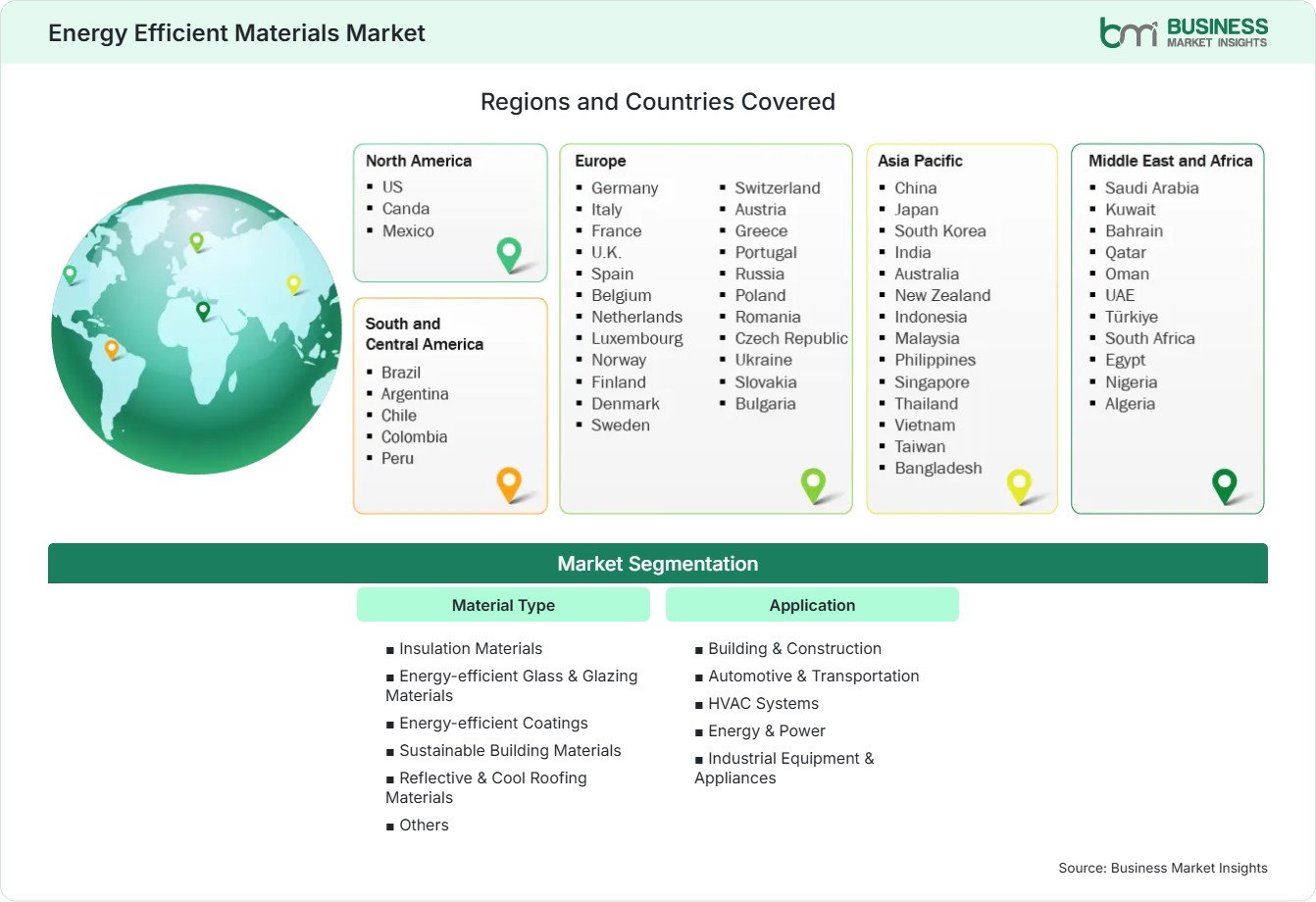
Global Market Geography
FREE PDF
Request your free sample
Request free sample
Segment Analysis

Energy Efficient Materials Market Segmentation

Material Type

This segment contributes roughly 55% to 58% to total revenue in 2025 and is expected to grow at a CAGR of 8.0% to 8.5%. The scope of the Energy Efficient Materials Market, in terms of material innovation, will continue to expand as emphasis is placed on thermal properties, durability, recyclability, and reduced carbon emissions.

  • Insulation Materials: Widely adopted across residential, commercial, and industrial environments to reduce heating and cooling demand while supporting compliance with increasingly stringent energy-performance standards.
  • Energy-efficient Glass & Glazing Materials: Growing deployment in high-performance buildings due to solar-control capabilities, daylight optimization benefits, and improved thermal insulation characteristics.
  • Energy-efficient Coatings: Used extensively to reduce heat gain, improve surface efficiency, and enhance durability in building and industrial applications.
  • Sustainable Building Materials: Demand is increasing as developers pursue lower embodied carbon, recycled content integration, and environmental certification requirements.
  • Reflective & Cool Roofing Materials: Adoption expands in warm climates where reduced heat absorption lowers cooling loads and improves building energy efficiency.

Application

Application demand is dominated by construction-related activities, accounting for 42%-45% in 2025 and achieving a CAGR of 7.8%-8.3%. The Energy Efficient Materials Market trends show increasing use of energy-efficient materials in transportation, power, and industrial facilities seeking improved energy productivity and lower lifecycle costs.

  • Building & Construction: Largest application segment benefiting from building codes, retrofit investments, sustainability certifications, and increasing demand for efficient building envelopes.
  • Automotive & Transportation: Manufacturers utilize lightweight and thermally efficient materials to improve fuel economy, vehicle performance, and electrification outcomes.
  • HVAC Systems: Increased deployment supports thermal retention, reduced operational costs, and enhanced overall system performance across commercial and residential projects.
  • Energy & Power: Utilities and energy infrastructure operators deploy efficient materials to improve asset performance and minimize energy losses.
  • Industrial Equipment & Appliances: Growing emphasis on energy conservation drives adoption of advanced insulation and coating technologies throughout industrial operations.
Market Forces

Energy Efficient Materials Market Dynamics

Key Market Drivers

Stringent Energy-Efficiency Regulations Worldwide

Aggressive standards for building performance and decarbonization measures adopted by governments provide direct support for the use of advanced materials. As noted by the International Energy Agency, buildings account for about 30% of the world's total final energy use, making them an important target for policy intervention. Changes to building codes include requirements for higher insulation qualities, glazing efficiency, and better thermal envelopes. Such policy initiatives increase the visibility of future purchase volumes for material manufacturers. Energy Efficient Materials Market growth will be supported by cycles of compliance-driven investments across all housing, commercial, and infrastructure segments. Regulatory alignment around net-zero construction targets further accelerates the specification of high-performance products during new construction and retrofit activities globally.

Expansion of Green Building and Retrofit Activity

Building owners are making efforts to reduce energy use due to rising utility costs and the increasing need for carbon accounting. Retrofitting initiatives for old buildings are one of the largest sources of steady demand. Modernization of commercial office spaces, hospitals, schools, and housing developments through improved insulation, reflective roofing, and high-efficiency glass is becoming increasingly popular. Trends in the market also include an increasing inclination towards lifecycle costing rather than just upfront costs. All this is driving the adoption of premium products, particularly in developed countries with large renovation backlogs.

Industrial Decarbonization and Energy Productivity Goals

Industrial manufacturing companies need technologies that reduce energy consumption without compromising operational reliability. Thermal insulation materials, efficiency coatings, and heat management materials provide direct contributions towards increasing energy productivity. Industrial operators are becoming concerned about the performance of materials throughout their entire lifecycle, maintenance, and emissions impact. Companies' sustainability objectives and environmental reports have led to more widespread use of materials with these features. Energy-intensive industries such as chemicals, metals, food processing, and power generation are working to become more energy-efficient by incorporating these materials.

Key Market Opportunities

Large-Scale Building Renovation Programs

A substantial portion of global building stock was developed before modern energy standards were introduced. Renovation programs create significant opportunities for suppliers of insulation materials, advanced glazing, cool roofing products, and sustainable construction solutions. Funding for public projects and green financing structures is supporting efforts to modernize both the residential and commercial sectors.  Energy Efficient Materials Market Forecasts takes into account the level of demand created by retrofit projects through the next decade. Suppliers that can offer comprehensive material products and documentation on their performance and carbon-reduction impact will benefit from increased procurement opportunities resulting from the efficiency programs.

Growth of Smart and Net-Zero Buildings

Net-zero buildings need to use highly efficient envelopes that reduce energy consumption before incorporating renewable energy sources. This phenomenon contributes to a rise in demand for energy-efficient glass, thermal insulation, energy-reflecting coatings, and sustainable building materials. Smart building systems also add value by improving energy performance through continuous monitoring. The developers of building materials create products that work well within the digital building ecosystem. The development prospects are especially bright for commercial, institutional, and mixed-use projects, since the energy savings make the high initial investment cost worthwhile. The integration of efficient materials within smart ecosystems creates opportunities for premium product differentiation.

Emerging Market Infrastructure Development

Urban growth within developing nations offers substantial opportunities for demand over time. The need for energy efficiency is now viewed as a necessity rather than a choice by governments and construction companies. Materials that function effectively are essential for constructing transport terminals, health care centers, educational institutions, industrial complexes, and commercial ventures, owing to increasing energy demand. Climate change concerns also highlight the importance of thermal systems. Companies that have increased their capacity to manufacture regionally and deliver regionally will be best placed to take advantage. As sustainability standards evolve in emerging economies, advanced materials are expected to be more widely included in infrastructure procurement frameworks.

Market Restraints and Challenges

High Initial Cost and Budget Constraints

Factor: Many advanced insulation systems, high-performance glazing products, and specialty coatings involve higher upfront procurement and installation costs compared with conventional alternatives. Impact: Budget-sensitive customers may delay adoption despite long-term savings potential. This challenge is particularly relevant in developing markets where construction decisions often prioritize capital expenditure over lifecycle economics. Limited awareness regarding total cost of ownership further compounds purchasing resistance. Smaller contractors and property owners may also lack resources to evaluate return-on-investment benefits comprehensively. Although operating savings eventually offset costs, adoption rates can remain constrained when financing support or incentive mechanisms are insufficient.

Performance Awareness and Installation Gaps

Factor: Material performance depends significantly on correct specification, installation quality, and integration within overall building systems. Impact: Inadequate technical expertise can reduce expected energy savings and diminish confidence among end users. Variations in contractor capabilities, inconsistent training standards, and fragmented project execution create implementation risks. Some regions continue experiencing knowledge gaps regarding advanced energy-efficient solutions and performance verification methodologies. These challenges may slow purchasing decisions and limit premium product penetration. Addressing the issue requires stronger industry education, certification programs, and collaboration between manufacturers, developers, engineers, and contractors.

Company Analysis

Competitive Landscape

The competitive environment reflects continuous innovation, sustainability investments, and capacity expansion. Energy efficient materials market analysis indicates that leading participants compete by enhancing thermal performance, pursuing circular-economy initiatives, integrating building solutions, and leveraging global distribution capabilities.

Company Name

Overview

Products and Services relevant to this market

Compagnie de Saint-Gobain S.A.

Global construction materials leader focused on sustainable building solutions and advanced energy-performance products.

Insulation systems, high-performance glass, building materials, roofing solutions, and energy-efficiency technologies.

Owens Corning

Major manufacturer specializing in insulation and building-envelope technologies supporting energy savings.

Fiberglass insulation, roofing products, composite materials, and thermal-performance solutions.

Kingspan Group plc

International provider of advanced building envelope and insulation products.

Insulated panels, building energy systems, roofing products, and efficiency-focused construction materials.

ROCKWOOL A/S

Global stone wool insulation specialist serving residential, commercial, and industrial markets.

Thermal insulation, acoustic solutions, fire-resilient materials, and building efficiency products.

BASF SE

Diversified chemical company supporting sustainable construction and energy optimization.

Performance chemicals, insulation raw materials, coatings, and construction solutions.

3M Company

Technology-focused manufacturer developing materials that improve efficiency and durability.

Reflective films, insulation technologies, industrial coatings, and building-performance materials.

AGC Inc.

Leading glass manufacturer with a strong focus on advanced glazing technologies.

Low-emissivity glass, solar-control glazing, architectural glass, and energy-saving materials.

PPG Industries, Inc.

Global coatings supplier serving construction and industrial end users.

Energy-efficient coatings, reflective technologies, protective finishes, and specialty materials.

Johns Manville Corporation

Berkshire Hathaway subsidiary specializing in engineered insulation products.

Fiberglass insulation, commercial roofing systems, and industrial thermal management solutions.

Knauf Insulation

Global insulation manufacturer emphasizing sustainability and performance.

Glass mineral wool, rock mineral wool, and building insulation solutions.

Trust & Transparency

Research Methodology

The market analysis combines proprietary research with secondary data from government agencies, company disclosures, regulatory filings, industry databases and expert interviews. Market estimates are validated through data triangulation, cross-market benchmarking and analyst review.

View Full Research Methodology

Questions Answered

Frequently Asked Questions

Which region presents the strongest long-term growth prospects?

Asia Pacific offers the strongest growth outlook because of rapid urbanization, infrastructure expansion, industrial development, and increasingly stringent energy-efficiency regulations.

What does the Energy Efficient Materials Market Report typically evaluate?

The Market Report generally assesses demand trends, competitive positioning, technological developments, regulatory impacts, regional opportunities, and future revenue potential across segments.

How do energy-efficient materials support sustainability goals?

These materials reduce heating and cooling loads, lower energy consumption, decrease emissions, improve building performance, and contribute to lifecycle sustainability objectives.

What application area generates the greatest demand?

Building and construction remains the largest application due to extensive use of insulation, glazing, roofing, and sustainable materials in new development and retrofit projects.

What factors are accelerating adoption of energy-efficient materials?

Regulatory standards, carbon-reduction goals, green building certifications, energy-cost savings, and renovation programs are collectively increasing demand across construction, industrial, and infrastructure sectors.

Access the Full Energy Efficient Materials Market Report

Get segment-level forecasts, regional estimates, competitive benchmarking, company profiles and downloadable Excel datasets.

Access the full Energy Efficient Materials Market Report
350 pages PDF & Excel | 2026-08-17
Similar Research

Related Market Reports