
Electrotherapy Devices Market Outlook: Size, Share, Trends, Growth Analysis, Competitive Landscape & Forecast, 2026-2033

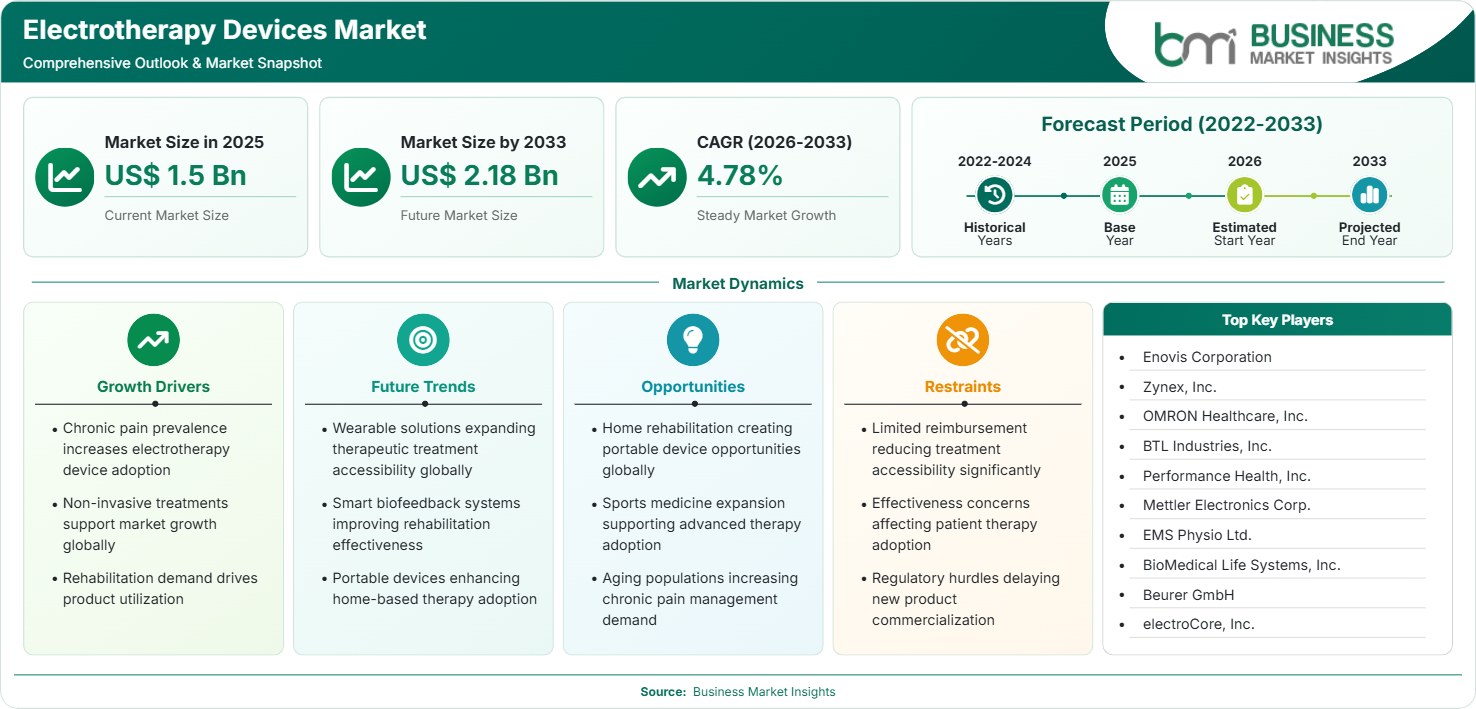
The Electrotherapy Devices Market size was valued at US$ 1.5 Billion in 2025 and is projected to reach US$ 2.18 Billion by 2033, growing at a CAGR of 4.78% during 2026–2033, driven by rehabilitation demand, chronic pain prevalence, homecare adoption, product portability, and technology innovation.

Report Coverage
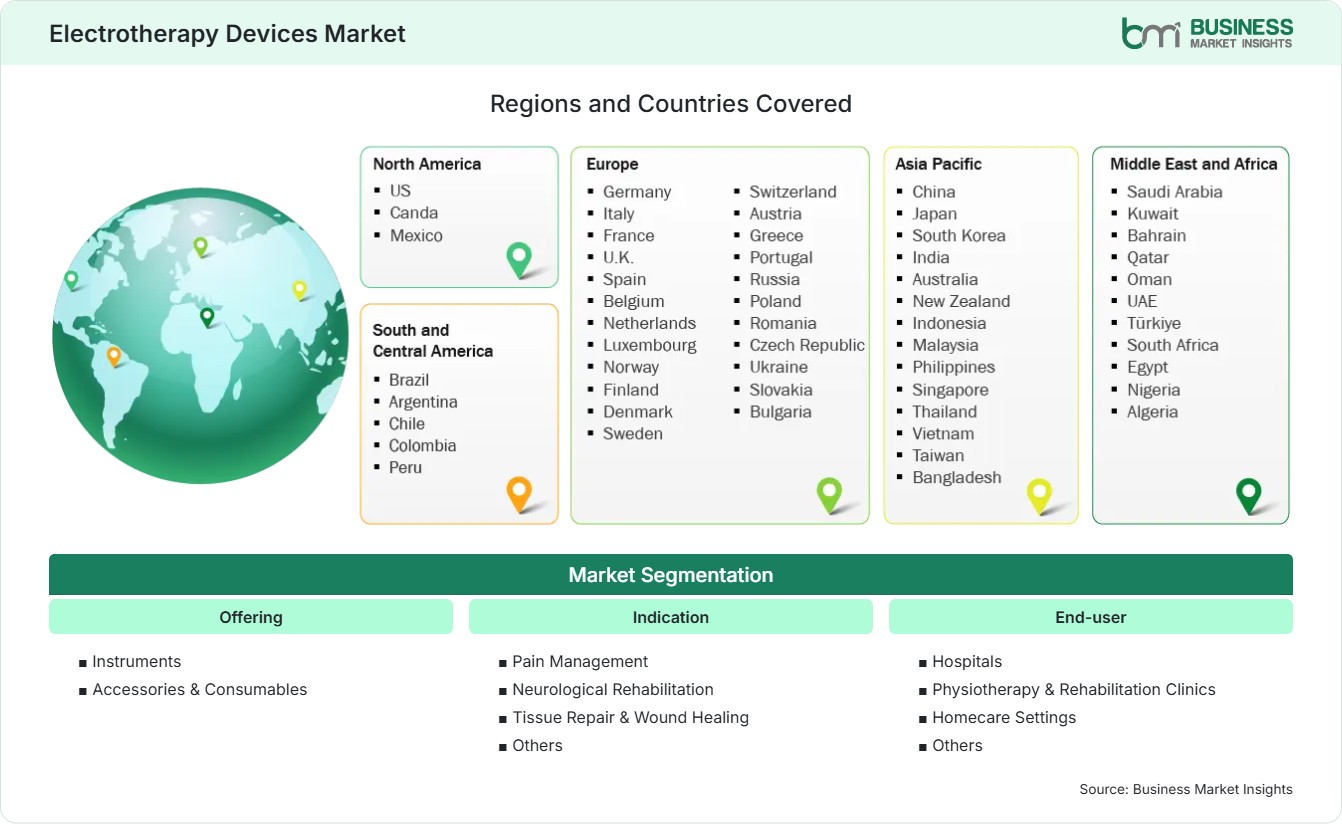
  • Offering: Instruments , Accessories & Consumables
  • Indication: Pain Management, Neurological Rehabilitation, Tissue Repair & Wound Healing, Others
  • End-user: Hospitals, Physiotherapy & Rehabilitation Clinics, Homecare Settings, Others
US$ 1.5 Bn Market size in 2025
US$ 2.18 Bn Market Size by 2033
4.78% CAGR, 2026 - 2033
2026-2033 Forecast Period

AI Overview

Electrotherapy Devices Market Summary

  • North America Region: North America holds a market share of 35%–38% in 2025, growing at a CAGR of 4.2%–4.7%, supported by established rehabilitation infrastructure, reimbursement pathways, aging populations, sports injury management, and home-based pain therapy adoption. The US market maintains approximately 80%–84% of North American demand, expanding at a 4.3%–4.8% CAGR as TENS, EMS, and multimodal rehabilitation systems gain clinical and homecare acceptance.
  • Fastest Growing Region: Asia Pacific holds a 20%–23% Electrotherapy Devices Market share in 2025 and is projected to expand at a 5.5%–6.2% CAGR, supported by expanding rehabilitation capacity, increasing healthcare expenditure, aging populations, manufacturing localization, and growing awareness of non-pharmacological pain management.
  • Leading Segment: Pain Management represents approximately 44%–48% of 2025 demand and is projected to grow at a 4.6%–5.1% CAGR, supported by chronic musculoskeletal conditions, demand for drug-free therapy, outpatient rehabilitation, and portable TENS solutions.
  • High Growth Segment: Homecare Settings account for approximately 18%–22% of 2025 demand and are projected to expand at a 5.8%–6.4% CAGR, driven by portable devices, remote rehabilitation, aging populations, self-management preferences, and increasing clinician-supported home treatment.
  • Key Market Opportunity: The strongest opportunity lies in connected, compact electrotherapy platforms combining stimulation, treatment tracking, personalized protocols, and clinician oversight for decentralized rehabilitation and chronic pain management.
  • Major Market Players: Enovis Corporation, Zynex, Inc., OMRON Healthcare, Inc., BTL Industries, Inc., Performance Health, Inc., Mettler Electronics Corp., EMS Physio Ltd., BioMedical Life Systems, Inc., Beurer GmbH, and electroCore, Inc.
Strategic Insights

Electrotherapy Devices Market: Strategic Insights

Electrotherapy Devices Market Strategic Framework
FREE PDF
Request your free sample
Request free sample
Stakeholder View

Key Takeaways

  • The value chain is shifting from using individual stimulators to embracing integrated ecosystems that include device manufacturers, suppliers of electrodes, rehabilitation providers, distributors, software developers, and clinicians, thus raising the significance of ongoing consumables and service relationships.
  • The greatest potential benefit comes from homecare and portable treatment options since these allow therapy to go beyond hospitals and clinics, decrease the need for travel, and enable the ongoing management of chronic musculoskeletal and neurological conditions.
  • As manufacturers compete on the basis of treatment precision and usability, features such as waveform optimization, programmable protocols, wireless connectivity, microcurrent functions, stimulation tailored to individual patients, and compact designs powered by batteries are becoming important factors that distinguish one product from another.
  • The Asia Pacific region offers a promising investment opportunity since, although rehabilitation capacity is still uneven, healthcare infrastructure, the production of medical devices, private clinics, and home-based care systems are all continuing to expand in China, India, Japan, South Korea, and throughout Southeast Asia.
  • A greater focus is now being placed on non-invasive bioelectronic technologies, rehabilitation services, and chronic-pain solutions. This is shown by electroCore's acquisition of NeuroMetrix in 2025, which demonstrates the strategic benefit of combining stimulation technologies with wider commercial distribution channels.
Geographic Outlook

Electrotherapy Devices Market Regional Highlights

North America Electrotherapy Devices Market

North America held a 35%–38% Electrotherapy Devices Market share in 2025 and is projected to expand at a 4.2%–4.7% CAGR through 2033, with strong clinical adoption, established rehabilitation networks, and chronic pain treatment. St medicine, and homecare utilization support regional demand.

  • The existing rehabilitation facilities meet the ongoing demand in hospitals, outpatient clinics, and specialist practices.
  • Chronic musculoskeletal conditions lead to an increased reliance on non-drug methods of pain management and a greater use of TENS-based treatments.
  • Access to rehabilitation is becoming available through the use of portable devices outside of traditional clinical settings.
  • Product differentiation increasingly centers on waveform control, patient comfort, usability, and treatment personalization.

US Electrotherapy Devices Market

The US represented approximately 80%–84% of North American Electrotherapy Devices Market demand in 2025 and is projected to grow at a 4.3%–4.8% CAGR through 2033. The country benefits from extensive physical therapy infrastructure, established medical-device distribution, specialist rehabilitation providers, and broad consumer familiarity with TENS.

  • The demand from consumers for convenient, drug-free methods of pain relief and for compact treatment devices has meant that home-use TENS products have benefited.
  • Hospitals and rehabilitation clinics prefer multifunctional systems which combine a number of therapeutic modalities into fewer devices.
  • The regulatory pathways are still having an effect on product innovation, as shown by the recent FDA approvals of TENS and EMS devices.

Europe Electrotherapy Devices Market

Europe accounted for a 27%–30% Electrotherapy Devices Market share in 2025 and is projected to expand at a 3.9%–4.4% CAGR. Germany, the UK, France, Italy, and Spain represent leading demand centers, supported by established physiotherapy networks and aging populations.

  • Germany is still a leading market due to its well-developed rehabilitation infrastructure and its effective medical-device distribution system.
  • France and the United Kingdom have the advantage of well-established physiotherapy systems and a rising demand for non-invasive rehabilitation.
  • Spain and Poland offer greater opportunities for growth as capacity in outpatient rehabilitation and private care increases.
  • European procurement is now giving greater consideration to device longevity, clinical evidence, workflow efficiency, and environmental performance.

Asia Pacific Electrotherapy Devices Market

Asia Pacific represented a 20%–23% Electrotherapy Devices Market share in 2025 and is projected to expand at a 5.5%–6.2% CAGR, making it the fastest-growing region. China, Japan, South Korea, Australia, and India represent major demand centers, while India, Indonesia, and Southeast Asian economies provide higher-growth opportunities.

  • China has a great demand for healthcare and at the same time possesses strong capabilities in the manufacture of electronics as well as expanding rehabilitation services.
  • Japan has a highly developed healthcare infrastructure; its population is aging, and it has established mature systems for homecare and rehabilitation.
  • India has great growth potential since private rehabilitation clinics, homecare providers, and medical-device manufacturers are expanding.
  • The healthcare sector in the Southeast Asian markets is growing as a result of increased investment in urban areas and because more portable rehabilitation equipment becomes available.

Rest of World Electrotherapy Devices Market

South and Central America represented a smaller portion of global demand in 2025, with Brazil, Mexico, Argentina, and Colombia providing the principal opportunities. Electrotherapy Devices Market Growth is supported by private rehabilitation networks, sports medicine, and expanding access to portable pain-management technologies.

  • Brazil and Mexico have achieved the highest level of adoption due to their extensive private healthcare systems and rehabilitation networks.
  • Colombia has growth potential due to the expansion of outpatient physiotherapy and the management of sports injuries.
  • Saudi Arabia and the United Arab Emirates are putting money into advanced healthcare infrastructure and into specialized rehabilitation services.
  • South Africa still serves as an important market for rehabilitation equipment in southern Africa.
Global Market Geography
FREE PDF
Request your free sample
Request free sample
Segment Analysis

Electrotherapy Devices Market Segmentation

Offering

The Offering segment includes instruments, accessories, and consumables, with instruments representing the principal value contribution in 2025. Instruments are supported by clinical demand for programmable stimulation and multimodal platforms, while recurring accessories strengthen manufacturer revenues. The segment reflects the Electrotherapy Devices Market scope across institutional and homecare procurement.

  • Instrument: Instruments support TENS, EMS, IFC, microcurrent, and related therapies through programmable electrical stimulation. Demand is shaped by clinical versatility, portability, treatment customization, waveform control, and increasing preference for multifunctional rehabilitation platforms.
  • Accessories & Consumables: Electrodes, lead wires, conductive materials, pads, and replacement components generate recurring demand alongside installed devices. Product comfort, conductivity, durability, skin compatibility, and replacement frequency influence purchasing decisions across clinical and homecare applications.

Indication

Pain Management represented approximately 44%–48% of 2025 Electrotherapy Devices Market demand and remains the leading indication, while neurological rehabilitation and tissue repair broaden clinical utilization.

  • Pain Management: Pain management is supported by chronic musculoskeletal conditions, postoperative discomfort, sports injuries, and consumer demand for non-pharmacological treatment. Portable TENS systems improve treatment accessibility and encourage repeated home-based use.
  • Neurological Rehabilitation: Neurological rehabilitation uses electrical stimulation to support muscle activation, functional retraining, and recovery following neurological impairment. Demand is influenced by stroke rehabilitation, neuromuscular dysfunction, specialist physiotherapy, and personalized treatment protocols.
  • Tissue Repair & Wound Healing: Electrical stimulation is increasingly evaluated and applied within selected tissue-repair protocols where clinicians seek supportive approaches for circulation, healing, and functional recovery. Specialized clinical applications create opportunities for evidence-driven product development.

End-user

Hospitals and physiotherapy clinics remain major purchasing channels, while Homecare Settings are gaining share as portable systems become easier to operate. The segment reflects changing care delivery, aging populations, decentralized rehabilitation, and patient preference for convenient therapy.

  • Hospitals: Hospitals use electrotherapy across rehabilitation departments, postoperative recovery, neurological care, and pain management. Procurement emphasizes clinical versatility, durability, safety, staff efficiency, protocol availability, and compatibility with multidisciplinary rehabilitation workflows.
  • Physiotherapy & Rehabilitation Clinics: Clinics represent a core demand center because therapists use electrical stimulation across pain relief, strengthening, neurological rehabilitation, and functional recovery. Device selection increasingly prioritizes multiple channels, programmable protocols, and rapid setup.
  • Homecare Settings: Homecare adoption is accelerating as compact battery-powered devices make treatment more accessible outside clinics. Consumer-friendly interfaces, wireless operation, remote guidance, reusable protocols, and simplified electrode placement support broader patient utilization.
Market Forces

Electrotherapy Devices Market Dynamics

Key Market Drivers

Growing Rehabilitation Demand from Chronic and Age-Related Conditions

The World Health Organization estimates that 2.4 billion people globally live with a condition that may benefit from rehabilitation, while more than half of people requiring rehabilitation in some low- and middle-income countries do not receive needed services. This unmet requirement supports broader deployment of accessible electrical stimulation technologies across hospitals, clinics, and homes. The Electrotherapy Devices Market growth opportunity is particularly strong where musculoskeletal, neurological, and age-related functional limitations increase demand for repeated rehabilitation.

Expansion of Drug-Free Pain Management

Chronic pain management is encouraging clinicians and consumers to evaluate non-pharmacological treatment options alongside conventional care. TENS provides a relatively accessible electrical stimulation approach for selected pain-management applications, supporting demand for both professional and home-use devices. Manufacturers are responding with preset programs, improved electrode designs, compact form factors, and wireless functionality. The Electrotherapy Devices Market Trends highlights that the commercial opportunity extends beyond initial device sales because replacement electrodes and accessories create recurring revenue.

Technology Development and Multimodal Rehabilitation Platforms

Device innovation is now progressing from simple stimulation to include integrated systems that provide multiple waveforms, programmable protocols, biofeedback, and modular treatment possibilities. Enovis has focused its Chattanooga systems on multimodal electrotherapy, and the existing platforms combine electrical stimulation with other rehabilitation technologies. These advances enable greater use of the equipment, as a single platform can address multiple treatment needs. Furthermore, programmable protocols can cut down on setup time and increase consistency from one session to the next.

Key Market Opportunities

Connected Home Rehabilitation and Remote Therapy

Homecare provides an attractive investment opportunity because portable stimulation devices can extend treatment beyond clinic visits. Bluetooth connectivity, treatment diaries, wireless controllers, and clinician-guided protocols can transform standalone devices into connected rehabilitation tools. Integration with remote-care platforms can enable therapists to monitor adherence, adjust parameters, and identify patients requiring additional intervention. Electrotherapy Devices Market Forecasts therefore increasingly favor business models combining equipment, consumables, software, and professional services.

Asia Pacific Manufacturing and Distribution Expansion

The Asia Pacific region presents an opportunity to link increased demand with manufacturing localization. Since China and other Asian production sites have well-developed electronics supply chains, and India and Southeast Asia are expanding their healthcare infrastructure and medical-device capabilities, companies can cut down on logistics costs and enhance their responsiveness in the region by setting up local assembly, arranging component sourcing, forming distribution partnerships, and establishing service networks. Moreover, localization can assist firms in adapting their products to varying purchasing environments, clinical workflows, and price levels.

Personalized Stimulation and Clinical Workflow Optimization

Personalized stimulation offers another possibility when manufacturers include parameters specific to the patient, programmable protocols, feedback from sensors, and treatment pathways defined by clinicians. Systems that make it easier to position the electrodes, automatically assist with treatment setup, or offer pre-stored protocols can reduce workflow complexity. Moreover, multichannel systems can provide different treatment programs for multiple patients, thereby enhancing their use in heavily occupied rehabilitation centers. Enovis's more recent electrotherapy systems show the commercial advantage of combining proprietary waveforms with simple interfaces and customizable protocols.

Market Restraints and Challenges

Regulatory Compliance and Clinical Evidence Requirements

The fact is that in many regions electrotherapy devices are regulated as medical products and therefore manufacturers are required to keep quality systems, produce technical documentation, carry out safety testing, comply with labeling requirements and obtain the appropriate market authorization. The effect of these regulatory requirements is that development costs rise, the time taken to bring the product to market is extended, and any changes to the product after approval may be restricted. When manufacturers wish to enter multiple markets, they must navigate different regulatory pathways, clinical expectations, post-market surveillance requirements, and documentation standards.

Reimbursement Variation and Patient Adherence Constraints

The extent of coverage and the way in which electrotherapy is reimbursed depend on the condition being treated, the insurance company, the location, the classification of the device, and the setting in which the treatment is given, and home users might stop having the therapy if they think the results are not adequate or if the instructions are hard to follow. As a result, inconsistent reimbursement and adherence can hinder the use of the device and cause people to be more influenced by clinical evidence and the overall cost when making their purchasing decisions.

Company Analysis

Competitive Landscape

The Electrotherapy Devices Market analysis indicates a competitive structure spanning diversified medical-technology companies, rehabilitation specialists, homecare device manufacturers, and bioelectronic technology providers. Competition increasingly centers on waveform technology, product portability, clinical evidence, connected functionality, distribution reach, and recurring consumables.

Company Name

Overview

Products and Services relevant to this market

Enovis Corporation

Global medical technology company with a substantial rehabilitation and recovery portfolio serving hospitals, clinics, sports medicine, and homecare users.

Chattanooga electrotherapy systems, TENS/NMES platforms, neuromuscular stimulation, rehabilitation technologies, accessories, and treatment-support solutions.

Zynex, Inc.

US-based medical technology company focused on non-invasive electrical stimulation and pain-management solutions for prescription and home-use applications.

Electrical stimulation devices, pain-management systems, TENS technologies, electrodes, accessories, and patient-support services.

OMRON Healthcare, Inc.

Healthcare technology company with established consumer and homecare capabilities and a portfolio addressing pain management and personal health.

TENS devices, wireless stimulation products, pain-management accessories, electrodes, and compact home-use electrotherapy solutions.

BTL Industries, Inc.

Medical technology specialist supplying non-invasive technologies across rehabilitation, physiotherapy, aesthetics, and other clinical applications.

Electrotherapy, rehabilitation equipment, electrical stimulation technologies, physiotherapy systems, and complementary treatment platforms.

Performance Health, Inc.

Rehabilitation-focused supplier serving clinicians, therapists, athletes, and home users through a broad therapy equipment portfolio.

Chattanooga-branded electrotherapy systems, TENS and NMES devices, electrodes, accessories, rehabilitation equipment, and clinical supplies.

Mettler Electronics Corp.

US rehabilitation technology manufacturer specializing in therapeutic equipment for professional clinical environments.

Electrical stimulation systems, combination therapy devices, ultrasound equipment, electrodes, and rehabilitation accessories.

EMS Physio Ltd.

UK-based specialist developing physiotherapy and electrotherapy equipment for clinical rehabilitation applications.

Electrical stimulation systems, TENS, EMS, interferential therapy, ultrasound, and physiotherapy treatment equipment.

BioMedical Life Systems, Inc.

Medical-device company focused on electrical stimulation technologies for pain management, rehabilitation, and homecare use.

TENS, EMS, interferential stimulation, combination therapy devices, electrodes, and patient-use accessories.

Beurer GmbH

German health and wellness technology company with a broad consumer portfolio that includes electrical stimulation and pain-management products.

TENS and EMS devices, electrostimulation accessories, heat therapy products, wellness technologies, and home-use health solutions.

electroCore, Inc.

Bioelectronic technology company expanding its non-invasive stimulation portfolio through chronic-pain and wellness applications.

Non-invasive nerve stimulation technologies, Quell-related solutions, bioelectronic therapy platforms, and chronic-pain management products.

Trust & Transparency

Research Methodology

The market analysis combines proprietary research with secondary data from government agencies, company disclosures, regulatory filings, industry databases and expert interviews. Market estimates are validated through data triangulation, cross-market benchmarking and analyst review.

View Full Research Methodology

Questions Answered

Frequently Asked Questions

How does the Electrotherapy Devices Market Report help businesses evaluate opportunities?

The report supports strategic planning by assessing offering categories, indications, end-user environments, geographic demand, competitive positioning, technology developments, growth drivers, constraints, and emerging opportunities relevant to manufacturers, suppliers, investors, and healthcare organizations.

What should healthcare providers evaluate before purchasing an electrotherapy system?

Providers should assess waveform options, treatment channels, programmable protocols, safety features, clinical evidence, ease of use, device durability, service support, consumable costs, regulatory status, and compatibility with the intended patient population.

Why are electrodes important to electrotherapy performance?

Electrodes provide the interface between the device and the patient's tissues. Conductivity, adhesion, geometry, skin compatibility, and durability influence current distribution, comfort, treatment consistency, and recurring consumable requirements.

How do portable electrotherapy devices affect home rehabilitation?

Portable devices allow prescribed stimulation programs to continue outside clinics, reducing dependence on frequent facility visits. Their value is strongest when patients require repeated treatment sessions and can safely follow clinician-defined instructions.

What conditions are commonly addressed with electrotherapy devices?

Electrotherapy devices are commonly used within pain management and rehabilitation programs for musculoskeletal pain, muscle weakness, selected neurological conditions, postoperative recovery, and functional rehabilitation. Appropriate modality selection depends on the patient, indication, treatment objective, contraindications, and clinical protocol.

Access the Full Electrotherapy Devices Market Report

Get segment-level forecasts, regional estimates, competitive benchmarking, company profiles and downloadable Excel datasets.

Access the full Electrotherapy Devices Market Report
350 pages PDF & Excel | 2026-11-03
Similar Research

Related Market Reports