Spinal Devices Market Regional Highlights
North America Spinal Devices Market
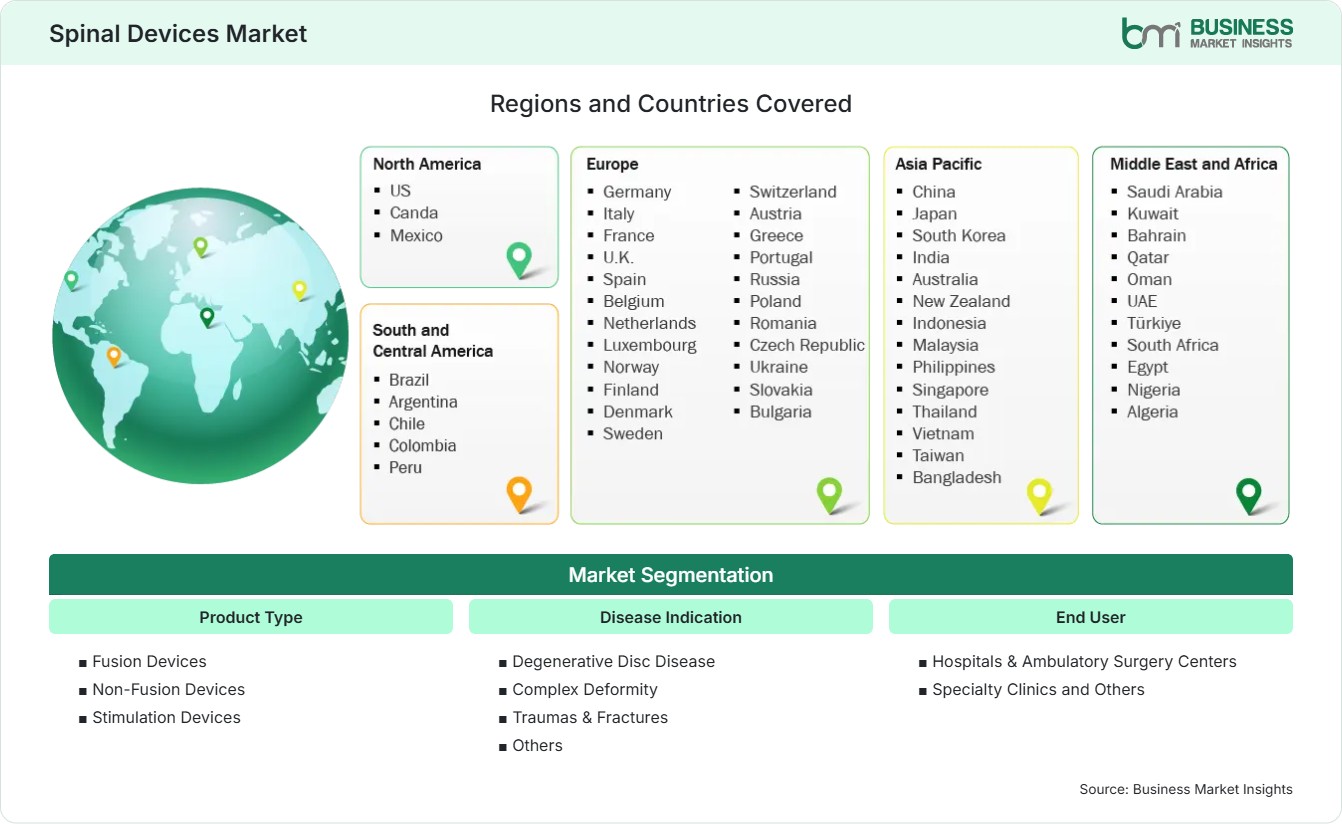
North America accounted for a 42%–45% Spinal Devices Market share in 2025 and is projected to expand at a 4.3%–4.7% CAGR through 2033. The region benefits from mature surgical infrastructure, high specialist density, advanced reimbursement systems, and rapid adoption of navigation and robotics. The US dominates regional demand, while Canada provides additional opportunities through tertiary hospitals and specialized orthopedic centers. Vendor competition increasingly centers on integrated procedural platforms, clinical evidence, surgeon training, and ambulatory surgery capabilities. The region also supports premium implant pricing where technologies demonstrate measurable workflow or outcome benefits.
- US demand remains anchored by high procedure volumes, sophisticated hospitals, specialist surgeons, and established reimbursement pathways, supporting rapid uptake of minimally invasive systems and enabling technologies across complex spinal procedures.
- Ambulatory surgery centers are expanding their role in selected spinal procedures, encouraging manufacturers to develop streamlined instrumentation, efficient workflows, predictable case times, and implants suitable for shorter postoperative pathways.
- Robotics and navigation remain important competitive differentiators as hospitals seek reproducibility, improved implant positioning, data capture, and greater surgeon confidence during technically demanding procedures.
- Canada offers incremental demand through specialized orthopedic centers, aging demographics, and investment in surgical infrastructure, although procurement cycles and public healthcare budgeting can moderate premium technology adoption.
US Spinal Devices Market
The US Spinal Devices Market accounted for about 78%–82% of the North American market demand in 2025 and is anticipated to grow at a CAGR of 4.2%–4.6% through 2033. The market's dominance is attributed to higher volumes of spinal procedures, wider availability of specialists, better hospitals, and faster commercialization of innovative implants and related technologies. Hospitals have begun to assess products based on their clinical performance and cost-effectiveness from a procedure perspective. ASCs’ rising importance benefits smaller instrumentation and related technologies, which help reduce the need for inpatient resources.
- Device utilization data demonstrate the scale of leading manufacturers, with Medtronic, DePuy Synthes, Globus Medical, and Stryker maintaining substantial presence across lumbar and cervical procedures.
- Integrated navigation and robotics are becoming stronger differentiators as providers seek improved surgical planning, precise implant placement, and standardized procedural execution.
- Commercial opportunities remain strongest in degenerative disease, complex deformity, minimally invasive fusion, and technologies that support efficient transition of appropriate procedures into ASCs.
Europe Spinal Devices Market
The Europe Spinal Devices Market share accounted for 25%-28% in 2025 and will have a CAGR of 4.5%–4.9% from 2026 to 2033. Germany, the United Kingdom, France, and Italy are leading the demand due to their orthopedic expertise and specialists. Germany is forecast to have a growth rate of 4.7% to 5.1%, while the United Kingdom is forecast to have a growth rate of 4.8% to 5.2%. There is greater focus on value in procurement than in the US, driven by clinical studies, efficiency, sustainability, and health economic value.
- Germany benefits from sophisticated hospital infrastructure, specialist surgical capacity, and established reimbursement mechanisms, supporting adoption of advanced fixation, interbody, navigation, and biologic technologies.
- The UK market increasingly emphasizes value-based procurement, encouraging suppliers to demonstrate measurable improvements in clinical outcomes, theatre efficiency, length of stay, and resource utilization.
- France and Italy provide opportunities through aging populations and specialist orthopedic networks, while public procurement requirements can favor suppliers with broad portfolios and established distribution capabilities.
- European manufacturers and global vendors are increasingly aligning products with regional regulatory requirements, clinical evidence expectations, and hospital purchasing frameworks.
Asia Pacific Spinal Devices Market
The Asia Pacific held an 18%-22% share of the Spinal Devices Market in 2025, and the region is expected to witness the highest growth rate during 2024 to 2033, at a 5.5%-6.2% CAGR. The primary countries for this region are China, Japan, India, South Korea, and Australia. The forecast for China is 6.0%-6.6%, while India is 6.2%-6.9%. Growing expenditure on healthcare, a growing number of private hospitals, professional training, and improved access to surgical procedures will drive market growth.
- China combines a large patient population with expanding domestic medical-device capabilities, creating opportunities for competitively priced implants, advanced imaging, navigation systems, and locally supported procedural technologies.
- India is developing specialist capacity across private hospitals and tertiary centers, increasing demand for cost-efficient fusion systems, biologics, minimally invasive procedures, and surgeon education programs.
- Japan benefits from an aging population and mature healthcare infrastructure, supporting demand for technologies addressing degenerative spinal conditions, although reimbursement discipline favors clinically differentiated solutions.
- South Korea and Australia offer advanced hospital environments where robotics, navigation, minimally invasive techniques, and premium implants can gain adoption through specialized centers.
Rest of World Spinal Devices Market
Rest of World is responsible for an estimated 8%-11% market share of the Spinal Devices Market in 2025 and is estimated to have a CAGR of 5.0%-5.8% during 2033. Latin America gains from investments in private hospitals and specialty services, and the Middle East & Africa gains from the development of tertiary care facilities. Brazil is expected to have a CAGR of about 5.3%-5.9%, while the UAE and Saudi Arabia are expected to have a CAGR of about 6.0%-6.7% as advanced healthcare infrastructure expands. Cost-sensitive product configurations remain important across emerging markets.
Latin American demand is concentrated in major urban healthcare centers where specialist surgeons and private hospitals can support advanced spinal interventions. Middle Eastern markets increasingly invest in technologically sophisticated tertiary hospitals, creating opportunities for robotics, navigation, premium implants, and training-led market entry strategies.
- Brazil remains the principal Latin American opportunity because of its population scale, specialist hospitals, and expanding private healthcare ecosystem, although reimbursement variation affects premium technology penetration.
- Mexico and selected South American markets provide opportunities for modular implants and distributor-led expansion as specialist capacity develops around metropolitan healthcare hubs.
- Saudi Arabia and the UAE are investing in advanced tertiary healthcare infrastructure, supporting demand for complex spine surgery, navigation, robotics, and high-value implant systems.
- South Africa represents a regional specialist hub, while broader African demand remains constrained by affordability, uneven infrastructure, and limited access to complex spinal surgery.