Market Summary
Executive Summary and Global Market Analysis
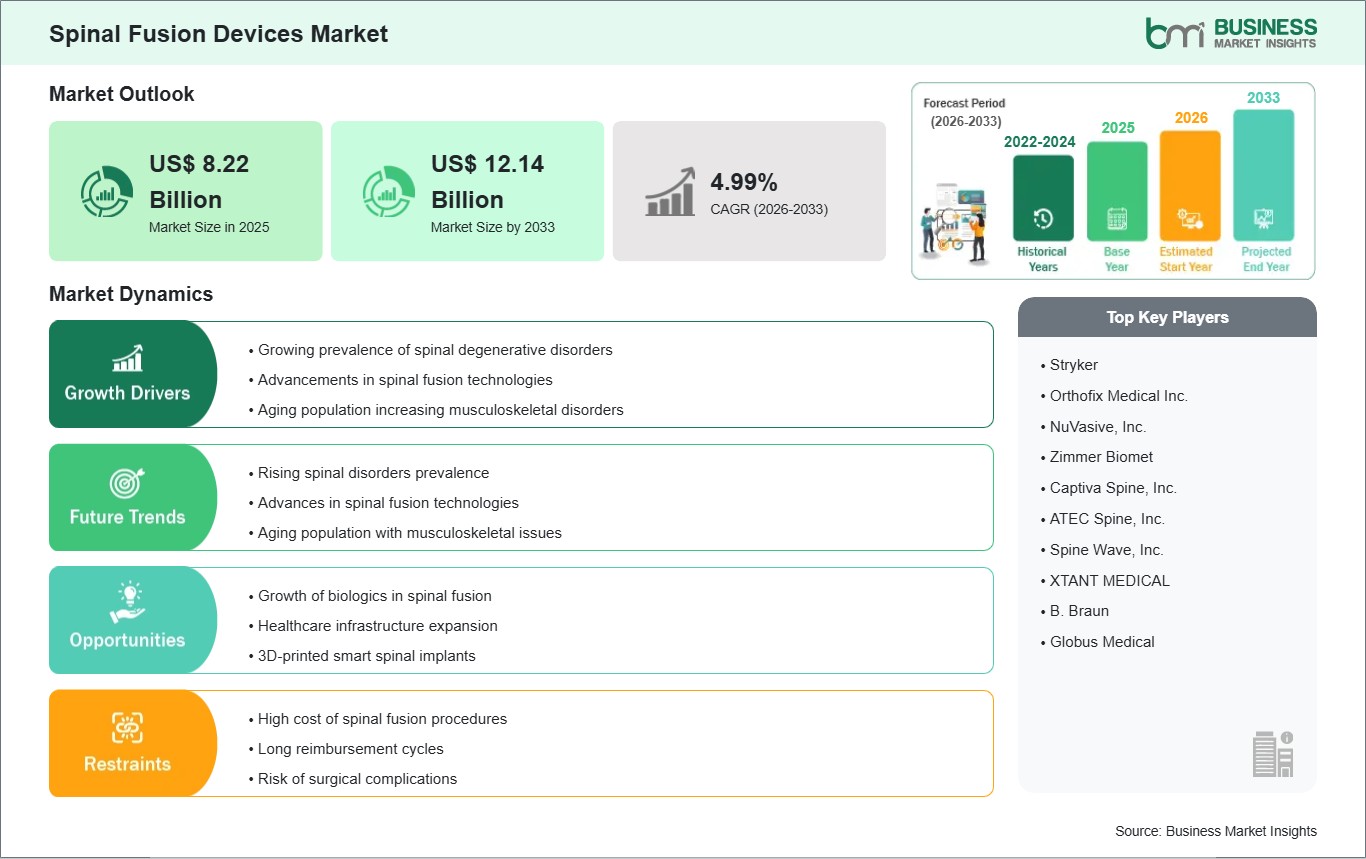
Spinal fusion surgery depends on spinal fusion devices which serve as medical implants and surgical instruments for enhancing vertebral stability through their capability to connect multiple vertebrae that treat spinal conditions which include degenerative disc disease and spinal stenosis and trauma and deformities. The system uses interbody cages together with pedicle screws and plates and rods and biologic bone graft substitutes which enable bone healing through their ability to create mechanical stability. Patients who fail to respond to noninvasive treatments still choose spinal fusion as their preferred surgical method which doctors now perform with safer techniques and modern materials that enhance treatment results while shortening patient recovery durations.
The spinal fusion devices market maintains its global growth momentum because of three main factors which include an increasing aging population and a growing number of spinal disorders and technological innovations which include 3D-printed implants and navigation-assisted systems and robotic surgery platforms. North America currently leads demand distribution because its advanced healthcare facilities enable doctors to perform procedures at high rates while Asia-Pacific markets show better growth potential because of their healthcare system improvements and increased public knowledge about medical procedures.
The industry faces multiple growth challenges because of three main factors which include high expenses for devices and procedures and strict rules from regulators and worries about surgical results and inconsistent operating procedures. The market will experience its next growth phase through outcome-based procurement processes and customized patient implant solutions and digital planning tools which enable better accuracy and successful long-term fusion results.
Segment Analysis
Spinal Fusion Devices Market Segmentation
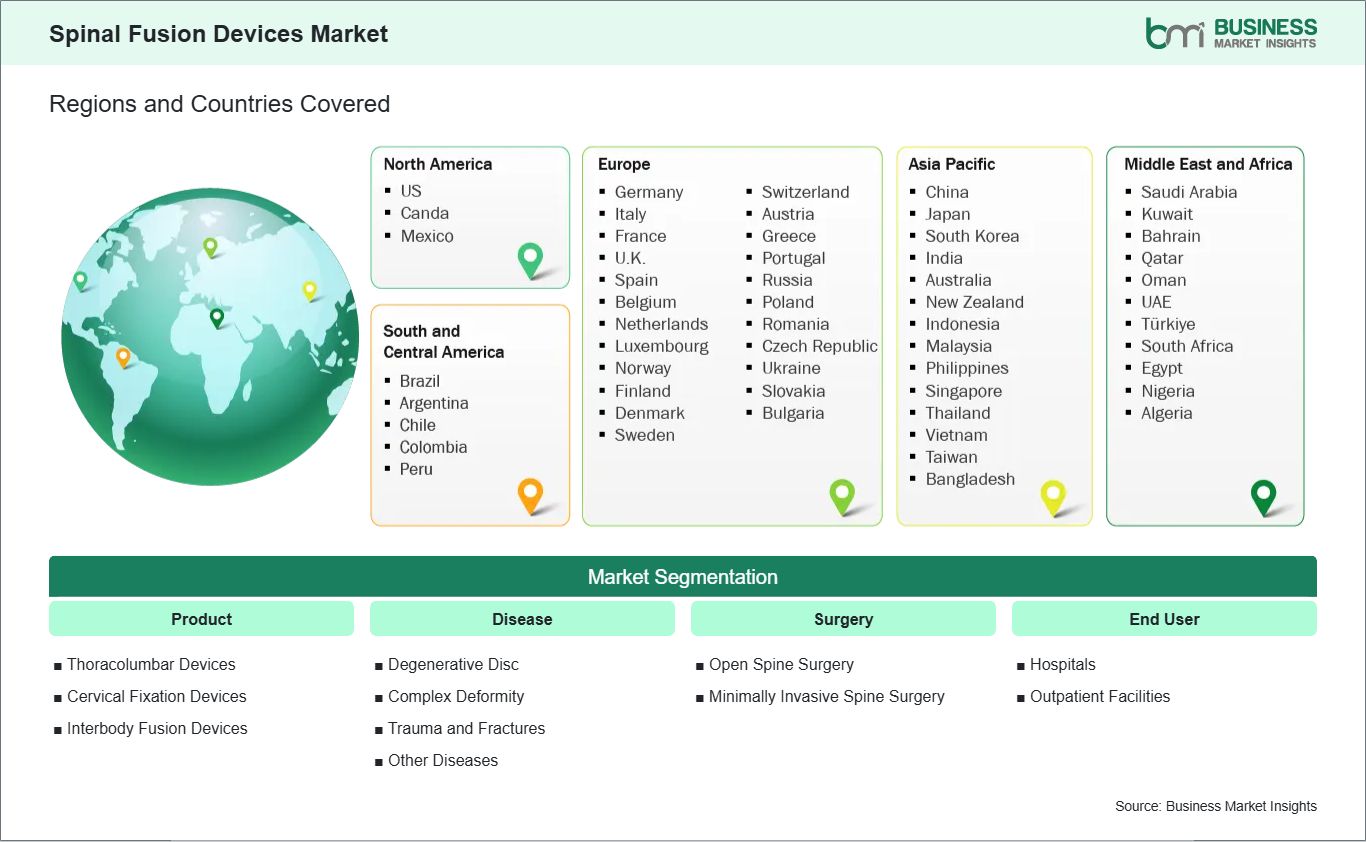
Key segments that contributed to the derivation of the spinal fusion devices market analysis are product, disease¸ surgery, and end user.
- By product, the spinal fusion devices market is categorized into thoracolumbar devices, cervical fixation devices, interbody fusion devices. The thoracolumbar devices segment held the largest share of the market in 2025.
- By disease, the market is segmented into degenerative disc, complex deformity, trauma and fractures, other diseases. The degenerative disc segment held the largest share of the market in 2025.
- By surgery, the market is categorized into open spine surgery, minimally invasive spine surgery. The minimally invasive spine surgery segment held the largest share of the market in 2025.
- By end user, the spinal fusion devices market is bifurcated into hospitals, outpatient facilities. The hospitals segment dominated the market in 2025.
Market Forces
Spinal Fusion Devices Market Drivers and Opportunities
Rising Prevalence of Degenerative Spinal Disorders and Aging Population
Degenerative spinal conditions which affect aging populations around the world are the main factor that drives spinal fusion devices market growth. Degenerative disc disease and spinal stenosis with their related disorders now account for more than half of all spinal cases which need surgical treatment because over 540 million people worldwide suffer from lower back pain and disc degeneration constitutes a major cause of their condition. The clinical need for treatment exists because between 22 and 27 percent of adults who reach 60 years of age will experience spinal instability which requires fusion or fixation procedures. The growth of surgical volumes results from the rising popularity of navigation-assisted spine surgery together with minimally invasive techniques. Technological enhancementssuch as 3D-printed patient-specific cages and robotic systems that improve placement accuracy (e.g., reported ~97 percent accuracy in screw placement)strengthen clinical adoption and drive device utilization across hospitals and surgical centers. The demand for spinal fusion devices will continue to grow throughout developed countries and developing nations because of rising demographic and clinical trends.
Technological Innovation and Advanced Materials
The spinal fusion devices market presents its primary opportunity through two main factors which include technological advancements that occur at fast speeds and the development of modern materials and digital surgical instruments. Recent years have seen the introduction of bioactive coatings in spinal implants which obtained approval from regulators because they enhance bone growth and osseointegration for approximately 34 percent of new products which manufacturers introduced to the market. Robotic navigation systems in spine surgery have demonstrated nearly 24 percent improvements in implant placement accuracy, encouraging broader adoption of precision technologies. The implementation of AI-based preoperative planning tools together with innovative regenerative bone grafts which experience growth above 27 percent shows that surgical centers are increasing their ability to provide distinctive clinical services. Device makers and research institutions work together to create new products, which have resulted in 19 new product approvals, that will lead to international market expansion while improving patient outcomes across the globe.
Size and Share Analysis
Spinal Fusion Devices Market Size and Share Analysis
By product, the spinal fusion devices market is categorized into thoracolumbar devices, cervical fixation devices, interbody fusion devices. The thoracolumbar devices segment held the largest share of the market in 2025. The thoracolumbar devices segment leads because disorders of the thoracic and lumbar spine (especially lumbar degenerative diseases and trauma) are more prevalent and constitute the majority of fusion procedures globally. These devices (e.g., pedicle screw systems and rods) provide robust stabilization and correction needed in multi-level and high-load spinal regions, making them the most widely adopted among surgeons.
By disease, the market is segmented into degenerative disc, complex deformity, trauma and fractures, other diseases. The degenerative disc segment held the largest share of the market in 2025. The degenerative disc segment dominates as age-related disc deterioration is the most common cause of chronic back pain and spinal instability worldwide. With aging populations and increasing lifestyle-related spinal degeneration, this indication drives the highest volume of fusion surgeries, leading to greater demand for fusion devices.
By surgery, the market is categorized into open spine surgery, minimally invasive spine surgery. The minimally invasive spine surgery segment held the largest share of the market in 2025. Minimally invasive spine surgery leads due to strong surgeon and patient preference for procedures with smaller incisions, reduced tissue trauma, less pain, shorter hospital stays, and faster recovery. These advantages have increased adoption of MIS approaches and associated devices, outpacing traditional open surgery in many markets.
By end user, the spinal fusion devices market is bifurcated into hospitals, outpatient facilities. The hospitals segment dominated the market in 2025. Hospitals leads because they handle the largest volume of complex spinal fusions requiring advanced infrastructure, multidisciplinary surgical teams, imaging and postoperative care, and they account for the majority of fusion procedures globally.
Report Coverage
Spinal Fusion Devices Market Report Coverage and Deliverables
The " Spinal Fusion Devices Market Size and Forecast (2022–2033)" report provides a detailed analysis of the market covering below areas:
- Spinal fusion devices market size and forecast at global, regional, and country levels for all the key market segments covered under the scope
- Spinal fusion devices market trends, as well as market dynamics such as drivers, restraints, and key opportunities
- Spinal fusion devices market analysis covering key market trends, global and regional framework, major players, regulations, and recent market developments
- Industry landscape and competition analysis covering market concentration, heat map analysis, prominent players, and recent developments for the spinal fusion devices market
- Detailed company profiles, including SWOT analysis
Geographic Insights
Spinal Fusion Devices Market Geographic Insights
The geographical scope of the spinal fusion devices market report is divided into five regions: North America, Asia Pacific, Europe, Middle East and Africa, and South and Central America. The spinal fusion devices market in Asia Pacific is expected to grow significantly during the forecast period.
The Asia-Pacific spinal fusion devices market is segmented into China, Japan, South Korea, India, Australia, New Zealand, Indonesia, Malaysia, the Philippines, Singapore, Thailand, Vietnam, Taiwan, Bangladesh, and the Rest of Asia. The Asia-Pacific spinal fusion devices market is experiencing robust growth, due to a combination of demographic, economic, and healthcare system factors. The rising aging demographic in Japan, China, and South Korea leads to increased cases of degenerative spinal disorders which include degenerative disc disease and spinal stenosis and this creates greater need for fusion procedures. The combination of rising urbanization and sedentary lifestyles in India and Southeast Asia leads to increased cases of chronic back pain and spinal injuries. The development of healthcare facilities in China and India has resulted in better access to advanced surgical procedures through the establishment of new orthopedic and spine specialty centers in urban and tier-2 locations. The regional governments increase their healthcare financial support while they promote the use of medical technologies which leads hospitals to purchase systems for minimally invasive spine surgery and advanced implant technologies. The expansion of medical tourism in Thailand, India, and Malaysia attracts international patients who want affordable spine surgeries. The global device manufacturers develop distribution networks which they use to partner with regional hospitals and this process increases product accessibility while driving market growth in the area.
Industry Activity
Recent Developments
The spinal fusion devices market is evaluated by gathering qualitative and quantitative data post primary and secondary research, which includes important corporate publications, association data, and databases. A few of the key developments in the spinal fusion devices market are:
- In October 2023, Silony Medical International AG, a growing challenger to "big medtech" in the global spinal fusion market, has completed the acquisition of Centinel Spine's Global Fusion Business. This combines Silony's Verticale posterior screw and rod fusion Platform, its Roccia, and Favo Interbody Fusion (IBF) Systems with the STALIF Technology Platform to create a first in class occiput to sacrum, posterior, lateral, and anterior Spinal Fusion Portfolio for open and minimally invasive spinal fusion cases.
- In August 2024, NanoHive Medical, a leader in 3D-printed titanium spinal interbody fusion devices, announced a US$7M Series C Financing to capitalize the company`s rapid growth and a priority on company-building to profitability. The primary use-of-proceeds include: expanding the US commercial organization; expanding the company`s innovative Hive portfolio of Soft Titanium spinal interbody fusion devices by way of product line-extensions, product launches, and “smart” sensor implant delivery research and development, entering select international markets; and expanding strategic partnerships.
Trust & Transparency
Research Methodology
The market analysis combines proprietary research with secondary data from government agencies, company disclosures, regulatory filings, industry databases and expert interviews. Market estimates are validated through data triangulation, cross-market benchmarking and analyst
review.
View Full Research Methodology
Key Sources Referred:
World Health Organization (WHO)Institute for Health Metrics and EvaluationCenters for Disease Control and PreventionUnited Nations Population DivisionOrganisation for Economic Co-operation and Development Health DataWorld Bank Health DataCompany websitesCompany annual reportsCompany investor presentations