
E-Commerce Packaging Market Outlook: Size, Share, Trends, Growth Analysis, Competitive Landscape & Forecast, 2026-2033

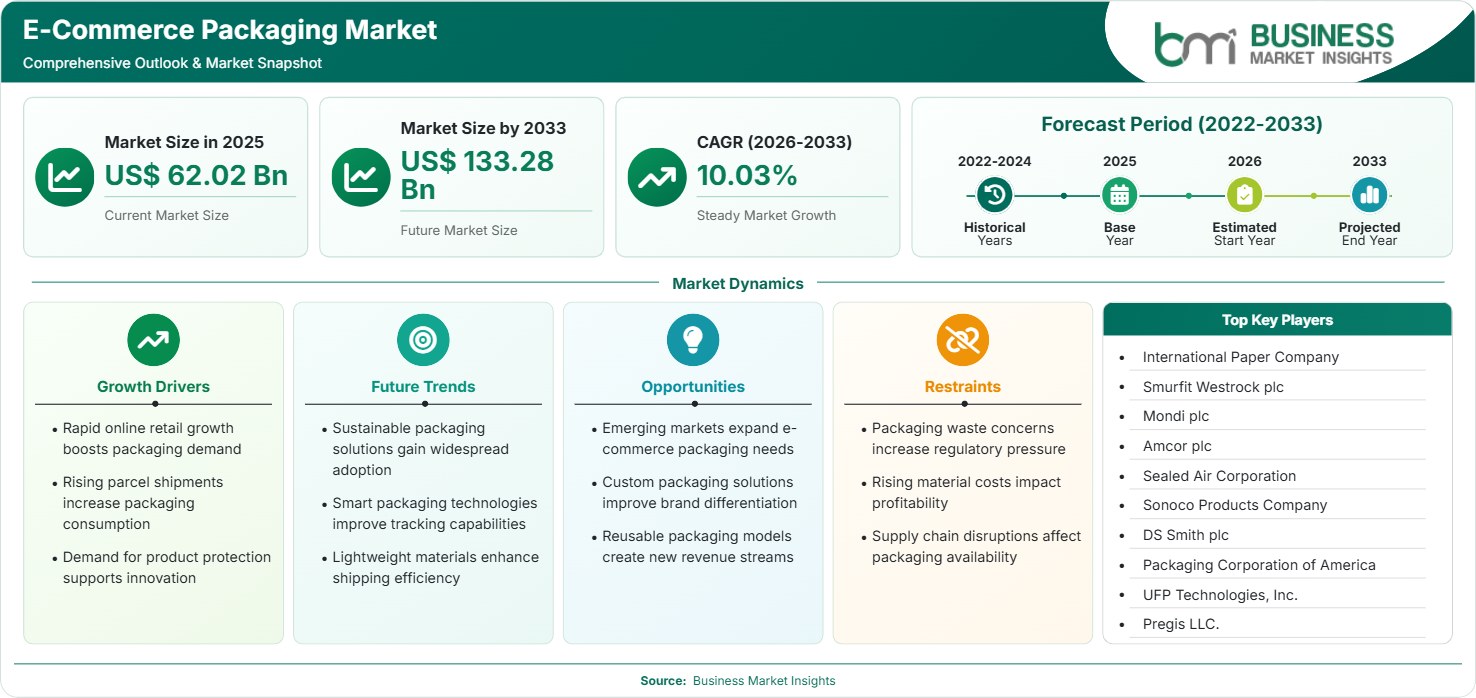
The E-Commerce Packaging Market size was valued at US$ 62.02 Billion in 2025 and is projected to reach US$ 133.28 Billion by 2033, growing at a CAGR of 10.03% during 2026–2033. Rising online retail volumes, sustainability mandates, right-sized packaging adoption, automated fulfillment expansion, and demand for protective last-mile solutions are creating substantial innovation and investment opportunities across global supply chains.

Report Coverage
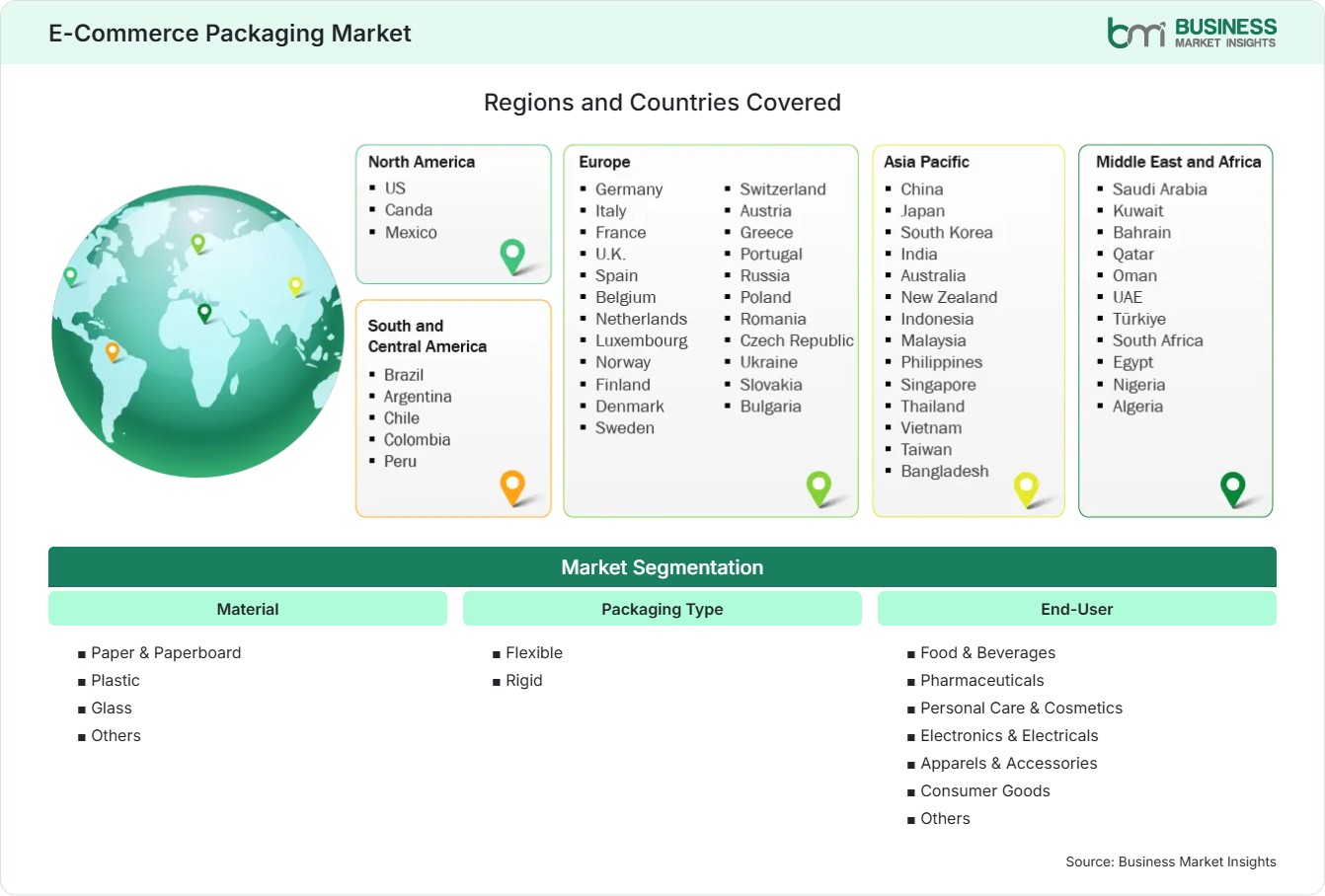
  • Material: Paper & Paperboard, Plastic, Glass, Others
  • Packaging Type: Flexible , Rigid
  • End-User: Food & Beverages, Pharmaceuticals, Personal Care & Cosmetics, Electronics & Electricals, Apparels & Accessories, Consumer Goods, Others
US$ 62.02 Bn Market size in 2025
US$ 133.28 Bn Market Size by 2033
10.03% CAGR, 2026 - 2033
2026-2033 Forecast Period

AI Overview

E-Commerce Packaging Market Summary

  • North America Region: Holds an E-Commerce Packaging Market share of 34%–37% in 2025, growing at a CAGR of 8.8%–9.4% during 2026–2033, supported by omnichannel retail, fulfillment automation, recyclable packaging adoption, subscription commerce expansion, and advanced logistics infrastructure. The U.S. accounts for 74%–78% of regional demand and is advancing at a CAGR of 8.9%–9.5% through strong e-retail and warehouse automation investments.
  • Fastest Growing Region: Asia Pacific holds a market share of 29%–32% in 2025 and grows at a CAGR of 11.8%–12.5% during 2026–2033, driven by mobile commerce penetration, cross-border retail growth, urban consumers, digital payments, and expanding fulfillment networks.
  • Leading Segment: Paper & Paperboard holds an E-Commerce Packaging Market share of 42%–46% in 2025 and grows at a CAGR of 10.1%–10.8% during 2026–2033, supported by recyclability goals, plastic reduction policies, premium printability, brand differentiation, and broad suitability across retail categories.
  • High Growth Segment: Flexible Packaging holds a market share of 37%–41% in 2025 and grows at a CAGR of 11.4%–12.1% during 2026–2033, encouraged by lightweight designs, freight savings, return-friendly formats, automation compatibility, and rising apparel shipments.
  • Key Market Opportunity: Development of recyclable mono-material mailers, AI-enabled packaging optimization, reusable shipment systems, and paper-based cushioning solutions is creating scalable value for retailers seeking cost efficiency and sustainability.
  • Major Market Players: International Paper Company, Smurfit Westrock plc, Mondi plc, Amcor plc, Sealed Air Corporation, Sonoco Products Company, DS Smith plc, Packaging Corporation of America, UFP Technologies, Inc., Pregis LLC.
Strategic Insights

E-Commerce Packaging Market: Strategic Insights

E-Commerce Packaging Market Strategic Framework
FREE PDF
Request your free sample
Request free sample
Stakeholder View

Key Takeaways

  • Supply chains are becoming increasingly integrated, with packaging developers collaborating directly with fulfillment operators, logistics providers, and online marketplaces to improve packing efficiency and reduce total delivered costs.
  • Flexible mailers, paper-based protective formats, and packaging designed for reverse logistics offer the strongest upside as return-friendly commerce models become more common across apparel and consumer goods sectors.
  • Packaging innovation is shifting toward lightweight engineered papers, digital printing, intelligent labeling, automated sealing systems, and data-enabled packaging optimization technologies.
  • India, Indonesia, Vietnam, and Saudi Arabia present compelling investment potential due to rapid e-commerce penetration, improving logistics infrastructure, and supportive digital economy initiatives.
  • Strategic acquisitions continue reshaping the industry as global packaging companies seek regional capacity, sustainability capabilities, and advanced automation technologies.
  • Circular packaging programs, including reusable transit packaging and curbside recyclable protective materials, are emerging as competitive differentiators for large retailers.
Geographic Outlook

E-Commerce Packaging Market Regional Highlights

North America E-Commerce Packaging Market

North America accounted for 34%–37% of global demand in 2025 and is projected to expand at a CAGR of 8.8%–9.4% through 2033. The region maintains leadership because of sophisticated logistics infrastructure, widespread online shopping behavior, and significant packaging automation deployments. E-Commerce Packaging Market share remains concentrated among large fulfillment networks that prioritize efficiency, sustainability, and customer experience. Major retailers continue investing in right-sized packaging programs to reduce transportation costs and material consumption across increasingly complex omnichannel distribution systems.

  • Sustainability regulations and retailer commitments are accelerating the replacement of difficult-to-recycle packaging materials with fiber-based alternatives across parcel delivery networks.
  • Warehouse automation investments support adoption of packaging formats compatible with high-speed fulfillment equipment and automated dimensioning systems.
  • Demand for premium unboxing experiences encourages digitally printed packaging, brand customization, and consumer-focused product presentation.
  • Electronics, food delivery, and health products remain major end-use categories driving packaging innovation and operational efficiency.

US E-Commerce Packaging Market

The United States accounted for 74%-78% of regional demand in 2025 and is expected to grow at a CAGR of 8.9%-9.5% through 2033. The country has high parcel volumes, an extensive fulfillment network, and high adoption of automation. Manufacturers have started focusing on packaging efficiency, sustainability, and waste reduction. Big e-commerce players are working to optimize package sizes and material consumption to improve transportation economics while meeting sustainability goals and evolving consumer preferences.

  • Large-scale automated fulfillment facilities drive adoption of packaging systems capable of handling diverse product categories efficiently.
  • Rising demand for recyclable mailers and corrugated formats supports ongoing fiber-based packaging investments.
  • Subscription commerce growth creates recurring demand for branded and protective delivery formats.
  • Reverse logistics expansion increases focus on resealable and return-ready packaging solutions.

Europe E-Commerce Packaging Market

Europe accounted for 25%-28% of total global demand in 2025 and is estimated to witness a CAGR of 9.2%-9.8% through 2033. The adoption of circular economy and packaging waste laws, as well as consumers' preferences for sustainability, is propelling innovation in this region. Germany is the largest market, whereas Poland and Spain offer higher growth potential than the region's average CAGR. Packaging manufacturers are developing recyclable paper-based packaging and lighter logistics packaging.

  • Extended producer responsibility regulations encourage development of recyclable and resource-efficient packaging formats.
  • Germany leads regional consumption due to strong online retail penetration and advanced logistics capabilities.
  • Spain and Poland benefit from rising fulfillment investments and growing consumer adoption of digital commerce.
  • Fiber-based materials gain traction as retailers pursue sustainability commitments and compliance objectives.

Asia Pacific E-Commerce Packaging Market

The Asia Pacific region accounted for 29% to 32% of worldwide consumption in 2025 and is expected to record a CAGR of 11.8% to 12.5% through 2033, making it the most rapidly growing regional market. China leads the market for revenue generation, whereas India and Southeast Asia represent the fastest-growing economies. The driving factors for growth include the adoption of mobile commerce, urbanization, digital payments, and the development of logistics networks. Strong E-Commerce Packaging Market growth across emerging economies continues supporting investments in corrugated manufacturing, flexible packaging capacity, and fulfillment infrastructure.

  • China dominates consumption through large-scale parcel shipment volumes and extensive online retail ecosystems.
  • India delivers robust expansion driven by digital commerce penetration and tier-two city logistics development.
  • Southeast Asia benefits from rapid marketplace adoption and cross-border trade activity.
  • Packaging automation adoption continues increasing among leading regional fulfillment operators.
  • Sustainability initiatives stimulate demand for recyclable alternatives and lightweight packaging structures.

Rest of World E-Commerce Packaging Market

The Rest of World region accounted for 10%–13% of global consumption in 2025 and is projected to grow at a CAGR of 10.0%–10.7% through 2033. The growth drivers include the growth of the digital retail landscape in South and Central America, especially in Brazil and Mexico. Demand in the Middle East and Africa is increasing owing to the development of regional marketplaces. In Saudi Arabia and the UAE, growth is driven by digital transformation initiatives and logistics development.

  • Brazil leads South and Central America demand through expanding consumer internet access and retail digitization.
  • Mexico benefits from growing cross-border commerce and manufacturing-linked fulfillment activities.
  • Saudi Arabia records strong growth supported by Vision 2030-related digital infrastructure investments.
  • UAE logistics hubs facilitate regional e-commerce expansion and packaging demand growth.
Global Market Geography
FREE PDF
Request your free sample
Request free sample
Segment Analysis

E-Commerce Packaging Market Segmentation

Material

The material segments are governed by sustainable practices, cost-efficiency, and performance. Paper & paperboard took the lead, with market share ranging from 42% to 46% in 2025, and has a CAGR of 10.1% to 10.8%. The scope of the E-Commerce Packaging Market continues to expand with the help of recycling solutions, and plastics are significant for applications that require durability and water resistance.

  • Paper & Paperboard: Preferred for cartons, mailers, and corrugated solutions due to recyclability, strong branding capabilities, and regulatory alignment supporting sustainable packaging transitions.
  • Plastic: Widely used for protective wraps, poly mailers, and flexible shipment formats requiring durability, moisture resistance, and logistics efficiency.
  • Glass: Utilized mainly for premium products requiring strong protection and secure secondary packaging throughout distribution channels.

Packaging Type

Packaging type segmentation is the result of the increased need for protection and logistics efficiency. The flexible format held a 37% to 41% share in 2025 and is expected to grow at a 11.4% to 12.1% CAGR. E-Commerce Packaging Market trends show a preference for lighter packaging that reduces freight costs and improves delivery efficiency.

  • Bags & Pouches: Popular across apparel, accessories, and lightweight consumer products because of reduced material use and lower shipping costs.
  • Tapes: Essential for package integrity, security, automation compatibility, and efficient fulfillment operations.
  • Wraps & Films: Provide protective cushioning and shipment stabilization for fragile goods during transit.
  • Mailers: Gaining momentum through paper-based innovations that balance protection, sustainability, and cost efficiency.
  • Corrugated Boxes: Dominant rigid packaging format delivering structural strength and strong customization potential.
  • Bottles: Important for liquid products requiring secure handling and secondary transportation protection.
  • Cartons: Widely adopted for organized storage, branded presentation, and efficient shipping performance.
  • Hinged & Lidded Containers: Used where product security and repeated access are required within delivery channels.
  • Trays: Support organized movement of multiple items and improve handling efficiency.

End-User

End-user demand varies with the number of shipments, the required protection level, and user demand. Food & Beverages was the leader, with a market share of 24% to 28% in 2025, and is estimated to have a CAGR of 10.4% to 11.0% over the forecast period. The E-Commerce Packaging Market share depends on the growing popularity of online grocery and quick-delivery systems.

  • Food & Beverages: Requires temperature-sensitive and protective packaging solutions that preserve product quality during transportation.
  • Pharmaceuticals: Benefits from tamper-evident features, compliance requirements, and secure delivery expectations.
  • Personal Care & Cosmetics: Encourages aesthetically appealing, protective, and sustainable packaging formats.
  • Electronics & Electricals: Demands robust cushioning and damage-prevention solutions for higher-value products.
  • Apparels & Accessories: Drives strong demand for lightweight mailers and return-ready packaging formats.
  • Consumer Goods: Requires scalable and cost-effective packaging adaptable to varied shipment profiles.
Market Forces

E-Commerce Packaging Market Dynamics

Key Market Drivers

Expansion of Global Online Retail Ecosystems

Global digital retail transactions continue increasing across developed and emerging economies. Based on data on global trade and e-commerce, online sales penetration continues to grow, driving growth in parcel delivery and packaging consumption. Businesses need reliable packaging that protects their goods during complex logistics processes. Factors such as better size ratio, reduced freight costs, and protection from damage are directly affecting packaging demand. The growth of the E-Commerce Packaging Market is driven by rising online purchases across the grocery, electronics, apparel, and health care industries. Fulfillment network expansion leads to the growth in demand for corrugated containers, mailers, flexible packaging, and protection materials.

Sustainability Regulations and Circular Economy Targets

The government and regulatory bodies are enacting tighter regulations concerning packaging waste reduction. There is an increasing trend towards packaging materials that are recyclable and renewable, driven by European packaging laws, producer responsibility, and corporate sustainability initiatives. There is increased use of paper-based packaging materials instead of non-recyclable ones. Companies within the retail chain are increasingly investing in developing materials with reduced environmental footprints without compromising performance. Consumers themselves prefer environmentally friendly packaging options. This increases demand for recyclable corrugated materials, molded fiber packaging, and lighter shipping packages.

Automation Across Fulfillment and Distribution Centers

Warehouses are using robotics, automation, intelligent dimensioning, and smart packaging to improve throughput. The packaging solutions should be compatible with the automated machinery and facilitate the objective of efficient packaging. Standardized packaging design, machine-usable sealing mechanisms, and optimized dimensions enhance operational efficiency. Packaging companies are now offering packaging solutions that meet the demands of high-velocity fulfillment processes. The trends in the E-Commerce Packaging Market demonstrate the convergence of automation technology, digital logistics, and packaging engineering. Fulfillment systems require packaging solutions that are labor-independent and economical.

Key Market Opportunities

Paper-Based Alternatives to Plastic Protective Packaging

Increased efforts by retailers to reduce unnecessary plastic have created ample opportunities to use fiber cushioning, recyclable envelopes, and mailers. Companies that can provide comparable-quality products at competitive prices will be well-positioned to benefit from long-term contracts with e-commerce platforms. Innovation in lightweight engineered papers is continuously being funded. Consumer acceptance of paper designs is also improving with the greater availability of recycling options. The E-Commerce Packaging Market forecasts indicate strong potential for protective, recyclable structures aligned with circular economy goals that can ensure sufficient protection for electronics, cosmetics, books, and other household products during transportation.

Reusable and Return-Friendly Packaging Systems

The volume of reverse logistics is rising due to the emergence of return-oriented retail segments such as fashion and consumer electronics. Recycling packaging that supports multiple uses will reduce waste and improve operational efficiency. Reusable shipping containers, recyclable mailers, and recyclable corrugated are some packaging options. Retailers aiming for cost efficiencies and environmental improvements are increasingly considering such systems. This applies not only to premium retail but also to ordinary e-commerce fulfillment. Packaging providers who are durable, consumer-friendly, and efficient have much to gain in a circular delivery system.

Emerging Market Fulfillment Infrastructure Development

The rise in digital commerce across Asia, Latin America, Africa, and the Middle East is driving high demand for packaging. There are opportunities for companies producing packaging solutions to set up facilities to increase their production capacity in the region. Local production will help them be more responsive and efficient in their operations. Increased availability of the internet, mobile payments, and urban consumers will provide them more scope for growth. Packaging solution providers that will make early investments in emerging markets will have a competitive advantage as regional e-commerce ecosystems continue to mature.

Market Restraints and Challenges

Raw Material Price Volatility and Supply Disruptions

Factor: Fluctuations in pulp, paper, resin, and energy costs create uncertainty across packaging value chains. Impact: Manufacturers experience pressure on margins and procurement strategies, particularly when long-term customer contracts limit pricing flexibility. Rising logistics expenses can further compound operating challenges. Supply chain disruptions affecting recycled fiber availability or petrochemical inputs may influence production schedules and material sourcing decisions. Companies increasingly adopt diversified procurement strategies and operational efficiencies to mitigate these risks. However, persistent cost volatility remains a significant challenge affecting profitability, investment planning, and competitive positioning throughout the industry.

Balancing Sustainability with Performance Requirements

Factor: Retailers seek environmentally responsible packaging without compromising durability, moisture resistance, or protection standards. Impact: Packaging developers must invest heavily in materials research and validation testing. Some sustainable alternatives remain more expensive or may not match performance characteristics across all applications. Achieving compliance with environmental objectives while maintaining operational efficiency presents ongoing challenges. Product categories such as electronics, pharmaceuticals, and fragile consumer goods require rigorous performance standards. The complexity of balancing sustainability objectives with transportation protection requirements may slow adoption rates for certain innovative packaging materials.

Company Analysis

Competitive Landscape

The competitive environment remains moderately consolidated, with global packaging leaders focusing on sustainability, automation, and regional expansion. This E-Commerce Packaging Market analysis highlights the strategic positioning of key participants.

Company Name

Overview

Products and Services relevant to this market

International Paper Company

Global paper and packaging producer with extensive corrugated manufacturing operations and strong e-commerce packaging capabilities.

Corrugated boxes, containerboard, shipping packaging solutions, protective transit packaging, customized retail shipment formats.

Smurfit Westrock plc

Major sustainable packaging company serving retail, industrial, and digital commerce customers globally.

E-commerce packaging, corrugated solutions, printed boxes, paper-based protective packaging, fulfillment solutions.

Mondi plc

International packaging leader emphasizing recyclable and paper-based innovations.

Mailers, kraft paper packaging, protective packaging, corrugated solutions, sustainable shipping formats.

Amcor plc

Global packaging supplier with broad material expertise and innovation capabilities.

Flexible packaging, protective materials, recyclable packaging structures, retail shipment solutions.

Sealed Air Corporation

Specialist in protective packaging and fulfillment automation technologies.

Automated bagging systems, cushioning materials, mailers, protective packaging equipment.

Sonoco Products Company

Diversified packaging manufacturer serving multiple consumer and industrial sectors.

Protective packaging, paperboard packaging, transit packaging, fulfillment solutions.

DS Smith plc

Fiber-based packaging specialist focused on circular economy principles.

Corrugated packaging, return-ready boxes, e-commerce packaging, recyclable solutions.

Packaging Corporation of America

Major North American containerboard and corrugated packaging company.

Shipping containers, corrugated boxes, protective packaging products.

UFP Technologies, Inc.

Engineering-focused packaging company with protective packaging expertise.

Protective inserts, cushioning systems, specialty transit packaging solutions.

Pregis LLC

Provider of protective packaging and automation technologies.

Mailers, cushioning materials, automation systems, flexible protective packaging.

Trust & Transparency

Research Methodology

The market analysis combines proprietary research with secondary data from government agencies, company disclosures, regulatory filings, industry databases and expert interviews. Market estimates are validated through data triangulation, cross-market benchmarking and analyst review.

View Full Research Methodology

Questions Answered

Frequently Asked Questions

Why is the E-Commerce Packaging Market Report valuable for stakeholders?

It helps manufacturers, investors, retailers, and logistics providers evaluate growth opportunities, competitive positioning, technology developments, regulatory impacts, and future demand patterns.

What makes Asia Pacific the fastest-growing regional market?

Rapid digital commerce expansion, increasing smartphone usage, urbanization, modern logistics investments, and broader access to digital payment systems support regional growth.

How are sustainability regulations influencing packaging decisions?

Regulations are encouraging retailers and manufacturers to adopt recyclable, renewable, and resource-efficient materials while reducing unnecessary packaging waste and improving recovery rates.

What end-user industry generates the highest packaging demand?

Food & beverages currently represent the leading end-user category due to strong online grocery adoption, frequent order volumes, and growing demand for reliable delivery packaging.

What factors are shaping future product innovation in this industry?

Innovation is increasingly focused on recyclable fiber materials, lightweight construction, automation compatibility, right-sized packaging, digital printing capabilities, and packaging solutions designed to improve reverse logistics efficiency.

Access the Full E-Commerce Packaging Market Report

Get segment-level forecasts, regional estimates, competitive benchmarking, company profiles and downloadable Excel datasets.

Access the full E-Commerce Packaging Market Report
350 pages PDF & Excel | 2026-08-28