
Drone Package Delivery Market Outlook: Size, Share, Trends, Growth Analysis, Competitive Landscape & Forecast, 2026-2033

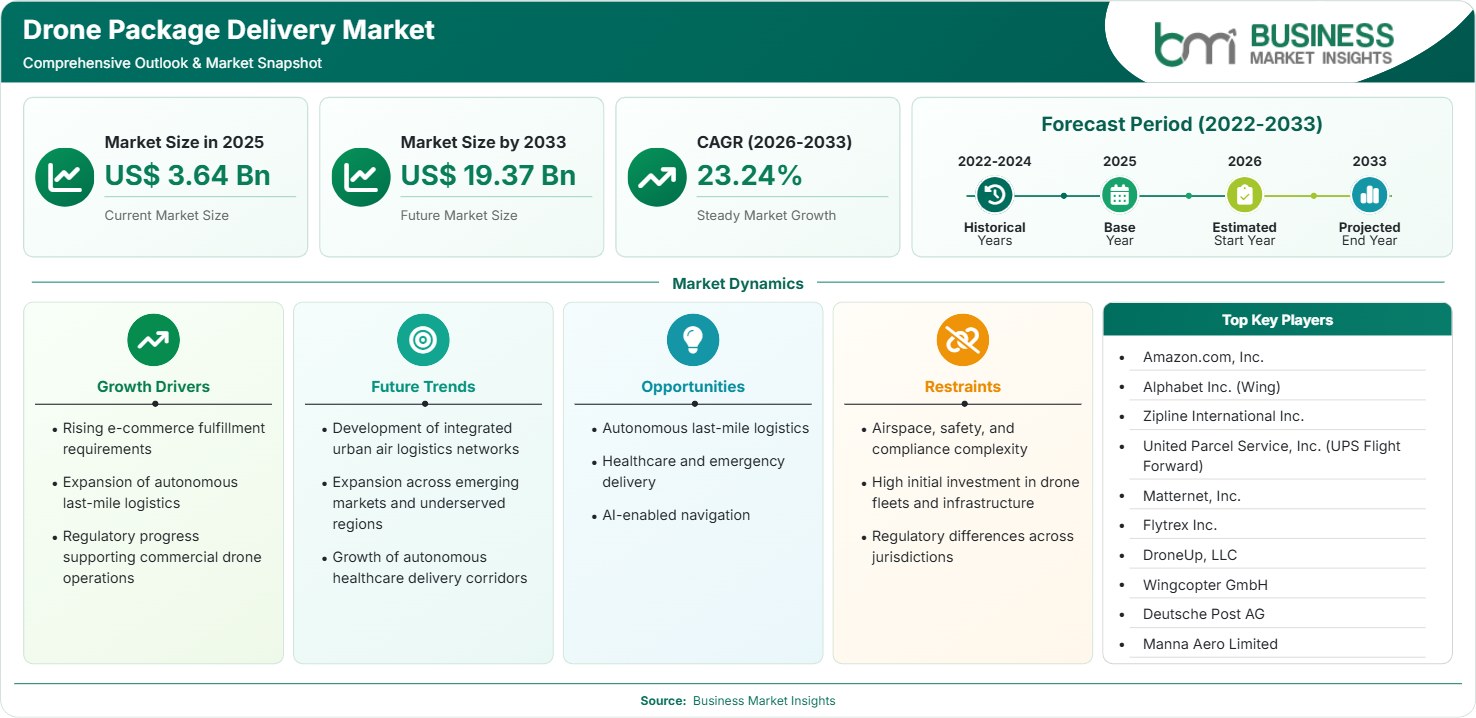
The Drone Package Delivery Market size was valued at US$ 3.64 Billion in 2025 and is projected to reach US$ 19.37 Billion by 2033, growing at a CAGR of 23.24% during 2026–2033, driven by autonomous logistics adoption, e-commerce expansion, healthcare deliveries, regulatory advancements, and investments in beyond-visual-line-of-sight operations creating scalable last-mile delivery opportunities.

Report Coverage
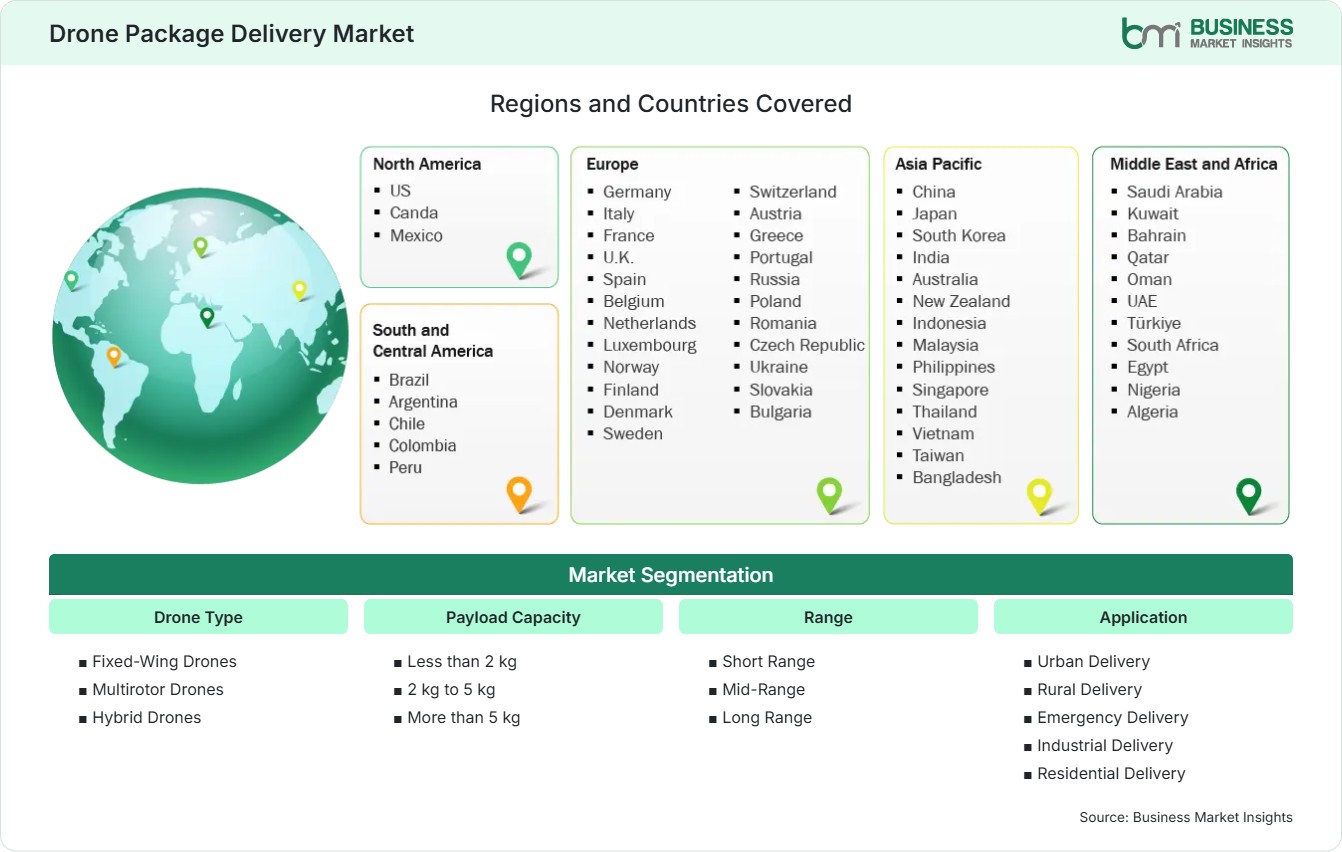
  • Drone Type: Fixed-Wing Drones, Multirotor Drones, Hybrid Drones
  • Payload Capacity: Less than 2 kg, 2 kg to 5 kg, More than 5 kg
  • Range: Short Range, Mid-Range, Long Range
  • Application: Urban Delivery, Rural Delivery, Emergency Delivery, Industrial Delivery, Residential Delivery
  • End-user: Retail and E-commerce, Healthcare and Pharmaceuticals, Food Delivery
US$ 3.64 Bn Market size in 2025
US$ 19.37 Bn Market Size by 2033
23.24% CAGR, 2026 - 2033
2026-2033 Forecast Period

AI Overview

Drone Package Delivery Market Summary

  • North America Region: North America holds a market share of 38%–41% in 2025, growing at a CAGR of 21%–23% during 2026–2033. Key drivers include FAA approvals, retail partnerships, medical logistics expansion, autonomous navigation improvements, urban fulfillment demand, infrastructure investments, operating efficiency gains, sustainability goals, rapid commercialization, and scalable delivery networks. The U.S. dominates regional demand through large-scale commercial deployments and is advancing at a CAGR of 21%–23%.
  • Fastest Growing Region: Asia Pacific holds a market share of 24%–27% in 2025, expanding at a CAGR of 25%–27% during 2026–2033. Growth is supported by smart city programs, e-commerce penetration, government drone corridors, healthcare accessibility initiatives, logistics modernization, manufacturing capabilities, population density advantages, digital infrastructure investment, and growing commercial acceptance.
  • Leading Segment: Multirotor Drones account for 48%–52% share in 2025 and advance at a CAGR of 22%–24% during 2026–2033. Adoption benefits from precision landings, operational flexibility, lower deployment costs, urban suitability, short-distance efficiency, payload optimization, rapid fulfillment requirements, commercial scalability, safety features, and improving battery performance.
  • High Growth Segment: Emergency Delivery accounts for 14%–17% share in 2025 and grows at a CAGR of 28%–30% during 2026–2033. Expansion is supported by medical supply transportation, disaster-response requirements, rural healthcare access, government programs, critical-time sensitivity, humanitarian logistics, regulatory support, healthcare digitization, inventory optimization, and emergency preparedness.
  • Key Market Opportunity: Expanding autonomous healthcare and retail logistics corridors can enable high-frequency deliveries, reduce fulfillment costs, improve rural accessibility, strengthen resilience during emergencies, accelerate network utilization, and support sustainable transportation objectives.
  • Major Market Players: Amazon.com, Inc.; Alphabet Inc. (Wing); Zipline International Inc.; United Parcel Service, Inc. (UPS Flight Forward); Matternet, Inc.; Flytrex Inc.; DroneUp, LLC; Wingcopter GmbH; Deutsche Post AG; Manna Aero Limited.
Strategic Insights

Drone Package Delivery Market: Strategic Insights

Drone Package Delivery Market Strategic Framework
FREE PDF
Request your free sample
Request free sample
Stakeholder View

Key Takeaways

  • The value chain is evolving from drone manufacturing toward integrated ecosystems combining fleet management software, charging infrastructure, navigation analytics, airspace management, and fulfillment partnerships.
  • Healthcare logistics and emergency response applications offer substantial upside because delivery speed directly impacts service outcomes in remote and underserved regions.
  • Innovation is moving toward hybrid platforms, AI-assisted navigation, autonomous detect-and-avoid capabilities, and enhanced battery systems supporting longer operational ranges.
  • Asia Pacific presents an attractive investment case as urban density, digital commerce volumes, and public-sector drone programs accelerate commercial deployments.
  • Venture funding, strategic alliances, and retailer-operator partnerships are increasingly shaping competition, supporting rapid scaling and commercialization of autonomous delivery networks.
  • Sustainability initiatives are encouraging adoption by reducing vehicle trips, lowering carbon emissions, and enhancing efficiency in last-mile logistics operations.
Geographic Outlook

Drone Package Delivery Market Regional Highlights

North America Drone Package Delivery Market

North America accounted for 38%–41% of revenue in 2025 and is expected to record a CAGR of 21%–23% through 2033. The region benefits from an established regulatory ecosystem, commercial trials, healthcare logistics programs, and strong retailer participation. Drone Package Delivery Market share remains highest in this region because operators continue expanding beyond pilot deployments into scalable delivery networks. Technology partnerships, investment activity, and demand for rapid fulfillment support sustained adoption across retail, pharmaceutical, and food-delivery applications.

  • FAA approvals continue widening operational flexibility for commercial operators across retail and healthcare routes.
  • Walmart, healthcare providers, and logistics firms are driving deployment scale through strategic partnerships.
  • Advanced air mobility infrastructure investments support navigation, tracking, and traffic-management capabilities.
  • Demand for same-hour deliveries strengthens commercial viability across suburban and urban locations.

US Drone Package Delivery Market

The United States represents 78%–82% of North American revenue and is expanding at a CAGR of 21%–23%. Strong e-commerce penetration, FAA regulatory progress, and commercial partnerships underpin market momentum. Drone Package Delivery Market growth is increasingly linked to autonomous last-mile logistics and healthcare delivery networks. Major operators are scaling service footprints, improving payload economics, and introducing advanced aircraft designs aimed at supporting higher delivery frequencies and broader geographical coverage.

  • Large retailers are integrating autonomous delivery services into fulfillment strategies.
  • Healthcare organizations increasingly deploy aerial logistics for medical supplies and diagnostics.
  • Investments in BVLOS capabilities improve network economics and operational scalability.
  • Urban and suburban demand supports commercial expansion beyond pilot-stage programs.

Europe Drone Package Delivery Market

Europe captured 26%–29% Drone Package Delivery Market share in 2025 and is forecast to grow at a CAGR of 22%–24%. Harmonized regulatory initiatives and sustainability targets encourage adoption across commercial logistics. Germany leads regional demand, while the United Kingdom demonstrates the highest growth trajectory with CAGR near the regional upper range. Market participants focus on healthcare access, parcel transportation efficiency, and lower-emission logistics solutions that align with environmental objectives and mobility modernization programs.

  • EU drone regulations improve cross-border operational consistency for commercial deployments.
  • Germany remains the leading revenue contributor through technology adoption and logistics capabilities.
  • The United Kingdom records stronger expansion supported by pilot corridors and innovation funding.
  • Sustainability-focused policies encourage replacement of carbon-intensive delivery alternatives.

Asia Pacific Drone Package Delivery Market

Asia Pacific held 24%–27% Drone Package Delivery Market revenue share in 2025 and is projected to expand at a CAGR of 25%–27%, the fastest globally. China drives regional volume through manufacturing leadership and logistics digitization, while India records the highest growth rate supported by policy reforms and healthcare applications. Expanding e-commerce ecosystems, urbanization, and smart-city programs enhance deployment opportunities. Strong demand for cost-efficient delivery solutions encourages investments across both metropolitan and remote communities.

  • China leads installations leveraging technology ecosystems and manufacturing scale.
  • India exhibits rapid adoption across healthcare delivery and rural connectivity initiatives.
  • Smart-city investments encourage integration of autonomous transportation solutions.
  • E-commerce growth creates sustained demand for faster and flexible fulfillment networks.

Rest of World Drone Package Delivery Market

Rest of World represented 8%–10% of global revenue in 2025 and is expected to grow at a CAGR of 23%–25%. South and Central America benefit from healthcare delivery programs and geographic accessibility requirements. The Middle East and Africa gain momentum through logistics modernization initiatives and public-sector investments. Brazil leads Latin American demand, while the United Arab Emirates demonstrates strong growth prospects through smart-mobility strategies and supportive regulatory environments.

  • Healthcare logistics remains a major adoption driver across African markets.
  • Brazil leads deployment activity within South and Central America.
  • Gulf countries continue investing in autonomous mobility infrastructure.
  • Geographic challenges enhance the value proposition of aerial logistics networks.
Global Market Geography
FREE PDF
Request your free sample
Request free sample
Segment Analysis

Drone Package Delivery Market Segmentation

Drone Type

This segment accounted for 30%–33% market share in 2025 and is projected to grow at a CAGR of 22%–24%. Drone Package Delivery Market scope continues expanding as operators select platforms based on payload needs, route characteristics, and operational economics. Performance, battery efficiency, and regulatory compliance remain critical selection criteria.

  • Fixed-Wing Drones: Preferred for long-distance missions due to extended endurance, efficient energy consumption, and suitability for medical and rural logistics applications.
  • Multirotor Drones: Widely adopted for urban deliveries because of vertical takeoff capability, precision landing, and operational flexibility in dense environments.
  • Hybrid Drones: Combining endurance and maneuverability, these platforms support expanding commercial operations requiring both range and delivery precision.

Payload Capacity

Payload categories influence commercial viability and route economics. This segment represented 26%–29% share in 2025 and advances at a CAGR of 23%–25%. Demand trends reflect diverse retail, food, healthcare, and industrial transportation requirements.

  • Less than 2 kg: Dominates food, pharmacy, and lightweight e-commerce deliveries where frequency and speed outweigh payload size.
  • 2 kg to 5 kg: Supports mainstream retail fulfillment with balanced operational efficiency and broad product compatibility.
  • More than 5 kg: Increasingly used for industrial logistics and specialized healthcare transportation requiring larger shipment capacity.

Range

Range capabilities determine service coverage and infrastructure requirements. This segment held about 18%–21% share in 2025 and is forecast to grow at a CAGR of 24%–26%.

  • Short Range (Less than 25 km): Most common for urban fulfillment and rapid consumer deliveries within densely populated service zones.
  • Mid-Range (25 km to 100 km): Enables suburban connectivity and links fulfillment centers with distributed customer locations.
  • Long Range (More than 100 km): Essential for rural logistics, remote healthcare services, and geographically challenging territories.

Application

Application diversity is accelerating adoption across multiple sectors. Drone Package Delivery Market trends increasingly highlight specialized delivery use cases. This segment accounted for 22%–25% share and is projected to expand at 25%–27%.

  • Urban Delivery: Driven by congestion reduction objectives and demand for rapid same-day service.
  • Rural Delivery: Addresses infrastructure limitations and improves accessibility for remote communities.
  • Emergency Delivery (Medical supplies, disaster relief): Supports time-critical missions requiring rapid transportation capabilities.
  • Industrial Delivery: Facilitates movement of parts, tools, and operational supplies across industrial facilities.
  • Residential Delivery: Expands consumer convenience and strengthens direct-to-home fulfillment models.

End-User

End-user adoption patterns reflect evolving logistics priorities. This segment represented 28%–31% share in 2025 and is expected to grow at a CAGR of 24%–26%.

  • Retail and E-commerce: Leading demand source as businesses pursue faster fulfillment and lower delivery costs.
  • Healthcare and Pharmaceuticals: Growing use for medical products, diagnostic samples, and urgent healthcare supplies.
  • Food Delivery: Benefits from shorter delivery times and improved service efficiency in urban markets.
Market Forces

Drone Package Delivery Market Dynamics

Key Market Drivers

Expansion of E-commerce Fulfillment Requirements

The global numbers of sales through e-commerce are still growing, and thus create pressure on the supply chain to minimize the delivery time and costs. Retailers now perceive autonomous aircraft to be a realistic way of solving the problems of the last mile. The high demand for same-day and even instant deliveries makes the use of drones and their management a necessity. Autonomous delivery drones reduce the need for ground transport in highly congested urban environments. With the improved efficiency of service delivery enabled by navigation systems powered by artificial intelligence and fleet management systems, adoption becomes more widespread along routes of high frequency of deliveries.

Regulatory Progress Supporting Commercial Operations

The government agencies from key markets are developing policies that relate to operations beyond visual line of sight, unmanned traffic management, and commercial certification. With clear regulatory policies, there are fewer risks associated with deployments. Operators can increase their coverage areas, optimize their utilization rates, and build scalable networks if regulations are standardized. Increased safety standards, systems to integrate into the airspace, and remote identification capabilities provide additional certainty to the market. Approval for general commercial deployment in the United States and some regulatory environments in Europe allows the creation of opportunities for unmanned flight operations. These pave the way for the adoption of aerial delivery solutions by retailers, hospitals, and logistics companies.

Healthcare Logistics Modernization

Healthcare institutions increasingly require rapid transportation of vaccines, medications, blood products, diagnostic samples, and emergency supplies. Time-sensitive delivery needs give autonomous aviation an edge in areas with infrastructure limitations. Healthcare providers are assisted with faster deliveries, reliability, and availability. Agencies in the public sector and humanitarian organizations are still supporting the efforts made towards deploying systems that ensure resilience and preparedness for emergencies within the healthcare system. Delivery systems for medical logistics are usually set up using well-tested operational models that are later used commercially. Therefore, healthcare is among the leading drivers of the demand for drones.

Key Market Opportunities

Development of Integrated Urban Air Logistics Networks

The future growth prospects are related to the development of connected urban air logistics networks connecting fulfillment centers, hospitals, retail outlets, and living quarters. In addition, investments in the development of recharging stations, scheduling software, and airspace management software will help increase the efficiency of the network. Companies that are able to integrate their services into existing logistics frameworks can benefit from higher route utilization rates. Drone Package Delivery Market Forecasts increasingly indicate that scalable city-level logistics ecosystems will become a major competitive differentiator across high-density commercial regions.

Expansion Across Emerging Markets

Many developing economies face transportation challenges that make autonomous aerial logistics economically attractive. Remote locations, a lack of roadways, and increased e-commerce use provide an ideal business environment. The government has now begun encouraging drone corridors, healthcare programs, and innovations to make services more accessible. New entrants can forge strategic alliances, leverage network benefits, and enjoy lower competitive pressure. Creating access to healthcare, food delivery, and retail deliveries in unserved regions provides ample opportunities for earning money in the long run.

Industrial and Enterprise Delivery Use Cases

Industrial sectors are beginning to utilize autonomous delivery systems for spare parts, maintenance equipment, and inventory movement. Energy stations, mining complexes, manufacturing complexes, and infrastructure projects benefit from faster movement in expansive work environments. The enterprise implementation offers higher-value transport needs as opposed to consumer packages. This type of application can increase asset uptime, cut down on labor costs, and increase efficiency. With increasing payload capacity and approval, industrial logistics could be a major source of income in the future market, alongside other sectors such as retail and healthcare.

Market Restraints and Challenges

Airspace, Safety, and Compliance Complexity

Factor: Commercial operations must comply with evolving safety, certification, airspace integration, and privacy requirements that differ across jurisdictions. Impact: This can lead to higher deployment costs, longer network roll-out periods, and operational uncertainties. Providers have to engage in numerous tests, approvals, and other compliance efforts before expanding their networks. Safety and privacy concerns in public opinion also play a role in shaping regulatory policies. All this may slow commercialization, especially for small firms that lack sufficient funds. Although regulation is slowly improving, inconsistencies remain in implementation across countries.

Economic Viability and Infrastructure Constraints

Factor: Large-scale deployment requires significant investment in aircraft fleets, charging systems, software platforms, and operational infrastructure. Impact: The large initial investment cost, along with uncertainty in delivery economics, could result in delayed profitability. The operators need to maintain proper delivery density and utilization rates for their operations to be profitable compared to traditional delivery methods. Weather restrictions, limitations on battery life, and maintenance considerations play roles in the operating costs. In areas with infrequent deliveries or bad weather, it is not easy to make a business case work.

Company Analysis

Competitive Landscape

Drone Package Delivery Market analysis indicates competition is centered on autonomous flight technology, regulatory approvals, healthcare logistics expertise, and retail delivery partnerships.

Company Name

Overview

Products and Services relevant to this market

Amazon.com, Inc.

Global e-commerce leader developing scalable autonomous delivery capabilities through Prime Air operations.

MK30 delivery drones, autonomous logistics systems, last-mile package delivery services.

Alphabet Inc. (Wing)

Advanced drone operator with significant retail and consumer delivery deployments.

Drone delivery platforms, fleet software, retail fulfillment and food delivery services.

Zipline International Inc.

Pioneer in medical and commercial autonomous logistics with global operations.

Medical logistics networks, parcel delivery drones, autonomous fulfillment solutions.

United Parcel Service, Inc. (UPS Flight Forward)

Logistics specialist leveraging aviation expertise for drone-based transportation.

Healthcare drone delivery, logistics integration, commercial aerial parcel services.

Matternet, Inc.

Focuses on healthcare and urban drone logistics applications.

Autonomous delivery aircraft, healthcare transport solutions, logistics software.

Flytrex Inc.

Consumer-focused operator emphasizing suburban delivery services.

Food delivery drones, retail fulfillment solutions, automated delivery platforms.

DroneUp, LLC

Expanding commercial drone network with retail partnerships.

Aerial logistics services, drone fleet operations, delivery management systems.

Wingcopter GmbH

Developer of efficient long-range delivery aircraft.

Hybrid delivery drones, healthcare logistics solutions, enterprise delivery services.

Deutsche Post AG

Logistics company exploring advanced unmanned delivery models.

Parcel logistics, autonomous delivery pilots, supply chain services.

Manna Aero Limited

Specialist in rapid consumer and food delivery operations.

Food delivery networks, urban drone services, automated logistics software.

Trust & Transparency

Research Methodology

The market analysis combines proprietary research with secondary data from government agencies, company disclosures, regulatory filings, industry databases and expert interviews. Market estimates are validated through data triangulation, cross-market benchmarking and analyst review.

View Full Research Methodology

Questions Answered

Frequently Asked Questions

Which end-user segment generates the largest revenue contribution?

Retail and e-commerce remains the leading end-user category because businesses increasingly seek faster fulfillment methods and lower last-mile delivery costs.

What does the Drone Package Delivery Market Report typically evaluate?

The Drone Package Delivery Market Report generally assesses market size, competitive positioning, technology developments, regulations, regional opportunities, segmentation performance, and strategic growth prospects.

What technologies are improving operational efficiency?

AI-enabled route optimization, detect-and-avoid systems, advanced batteries, fleet management software, and autonomous navigation technologies are improving flight performance and network utilization.

Why is Asia Pacific expanding faster than other regions?

Rapid e-commerce growth, supportive policies, manufacturing capabilities, smart-city investments, and large underserved populations collectively accelerate adoption across the region.

Which application area is creating the strongest long-term demand?

Emergency healthcare logistics and time-critical medical deliveries present the strongest long-term demand drivers because delivery speed directly affects service quality, accessibility, and emergency response outcomes.

Access the Full Drone Package Delivery Market Report

Get segment-level forecasts, regional estimates, competitive benchmarking, company profiles and downloadable Excel datasets.

Access the full Drone Package Delivery Market Report
350 pages PDF & Excel | 2026-09-02
Similar Research

Related Market Reports