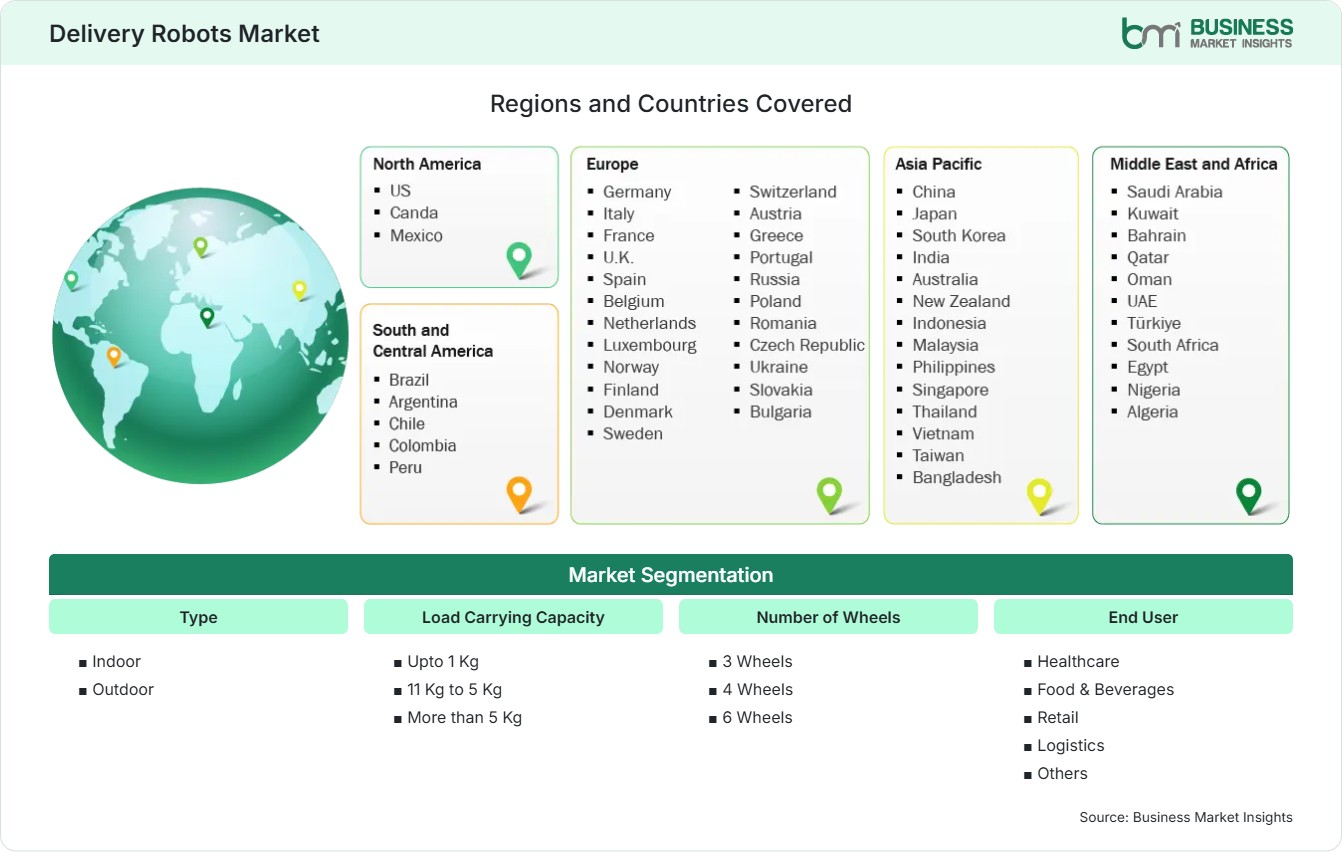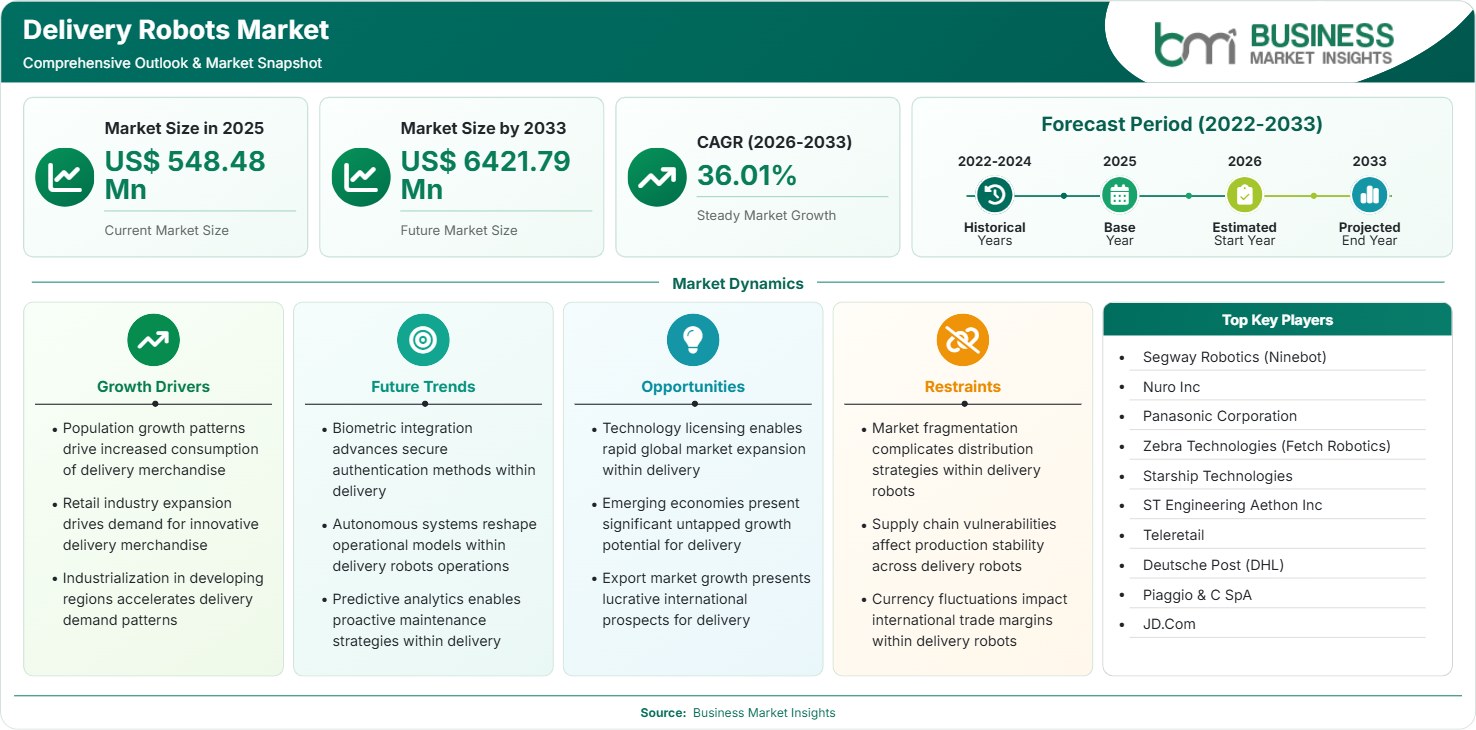
Delivery Robots Market Regional Highlights
North America Delivery Robots Market
North America accounted for approximately 38%–41% of global revenue in 2025 and is expected to expand at a CAGR of 34%–36% through 2033. The region benefits from strong robotics innovation ecosystems, significant venture funding activity, and widespread technology adoption. The Delivery Robots Market share leadership stems from extensive pilot programs and commercial deployments across campuses, neighborhoods, and urban districts. Retailers and food-service providers increasingly integrate autonomous delivery capabilities to improve efficiency, reduce labor dependency, and enhance customer convenience while maintaining service quality.
- Major technology clusters support robotics innovation, testing activity, autonomous software development, and commercialization partnerships.
- Food delivery platforms increasingly evaluate robotic fleets to improve route efficiency and manage labor expenses.
- University campuses remain key deployment environments due to predictable travel routes and operational safety advantages.
- Smart city programs encourage autonomous mobility experimentation and future infrastructure readiness.
- Investors continue funding autonomous delivery developers demonstrating scalable operating models.
US Delivery Robots Market
The United States accounts for about 79%-83% of regional demand and is expected to witness a CAGR of 35%- 37% through 2033. Commercial deployment is constantly increasing in restaurants, health care institutions, retail outlets, and logistics facilities. A robust technology backbone, along with regulatory testing and consumer awareness of automation, drives future adoption. Firms are increasingly partnering with municipal authorities and delivery platforms to build large networks capable of handling autonomous last-mile fulfillment requirements.
- Autonomous delivery pilots continue expanding from campuses into mixed-use urban environments.
- Restaurant operators increasingly deploy robotic solutions to reduce delivery costs and improve consistency.
- Robotics startups benefit from access to technology talent, venture funding, and commercial partners.
- Public agencies increasingly establish frameworks supporting autonomous mobility development.
Europe Delivery Robots Market
Europe accounted for about 27%–30% of global revenues in 2025 and is predicted to grow at a CAGR of 33%–35% till 2033. Germany is seen as the dominant country-level market because of its capabilities in industrial automation, and the UK is known for its strong growth prospects, having a CAGR of about 35%–37%. Sustainable development goals of cities and urban mobility programs promote the use of autonomous deliveries. Research institutions, advanced manufacturing capabilities, and innovation funding mechanisms support continuous product development and the expansion of deployment throughout the region.
- Germany benefits from strong robotics engineering expertise and industrial technology capabilities.
- The United Kingdom supports deployments through innovation-friendly testing environments and digital infrastructure.
- Sustainability goals encourage alternatives to conventional short-distance transport methods.
- Retailers explore autonomous solutions to improve fulfillment economics in dense urban locations.
- Collaborative research initiatives accelerate technological advancements and commercialization.
Asia Pacific Delivery Robots Market
Asia Pacific contributed approximately 24% to 27% of the world’s revenue in 2025 and is projected to grow at a CAGR of 38% to 40%, making it the fastest-growing region. China is the leader in implementation due to its robust robot manufacturing industry and digital commerce, whereas India’s CAGR is 40%-42%. Urban population growth, investments in smart infrastructure, and technology commercialization drive regional demand. The delivery robots market continues to grow as companies aim to implement automation to meet delivery capacity needs across rapidly growing consumer markets.
- China maintains regional leadership through advanced robotics ecosystems and large-scale testing programs.
- India benefits from digitalization initiatives, startup activity, and increasing e-commerce fulfillment requirements.
- Smart city investments create favorable environments for autonomous mobility deployment.
- Food delivery and parcel transport applications remain primary adoption drivers.
- Manufacturers increasingly localize production to improve affordability and market access.
Rest of World Delivery Robots Market
Rest of World accounted for approximately 6% to 8% of total revenue in 2025 and is expected to grow at a CAGR of 35% to 37% during 2033. There is increasing attention toward urban automation projects and digital delivery solutions in South and Central America. In addition, the Middle Eastern nations are making substantial efforts to develop smart mobility and robotics centers. Brazil is ahead of the rest of Latin America in deployment activity, and the UAE leads in deployment momentum, supported by advanced smart city programs and technology investment strategies.
- Gulf countries continue investing in autonomous mobility and next-generation urban infrastructure.
- Brazil is emerging as a regional test market for automated delivery solutions.
- Technology partnerships accelerate robotic deployment across commercial districts and campuses.
- Public innovation programs support research, testing, and regulatory development.
- Growing consumer acceptance improves long-term commercialization prospects.