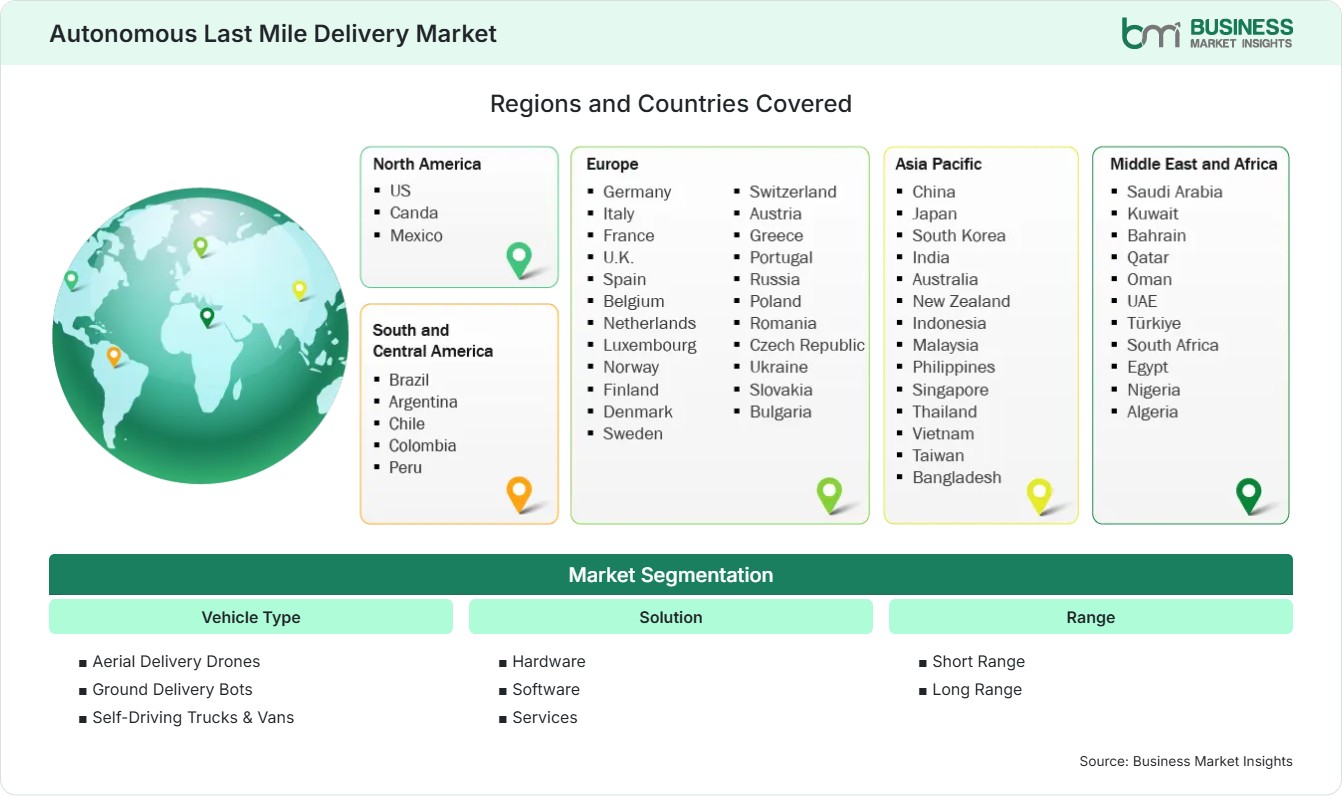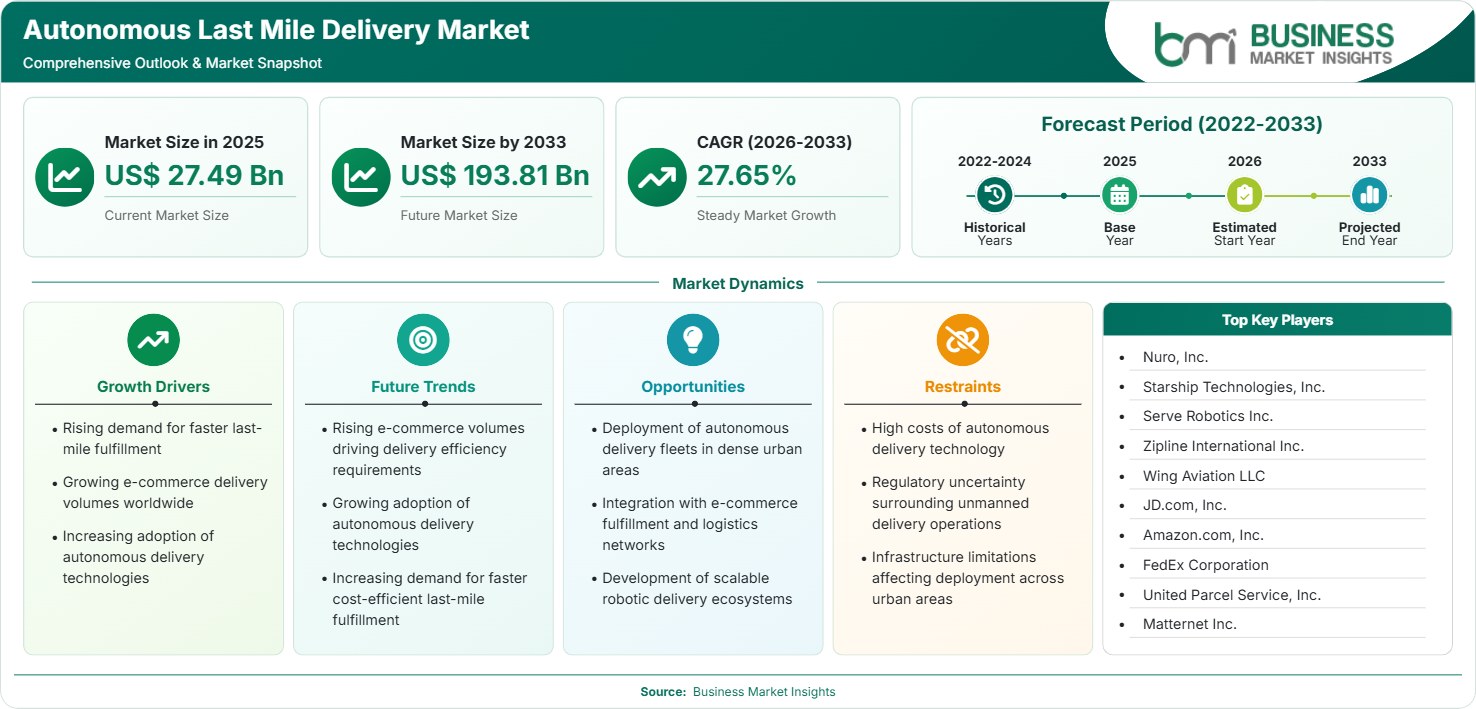
Autonomous Last Mile Delivery Market Regional Highlights
North America Autonomous Last Mile Delivery Market
North America commands 38%–41% of global demand in 2025 and advances at a CAGR of 25%–28% through 2033. The region benefits from mature e-commerce ecosystems, substantial robotics funding, advanced connectivity infrastructure, and supportive testing frameworks. Autonomous Last Mile Delivery Market share remains highest in this region owing to leading deployments across retail, food delivery, and healthcare applications. Commercial scaling by robotics providers, expanding drone authorizations, and retailer investments in same-day fulfillment continue strengthening regional leadership.
- Retailers increasingly integrate autonomous fleets with micro-fulfillment networks, enabling lower delivery costs, shorter delivery windows, and improved scalability during periods of peak order demand.
- University campuses and controlled environments remain critical commercialization hubs, helping operators validate business models and improve fleet utilization.
- Strong venture funding continues supporting autonomous mobility innovation, creating a favorable ecosystem for pilot expansion and technology commercialization.
- Healthcare delivery applications, including pharmaceutical distribution and laboratory sample transportation, are generating consistent demand for aerial delivery systems.
US Autonomous Last Mile Delivery Market
The United States accounts for 74%–78% of North American revenue in 2025 and progresses at a CAGR of 26%–29% through 2033. Strong consumer adoption of on-demand services, supportive state-level pilots, and investments from logistics leaders support expansion. Commercial deployments across campuses, neighborhoods, and retail corridors provide operational data for autonomous optimization. Market participants increasingly prioritize software-driven fleet coordination, making the country a major innovation center.
- Retail chains increasingly implement autonomous delivery ecosystems to address driver shortages and improve last-mile economics across metropolitan markets.
- Partnerships between logistics companies and robotics providers accelerate route optimization, fleet scaling, and commercial deployment capabilities.
- Drone delivery programs continue expanding beyond testing toward commercial operations in healthcare, food service, and retail sectors.
- AI-enabled fleet management technologies improve operational visibility and asset utilization, enhancing return on investment.
Europe Autonomous Last Mile Delivery Market
Europe has a market share of 26%-29% in 2025 and a CAGR of 24%-27% up to 2033. This growth can be attributed to sustainability goals, smart mobility initiatives, and logistics advancements in urban settings. The country that earns the most revenue in the region is Germany; however, the UK has one of the fastest growth rates at 27%-30%. Regulatory emphasis on emissions reduction supports the deployment of electric autonomous delivery solutions across major metropolitan centers.
- Environmental regulations increasingly encourage low-emission logistics operations, supporting electric delivery robot deployments.
- Public-private partnerships are facilitating urban testing zones and commercial demonstrations for autonomous delivery technologies.
- Germany maintains leadership through industrial automation expertise and advanced logistics infrastructure supporting deployment readiness.
- The United Kingdom exhibits strong momentum due to e-commerce demand, technology investment, and supportive innovation frameworks.
- Grocery and parcel delivery applications continue dominating commercial implementation across European cities.
Asia Pacific Autonomous Last Mile Delivery Market
Asia Pacific accounts for 24%–27% of global revenue in 2025 and achieves the highest CAGR of 30%–33% through 2033. China leads the region through extensive logistics automation initiatives, while India shows one of the fastest growth trajectories with a CAGR of 32%–35%. Rapid urbanization, increasing digital commerce volumes, and government support for smart transportation create favorable deployment conditions. Autonomous Last Mile Delivery Market share continues expanding rapidly across retail and healthcare sectors.
- China benefits from strong domestic technology ecosystems, large delivery volumes, and significant investment in autonomous mobility.
- India's expanding e-commerce industry creates substantial opportunities for scalable and cost-efficient automated delivery services.
- Smart city projects across the region encourage adoption of connected mobility and logistics technologies.
- High population density improves delivery economics and supports frequent, localized deployments.
- Investments in drone logistics enhance healthcare accessibility across remote and underserved locations.
Rest of World Autonomous Last Mile Delivery Market
Rest of World holds an 8% to 11% market share in 2025 and has growth potential of 27% to 30% through 2033. South & Central America are experiencing growth due to an increase in pilot projects driven by rising demand in e-commerce and urban delivery. Brazil is a dominant player in the region, whereas Mexico offers huge growth potential.
The Middle East and Africa are gaining ground due to the emergence of smart cities and the modernization of healthcare logistics. The UAE stands out for its commercialization, and Saudi Arabia for high growth opportunities supported by digital transformation initiatives.
- Smart city investments across Gulf economies support autonomous mobility testing and commercial implementation activities.
- Healthcare logistics remains an important use case for drone deliveries across geographically dispersed communities.
- E-commerce expansion drives demand for efficient delivery systems throughout Latin American metropolitan areas.
- Infrastructure modernization programs improve readiness for connected logistics platforms and autonomous transportation networks.
- Strategic government support helps reduce barriers to commercial deployment and technological adoption.