
Direct Reduced Iron Market Outlook: Size, Share, Trends, Growth Analysis, Competitive Landscape & Forecast, 2026-2033

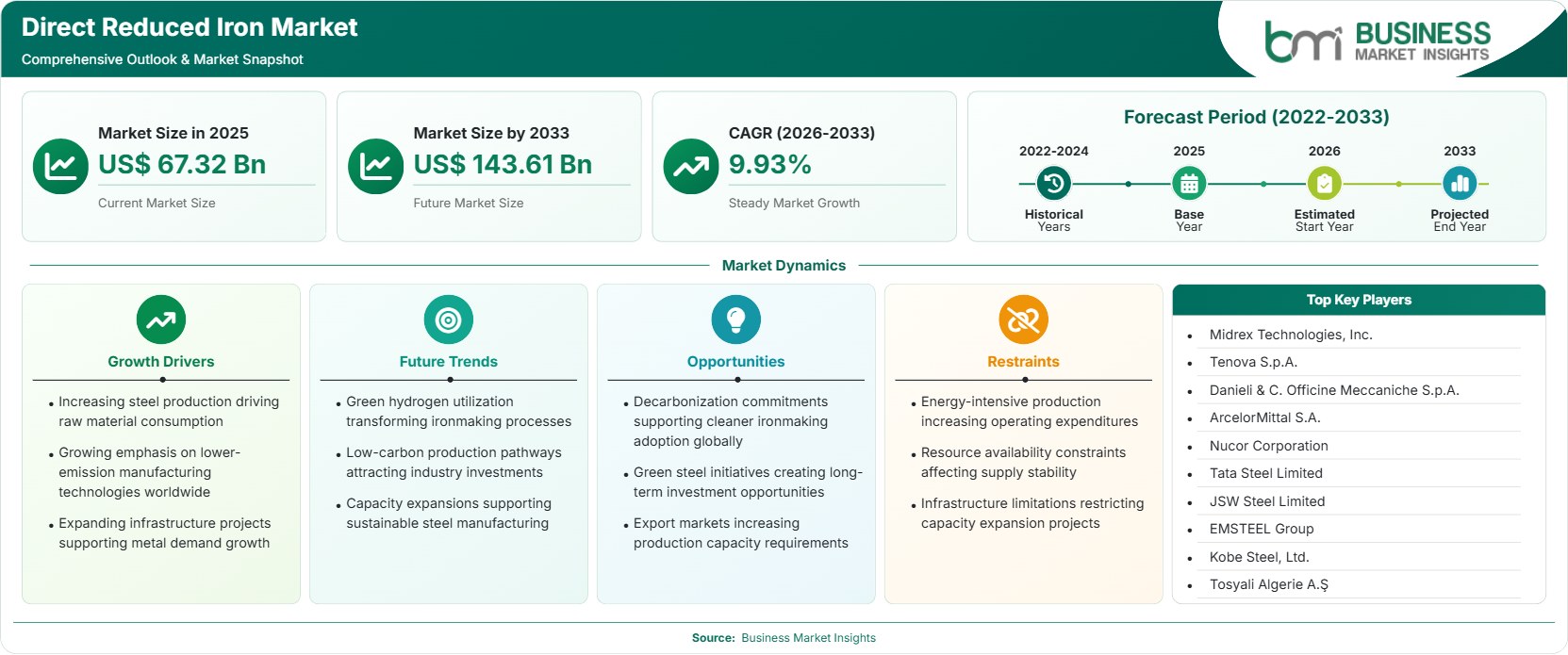
The Direct Reduced Iron Market size was valued at US$ 67.32 Billion in 2025 and is projected to reach US$ 143.61 Billion by 2033, growing at a CAGR of 9.93% during 2026–2033, driven by decarbonization, EAF adoption, hydrogen readiness, and expanding low-carbon steel investments.

Report Coverage
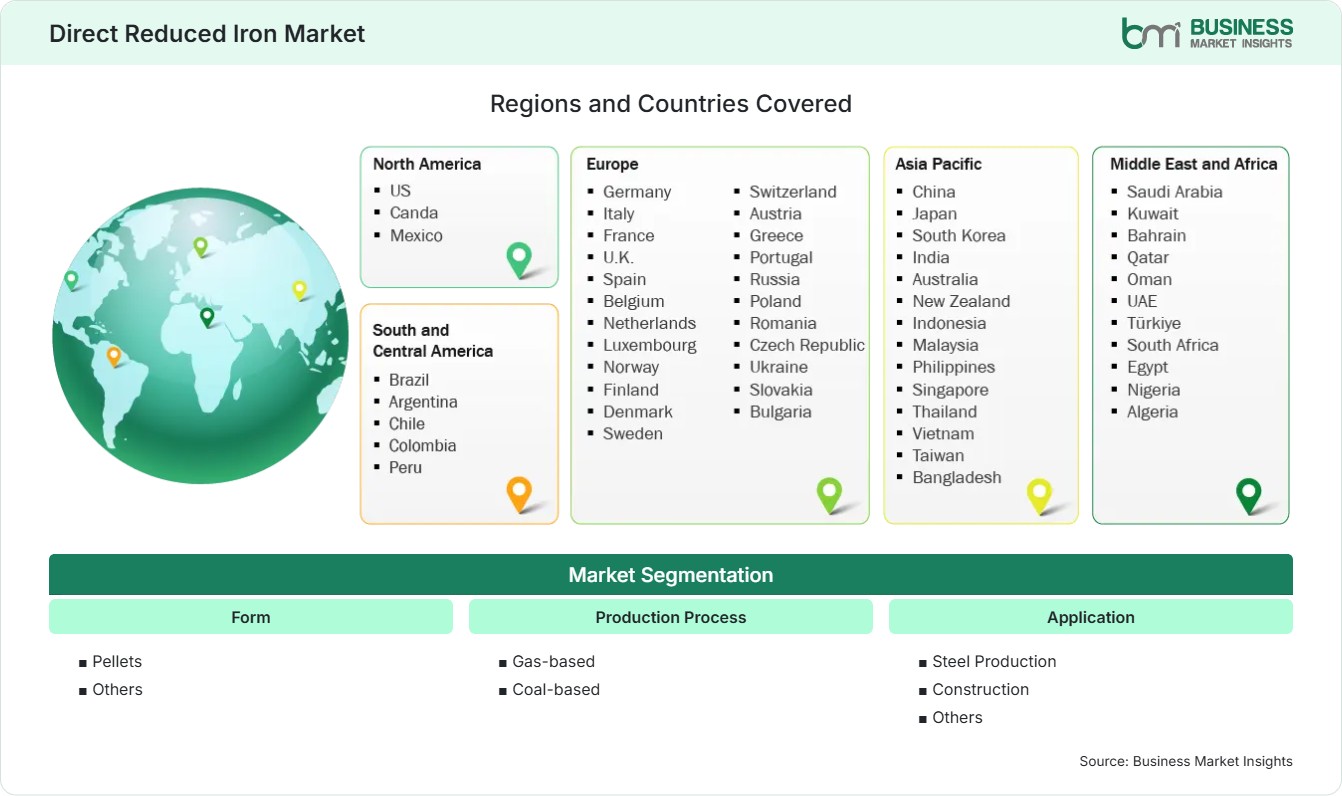
  • Form: Pellets, Others
  • Production Process: Gas-based, Coal-based
  • Application: Steel Production, Construction, Others
US$ 67.32 Bn Market size in 2025
US$ 143.61 Bn Market Size by 2033
9.93% CAGR, 2026 - 2033
2026-2033 Forecast Period

AI Overview

Direct Reduced Iron Market Summary

  • North America Region: North America holds a Direct Reduced Iron Market share of 18%–21% in 2025, growing at a CAGR of 8.8%–9.5% during 2026–2033, supported by EAF capacity, domestic metallics demand, infrastructure investment, hydrogen projects, and reshoring of steel production. The US represents the regional core, supported by integrated DRI-HBI-EAF investments, natural-gas availability, and policy support for domestic low-emission steelmaking, with a 9.0%–9.7% CAGR during 2026–2033.
  • Fastest Growing Region: Asia Pacific holds a 35%–38% share in 2025, with the fastest regional CAGR of 11.0%–11.8% during 2026–2033, driven by Indian steel expansion, Chinese hydrogen-based projects, rising EAF penetration, domestic iron ore availability, and investments in flexible reduction technologies.
  • Leading Segment: Pellets account for a 62%–66% share in 2025, advancing at a 9.5%–10.2% CAGR during 2026–2033, supported by superior permeability, consistent metallization, EAF compatibility, established pelletizing infrastructure, and growing demand for high-quality metallic feedstock in modern steelmaking operations.
  • High Growth Segment: Gas-based production represents a 67%–71% Direct Reduced Iron Market share in 2025, registering a 10.4%–11.2% CAGR during 2026–2033, as producers favor gas-based shaft furnaces for scalability, lower emissions, operational flexibility, and progressive substitution of natural gas with hydrogen.
  • Key Market Opportunity: Hydrogen-ready reduction facilities create an investment pathway linking renewable electricity, electrolyzers, premium iron ore, DRI production, and EAF steelmaking, enabling producers to progressively lower emissions while protecting long-term asset utilization.
  • Major Market Players: Midrex Technologies, Inc.; Tenova S.p.A.; Danieli & C. Officine Meccaniche S.p.A.; ArcelorMittal S.A.; Nucor Corporation; Tata Steel Limited; JSW Steel Limited; EMSTEEL Group; Kobe Steel, Ltd.; and Tosyali Algerie A.Ş.
Strategic Insights

Direct Reduced Iron Market: Strategic Insights

Direct Reduced Iron Market Strategic Framework
FREE PDF
Request your free sample
Request free sample
Stakeholder View

Key Takeaways

  • The value chain increasingly connects premium iron ore pellet suppliers, reduction technology licensors, gas and hydrogen providers, EAF operators, logistics companies, and steelmakers, making integrated project development more important than standalone DRI capacity.
  • Gas-based shaft furnaces remain commercially dominant, but hydrogen-ready configurations provide the strongest long-term upside because they allow producers to use existing infrastructure while adapting to changing reductant economics.
  • Product innovation is moving toward higher metallization, controlled carbon content, hot charging, and HBI production, improving furnace productivity and enabling DRI to serve both integrated and merchant steelmaking operations.
  • India, the Middle East, North Africa, and selected North American markets offer compelling investment conditions because they combine steel demand, energy resources, export infrastructure, and policy support for lower-emission production.
  • Strategic partnerships are increasingly structured around technology licensing, engineering, hydrogen supply, renewable power, and downstream EAF integration rather than isolated equipment purchases, increasing opportunities for cross-sector investment and consolidation.
  • Project developers that secure high-quality pellet supply and flexible energy contracts can reduce operating volatility while positioning DRI assets for progressively stricter carbon-intensity requirements.
Geographic Outlook

Direct Reduced Iron Market Regional Highlights

North America Direct Reduced Iron Market

North America represented 18%–21% of the Direct Reduced Iron Market share in 2025 and is projected to expand at a CAGR of 8.8%–9.5% during 2026–2033. The regional opportunity centers on EAF steelmaking, domestic metallics supply, and replacement of imported pig iron and scrap. US investments provide the principal demand anchor, while Canada supports hydrogen-ready transformation. Natural-gas availability remains advantageous for transitional production, whereas carbon-management technologies increasingly influence investment decisions and technology selection.

  • US steelmakers are expanding DRI and HBI capabilities to secure predictable virgin metallics for EAF operations, reducing exposure to scrap quality variations and supporting higher-value steel grades.
  • Canadian projects emphasize hydrogen-ready DRI technology alongside EAF conversion, aligning steel decarbonization investments with federal and provincial industrial policy and renewable-energy development.
  • North American producers increasingly evaluate hot DRI charging because proximity between reduction units and EAFs can reduce handling, reheating, and electricity requirements.
  • Project economics remain sensitive to natural-gas, electricity, pellet, and carbon costs, making integrated energy procurement a critical determinant of investment returns.

US Direct Reduced Iron Market

The US represented 65%–69% of the North American share in 2025 and is forecast to grow at a CAGR of 9.0%–9.7% during 2026–2033. Demand is anchored by EAF steelmaking, automotive-grade steel requirements, infrastructure programs, and domestic supply-chain strategies. New DRI capacity is increasingly paired with EAFs and designed for future hydrogen use. The planned Big River Steel DRI facility illustrates the scale of investment entering the domestic metallics ecosystem.

  • US steelmakers are using DRI and HBI to diversify metallic input portfolios, particularly where high-quality scrap availability cannot consistently meet specifications for demanding flat-steel applications.
  • Natural gas provides a commercially established transitional reductant, while hydrogen-ready plant designs preserve flexibility as clean hydrogen infrastructure expands.
  • Domestic DRI investment also strengthens regional logistics by reducing dependence on imported metallics and shortening supply routes between ironmaking and EAF facilities.

Europe Direct Reduced Iron Market

Europe held a 22%–25% share in 2025 and is projected to register a 9.2%–10.0% CAGR during 2026–2033 in the Direct Reduced Iron Market. Germany remains a leading market, while Sweden and Spain provide important growth opportunities through hydrogen-based steelmaking. European producers are replacing conventional blast furnaces with DRI-EAF configurations to address carbon costs, industrial decarbonization targets, and customer demand for lower-emission steel. Carbon-border measures and public funding improve the strategic case, although electricity prices remain a material project constraint.

  • Germany combines large steelmaking capacity with established hydrogen and renewable-energy investments, supporting DRI projects designed around progressive replacement of fossil reducing gases.
  • Sweden remains an important technology-development center because hydrogen-based DRI projects integrate renewable electricity, electrolyzers, shaft furnaces, and EAF steelmaking into a unified low-carbon pathway.
  • Spain is gaining relevance through renewable electricity availability, industrial decarbonization initiatives, and potential access to imported high-grade iron ore and hydrogen.
  • European projects increasingly evaluate lifecycle emissions, electricity sourcing, pellet quality, and hydrogen availability simultaneously rather than optimizing reduction technology in isolation.

Asia Pacific Direct Reduced Iron Market

Asia Pacific held 35%-38% market share in 2025 and is expected to grow with a CAGR of 11.0%-11.8% from 2026 to 2033. India stands out as the major driver of growth in the region, while China, Japan, and Australia drive industry growth through technological advancements and investments in industrial plants. High steel consumption, domestic availability of iron ore, growth in EAF capacity, and decarbonization efforts aid the application. The region features well-established coal-based direct reduced iron facilities, thereby giving rise to two pathways.

  • India provides the strongest volume opportunity because DRI already forms an established part of the domestic steel ecosystem and supports smaller and medium-sized EAF and induction-furnace operators.
  • China is accelerating hydrogen-based reduction technology, with Baosteel Zhanjiang completing a performance test involving 70% hydrogen-based reducing gas and 1 million tonnes of annual design capacity.
  • Japan is emphasizing demonstration-scale hydrogen reduction technology, including an experimental facility developed through collaboration involving Nippon Steel, JFE Steel, and Tenova.
  • Australia offers strategic potential as an iron ore supplier seeking greater downstream value creation, with NeoSmelt evaluating DRI-electric smelting based on Pilbara ores.

Rest of World Direct Reduced Iron Market

Rest of World constituted a 17%-20% market share in 2025 and is expected to register a CAGR of 9.6%-10.4% during 2026-2033 in the Direct Reduced Iron Market. The Middle East and Africa present lucrative opportunities for gas-based production facilities, and South and Central America offer iron ore resources, renewable energy, and export capabilities. Gulf countries continue to add DRI to EAF steelmaking operations, and North African facilities will help meet demand for emission-free metallics from Europe.

Latin American growth is backed up by iron ore presence, regional steel consumption, and renewable-driven reduction processes. In 2025, Bolivia opened its first DRI facility, and Libya is building new facilities for exporting its output to Mediterranean countries.

  • Saudi Arabia, Qatar, the UAE, Bahrain, and Oman benefit from established gas infrastructure and proximity to Asian and European steel markets, supporting merchant DRI and HBI production.
  • Algeria is expanding DRI capacity and achieved a single-module production record in 2025, reinforcing North Africa's position as a competitive metallics production base.
  • Libya's planned 2.5 million-tonne first-phase project demonstrates the potential for new export-oriented DRI hubs around the Mediterranean.
  • Bolivia's first DRI facility expands technology adoption into South America while demonstrating that modular reduction systems can support smaller national steelmaking ecosystems.
Global Market Geography
FREE PDF
Request your free sample
Request free sample
Segment Analysis

Direct Reduced Iron Market Segmentation

Form

Pellets constituted 62%-66% of the market in 2025 and are anticipated to grow at a CAGR of 9.5%-10.2% from 2026-2033. Reducing iron using pellets is advantageous due to their uniform size, permeability, and metallurgy. This makes the use of pellets essential for efficient furnace operations and ensures productivity and consistency of metal composition.

  • Pellets: Pelletized iron ore provides consistent feed geometry and chemistry, supporting reduction efficiency, high metallization, stable furnace permeability, and reliable EAF metallics quality across large-scale production facilities.

Production Process

The gas-based process accounted for 67% to 71% of the market in 2025 and is expected to grow at a 10.4% to 11.2% CAGR during 2023-2033 in the Direct Reduced Iron Market. The gas-based process has a technological edge due to the use of a shaft furnace, scalability in production, and suitability for hydrogen blending. The coal-based process remains relevant in countries like India due to legacy infrastructure and cost advantages.

  • Gas-based: Gas-based shaft furnaces offer high operating maturity, scalable capacity, and flexibility to transition toward hydrogen, making them central to low-carbon DRI strategies and integrated EAF developments.
  • Coal-based: Coal-based reduction remains commercially relevant where local coal resources and established rotary-kiln infrastructure support cost competitiveness, particularly among smaller producers serving regional steelmaking requirements.

Application

Steel manufacturing accounted for 84%-88% of the market in 2025 and is expected to grow at a CAGR of 9.7%-10.4% between 2026 and 2033. DRI ensures the controlled availability of virgin metals for EAF and other steelmaking processes, enabling manufacturers to manage residual elements and achieve product consistency. Construction will continue to be an indirect source of demand via reinforcement steel.

  • Steel Production: Steelmakers consume DRI as a high-quality virgin metallic input, supporting EAF productivity, controlled chemistry, lower residual content, and production of demanding flat and long steel grades.
  • Construction: Construction activity indirectly supports DRI demand through reinforcement bar, structural steel, wire rod, and infrastructure products, particularly in fast-growing urbanization and industrialization markets.
Market Forces

Direct Reduced Iron Market Dynamics

Key Market Drivers

Expansion of Electric Arc Furnace Steelmaking

The Direct Reduced Iron Market growth is closely linked to EAF expansion because DRI provides virgin metallic units that complement recycled scrap. According to the IEA, H2 DRI-EAF represents the new generation of low-carbon technology, while BF-BOF continues to account for up to 70% of the world’s total steel output. With increased use of EAF in the steel industry, the requirement for a steady feed of metals becomes ever greater. DRI allows for the regulation of the content of residual components, such as copper and tin, in the scrap. This benefit is crucial for the production of automotive sheets, electrical steel, and special grades. Growing EAF capacities thus represent the structural demand for DRI, especially where high-grade scrap is scarce.

Industrial Decarbonization and Hydrogen Readiness

Decarbonization is reshaping Direct Reduced Iron Market trends, shifting from traditional gas-based reduction processes to flexible processes that can easily switch to hydrogen. Hydrogen can substitute for carbon-containing reducing gases, thereby reducing emissions when produced from low-emission electricity. According to the IEA, in 2024, hydrogen demand was 100 Mt, but new hydrogen applications were still in the initial stages of commercialization. Steel is one of those industrial sectors where hydrogen can substitute fossil-based reduction processes. Therefore, projects are increasingly equipped with hydrogen-ready furnaces, flexible gas systems, and carbon management systems.

Growth of High-Quality Iron Ore Pellet Supply

Feedstock quality is becoming a central determinant of the Direct Reduced Iron Market because modern shaft furnaces require suitable iron ore characteristics for efficient reduction. High-quality pellets could increase furnace productivity, improve metallization, and enhance steelmaking efficiency while reducing the amount of gangue entering the process. According to the International Iron Metallics Association, iron ore is mainly used in either pellet or lump form in direct reduction processes. With the emergence of new plants for direct reduced iron, which aim to reduce emissions and increase productivity, securing pellets through long-term contracts, captive sources, and mining linkages has become common practice among steelmakers.

Key Market Opportunities

Development of Hydrogen-Ready DRI Clusters

Hydrogen-ready DRI clusters create a scalable investment model connecting renewable electricity, electrolyzers, iron ore beneficiation, reduction plants, EAFs, and steel finishing. Direct Reduced Iron Market Forecasts are now leaning toward projects that can modify the composition of reductants without requiring new furnace technology. This kind of flexibility provides protection against losses in value from hydrogen price drops that are not uniform across regions. Clusters enable a common pipeline for hydrogen, renewable power generation and storage, water, and carbon management infrastructure. These projects will be most successful in areas with high-quality pellets, renewable power generation, and high steel consumption. Hot DRI transfers to the EAF can further increase efficiency.

Merchant HBI and Cross-Border Metallics Trade

A merchant HBI operation decouples DRI production from its current use in steelmaking, enabling producers to ship metallics in a compact form to remote EAF and integrated plants. The merchant HBI option is especially viable when there is future production capability for DRI using competitive natural gas or hydrogen, and the destination markets do not have sufficient appropriate metallics. The export ventures in North Africa, the Middle East, and certain parts of Latin America will benefit from access to port facilities and to European and Asian customers.

Integration of DRI With Carbon Management

Carbon capture, utilization, and storage may allow natural-gas-based DRI to retain its transitional value as hydrogen infrastructure develops. The installations using ENERGIRON technology illustrate how a flexible system for reducing gas can be designed to use natural gas and gradually increase the hydrogen share in the blend, while carbon management technologies would address process emissions. In this way, steelmakers can use this interim solution until they find sources of sufficient renewable hydrogen. Carbon capture can also be integrated into industrial utilization systems when there is local demand for captured carbon. The most promising location for this solution is an area with adequate geological conditions and a carbon pipeline network.

Market Restraints and Challenges

Volatility in Energy and Pellet Costs

Factor: The economics of DRI are largely driven by the prices of natural gas, electricity, hydrogen, and high-grade iron ore pellets, all of which can vary by location and season. The cost of facilities varies with gas prices, while facilities using hydrogen depend on uncertainties in renewable energy sources, electrolysis rates, storage, and transportation costs. Impact: Variations in cost elements can influence decision-making, reduce profits, and make DRI production more expensive than scrap and normal iron production. Cost variations can be mitigated through long-term contracts for fuel acquisition, electricity generation, and pellet purchases, as well as diversified supply lines. Small players lack the required bargaining power.

Limited Availability of Premium-Grade Reduction Feedstock

Factor: Shaft furnaces that make DRI typically need an ore or pellet feed that is suitable in terms of its iron, gangue, strength, and reduction characteristics. There are many deposits of iron ores around the world, but not all can be converted to produce the ore or pellets that meet the requirements of the DRI without further beneficiation or pelletization. Impact: The demand for suitable feedstock can raise raw material premiums and constrain plant capacity, thereby leading to vertical integration of ore-to-steel operations. DRI plants will hence need to have their feedstock evaluated at an early stage and have to take into account the benefits of beneficiation, pelletization, logistics, and blending.

Company Analysis

Competitive Landscape

The Direct Reduced Iron Market analysis indicates competition is shaped by technology licensing, plant operating expertise, captive steel demand, pellet access, energy economics, and transition readiness. The competitive environment includes technology providers and integrated steelmakers, with established players combining proprietary reduction technologies with downstream EAF, HBI, and steelmaking capabilities.

Company Name

Overview

Products and Services relevant to this market

Midrex Technologies, Inc.

US-based direct reduction technology specialist with extensive global plant experience and a large installed technology base.

MIDREX direct reduction plants, hydrogen-ready systems, HBI, HDRI, CDRI solutions, process optimization, engineering, and technical services.

Tenova S.p.A.

Global metals technology provider focused on sustainable ironmaking and flexible low-emission production pathways.

ENERGIRON direct reduction technology, hydrogen-ready DRI systems, carbon capture integration, engineering, and plant services.

Danieli & C. Officine Meccaniche S.p.A.

Italian steel technology company with broad engineering capabilities across ironmaking and steel production.

ENERGIRON technology, DRI plants, EAF systems, steelmaking equipment, engineering, automation, and process integration.

ArcelorMittal S.A.

Global steel producer developing DRI-EAF pathways across multiple major steelmaking regions.

DRI, HBI, steel products, EAF operations, low-carbon steelmaking projects, and integrated metallics solutions.

Nucor Corporation

Major US steelmaker with extensive EAF operations and established DRI/HBI consumption capabilities.

DRI and HBI production, EAF steelmaking, flat and long steel products, and downstream steel solutions.

Tata Steel Limited

Diversified Indian steel producer participating in technology-led efficiency and lower-emission steelmaking initiatives.

DRI-related metallics, steel products, ironmaking, EAF-related technologies, and integrated steelmaking solutions.

JSW Steel Limited

Major Indian steel producer with substantial domestic capacity and exposure to DRI-based steelmaking.

DRI, iron and steel products, EAF and induction-furnace metallics, pellets, and integrated steelmaking operations.

EMSTEEL Group

UAE-based steel producer with a strategically important DRI-EAF production platform.

DRI, HBI, billets, long products, EAF steelmaking, and lower-carbon steel solutions.

Kobe Steel, Ltd.

Japanese industrial group with deep expertise in direct reduction and ironmaking technology.

MIDREX-related technology participation, ironmaking solutions, steel products, engineering, and metallics expertise.

Tosyali Algérie A.Ş.

North African steel producer operating large-scale DRI facilities serving domestic and export markets.

DRI, HDRI, CDRI, HBI, steel products, pellet-based ironmaking, and integrated steelmaking operations.

Trust & Transparency

Research Methodology

The market analysis combines proprietary research with secondary data from government agencies, company disclosures, regulatory filings, industry databases and expert interviews. Market estimates are validated through data triangulation, cross-market benchmarking and analyst review.

View Full Research Methodology

Questions Answered

Frequently Asked Questions

What does a Direct Reduced Iron Market report help stakeholders evaluate?

A Market report helps stakeholders assess regional demand, production pathways, application opportunities, competitive positioning, technology trends, investment priorities, and emerging low-carbon projects. It also supports strategic decisions concerning capacity expansion, partnerships, feedstock sourcing, and geographic market entry.

What should investors evaluate before developing a new DRI facility?

Investors should assess iron ore quality, pellet supply, energy costs, hydrogen availability, EAF proximity, logistics, carbon policy, infrastructure, offtake commitments, and technology flexibility. Long-term competitiveness depends on the combined economics of feedstock, energy, reduction, steelmaking, and transportation.

Why are pellets important for direct reduction facilities?

Pellets provide consistent physical and chemical properties that support furnace permeability, reduction kinetics, metallization, and stable production. Their importance increases as shaft furnaces become larger and operators seek predictable metallic quality for demanding EAF steel grades.

How does DRI support steel industry decarbonization?

DRI enables steelmakers to replace part of the carbon-intensive blast furnace route with direct reduction and EAF production. When hydrogen replaces fossil-based reducing gases and renewable electricity powers associated processes, the resulting pathway can substantially lower process emissions.

What factors will influence the Direct Reduced Iron Market over the forecast period?

Energy prices, pellet availability, EAF expansion, hydrogen infrastructure, carbon policy, and demand for lower-emission steel will determine investment and operating economics. Technology flexibility will remain important because producers need to manage changing relationships between natural gas, hydrogen, electricity, and premium iron ore feedstock.

Access the Full Direct Reduced Iron Market Report

Get segment-level forecasts, regional estimates, competitive benchmarking, company profiles and downloadable Excel datasets.

Access the full Direct Reduced Iron Market Report
350 pages PDF & Excel | 2026-09-18
Similar Research

Related Market Reports