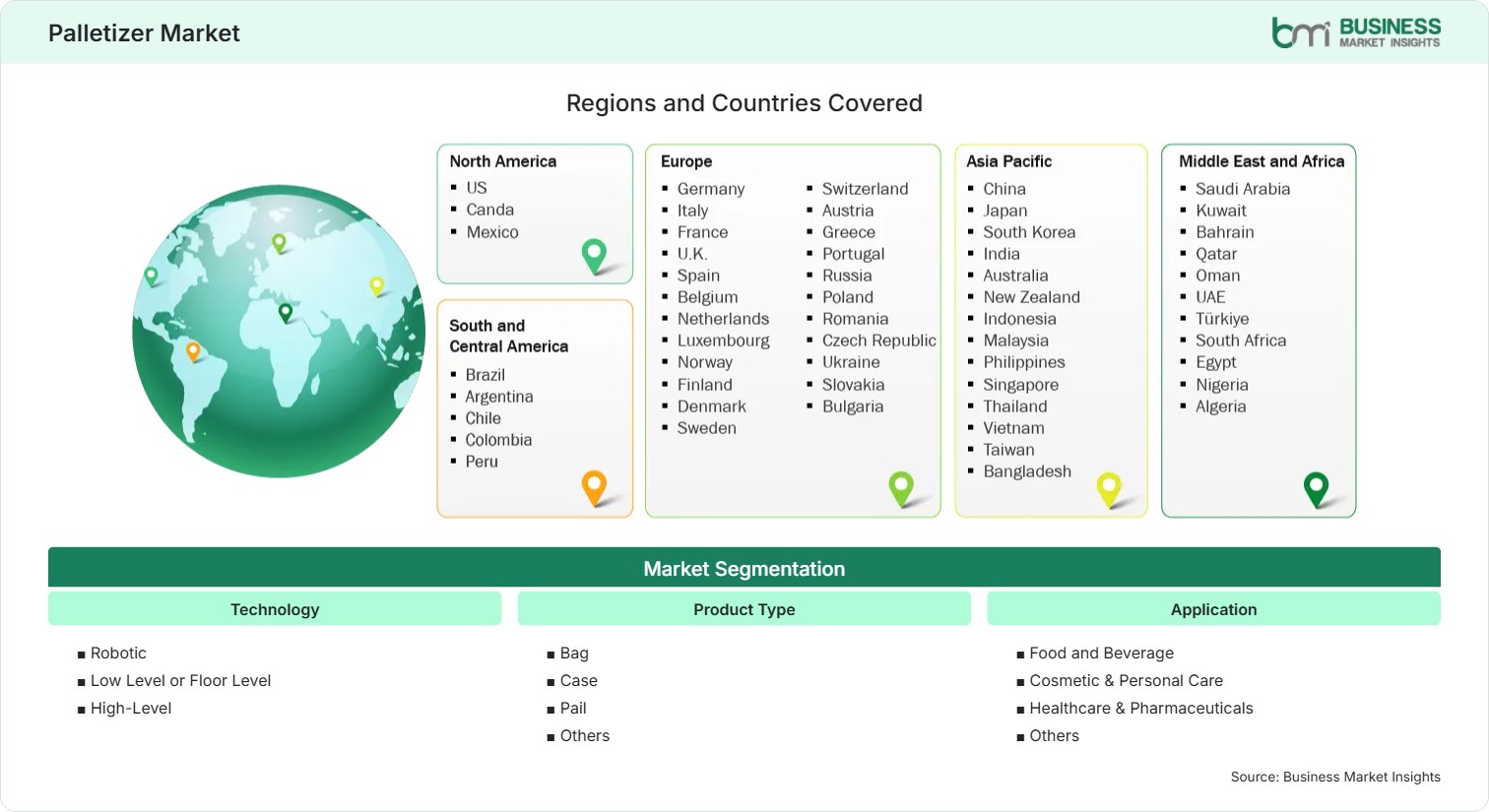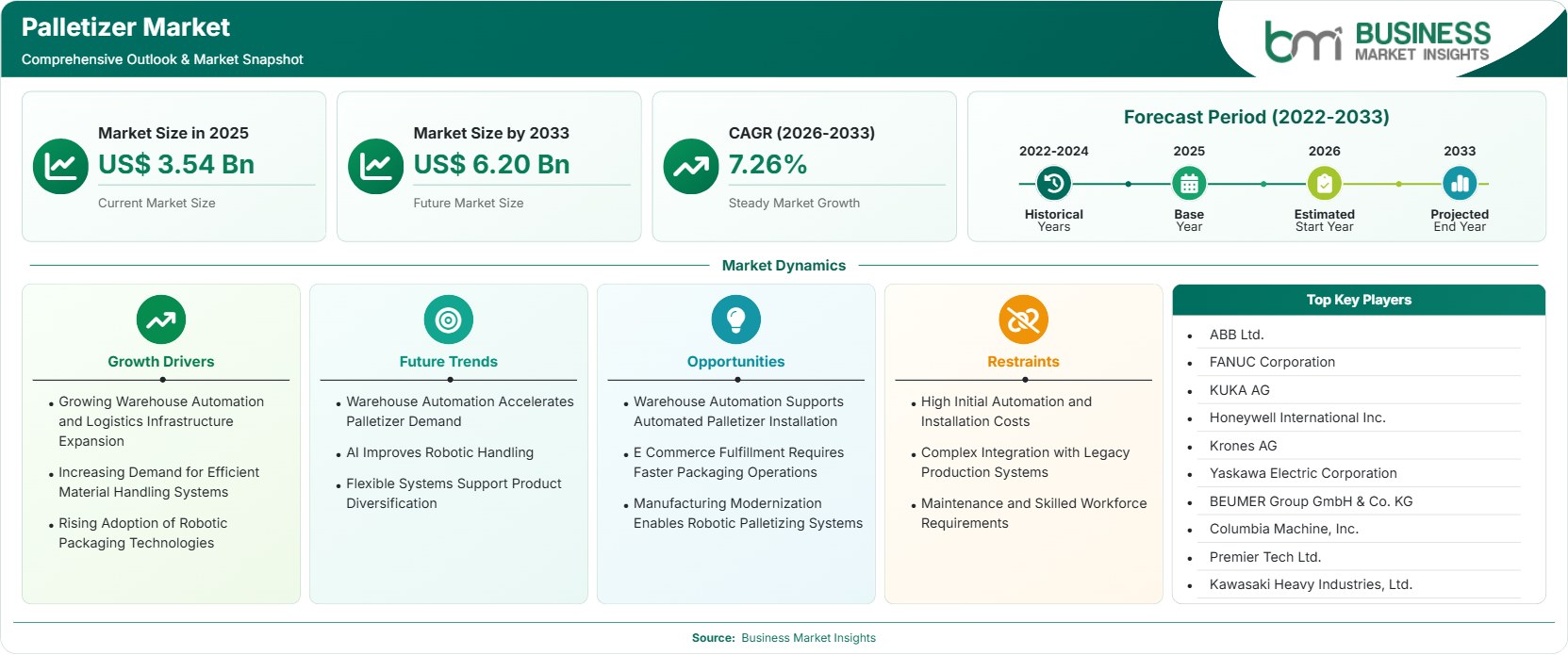
Palletizer Market Regional Highlights
North America Palletizer Market
North America accounts for approximately 34%–37% Palletizer Market share in 2025 and is forecast to expand at 6.5%–7.0% CAGR through 2033. Investment in strong warehouse automation, labor shortage, stringent packaging standards, and high use of robots help drive the market. Food processing companies are still spending on end-of-line systems that will increase efficiency, but at the same time reduce ergonomic issues. There is a high deployment of intelligent palletizing technology by logistics companies.
- Food and beverage producers prioritize high-throughput automation for labor optimization.
- E-commerce distribution centers increasingly integrate robotic palletizing cells.
- Pharmaceutical manufacturers invest in precise and traceable material handling.
- AI-enabled maintenance platforms improve uptime and equipment efficiency.
- Sustainability initiatives encourage optimized packaging and pallet utilization.
US Palletizer Market
The United States represents roughly 72%–76% share within North America and records a 6.7%–7.2% CAGR. Rising reshoring activities, advanced manufacturing upgrades, and warehouse expansion programs fuel adoption. Major consumer goods producers continue deploying integrated robotics to improve operational resilience. Investments in smart factories and digitized packaging lines strengthen long-term demand. Strong capital expenditure across logistics and distribution operations reinforces market expansion across multiple industries.
- Labor scarcity continues accelerating automation investment decisions.
- Large-scale fulfillment centers require flexible mixed-product handling capabilities.
- Smart manufacturing programs support connected equipment deployment.
- Healthcare packaging operations increasingly adopt robotic systems.
Europe Palletizer Market
Europe maintains a 26%–29% share in 2025 and advances at 6.8%–7.4% CAGR. Industrial automation maturity, workforce constraints, and sustainability objectives support equipment deployment. Germany remains the leading country, while Poland demonstrates stronger expansion momentum with CAGR above the regional average. Food processing, beverage production, and pharmaceuticals remain significant demand contributors. Manufacturers increasingly focus on energy-efficient solutions and integrated digital monitoring capabilities.
- Germany leads regional adoption through Industry 4.0 initiatives.
- Poland and Central Europe attract manufacturing investments.
- Beverage and consumer goods industries expand automation deployment.
- Sustainability regulations encourage efficient packaging operations.
- Advanced robotics integration supports flexible production environments.
Asia Pacific Palletizer Market
Asia Pacific holds 27%–30% share in 2025 and exhibits the highest CAGR of 8.5%–9.2%. China remains the largest market, while India records the fastest expansion due to accelerating industrial automation and warehousing investments. Rising labor costs, growing e-commerce activity, and expanding consumer products manufacturing stimulate demand. Regional governments continue supporting smart manufacturing initiatives and factory modernization efforts.
- China dominates manufacturing-driven deployment volumes.
- India benefits from expanding industrial automation investments.
- Southeast Asia attracts multinational production facilities.
- Consumer goods output expands demand for packaging automation.
- Warehouse construction supports long-term equipment requirements.
Rest of World Palletizer Market
Rest of World accounts for 10%–13% share in 2025 and grows at 7.2%–7.8% CAGR. South and Central America benefit from food export growth and packaging modernization initiatives. The Middle East and Africa gain traction through logistics infrastructure development, industrial diversification projects, and distribution center investments. Brazil leads Latin America, while Saudi Arabia and the UAE represent key high-growth markets.
- Brazil remains the leading Latin American adopter.
- Gulf countries invest heavily in logistics automation.
- Food export industries strengthen adoption potential.
- Distribution hub expansion creates equipment demand.
- Industrial diversification supports modernization spending.