
Bearings Market Outlook: Size, Share, Trends, Growth Analysis, Competitive Landscape & Forecast, 2026-2033

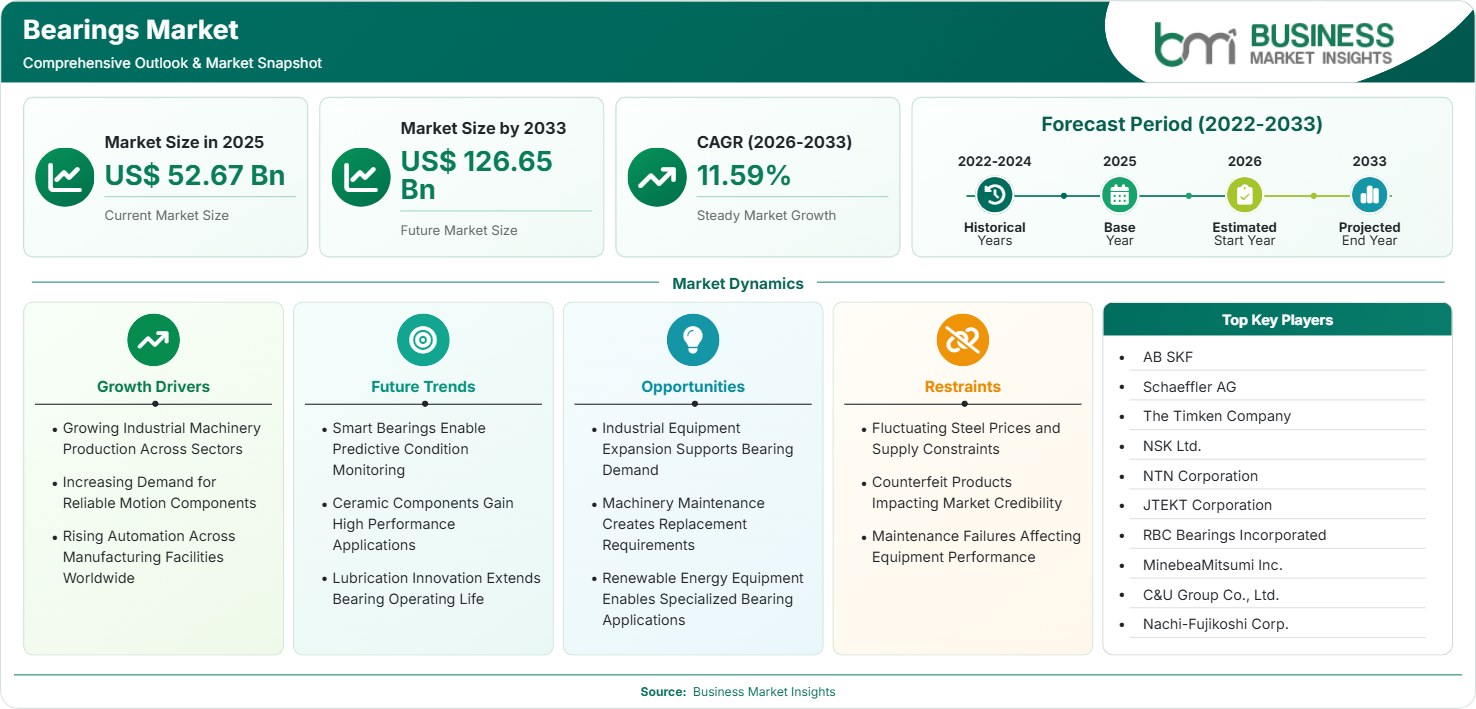
The Bearings Market size was valued at US$ 52.67 Billion in 2025 and is projected to reach US$ 126.65 Billion by 2033, growing at a CAGR of 11.59% during 2026–2033. Rising industrial automation, electric vehicle adoption, renewable energy installations, and demand for predictive maintenance solutions are accelerating product innovation and creating long-term opportunities across manufacturing, transportation, and aerospace sectors.

Report Coverage
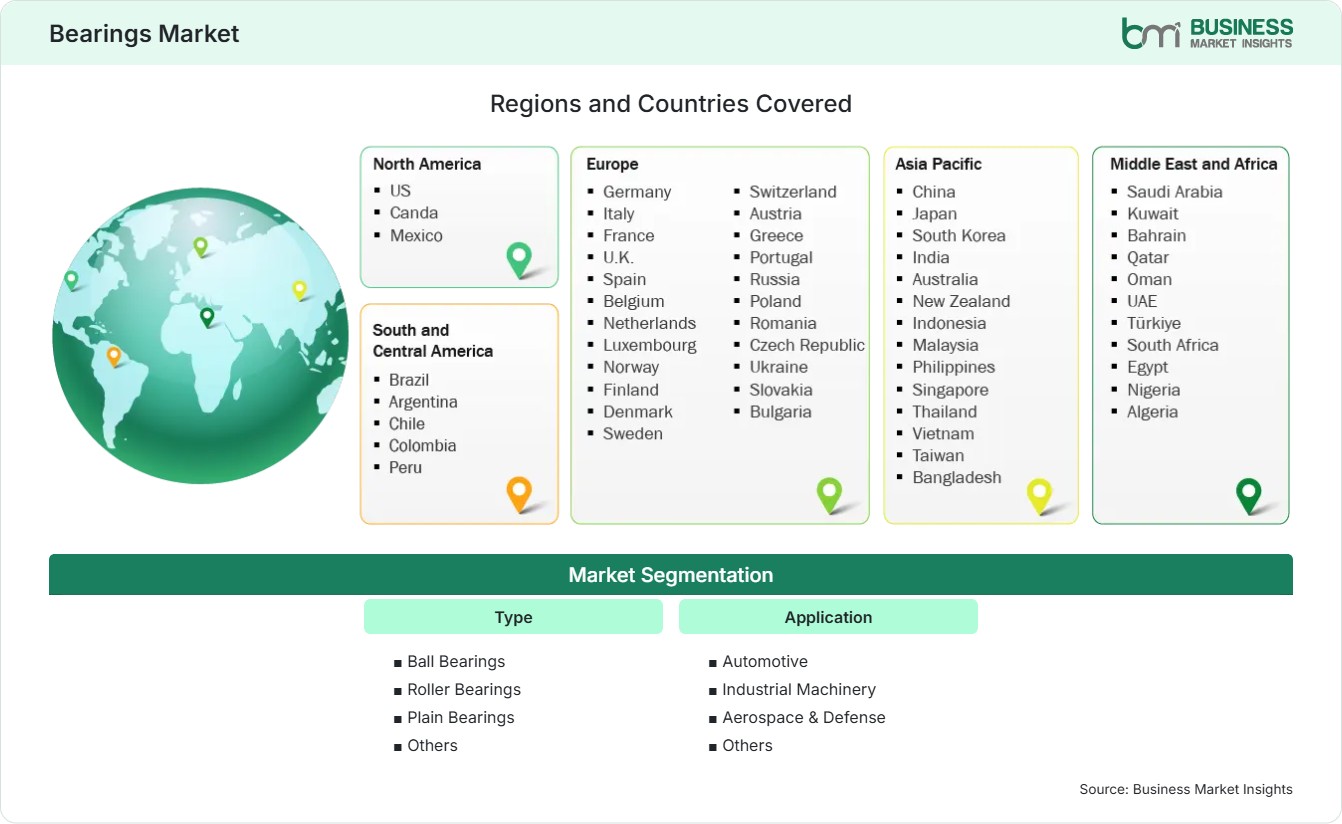
  • Type: Ball Bearings, Roller Bearings, Plain Bearings, Others
  • Application: Automotive, Industrial Machinery, Aerospace & Defense, Others
US$ 52.67 Bn Market size in 2025
US$ 126.65 Bn Market Size by 2033
11.59% CAGR, 2026 - 2033
2026-2033 Forecast Period

AI Overview

Bearings Market Summary

  • North America Region: Holds a 24%–27% share in 2025, growing at a CAGR of 10.2%–11.0% during 2026–2033, supported by aerospace production, industrial automation investments, energy infrastructure upgrades, advanced manufacturing adoption, condition monitoring integration, supply-chain localization initiatives, and increasing aftermarket replacement demand across critical industries. US market benefits from aerospace expansion, automation spending, and electrified mobility investments, advancing at 10.5%–11.3% CAGR.
  • Fastest Growing Region: Asia Pacific holds a 40%–43% share in 2025, growing at a CAGR of 12.8%–13.6% during 2026–2033, driven by industrial expansion, EV manufacturing growth, renewable energy deployment, robotics integration, infrastructure development, domestic production capacity additions, export competitiveness, and modernization of manufacturing ecosystems.
  • Leading Segment: Ball Bearings account for a 42%–45% share in 2025 and are expected to grow at a CAGR of 11.0%–11.8% through 2033, supported by widespread utilization across motors, automotive assemblies, industrial equipment, consumer machinery, efficiency requirements, and reliability-focused maintenance strategies.
  • High Growth Segment: Aerospace & Defense holds a 13%–16% share in 2025 and advances at a CAGR of 12.8%–13.7% through 2033, supported by aircraft fleet renewal, defense modernization programs, stricter reliability standards, lightweight engineering requirements, and rising procurement of precision components.
  • Key Market Opportunity: Expansion of sensor-enabled intelligent bearings supporting predictive maintenance, machine diagnostics, remote monitoring, reduced downtime, energy efficiency improvements, and asset lifecycle optimization across industrial, transportation, renewable energy, and aerospace environments.
  • Major Market Players: AB SKF, Schaeffler AG, The Timken Company, NSK Ltd., NTN Corporation, JTEKT Corporation, RBC Bearings Incorporated, MinebeaMitsumi Inc., C&U Group Co., Ltd., and Nachi-Fujikoshi Corp.
Strategic Insights

Bearings Market: Strategic Insights

Bearings Market Strategic Framework
FREE PDF
Request your free sample
Request free sample
Stakeholder View

Key Takeaways

  • The value chain is becoming increasingly integrated as manufacturers combine bearing production with digital monitoring platforms, lubrication systems, engineering services, and aftermarket predictive maintenance offerings.
  • Electric mobility, industrial robotics, wind energy equipment, and advanced aerospace applications present the strongest long-term revenue potential due to higher performance specifications and replacement cycles.
  • Innovation is shifting toward sensor-equipped products, ceramic rolling elements, lightweight materials, low-friction coatings, and AI-assisted maintenance systems that improve operational efficiency.
  • India, China, Southeast Asia, and selected Gulf economies represent compelling investment destinations because of manufacturing expansion, infrastructure commitments, and industrial localization initiatives.
  • Strategic acquisitions increasingly focus on motion-control technologies, precision engineering assets, automation solutions, and specialty component producers to strengthen competitive differentiation.
  • Sustainability objectives are encouraging development of energy-efficient designs, recyclable materials, and extended-life products that reduce lifecycle operating costs across industrial assets.
Geographic Outlook

Bearings Market Regional Highlights

North America Bearings Market

North America accounts for 24%–27% of global demand in 2025 and is projected to register a CAGR of 10.2%–11.0% through 2033. The region benefits from strong aerospace manufacturing, advanced industrial automation, renewable energy investment, and extensive aftermarket replacement activity. Bearings Market share remains supported by localized manufacturing strategies and growing adoption of predictive maintenance technologies. Investments in semiconductors, logistics infrastructure, and electrified transportation continue strengthening procurement activity. Industrial asset operators prioritize durability, performance optimization, and digital condition monitoring capabilities.

  • Aerospace engine and airframe production programs continue driving demand for precision products capable of meeting strict reliability and safety requirements.
  • Energy infrastructure upgrades and wind power installations stimulate procurement of high-load and long-service-life components across utility applications.
  • Growing adoption of smart factories increases demand for digitally monitored systems supporting predictive maintenance and operational efficiency objectives.
  • Rail modernization, warehouse automation, and logistics investments support replacement demand across transportation and material-handling systems.

US Bearings Market

The United States represents approximately 78%–82% of regional demand and advances at a CAGR of 10.5%–11.3% through 2033. Strong activity in aerospace, defense, industrial machinery, mining, and transportation sustains consumption. Federal manufacturing initiatives and reshoring efforts encourage domestic sourcing and production investments. Bearings Market share within the country is reinforced by technology-intensive industries seeking reliability improvements, energy savings, and reduced maintenance costs. Growth in robotics and automated production systems further strengthens demand for precision-engineered solutions.

  • Commercial aviation fleet expansion and defense platform procurement create sustained requirements for specialized high-performance products.
  • Domestic semiconductor fabrication investments increase demand from high-precision manufacturing environments and automation systems.
  • Warehousing automation and e-commerce logistics expansion accelerate replacement cycles and equipment modernization initiatives.
  • Wind energy installations and industrial electrification support long-term procurement opportunities across multiple end-user sectors.

Europe Bearings Market

Europe holds a 21%–24% market share in 2025 and is expected to grow at a CAGR of 10.0%–10.8% through 2033. Demand is supported by automotive engineering, industrial machinery production, renewable energy deployment, and advanced manufacturing ecosystems. Germany remains the leading market, while Eastern European manufacturing hubs demonstrate faster expansion. Sustainability regulations encourage adoption of energy-efficient designs and longer-life products. Strong engineering capabilities and expanding automation investments contribute to stable demand across industrial sectors.

  • Germany leads regional demand due to automotive equipment manufacturing and sophisticated industrial machinery production capabilities.
  • Poland exhibits one of the strongest growth outlooks, supported by manufacturing investments and expanding industrial activity.
  • Wind energy deployment across Northern Europe sustains demand for large and high-performance components.
  • Digital manufacturing adoption enhances demand for products incorporating monitoring and predictive maintenance capabilities.

Asia Pacific Bearings Market

Asia Pacific commands 40%–43% of global demand in 2025 and records the fastest CAGR of 12.8%–13.6% through 2033. China remains the largest contributor, while India demonstrates the highest growth trajectory. Expanding automotive production, industrialization, robotics deployment, renewable energy investments, and infrastructure projects support regional expansion. Manufacturing localization continues attracting global suppliers. The region's Bearings Market growth is reinforced by its role as a global production hub supplying domestic and export-oriented industries.

  • China leads regional demand through extensive manufacturing ecosystems spanning automotive, machinery, electronics, and renewable energy sectors.
  • India records the highest growth rate, supported by industrial policy programs and rising domestic manufacturing investments.
  • Industrial robot adoption in Japan and South Korea encourages demand for precision and specialty solutions.
  • EV production expansion strengthens procurement requirements across drivetrains, motors, and associated manufacturing equipment.
  • Infrastructure development projects support demand from construction machinery and transportation equipment applications.

Rest of World Bearings Market

Rest of World represents 10%–13% of market demand in 2025 and grows at a CAGR of 11.3%–12.1% through 2033. South America benefits from mining, agriculture, and transportation investments. The Middle East and Africa gain momentum through industrial diversification programs, logistics developments, and energy infrastructure projects. Brazil leads regional demand in South America, while Saudi Arabia and the UAE display faster growth prospects. Industrial modernization and infrastructure spending remain the primary demand catalysts across these markets.

  • Brazil benefits from agricultural machinery modernization and mining sector investment programs.
  • Saudi Arabia records strong expansion tied to industrial diversification and manufacturing localization initiatives.
  • The UAE strengthens demand through logistics infrastructure projects and advanced industrial investments.
  • Mining activities across Africa continue generating replacement and maintenance requirements for heavy-duty equipment.
Global Market Geography
FREE PDF
Request your free sample
Request free sample
Segment Analysis

Bearings Market Segmentation

Type

The type section is vital when talking about product demand. The category had total market coverage, with Ball Bearings being the largest contributors. The bearings market's scope is expanding due to industrial automation, electrification, and equipment upgrades. Ball Bearings are the most significant contributors in 2025, taking a 42% - 45% share and growing at a 11.0% - 11.8% CAGR, supported by broad application diversity and cost-effective performance.

  • Ball Bearings: Widely utilized in motors, pumps, automotive systems, and industrial equipment due to lower friction characteristics, operational efficiency improvements, and favorable lifecycle economics.
  • Roller Bearings: Preferred for high-load applications across mining, construction equipment, rail systems, and heavy machinery where durability and load-bearing capacity are primary requirements.
  • Plain Bearings: Increasingly adopted in applications requiring compact design, lower maintenance requirements, quieter operation, and reliable performance under oscillating movement conditions.

Application

The demand for applications is increasingly driven by automation intensity, asset reliability needs, and efficiency goals. The Automotive industry continues to dominate in terms of market share, at 34%–37%, while Aerospace & Defense emerges as the fastest-growing industry, with a 12.8%–13.7% CAGR. The Bearings market is experiencing increased demand due to equipment modernization and the electromobility ecosystem.

  • Automotive: Demand is driven by passenger vehicles, commercial transportation, electric drivetrains, wheel hubs, transmissions, and manufacturing equipment requiring precision and durability.
  • Industrial Machinery: Extensive utilization across pumps, compressors, motors, conveyors, robotics, and process equipment supports steady procurement volumes and replacement demand.
  • Aerospace & Defense: Fleet modernization, aircraft production growth, defense procurement, and rigorous performance standards create opportunities for premium, precision-engineered solutions.
Market Forces

Bearings Market Dynamics

Key Market Drivers

Expansion of Industrial Automation and Smart Manufacturing

The worldwide investments in industrial automation have led to increased use of advanced motion control systems and precision parts. According to international manufacturing indices and industry robotics usage trends, industries continue to automate, raising automation levels to enhance efficiency and minimize downtime. The growth of the bearings market is a direct consequence of the high installations of industrial robots, automated conveyors, and digitized manufacturing equipment. Smart plants need components that support predictive maintenance, continuous operations, and efficiency improvements. This is why the makers are introducing sensors and other features in their new products. This increases operational reliability and reduces maintenance costs across industrial environments.

Rapid Growth of Electric Vehicle Production

Growth in electrified mobility will create constant demand for high-quality mechanical parts. In particular, EV platforms will need specific products that can cope with increased speed, reduced noise levels, and improved energy consumption. International automakers will continue to ramp up battery-electric manufacturing capacity in North America, Europe, and Asia Pacific. Current Bearings Market trends show procurement for e-motors, transmissions, drivetrain components, and manufacturing equipment used in EV plants. Lightweight construction, high precision, and extended lifetime will become essential features. Thus, the shift to environmentally friendly vehicles will create sustained demand across both the original equipment and replacement segments.

Rising Renewable Energy Installations

Wind energy and related renewable infrastructure projects require highly durable components capable of operating in challenging environments. International energy agencies report continuing additions of renewable generation capacity worldwide, creating long-term demand for large-scale industrial equipment. There is increasing demand for wind turbines for high-load systems such as gearboxes, generators, and rotors. Manufacturers have been improving their products through materials engineering, new lubricants, and monitoring technologies that can help extend the lifespan of these systems with minimal downtime. The demand is growing due to high reliability and low maintenance requirements. This trend supports long-term demand across utility-scale energy projects globally.

Key Market Opportunities

Sensor-Integrated Intelligent Product Platforms

The incorporation of sensors into spinning devices offers significant business opportunities. The smart system will enable condition monitoring, vibration testing, temperature sensing, and predictive maintenance. Digital reliability technology solutions are increasingly attractive in asset-heavy industries due to their efficiency-improving capabilities and reduced maintenance costs. According to Bearings Market Forecasts, smart machines are becoming increasingly common in manufacturing, transportation, mining, and energy. The vendors that succeed in combining engineering and software analysis techniques will have a high chance of achieving good profit margins. Providing lifecycle services, remote diagnostics, and performance optimization increases the potential of ongoing income sources.

Growing Demand from Aerospace Modernization Programs

Fleet modernization initiatives are being undertaken by aircraft manufacturers, maintenance organizations, and defense companies. The revival of commercial aviation, growth in traffic volume, and improvements in the defense industry lead to high demand for specialty precision components. The other obstacles that one might face include advanced materials, durability, and high-end certification requirements, which provide a first-mover advantage for the incumbents. Future airplanes and unmanned vehicles would have to be designed with performance in mind for difficult conditions. As more aerospace products are manufactured, suppliers with demonstrated technical expertise and a track record of qualification are involved in profitable procurement deals and recurring replacement demand.

Manufacturing Expansion Across Emerging Economies

In Asia, the Middle East, and selected Latin American countries, efforts to formulate industrial policies are fostering the localization of manufacturing operations. There is ongoing government support for investments in transport networks, industrial estates, machinery manufacturing, and the production of renewable energy equipment. Such developments provide an opportunity for firms that wish to grow geographically and reach more customers. Opening manufacturing facilities would make the supply chain more resilient while reducing logistics expenses. Adoption of automation technology in the developing world would further increase the customer base. Firms that form regional alliances and develop their distribution channels would penetrate the market better over the forecast period.

Market Restraints and Challenges

Raw Material Cost Volatility and Supply Risks

Factor: The bearing industry works with unique steels and alloys that are highly price- and supply-sensitive. Impact: Unexpected hikes in raw material costs will result in shrinking margins for producers and in unpredictable pricing for OEMs. Global geopolitical events, logistical problems, and energy prices can also affect the economic aspects of production. It is always difficult for suppliers to reconcile long-term contracts amid escalating input costs. Even though quality products will give better bargaining positions, competitive markets can stand in the way of these intentions. These factors increase operational complexity and influence procurement decisions across industrial and transportation sectors.

Counterfeit Products and Quality Compliance Issues

Factor: The problem of counterfeits and poor-quality products persists as a concern in industrial supply chains. Impact: Defective products can result in early failures, risk exposure, repair costs, and even reputational damage. Contemporary buyers need certifications, traceability, and validation before purchasing a product. Systems for authentication, logistics, and compliance will need to be developed to help companies protect their brands. In highly regulated industries such as aerospace and defense, qualification procedures extend sales cycles and incur costs. These challenges can constrain adoption and complicate market expansion strategies.

Company Analysis

Competitive Landscape

The competitive environment remains shaped by innovation, localization strategies, and aftermarket service expansion. This Bearings Market analysis highlights major participants operating across industrial, automotive, aerospace, and energy applications.

Company Name

Overview

Products and Services relevant to this market

AB SKF

Global engineering company specializing in rotating equipment reliability, industrial technologies, and predictive maintenance solutions.

Ball bearings, roller bearings, seals, lubrication systems, condition monitoring, asset management services.

Schaeffler AG

German motion technology leader serving automotive and industrial customers through advanced engineering capabilities.

FAG and INA bearings, linear motion systems, precision components, industrial services.

The Timken Company

U.S.-based manufacturer focused on engineered bearings and industrial motion technologies.

Tapered roller bearings, housed units, lubrication solutions, transmission technologies.

NSK Ltd.

Major Japanese producer with strong presence across automotive and industrial sectors.

Precision bearings, automotive bearings, linear guides, mechatronic solutions.

NTN Corporation

Global supplier serving transportation, industrial, and aerospace applications.

Ball bearings, roller bearings, constant velocity joints, maintenance solutions.

JTEKT Corporation

Diversified manufacturer known for Koyo-branded bearing technologies and motion systems.

Automotive bearings, machine bearings, steering systems, precision solutions.

RBC Bearings Incorporated

Specialist manufacturer focused on highly engineered precision components.

Aerospace bearings, industrial bearings, specialty motion-control solutions.

MinebeaMitsumi Inc.

Precision component producer serving electronics, industrial, and mobility sectors.

Miniature bearings, precision mechanical assemblies, motion components.

C&U Group Co., Ltd.

Large-scale bearing manufacturer with extensive manufacturing footprint and broad portfolio.

Automotive bearings, industrial bearings, customized application solutions.

Nachi-Fujikoshi Corp.

Japanese engineering company active in bearings, robotics, and machine tools.

Ball bearings, roller bearings, precision bearings, industrial automation products.

Trust & Transparency

Research Methodology

The market analysis combines proprietary research with secondary data from government agencies, company disclosures, regulatory filings, industry databases and expert interviews. Market estimates are validated through data triangulation, cross-market benchmarking and analyst review.

View Full Research Methodology

Questions Answered

Frequently Asked Questions

What does a Bearings Market Report typically evaluate?

A Market Report generally examines market size, competitive positioning, regional demand patterns, technology developments, segment performance, supply-chain dynamics, and future growth opportunities.

How do intelligent bearings create value for users?

They reduce downtime through continuous monitoring, detect developing equipment faults earlier, improve maintenance planning, and support longer asset life through data-driven operational decisions.

Why is Asia Pacific the leading regional market?

The region combines large-scale manufacturing activity, strong automotive production, expanding renewable energy deployment, and significant industrial automation investment, creating the largest consumption base globally.

What factor is most influencing future product innovation?

Digitalization is the most influential factor, encouraging development of sensor-enabled products capable of predictive maintenance, asset diagnostics, and real-time performance monitoring.

What industries generate the highest demand for advanced bearing solutions?

Automotive, industrial machinery, aerospace, defense, renewable energy, rail transportation, and robotics industries generate the highest demand due to reliability, efficiency, and high-performance operational requirements.

Access the Full Bearings Market Report

Get segment-level forecasts, regional estimates, competitive benchmarking, company profiles and downloadable Excel datasets.

Access the full Bearings Market Report
350 pages PDF & Excel | 2026-09-16
Similar Research

Related Market Reports