
Digital MRO Market Outlook: Size, Share, Trends, Growth Analysis, Competitive Landscape & Forecast, 2026-2033

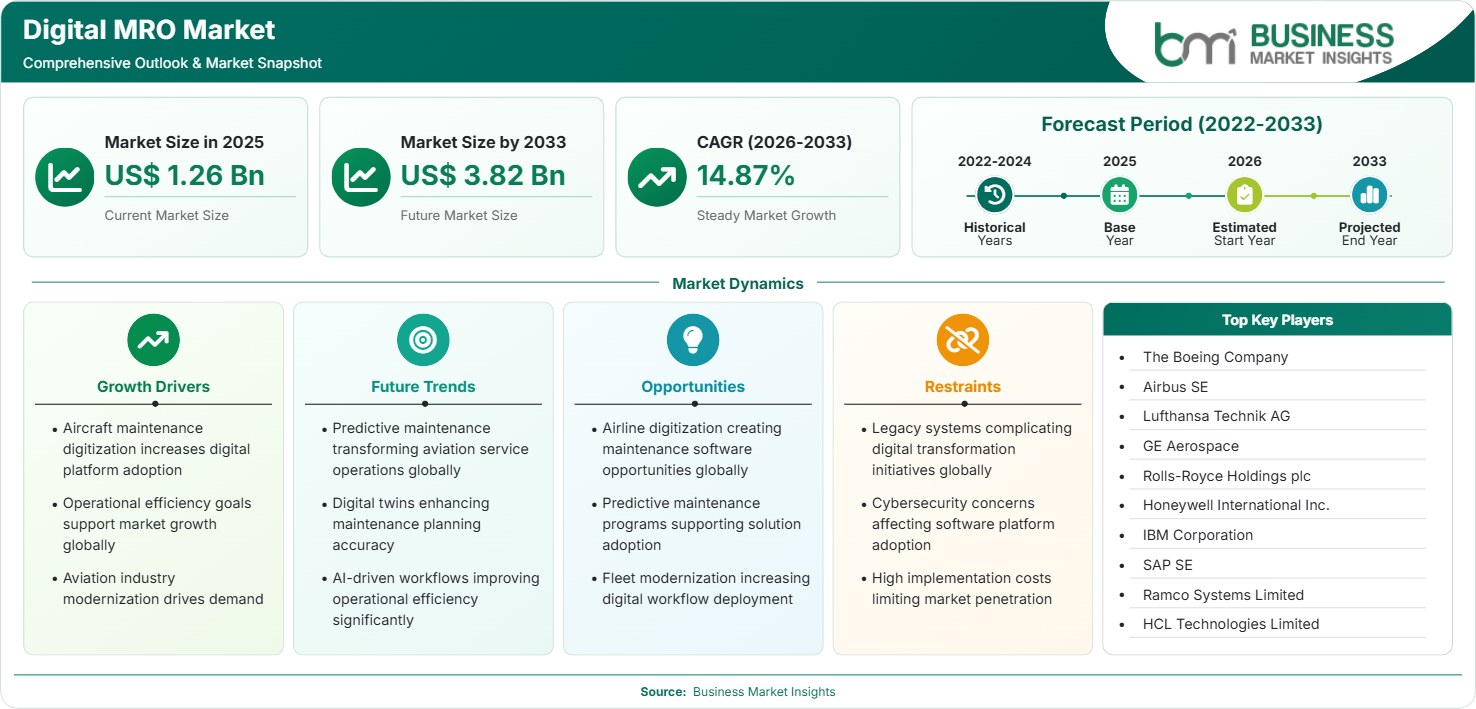
The Digital MRO Market size was valued at US$ 1.26 Billion in 2025 and is projected to reach US$ 3.82 Billion by 2033, growing at a CAGR of 14.87% during 2026–2033, driven by predictive maintenance adoption, connected aircraft ecosystems, AI-based diagnostics, fleet modernization programs, and increasing demand for operational efficiency across aviation maintenance operations.

Report Coverage
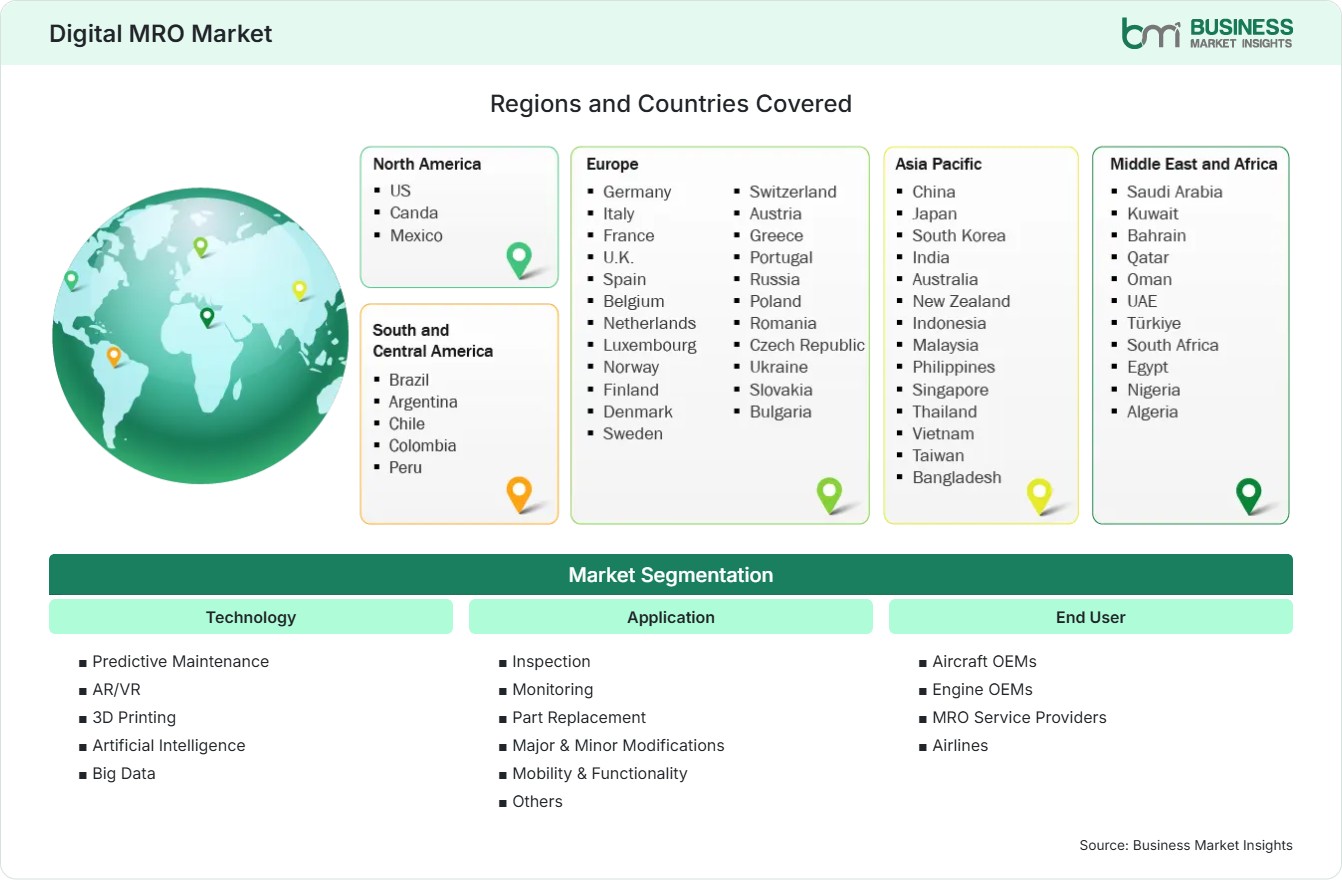
  • Technology: Predictive Maintenance, AR/VR, 3D Printing, Artificial Intelligence, Big Data
  • Application: Inspection, Monitoring, Part Replacement, Major & Minor Modifications, Mobility & Functionality, Others
  • End User: Aircraft OEMs, Engine OEMs, MRO Service Providers, Airlines
US$ 1.26 Bn Market size in 2025
US$ 3.82 Bn Market Size by 2033
14.87% CAGR, 2026 - 2033
2026-2033 Forecast Period

AI Overview

Digital MRO Market Summary

  • North America Region: North America holds a market share of 36%–39% in 2025, growing at a CAGR of 13.5%–14.5% during 2026–2033, supported by connected aircraft fleets, digital maintenance platforms, predictive analytics deployment, aerospace software investments, and advanced regulatory acceptance of electronic maintenance records. US benefits from strong airline digitization investments and aircraft health monitoring adoption, advancing at approximately 13.8%–14.8% CAGR.
  • Fastest Growing Region: Asia Pacific holds a market share of 24%–28% in 2025, growing at a CAGR of 16.5%–18.5% during 2026–2033, supported by airline fleet expansion, airport infrastructure investments, indigenous aerospace programs, maintenance digitalization initiatives, and increasing adoption of AI-enabled maintenance technologies.
  • Leading Segment: Predictive Maintenance holds a Digital MRO Market share of 28%–32% in 2025, growing at a CAGR of 15.5%–17.0% during 2026–2033, driven by aircraft health monitoring, reduced unscheduled maintenance events, real-time data analytics, operational efficiency gains, and improved maintenance planning capabilities.
  • High Growth Segment: Artificial Intelligence holds a market share of 14%–18% in 2025, growing at a CAGR of 18.0%–20.0% during 2026–2033, supported by automated inspections, intelligent diagnostics, digital workflows, maintenance optimization requirements, workforce productivity enhancement, and expanding aviation data ecosystems.
  • Key Market Opportunity: Increasing integration of digital twins, predictive analytics, and electronic maintenance documentation across airline fleets creates scalable opportunities for software providers, MRO organizations, OEMs, and aviation technology ecosystems globally.
  • Major Market Players: The Boeing Company, Airbus SE, Lufthansa Technik AG, GE Aerospace, Rolls-Royce Holdings plc, Honeywell International Inc., IBM Corporation, SAP SE, Ramco Systems Limited, HCL Technologies Limited.
Strategic Insights

Digital MRO Market: Strategic Insights

Digital MRO Market Strategic Framework
FREE PDF
Request your free sample
Request free sample
Stakeholder View

Key Takeaways

  • The industry value chain is moving towards integrated digital ecosystems in which the various players (aircraft operators, OEMs, software providers, engine manufacturers and maintenance organizations) are sharing operational data via connected platforms.
  • The biggest commercial upside is in the predictive maintenance applications, which can reduce aircraft on-ground incidents, improve asset utilization, and enable condition-based maintenance scheduling.
  • AI, machine vision and digital twin are all becoming key innovation areas with the potential to enable automated inspection, anomaly detection, predictive maintenance and improved decision support.
  • Asia Pacific remains the most attractive regional investment case with fleet growth, airport expansion programs, growing aviation passenger traffic and increasing investment in advanced MRO infrastructure.
  • Strategic partnerships between the airlines, the OEMs, the cloud providers and the software vendors are rapidly driving market consolidation and the development of integrated maintenance intelligence platforms.
  • Workforce productivity solutions leveraging generative AI and digital knowledge management tools are increasingly relevant as aviation maintenance organizations grapple with the issue of skilled labor shortages.
Geographic Outlook

Digital MRO Market Regional Highlights

North America Digital MRO Market

North America accounted for approximately 36%–39% of global Digital MRO Market revenue in 2025 and is projected to expand at a 13.5%–14.5% CAGR through 2033. The region benefits from extensive deployment of connected aircraft systems, mature aviation data infrastructure, advanced MRO networks, and early adoption of predictive maintenance technologies.

  • The leading airlines are now extending their aircraft health monitoring programs to reduce the number of unscheduled maintenance events, improve asset utilization, optimize spare part inventories, and enhance the long-term reliability of their commercial fleets.
  • Digital twin implementation is still accelerating amongst the maintenance providers with the capability to enable simulation-driven maintenance planning, lifecycle forecasting and real-time aircraft condition assessment, all of which serve to reduce maintenance turnaround times.
  • Cloud-based maintenance management platforms are taking over the legacy systems, offering improved levels of cross-functional collaboration, electronic documentation access, compliance management and operational visibility across the entire maintenance workflow.
  • Growing integration between the OEMs, the maintenance providers, and the airlines themselves is creating these integrated data environments, which in turn support predictive diagnostics, component tracking, and the automation of maintenance decisions.
  • The Digital MRO Market share remains highest in North America because of strong aerospace technology spending, established aviation infrastructure, and early commercialization of intelligent maintenance analytics.

US Digital MRO Market

The United States represented nearly 74%–78% of the North American Digital MRO Market in 2025 and is forecast to record a 13.8%–14.8% CAGR during 2026–2033. Large commercial fleets, significant defense aviation investments, and extensive digital aviation infrastructure support technology adoption.

  • Airline operators are increasingly using machine learning applications that can identify early signs of component degradation, enabling proactive repair decisions and reducing the number of aircraft on the ground.
  • Federal acceptance of electronic documentation enables a scalable implementation of paperless maintenance environments, resulting in improved maintenance accuracy and more efficient compliance management.
  • The major technology providers are working with the aerospace organizations to bring in the analytics, digital workflows, and real-time maintenance intelligence across the operations.
  • Workforce productivity tools based on AI knowledge systems are used to mitigate the technician shortage and at the same time improve the speed and effectiveness of maintenance planning and troubleshooting.

Europe Digital MRO Market

Europe held approximately 27%–30% Digital MRO Market share in 2025 and is anticipated to achieve a 13.8%–15.0% CAGR through 2033. The regional aviation ecosystem benefits from strong OEM participation, sustainability-focused aviation modernization, and increasing digitalization initiatives among airlines and maintenance providers.

  • European carriers are embedding predictive maintenance into their sustainability initiatives with the aim of improving aircraft utilization and, at the same time, reducing the amount of resource-intensive maintenance.
  • Regulatory digitization is helping to drive acceptance of electronic maintenance records and is resulting in more efficient and traceable maintenance operations.
  • Germany has regional leadership through its aerospace manufacturing base, its very extensive maintenance infrastructure and its digital engineering capability.
  • Spain has real growth potential. The country is seeing its aircraft fleets expand, with significant investment in aviation and growing demand for technology-driven maintenance services.
  • Maintenance providers are looking at AR applications for training of technicians, for inspection support, and for the standardization of maintenance execution across sites.

Asia Pacific Digital MRO Market

Asia Pacific represented approximately 24%–28% of global Digital MRO Market revenue in 2025 and is expected to register the fastest expansion at a 16.5%–18.5% CAGR through 2033. Rising air passenger traffic, expanding aircraft fleets, and increasing aviation infrastructure investments are driving technology adoption.

  • Airlines throughout the region are focused on digitalizing their maintenance to improve aircraft availability, improve operational reliability, and reduce maintenance spend over the longer term.
  • China is still the leader in regional deployments with its investments in smart aviation, advanced analytics and indigenous aerospace development programs.
  • India has particularly strong expansion potential with airlines adding to their fleets and investing heavily in technology-enabled maintenance.
  • Regional MROs are moving to cloud-native platforms which in turn improve maintenance scheduling, inventory visibility and regulatory compliance across their disparate facilities.
  • Strong government support for the modernization of the aviation sector is the driver behind the integration of AI, predictive analytics, and digital maintenance management solutions.

Rest of World Digital MRO Market

The Rest of World region accounted for roughly 8%–11% of global Digital MRO Market revenue during 2025 and is projected to advance at a 14.0%–15.5% CAGR through 2033. In South and Central America, fleet modernization and airline efficiency initiatives are supporting maintenance digitalization.

  • Aviation operators throughout the Middle East are increasingly using predictive analytics to improve asset reliability and to optimize the efficiency of their maintenance scheduling.
  • Brazil is still leading the way in terms of implementation, with strong commercial aviation activity, a good base of maintenance capability and continued investment in digital transformation.
  • Gulf states are heavily investing in smart aviation platforms which support maintenance planning, component traceability and fleet performance optimization.
  • African aviation markets are slowly moving towards digital maintenance management systems as the various modernization initiatives get under way.
  • Cross-border aviation partnerships are enabling the transfer of technology, maintenance know-how, and digital workforce capabilities into the emerging aviation ecosystems.
Global Market Geography
FREE PDF
Request your free sample
Request free sample
Segment Analysis

Digital MRO Market Segmentation

Technology

The technology segment accounted for the largest proportion of industry investment, with predictive maintenance-led solutions representing approximately 28%–32% share in 2025 and the segment advancing at an estimated 15.5%–17.0% CAGR. Increasing aircraft connectivity, real-time health monitoring, and advanced analytics integration continue to expand the Digital MRO Market scope across maintenance planning, inspection, diagnostics, and lifecycle management activities.

  • Predictive maintenance: Widely adopted across commercial aviation operations to identify component degradation early, reduce unscheduled maintenance requirements, improve aircraft availability, and strengthen maintenance planning efficiency.
  • AR/VR: Supports technician training, maintenance guidance, remote expert assistance, and inspection standardization, enabling workforce productivity improvements and greater maintenance execution consistency.
  • 3D Printing: Increasingly utilized for approved component production, inventory optimization, spare-parts availability enhancement, and reduction of supply chain disruptions affecting maintenance operations.
  • Artificial Intelligence: Enables anomaly detection, automated diagnostics, maintenance forecasting, workflow optimization, and intelligent decision support throughout aviation maintenance environments.
  • Big Data: Supports real-time analysis of operational, maintenance, and performance datasets, strengthening predictive capabilities and improving maintenance planning outcomes.

Application

The application segment reflects growing demand for digitally enabled maintenance execution. Inspection-related solutions accounted for approximately a 26%–30% share in 2025, while the segment is projected to expand at a 15.0%–16.5% CAGR through the forecast period. Expanding automation capabilities, aircraft health monitoring systems, and Digital MRO Market trends related to predictive maintenance continue to influence adoption patterns.

  • Inspection: Digital inspections leverage analytics, computer vision, drones, and automated reporting capabilities, reducing inspection time while improving defect detection accuracy.
  • Monitoring: Continuous aircraft monitoring enables real-time operational visibility, facilitating proactive maintenance decisions and minimizing operational disruptions.
  • Part Replacement: Data-driven replacement scheduling helps optimize inventory management, reduce unnecessary component changes, and improve maintenance cost management.
  • Major and Minor Modifications: Digital documentation and engineering management tools support modification planning, certification processes, and maintenance compliance requirements.
  • Mobility and Functionality: Mobile maintenance applications improve technician productivity through real-time information access, workflow management, and collaborative maintenance execution.

End User

The end-user segment continues to benefit from increasing maintenance digitalization across the aviation value chain. Airlines maintained approximately a 34%–38% share in 2025 and are expected to achieve a 15.0%–16.8% CAGR through 2033. The Digital MRO Market Forecasts indicate sustained investments in predictive maintenance, workforce productivity technologies, and digital maintenance platforms across airline operations.

  • Aircraft OEMs: Focus on integrated maintenance ecosystems, digital twins, aircraft health monitoring, and lifecycle service offerings supporting long-term asset performance.
  • Engine OEMs: Utilize performance analytics, predictive diagnostics, and condition monitoring technologies to improve reliability and optimize maintenance outcomes.
  • MRO service providers: Continue expanding technology capabilities to improve maintenance efficiency, turnaround times, compliance management, and customer value creation.
  • Airlines: Drive adoption through fleet availability objectives, maintenance cost optimization strategies, and increasing demand for proactive maintenance intelligence.
Market Forces

Digital MRO Market Dynamics

Key Market Drivers

Expansion of Predictive Maintenance Across Commercial Fleets

Airlines are increasingly deploying predictive maintenance platforms to reduce unplanned aircraft groundings and improve fleet utilization. Industry adoption is supported by connected aircraft architecture, expanding sensor installations, and real-time data analytics capabilities. According to industry observations, predictive maintenance can lower airline maintenance costs by up to 15% and reduce unplanned delays by up to 35%, making it one of the strongest contributors to Digital MRO Market growth. Predictive maintenance solutions enable maintenance teams to identify component deterioration before operational failure occurs, improving maintenance scheduling efficiency and spare-parts management.

Industry Shift Toward Connected Aircraft Operations

Connected aircraft programs are now at the heart of many maintenance modernization initiatives underway around the world. Industry bodies are increasingly promoting the use of digital aircraft through aircraft health management, predictive analytics, RFID, digital records, and machine learning. Connected aircraft allow the continuous flow of operational performance data from the key systems, enabling the maintenance provider to make decisions in near real time. The availability of live aircraft performance data leads to better maintenance planning, better component traceability and improved operational reliability.

Growing Adoption of AI-Assisted Maintenance Workflows

AI is revolutionizing the way aviation maintenance organizations conduct diagnostics, inspections, work planning, and knowledge transfer. AI-powered computer vision can detect structural anomalies during inspections. Machine learning can be used to analyze operational data to predict when maintenance will be required. Generative AI is also emerging as a productivity enabler for maintenance organizations under pressure from both a technician shortage and the sheer complexity of their operations. AI-assisted systems can improve troubleshooting efficiency, automate documentation review, and speed up maintenance execution.

Key Market Opportunities

Digital Twin Deployment Across Aircraft Lifecycles

Digital twin technology offers real commercial potential for airlines, OEMs and MROs. The concept is to create a virtual representation of an asset (an aircraft system or component) and use that to simulate its performance and assess the likely outcome of a maintenance action prior to any physical work being carried out. Broader adoption of the technology has the potential to improve the accuracy of maintenance planning, improve lifecycle management, and improve operational reliability. As operators look more to data-driven asset management, the demand for digital twin software and the associated analytics platforms is likely to grow.

Expansion of Digital MRO Platforms in Emerging Aviation Markets

Rapid aviation development across Asia Pacific, the Middle East, and selected Latin American countries creates significant market expansion opportunities. Many airlines in these regions are modernizing maintenance environments through cloud-based software, digital records management, and predictive maintenance applications. The Digital MRO Market Forecasts for emerging aviation regions remain favorable because operators can implement advanced digital systems without extensive dependence on legacy infrastructure.

Automation of Maintenance Documentation and Compliance

Aviation regulation continues to stress traceability, accuracy, and transparency of maintenance activities. There's clearly a market for providers of electronic technical records, automated compliance reporting, and digital workflow management systems. The airlines and MROs are looking for solutions that will reduce the amount of admin they have to do while improving their compliance. The automated documentation solution can facilitate quicker audits, better access to records, and better working relationships across the maintenance community.

Market Restraints and Challenges

High Integration Complexity Across Legacy Systems

Factor: A huge number of airlines and MROs are still running on legacy maintenance software, with a whole host of disparate databases and disconnected operational systems. Impact: Bringing in the benefits of advanced analytics, predictive maintenance, and digital workflows typically requires a major investment, extensive migration work, and a complete rethink of how things are done. There's a real risk of operational disruption, which can lead to delays and increased project costs. It's vital that the various systems across aircraft platforms, MROs, OEMs and the various regulatory reporting systems are all interoperable.

Cybersecurity and Aviation Data Protection Concerns

Factor: Digital maintenance environments rely on connected aircraft, cloud platforms, sensor networks, and extensive data exchange among various stakeholders. Impact: Increased connectivity creates a significantly larger attack surface for cyberattacks, data breaches, and operational disruptions. Airlines and maintenance providers will need to continue to invest in cybersecurity infrastructure, staff training, data governance controls, and compliance.

Company Analysis

Competitive Landscape

Digital MRO Market analysis indicates increasing competition among aerospace OEMs, maintenance specialists, enterprise software providers, and industrial technology companies focused on predictive maintenance and digital aviation operations.

Company Name

Overview

Products and Services relevant to this market

The Boeing Company

Major aerospace manufacturer providing fleet-support solutions, analytics, and connected aviation maintenance services globally.

Aircraft health management, predictive analytics, maintenance software, fleet performance monitoring, and digital aviation services.

Airbus SE

Global aircraft manufacturer investing heavily in connected aircraft ecosystems and digital maintenance technologies.

Skywise platform, predictive maintenance tools, aircraft analytics, and digital operational intelligence solutions.

Lufthansa Technik AG

Leading independent aviation maintenance provider serving airlines and aircraft operators worldwide.

Digital maintenance management, predictive maintenance services, technical operations software, and aircraft diagnostics.

GE Aerospace

Major engine and aerospace technology provider with advanced maintenance analytics capabilities.

Engine health monitoring, predictive analytics, digital twins, asset performance management, and maintenance intelligence solutions.

Rolls-Royce Holdings plc

Global aircraft engine producer emphasizing power-by-the-hour and condition monitoring solutions.

Engine analytics, digital maintenance services, predictive diagnostics, and lifecycle performance monitoring.

Honeywell International Inc.

Industrial technology provider delivering connected aviation and maintenance optimization systems.

Aircraft connectivity, maintenance software, operational analytics, and predictive maintenance tools.

IBM Corporation

Enterprise technology company supporting aviation digital transformation initiatives globally.

Artificial intelligence solutions, cloud services, analytics platforms, and maintenance optimization software.

SAP SE

Enterprise software provider enabling digital asset and maintenance management capabilities.

ERP integration, maintenance management applications, analytics, and operational workflow solutions.

Ramco Systems Limited

Specialized aviation software company focused on MRO digitalization.

Aviation MRO software, maintenance planning tools, inventory management, and digital workflow platforms.

HCL Technologies Limited

Technology services company supporting aerospace digitization and engineering services.

Digital engineering, analytics, cloud transformation, AI-enabled maintenance solutions, and aviation IT services.

Trust & Transparency

Research Methodology

The market analysis combines proprietary research with secondary data from government agencies, company disclosures, regulatory filings, industry databases and expert interviews. Market estimates are validated through data triangulation, cross-market benchmarking and analyst review.

View Full Research Methodology

Questions Answered

Frequently Asked Questions

What does a Digital MRO Market Report typically evaluate?

A Digital MRO Market Report generally evaluates market size, technology adoption patterns, competitive positioning, segmentation trends, regulatory developments, investment opportunities, regional outlooks, and demand drivers influencing long-term industry growth.

How does artificial intelligence support aviation maintenance operations?

Artificial intelligence supports anomaly detection, maintenance forecasting, automated inspections, document analysis, troubleshooting assistance, and workflow optimization. These capabilities improve technician productivity and enable more informed maintenance decisions.

Why is Asia Pacific considered the fastest-growing regional market?

Rapid fleet expansion, increasing passenger traffic, airport infrastructure development, government aviation initiatives, and investments in advanced maintenance facilities are accelerating technology adoption across several Asia Pacific countries.

Which technology segment is expected to create the highest value during the forecast period?

Predictive maintenance is expected to create the highest value because it directly improves operational reliability, reduces unscheduled maintenance events, enhances spare-parts planning, and supports optimization of maintenance resources across airline fleets.

What is driving adoption of digital maintenance technologies in aviation?

Airlines increasingly seek higher aircraft availability, lower maintenance costs, and reduced operational disruptions. Predictive analytics, aircraft health monitoring, connected aircraft systems, and AI-assisted diagnostics enable maintenance organizations to transition from reactive to condition-based maintenance approaches.

Access the Full Digital MRO Market Report

Get segment-level forecasts, regional estimates, competitive benchmarking, company profiles and downloadable Excel datasets.

Access the full Digital MRO Market Report
350 pages PDF & Excel | 2026-11-10
Similar Research

Related Market Reports