
Aviation MRO Software Market Outlook: Size, Share, Trends, Growth Analysis, Competitive Landscape & Forecast, 2026-2033

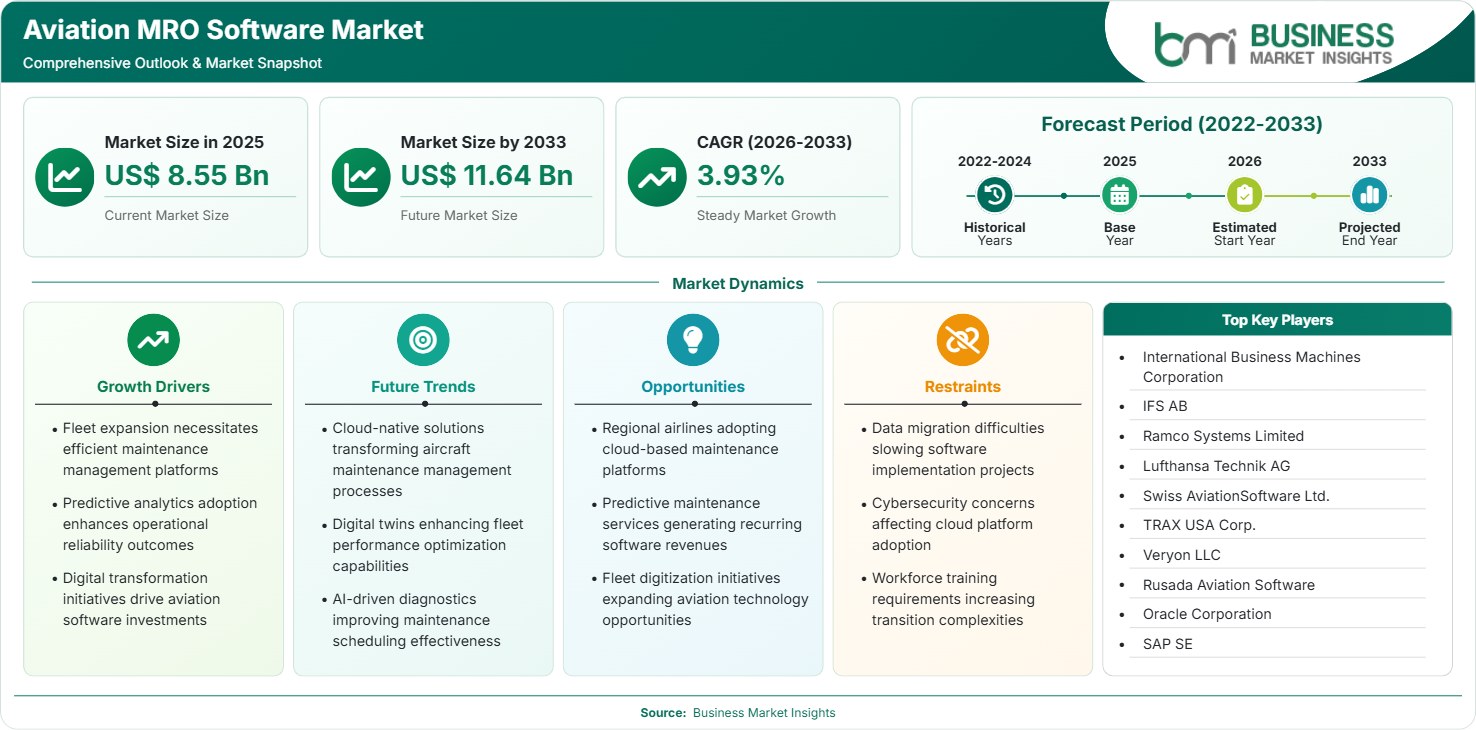
The Aviation MRO Software Market size was valued at US$ 8.55 Billion in 2025 and is projected to reach US$ 11.64 Billion by 2033, growing at a CAGR of 3.93% during 2026–2033, driven by fleet expansion, digital maintenance, predictive analytics, cloud adoption, regulatory traceability, and supply-chain visibility.

Report Coverage
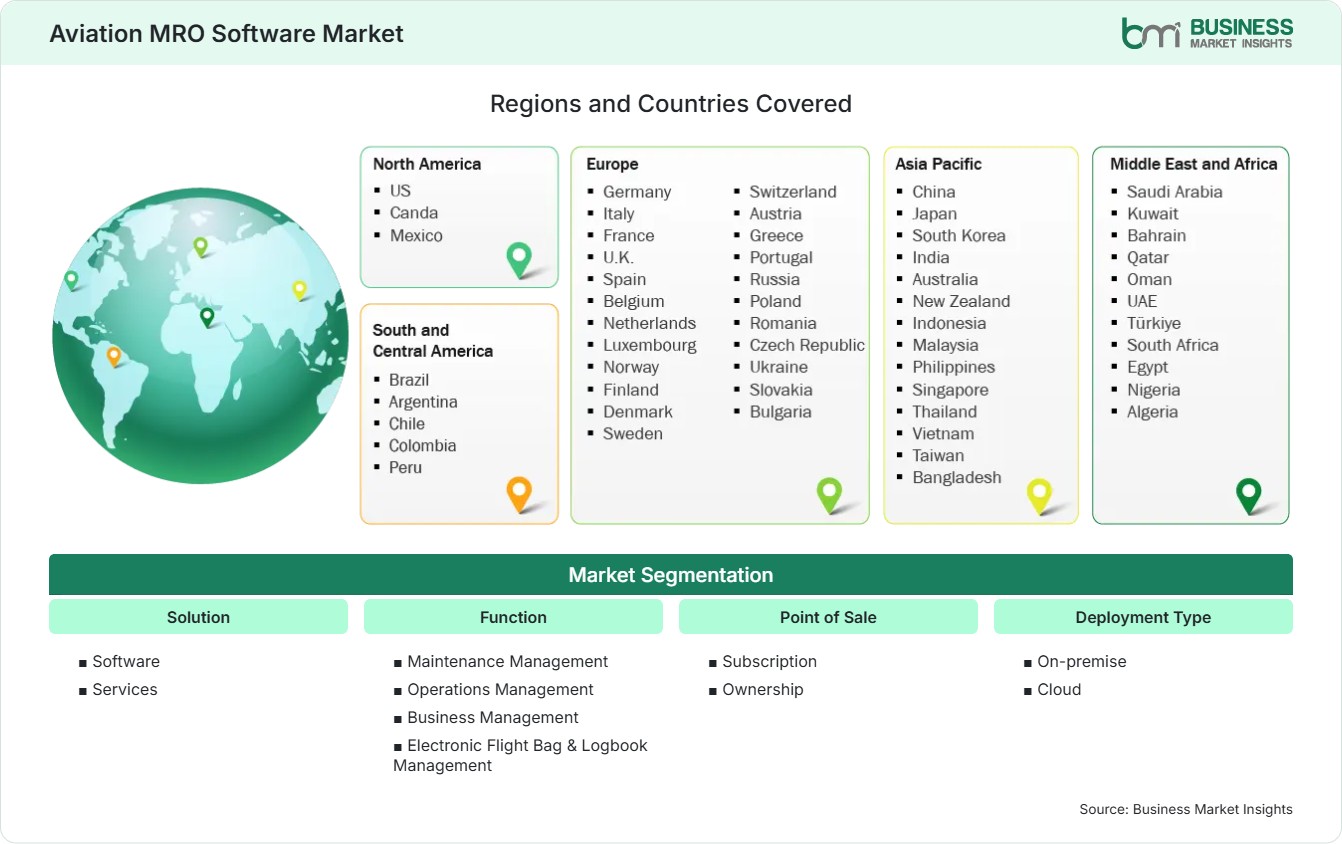
  • Solution: Software, Services
  • Function: Maintenance Management, Operations Management, Business Management, Electronic Flight Bag & Logbook Management
  • Point of Sale: Subscription, Ownership
  • Deployment Type: On-premise, Cloud
  • End-use: Airline Operator, MROs, OEMs
US$ 8.55 Bn Market size in 2025
US$ 11.64 Bn Market Size by 2033
3.93% CAGR, 2026 - 2033
2026-2033 Forecast Period

AI Overview

Aviation MRO Software Market Summary

  • North America: North America holds market share of 27%–30% in 2025, growing at a CAGR of 3.5%–4.2%, influenced by mature airline fleets, regulatory digitization, predictive maintenance adoption, integrated enterprise platforms, strong MRO infrastructure, and investment in AI-enabled maintenance workflows. The US market benefits from large airline fleets, established MRO providers, FAA compliance requirements, and advanced enterprise software adoption, supporting approximately 3.6%–4.2% CAGR during 2026–2033.
  • Fastest Growing Region: Asia Pacific holds market share of 25%–28% in 2025, expanding at a CAGR of 4.3%–5.0%, supported by expanding commercial fleets, airline modernization, growing MRO outsourcing, new aircraft deliveries, cloud adoption, and increasing digital maintenance investment across China, India, Japan, and Southeast Asia.
  • Leading Segment: Maintenance Management holds approximately 34%–38% Aviation MRO Software Market share in 2025, expanding at a CAGR of 4.0%–4.6%, supported by maintenance planning, fleet availability requirements, compliance documentation, predictive analytics, work-order automation, technician productivity, and increasingly integrated aircraft, component, and engine management.
  • High Growth Segment: Cloud deployment represents approximately 25%–30% share in 2025 and is expanding at a CAGR of 5.5%–6.2%, supported by subscription economics, faster deployment, remote accessibility, centralized data, lower infrastructure requirements, scalable computing, and demand for continuously updated maintenance applications.
  • Key Market Opportunity: The strongest opportunity lies in integrating AI, electronic technical logs, predictive maintenance, inventory intelligence, and workforce planning into unified cloud platforms that convert fragmented maintenance data into operational decisions.
  • Major Market Players: International Business Machines Corporation, IFS AB, Ramco Systems Limited, Lufthansa Technik AG, Swiss AviationSoftware Ltd., TRAX USA Corp., Veryon LLC, Rusada Aviation Software, Oracle Corporation, and SAP SE.
Strategic Insights

Aviation MRO Software Market: Strategic Insights

Aviation MRO Software Market Strategic Framework
FREE PDF
Request your free sample
Request free sample
Stakeholder View

Key Takeaways

  • Value is moving toward integrated platforms connecting maintenance planning, inventory, engineering, compliance, finance, and workforce management rather than isolated point applications.
  • Cloud deployment and predictive maintenance provide higher expansion potential because operators increasingly require scalable infrastructure, remote access, continuous updates, and data-driven maintenance decisions.
  • AI-assisted troubleshooting, electronic technical logs, machine-learning recommendations, digital records, and real-time aircraft information are becoming embedded in maintenance workflows. IATA specifically identifies these technologies within its digital aircraft operations agenda.
  • Asia Pacific combines fleet expansion with increasing MRO outsourcing and modernization programs, creating opportunities for vendors able to deliver localized compliance, multilingual interfaces, cloud hosting, and rapid implementation.
  • Vendor consolidation is strengthening integrated maintenance portfolios. Veryon, for example, incorporated EBIS solutions following its October 2025 acquisition, subsequently launching Veryon Work Center and Veryon GSE.
  • Subscription models increasingly allow smaller operators and independent MROs to avoid large infrastructure investments while obtaining continuously updated software and analytics capabilities.
Geographic Outlook

Aviation MRO Software Market Regional Highlights

North America Aviation MRO Software Market

North America accounted for approximately 27%–30% of the Aviation MRO Software Market share in 2025 and is projected to expand at 3.5%–4.2% CAGR through 2033. Mature airline fleets, extensive MRO infrastructure, strong enterprise software capabilities, and stringent regulatory documentation requirements support adoption. The region also benefits from established vendors and large-scale airline technology programs. Demand is increasingly shifting toward predictive maintenance, cloud platforms, mobile execution, and integrated supply-chain management.

  • Fleet complexity is encouraging integrated maintenance planning, component tracking, inventory optimization, and compliance workflows across large operators and independent MRO organizations.
  • AI-enabled diagnostics and predictive analytics are increasingly connected with maintenance records, allowing operators to prioritize recurring defects and reduce avoidable troubleshooting effort.
  • FAA-oriented traceability requirements reinforce digital documentation, electronic records, technician authorization controls, and auditable maintenance histories.
  • Cloud modernization is creating demand for scalable platforms that support geographically distributed maintenance facilities without duplicating local infrastructure.

US Aviation MRO Software Market

The US represents the largest national market within North America, supported by extensive commercial aviation activity, major MRO providers, OEM ecosystems, and mature enterprise technology adoption. Its 2025 share within North America is approximately 58%–64%, while growth is expected at 3.6%–4.2% CAGR. Demand increasingly centers on predictive maintenance, electronic records, fleet planning, inventory visibility, and compliance automation.

  • Large airline and MRO fleets require sophisticated maintenance planning and component-control functionality, supporting continued investment in integrated platforms.
  • Digital compliance and electronic documentation are important adoption factors as operators seek traceable maintenance histories and faster audit preparation.
  • Cloud migration is gradually replacing fragmented infrastructure, particularly where operators need standardized applications across multiple facilities and maintenance locations.

Europe Aviation MRO Software Market

Europe Aviation MRO Software Market was estimated to account for around 23%-25% in 2025 and is predicted to grow at a CAGR of 3.2%-4.0% through 2033. The important technology centers and MRO centers are Germany, the UK, France, Spain, and Switzerland. Germany and the UK have significant enterprise demand, while Spain and other Central European aviation centers have growth potential.

  • Germany and the UK remain important markets because of established airlines, MRO providers, aerospace manufacturers, and technology-intensive maintenance ecosystems.
  • France benefits from a strong aerospace industrial base and continued integration between OEM, airline, and MRO digital workflows.
  • Switzerland remains strategically important through AMOS adoption and the international customer base served by Swiss AviationSoftware.
  • Cloud-based maintenance systems are gaining traction as operators modernize legacy platforms and seek standardized data access across locations.

Asia Pacific Aviation MRO Software Market

Asia Pacific market contributed around 25%-28% in 2025 and is expected to expand at a 4.3%-5.0% CAGR, making it the fastest-growing among the regions considered. China, Japan, India, Singapore, South Korea, and Southeast Asia are major demand centers in this market. Expansion of fleet, increased passenger traffic, outsourcing of MRO, new aircraft additions, and legacy system modernization are driving adoption.

  • India offers strong demand as airline fleets expand and domestic MRO capabilities develop, creating opportunities for integrated maintenance and supply-chain platforms.
  • China remains significant because of fleet scale, domestic aviation development, and demand for localized digital maintenance capabilities.
  • Japan is moving toward cloud modernization, illustrated by Japan Airlines selecting IFS Cloud for Aviation Maintenance in 2025.
  • Southeast Asian airlines are increasingly adopting hosted systems to improve documentation, maintenance planning, and operational scalability without extensive infrastructure investment.

Rest of World Aviation MRO Software Market

Rest of World Aviation MRO Software Market constitutes around 19%-25% of global demand in 2025 and is expected to grow at a CAGR of 3.0%-4.0%. South and Central America are dominated by Brazil and Mexico, while the Middle East and Africa will gain due to growth in air traffic, MRO, and upgrades to aviation infrastructure. Gulf markets have a technological advantage, whereas emerging markets have an economic edge.

Latin American airlines need software solutions to plan their fleets, schedule maintenance, manage inventory, and report regulatory issues as their aviation networks mature. While Brazil offers the biggest technology play in the sub-region, Mexico will leverage its proximity to the North American aerospace ecosystem.

  • Gulf aviation investment supports sophisticated maintenance platforms integrating fleet, engineering, inventory, and operational information.
  • Brazil provides a substantial Latin American opportunity as operators modernize maintenance infrastructure and pursue greater operational efficiency.
  • Saudi Arabia and the United Arab Emirates are attractive technology markets because aviation expansion is being accompanied by MRO ecosystem development.
  • African operators increasingly require cloud-based systems that reduce infrastructure requirements while improving maintenance documentation and parts visibility.
Global Market Geography
FREE PDF
Request your free sample
Request free sample
Segment Analysis

Aviation MRO Software Market Segmentation

Solution

The Solution category accounted for around 68%–73% of the Aviation MRO Software Market in 2025 and is expected to grow at a 3.8%–4.4% CAGR through 2033. The importance of software persists in maintenance planning, whereas the role of services is in implementing, integrating, migrating, and optimizing solutions.

  • Software: Software supports maintenance planning, asset records, work orders, inventory, engineering, compliance, and analytics, with integrated platforms gaining adoption as operators consolidate disconnected applications.
  • Services: Services encompass implementation, integration, consulting, support, migration, and upgrades, remaining essential where legacy maintenance databases require complex transformation and operational alignment.

Function

The function category accounted for 62%–67% of the market in 2025 and is expected to grow at a 4.0%–4.6% CAGR over the forecast period from 2026 to 2033. The role of maintenance-oriented processes is significant, while the business and operational modules link maintenance actions to enterprise resources and labor.

  • Maintenance Management: Maintenance management coordinates scheduled tasks, defects, work orders, aircraft records, components, and maintenance planning, supporting higher fleet availability and compliance.
  • Operations Management: Operations management connects training, safety, quality assurance, supply-chain activities, and operational planning, reducing information gaps between maintenance and flight operations.
  • Business Management: Business management integrates accounts, finance, sales, marketing, and human resources, helping MRO organizations align maintenance activity with commercial and workforce planning.
  • Electronic Flightbag & Logbook Management: Electronic flightbag and logbook systems digitize technical information, flight records, maintenance observations, and electronic signatures, supporting paperless operations and faster data transfer.

Point of Sale

Point of Sale represented approximately 54%–59% of the Aviation MRO Software Market share, and subscription-oriented purchasing and ownership-based licensing remain important among established operators. Subscription adoption is increasing as customers prioritize predictable costs, continuous upgrades, scalable capacity, and reduced infrastructure responsibilities.

  • Subscription: Subscription models lower upfront technology expenditure and support recurring access to upgrades, security enhancements, hosting, analytics, and customer support.
  • Ownership: Ownership remains relevant for organizations requiring extensive control over software environments, data architecture, customization, and internal technology governance.

Deployment Type

Deployment Mode is shifting towards the cloud mode, while on-premises continues to have a large user base. Cloud Deployment mode will grow at a 5.5%–6.2% CAGR through 2033, owing to its scalability, ease of access, and reduced infrastructure needs.

  • On-premise: On-premise platforms remain important among large organizations with established infrastructure, stringent internal controls, extensive customization, and long-running legacy maintenance databases.
  • Cloud: Cloud platforms enable centralized data access, faster deployment, subscription pricing, remote operations, and continuous software updates across geographically distributed maintenance environments.

End-use

End-use demand is primarily concentrated among MRO providers, airlines, and OEMs, with MROs having a significant installed base. Aviation MRO Software Market Growth is influenced by fleet growth, outsourcing of maintenance services, integration of aftermarket activities, and the increasing need to link technical and commercial processes.

  • Airline Operator: Airlines use MRO software to manage aircraft availability, maintenance schedules, technical records, parts, workforce requirements, and operational compliance.
  • MROs: MRO providers require multi-customer functionality covering work orders, quoting, inventory, billing, engineering, quality, and maintenance execution.
  • OEMs: OEMs use maintenance software to support aftermarket services, technical information, component management, fleet analytics, and customer support.
Market Forces

Aviation MRO Software Market Dynamics

Key Market Drivers

Fleet Aging and Maintenance Complexity

As aircraft age, the need to coordinate maintenance processes becomes more complex, and operators must manage multiple aircraft simultaneously. According to IATA, the global average age of aircraft was 15.2 years in 2026, while supply chain issues are making it harder to coordinate maintenance due to part shortages. This makes investing in software that coordinates scheduled maintenance, component history, stock management, engineering instructions, and workforce capabilities all the more relevant. The Aviation MRO Software Market growth is thus driven by operational challenges rather than by the number of aircraft alone. Aircraft health management and predictive maintenance have been identified by IATA as critical areas of digital aircraft operations.

Digital Compliance and Paperless Maintenance

Requirements for traceability have led to the adoption of more electronic documentation and other controls to replace the fragmented paper processes used to maintain systems. IATA identifies electronic logbooks, digital signatures, electronic maintenance records, and standardized maintenance data among its digital aircraft operations priorities. The Aviation MRO Software Market trends are therefore increasingly shaped by the requirement to preserve data integrity while allowing technicians to access approved information at the point of maintenance. It will also increase the need for mobile interfaces, role-based authorization, automatic task closure, and integrated engineering documentation. Companies that can incorporate their compliance controls directly into their maintenance execution process can eliminate data entry duplication and bring consistency to technical and operational systems.

Supply-Chain Visibility and Predictive Analytics

Aircraft parts shortages, repair bottlenecks, and long lead times are increasing the value of software that links maintenance planning with procurement, inventory, repair, warranty, and supplier information. According to IATA’s estimate, supply chain issues in the aviation sector will cost airlines at least $11 billion in 2025. Visibility, data, digitization, and AI were identified as the main concerns in this regard. Such factors drive the growth of the Aviation MRO Software Market, including forecasted inventory, recognition of shortages, decisions on whether to fix or replace a part, and automated demand planning. Predictive analysis can help focus on recurring flaws and maintenance patterns before they lead to unnecessary downtime.

Key Market Opportunities

Cloud Migration Across Legacy MRO Environments

Traditional MRO systems are deeply entrenched in airline and MRO practices, creating enormous migration potential for cloud companies. In June 2025, Japan Airlines chose IFS Cloud to modernize an aircraft maintenance system that has been running for over 15 years, illustrating the replacement cycle available to tech providers. Cloud systems enable infrastructure redundancy avoidance while delivering centralized data, standardized processes, continuous upgrades, and scalability. As such, the scope of the Aviation MRO Software Market goes beyond new clients to existing organizations looking to replace their outdated tech estates.

AI-Enabled Maintenance Decision Support

While there is an opportunity beyond automatic reporting for defect detection, troubleshooting, parts recommendations, forecasting, and maintenance scheduling, AI can be useful in providing these benefits. IATA explicitly addresses the use of AI and machine learning in aircraft maintenance and predictive analytics as part of digital aviation solutions. Aviation MRO Software Market Forecasts will become more dependent upon the economic benefit that results from the application of AI to aircraft maintenance than simply using the term. Successful implementations will rely on high-quality maintenance history records, controlled engineering data, transparent recommendations, and effective system integration. Vendors with substantial maintenance databases may find opportunities to develop unique models for defects, troubleshooting, inventory needs, and component reliability.

Electronic Technical Logs and Connected Maintenance

Electronic technical logs offer an opportunity to link cockpit observations to maintenance control, engineering, compliance, and operations planning. According to Swiss AviationSoftware, SunExpress successfully deployed its fleet with AMOSeTL following a phased implementation that took place with over 101,000 flights in a parallel run. This example shows how using electronic logs can help information flow quickly between the flight and maintenance departments. Suppliers can capitalize on this by integrating information from the eTechLog system with defect management, maintenance planning, inventory, and aircraft health data. The resulting workflow can reduce manual transcription and improve the speed at which operational defects enter maintenance planning.

Market Restraints and Challenges

Legacy-System Integration and Migration Complexity

Factor: Many aviation operators rely heavily on legacy databases unique to them, proprietary interfaces, maintenance histories, and other processes that cannot easily be replaced. Impact: The migration process could involve extensive data cleaning, interface development, and the parallel running of the two applications, which will increase implementation costs. This issue is particularly pertinent, especially for large airlines or MRO companies that have been collecting maintenance data for many years. It is important for vendors to prove their ability to integrate with engineering, flight operations, ERP, inventory, OEM, and regulatory systems, not just develop the MRO software in isolation.

Cybersecurity, Data Governance, and Operational Resilience

Factor: Connected cloud systems increase the number of interfaces through which sensitive maintenance, operational, supplier, and aircraft information can be accessed. Impact: The operators need to enhance their capabilities in identity management, access control, encryption, monitoring, backups, and incident response without affecting critical safety processes. In addition, aviation entities require assurances that their software upgrades and integration capabilities will not jeopardize system availability. The cybersecurity needs thus impact vendor choice, hosting model, data location, and solution design. Small-scale MRO operators might have limited budgets and manpower for supporting advanced security solutions. If vendors lack strong governance, auditing, resilience, and change management controls, they will experience a prolonged procurement process.

Company Analysis

Competitive Landscape

The Aviation MRO Software Market analysis shows competition between specialized aviation platforms and broader enterprise technology providers. Differentiation increasingly depends on maintenance depth, cloud architecture, AI capabilities, electronic records, implementation expertise, and integration with aircraft and supply-chain data.

Company Name

Overview

Products and Services relevant to this market

International Business Machines Corporation

Global technology provider with capabilities spanning cloud, AI, analytics, enterprise integration, and aviation data environments.

AI and analytics, cloud infrastructure, data integration, asset management, enterprise technology, and maintenance decision-support capabilities.

IFS AB

Enterprise software provider with dedicated aviation maintenance functionality and strong aerospace and defense positioning.

IFS Cloud for Aviation Maintenance, maintenance planning, logistics, inventory, compliance, asset management, and enterprise functions.

Ramco Systems Limited

Aviation technology specialist providing integrated maintenance and enterprise applications to airlines and MRO organizations.

Ramco Aviation Software covering maintenance, engineering, supply chain, quality, contracts, finance, and workforce functions.

Lufthansa Technik AG

Aviation MRO organization with extensive technical expertise and digital capabilities supporting aircraft maintenance ecosystems.

AVIATAR digital services, predictive maintenance, technical analytics, fleet management, and digital MRO solutions.

Swiss AviationSoftware Ltd.

Aviation software specialist behind AMOS, used extensively for airline and MRO maintenance management.

AMOS, AMOSeTL, maintenance planning, engineering, logistics, electronic technical records, and hosted services.

TRAX USA Corp.

Specialist aviation MRO software provider focused on integrated maintenance management for airlines and MROs.

eMRO, eMobility, maintenance planning, inventory, engineering, reliability, mobile maintenance, and analytics.

Veryon LLC

Aviation software and information provider combining maintenance workflows, technical publications, tracking, and analytics.

Veryon Tracking, Veryon Work Center, Veryon GSE, diagnostics, technical publications, maintenance and inventory workflows.

Rusada Aviation Software

Aviation software specialist serving airlines, MROs, CAMOs, and aviation organizations.

ENVISION, maintenance management, engineering, inventory, planning, compliance, and operational workflows.

Oracle Corporation

Enterprise software provider with cloud, ERP, finance, supply-chain, analytics, and asset-management capabilities applicable to aviation.

Oracle Cloud, enterprise resource planning, supply-chain management, financial management, analytics, and asset-management technologies.

SAP SE

Global enterprise software company with strong capabilities in ERP, asset management, procurement, analytics, and cloud infrastructure.

SAP S/4HANA, asset management, supply chain, finance, procurement, analytics, and enterprise integration.

Trust & Transparency

Research Methodology

The market analysis combines proprietary research with secondary data from government agencies, company disclosures, regulatory filings, industry databases and expert interviews. Market estimates are validated through data triangulation, cross-market benchmarking and analyst review.

View Full Research Methodology

Questions Answered

Frequently Asked Questions

What role does supply-chain visibility play in aviation maintenance technology?

Parts availability directly influences maintenance planning and aircraft availability. Integrated software can connect inventory, procurement, repair, warranty, and maintenance requirements, helping operators identify shortages and make better repair-or-replace decisions.

Why is AI becoming important in maintenance software?

AI can support troubleshooting, predictive maintenance, parts recommendations, demand forecasting, defect analysis, and maintenance prioritization. IATA identifies AI, machine learning, predictive maintenance, and aircraft health management among important digital aircraft operations priorities.

How are electronic technical logs changing maintenance workflows?

Electronic technical logs transfer technical observations digitally between flight crews and maintenance teams, reducing manual transcription and improving record availability. SunExpress deployed AMOSeTL across its fleet following an extensive implementation and parallel-run program.

What is driving the shift toward cloud-based MRO systems?

As per the Aviation MRO Software Market report, cloud deployment provides centralized access, scalable infrastructure, recurring subscription economics, continuous updates, and easier support for geographically distributed maintenance operations. Japan Airlines' 2025 IFS Cloud selection illustrates this modernization direction.

What capabilities should buyers prioritize when selecting aviation MRO software?

Buyers should evaluate maintenance planning, engineering, inventory, electronic records, compliance, mobile execution, analytics, integration, cybersecurity, scalability, and implementation capability rather than assessing individual modules independently.

Access the Full Aviation MRO Software Market Report

Get segment-level forecasts, regional estimates, competitive benchmarking, company profiles and downloadable Excel datasets.

Access the full Aviation MRO Software Market Report
350 pages PDF & Excel | 2026-10-12
Similar Research

Related Market Reports