
Helicopter MRO Services Market Outlook: Size, Share, Trends, Growth Analysis, Competitive Landscape & Forecast, 2026-2033

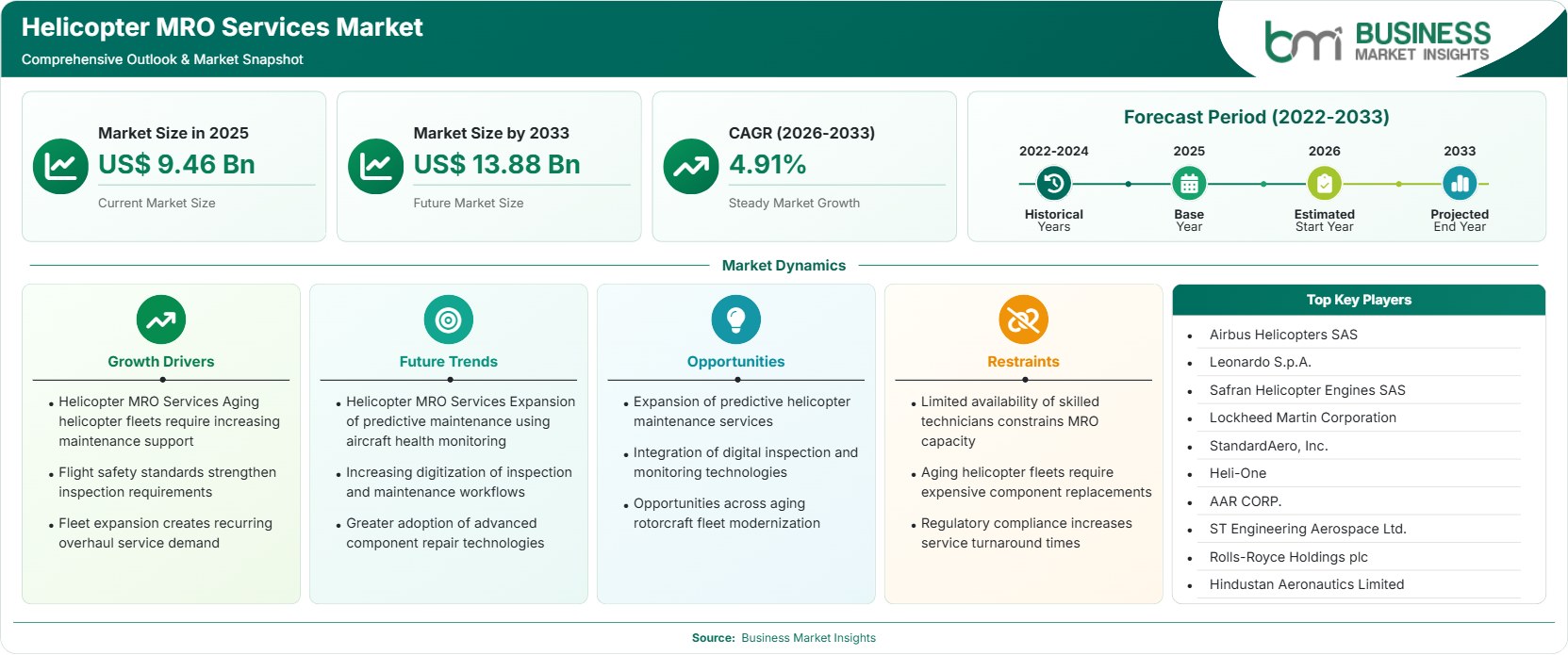
The Helicopter Maintenance, Repair, and Overhaul (MRO) Services Market size was valued at US$ 9.46 Billion in 2025 and is projected to reach US$ 13.88 Billion by 2033, growing at a CAGR of 4.91% during 2026–2033, driven by aging fleets, defense readiness, predictive maintenance, fleet modernization, and localized aftermarket capacity.

Report Coverage
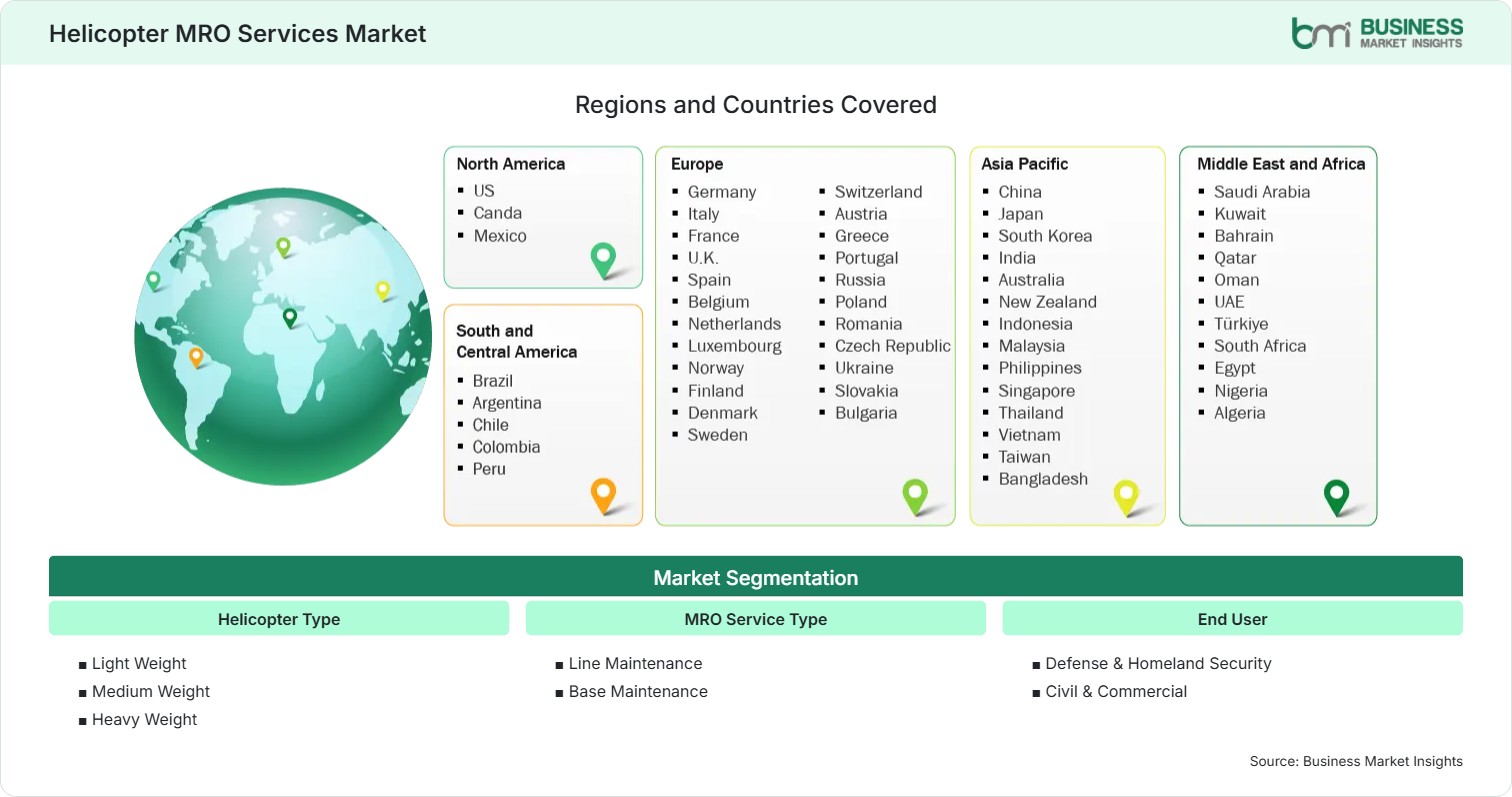
  • Helicopter Type: Light Weight, Medium Weight, Heavy Weight
  • MRO Service Type: Line Maintenance, Base Maintenance
  • End User: Defense & Homeland Security, Civil & Commercial
US$ 9.46 Bn Market size in 2025
US$ 13.88 Bn Market Size by 2033
4.91% CAGR, 2026 - 2033
2026-2033 Forecast Period

AI Overview

Helicopter MRO Services Market Summary

  • North America Region: North America holds a Helicopter MRO Services Market share of 40%–44% in 2025, growing with a CAGR of 4.2%–4.8% during 2026–2033, influenced by large installed fleets, defense sustainment, mature MRO infrastructure, component availability, and digital maintenance investments.
  • Fastest Growing Region: Asia Pacific holds a market share of 18%–22% in 2025, growing with a CAGR of 6.0%–6.8% during 2026–2033, supported by expanding helicopter fleets, infrastructure development, defense localization, rising utilization, and new regional MRO capabilities.
  • Leading Segment: Medium Weight helicopters hold a market share of 70%–75% in 2025, growing with a CAGR of 4.7%–5.3% during 2026–2033, supported by utility, offshore, emergency medical, transport, defense, and multi-mission applications requiring recurring maintenance.
  • High Growth Segment: Defense & Homeland Security holds a market share of 55%–60% in 2025, growing with a CAGR of 5.1%–5.7% during 2026–2033, driven by readiness requirements, fleet life extension, modernization, mission availability, indigenous sustainment, and long-term government contracts.
  • Key Market Opportunity: Fleet health monitoring, predictive maintenance, localized component repair, digital records, power-by-the-hour contracts, and regional service hubs create opportunities to reduce aircraft downtime while improving recurring aftermarket revenue.
  • Major Market Players: Airbus Helicopters SAS; Leonardo S.p.A.; Safran Helicopter Engines SAS; Lockheed Martin Corporation; StandardAero, Inc.; Heli-One; AAR CORP.; ST Engineering Aerospace Ltd.; Rolls-Royce Holdings plc; Hindustan Aeronautics Limited.
Strategic Insights

Helicopter MRO Services Market: Strategic Insights

Helicopter MRO Services Market Strategic Framework
FREE PDF
Request your free sample
Request free sample
Stakeholder View

Key Takeaways

  • The value chain is moving toward integrated aftermarket ecosystems in which OEMs, independent MRO providers, engine specialists, component suppliers, leasing organizations, and operators share maintenance data and inventory responsibilities.
  • The strongest upside lies in medium-weight platforms and defense fleets because these aircraft combine high utilization, complex mission profiles, expensive components, and recurring inspection requirements that support attractive aftermarket intensity.
  • Innovation is concentrating on predictive diagnostics, connected aircraft records, remote technical assistance, additive repair methods, digital twins, and analytics that convert maintenance history into actionable remaining-useful-life decisions.
  • Asia Pacific offers the strongest capacity-expansion case as fleet growth, domestic aerospace policies, infrastructure investment, and operator localization strategies encourage regional maintenance hubs rather than dependence on overseas facilities.
  • Investment activity is favoring capability expansion and consolidation. Recent aerospace aftermarket transactions demonstrate that engineering, certification, inventory, and heavy-maintenance capacity can be combined to increase customer retention and asset utilization.
  • Long-term service agreements are becoming strategically important because operators increasingly value guaranteed availability, fixed-cost planning, parts access, and technical support alongside conventional repair execution.
Geographic Outlook

Helicopter MRO Services Market Regional Highlights

North America Helicopter MRO Services Market

North America Helicopter MRO Services Market represents the largest regional demand pool, with a 40%–44% share in 2025 and CAGR of 4.2%–4.8% through 2033. Mature military fleets, extensive utility operations, established OEM networks, and sophisticated component ecosystems support recurring maintenance volumes.

  • Defense sustainment remains resilient as operators prioritize readiness, fleet availability, and life-extension programs for established rotorcraft platforms.
  • Offshore, emergency medical, utility, and law-enforcement missions generate frequent line-maintenance requirements because aircraft utilization and dispatch reliability directly affect operator economics.
  • Independent providers compete through turnaround time, component capability, mobile teams, and access to exchange inventories rather than facility scale alone.
  • Digital maintenance records and predictive diagnostics are increasingly incorporated into contracts, enabling earlier intervention and better planning of expensive component removals.

US Helicopter MRO Services Market

The US Helicopter MRO Services Market represents the largest country-level demand center within North America, accounting for approximately 34%–38% of global revenue in 2025 and expanding at 4.3%–4.8% through 2033. Demand is supported by defense fleets, commercial operators, emergency services, offshore activity, and substantial installed aircraft populations.

  • Defense aircraft sustainment provides predictable workloads, particularly where readiness requirements require depot maintenance, upgrades, component overhaul, and extended service lives.
  • Civil operators increasingly outsource specialized maintenance to reduce fixed infrastructure costs while retaining internal control over daily inspections and operational decisions.
  • MRO providers are investing in digital scheduling, inventory analytics, technician training, and repair engineering to reduce turnaround times and protect margins.

Europe Helicopter MRO Services Market

Europe Helicopter MRO Services Market holds a 23%–27% share in 2025, with CAGR of 4.0%–4.6% through 2033. France, Germany, Italy, the United Kingdom, and Spain form major maintenance centers, while Poland and Eastern European markets offer higher expansion potential.

  • France and Germany remain important defense-support markets, with industrial ecosystems capable of complex airframe, engine, avionics, and component work.
  • Italy benefits from strong helicopter manufacturing and aftermarket capabilities, supporting lifecycle services for Leonardo platforms and international operators.
  • The United Kingdom maintains specialized demand from offshore energy, emergency services, military fleets, and operators requiring high dispatch reliability.
  • Eastern Europe provides growth potential as defense modernization and fleet replacement increase requirements for authorized maintenance, training, and component support.

Asia Pacific Helicopter MRO Services Market

Asia Pacific Helicopter MRO Services Market accounts for 18%–22% of 2025 revenue and is the fastest-growing region, with CAGR of 6.0%–6.8% through 2033. China, Australia, Japan, India, and Southeast Asian markets anchor demand, while India, Indonesia, and selected regional operators offer strong expansion potential.

  • India is developing domestic aerospace capabilities, creating opportunities for OEM-authorized MRO, component repair, engine support, technical training, and lifecycle sustainment.
  • China combines a large domestic aerospace ecosystem with expanding commercial helicopter applications, generating demand for localized maintenance and parts capabilities.
  • Australia remains a mature regional operator market, supported by utility, emergency response, offshore, and defense missions requiring reliable maintenance infrastructure.
  • Southeast Asia offers strong potential as operators expand helicopter use for energy, tourism, emergency response, infrastructure, and public-sector missions.

Rest of World Helicopter MRO Services Market

South and Central America Helicopter MRO Services Market represent an emerging maintenance pool supported by energy, utility, emergency response, and public-sector operations. Brazil is the principal regional center, while Mexico and Colombia offer additional demand. Regional CAGR is estimated at 4.8%–5.5% through 2033, supported by localized support and fleet utilization.

Middle East and Africa demand is concentrated around defense, offshore energy, VIP transport, emergency services, and utility missions. The region is expected to grow at 5.0%–5.8%, with Saudi Arabia, the UAE, and South Africa offering the strongest investment cases.

  • Brazil is strengthening localized helicopter support as offshore energy and specialized aviation create requirements for component repair and platform-specific expertise.
  • Mexico and Colombia benefit from energy, government, and utility missions where aircraft availability and field maintenance capability are operational priorities.
  • Saudi Arabia and the UAE provide attractive defense and commercial opportunities because high-value fleets require sophisticated support, training, inventory, and technical infrastructure.
  • South Africa remains an important African maintenance base because of established aerospace capabilities and demand from utility, defense, emergency, and regional operators.
Global Market Geography
FREE PDF
Request your free sample
Request free sample
Segment Analysis

Helicopter MRO Services Market Segmentation

Helicopter Type

The Helicopter Type segment is led by Medium Weight aircraft, representing a 70%–75% share in 2025 and CAGR of 4.7%–5.3% through 2033. Their broad utility across defense, offshore, emergency response, transport, and commercial missions supports high maintenance intensity and recurring component demand. The Helicopter MRO Services Market scope remains broad because platform complexity varies considerably across weight categories.

  • Light Weight (Up to 3,000kg): Light platforms serve training, tourism, utility, surveillance, emergency response, and private operations, creating frequent line-maintenance demand and growing interest in cost-efficient digital diagnostics.
  • Medium Weight (3,000kg to 8,000kg): Medium platforms combine broad mission flexibility with substantial installed fleets, generating recurring inspections, dynamic-component repairs, engine support, avionics work, and lifecycle modernization requirements.
  • Heavy Weight (Above 8,000kg): Heavy helicopters require specialized structural, propulsion, transmission, and systems expertise, with maintenance demand concentrated among defense, offshore, heavy-lift, and specialized public-sector operators.

MRO Service Type

MRO Service Type demand is balanced between recurring operational maintenance and deeper scheduled interventions, with Line Maintenance holding a 35%–40% Helicopter MRO Services Market share in 2025 and growing at 4.4%–5.0% through 2033. Base Maintenance carries higher technical complexity and supports major inspections, structural work, modifications, and component-intensive activities.

  • Line Maintenance: Line maintenance supports daily dispatch through inspections, defect rectification, troubleshooting, servicing, and minor component replacement, making technician availability and parts logistics critical.
  • Base Maintenance: Base maintenance addresses deeper scheduled inspections, structural repairs, modifications, component replacement, and system overhauls, with demand increasing as aircraft age and operators extend service lives.

End User

Defense & Homeland Security leads the End User segment with a 55%–60% Helicopter MRO Services Market share in 2025 and CAGR of 5.1%–5.7% through 2033. Government fleets prioritize readiness and lifecycle availability, while Civil & Commercial operators emphasize cost control, dispatch reliability, and flexible outsourcing models. These requirements shape differentiated service contracts across the market.

  • Defense & Homeland Security: Military and government operators prioritize fleet availability, mission readiness, life-extension programs, depot maintenance, modernization, and secure supply chains for critical components.
  • Civil & Commercial: Civil operators focus on predictable maintenance costs, short turnaround times, safety compliance, passenger-service reliability, and outsourced support for specialized maintenance requirements.
Market Forces

Helicopter MRO Services Market Dynamics

Key Market Drivers

 Aging Fleets Increase Maintenance Intensity

As a result of increased fleet age, there is an increased demand for inspections, structural assessment, component replacement, corrosion protection, and life extension activities. Military and civil helicopters with mature fleets provide aftermarket demands despite limited purchases of new aircraft because the operators need to ensure mission availability. This dynamic supports Helicopter MRO Services Market growth through higher maintenance content per aircraft. Operators are also using refurbishment to extend useful life, upgrade avionics, improve safety systems, and address obsolescence.

Mission Availability Drives Outsourcing

Aircraft availability is increasingly the metric mission-critical operators use to measure maintenance performance. Forces in defense, emergency medical services, offshore operations, law enforcement, and utility services cannot afford any extended periods of grounding of their aircraft, as the availability of aircraft affects income generation, preparedness, and the results of public service. The Helicopter MRO Services Market trends increasingly favor providers able to combine scheduled maintenance with rapid defect resolution and supply-chain coordination.

Digital Maintenance Improves Planning Efficiency

Digital health management is shifting how maintenance needs are identified prior to the degradation of components being an issue that affects operations. Engine monitoring, vibration monitoring, electronic maintenance records, connectivity, and predictive analytics can all assist in prioritizing inspections and detecting abnormal trends. This approach works best when applied to fleets with higher utilization and expensive downtime. Helicopter MRO Services Market Digital tools also improve maintenance planning by integrating aircraft status, technician availability, parts inventory, and scheduled inspections. Providers capable of converting operational data into maintenance recommendations can strengthen customer retention and support longer-term service agreements.

Key Market Opportunities

Localized MRO Hubs in Emerging Markets

Localized maintenance hubs can capture demand currently routed to distant facilities, particularly in Asia Pacific, the Middle East, Latin America, and selected African markets. The regional nature of the facilities leads to reduced cost for the ferries, reduced response time, increased availability of the spare parts, and domestic employment in technical positions. It has become apparent to the governments that aerospace MRO is an industrial capability since the maintenance facilities ensure readiness of the fleet and decrease reliance on foreign contractors.

Predictive and Condition-Based Maintenance Services

Condition-based maintenance offers a recurring digital revenue opportunity alongside conventional repair work. Operators can subscribe to monitoring, analytics, technical alerts, maintenance planning, and remote support instead of purchasing isolated diagnostic services. Such a model is especially beneficial for multiple aircraft fleets since central monitoring will give technical staff the ability to compare different aircraft performance and detect common faults in components. Predictive analytics can be combined by MRO providers with component forecasting and technician scheduling to make operational decisions based on maintenance data. The commercial benefit for providers will increase if they tie monitoring to a guaranteed response.

Long-Term Performance-Based Support Contracts

Performance-based contracts can deepen customer relationships by shifting commercial emphasis from individual maintenance events toward fleet availability, predictable expenditure, and lifecycle outcomes. This type of agreement involves OEMs and non-OEMs working together in pooling parts, repair, service, engineering documentation, training, and data analysis through a bundled agreement. This concept is especially applicable to military aircraft and government fleets because their acquisition cycles require sustainment solutions for several years. Civil aircraft operators can also use such an arrangement if their maintenance costs are unpredictable or if technical expertise is hard to obtain internally.

Market Restraints and Challenges

Skilled Technician Shortages Constrain Capacity

Factor: A shortage of experienced rotorcraft technicians, inspectors, engineers, and specialized component personnel can restrict available maintenance capacity even when customer demand remains firm. Rotorcraft work requires platform-specific knowledge, certification, tooling familiarity, and practical experience that cannot be developed rapidly through short training cycles. Impact: Turnaround periods can be elongated by labor limitations, resulting in increased overtime expenses, restricting plant capacity, and hindering market expansion efforts. Organizations should focus on apprenticeship programs, technical schools, certifications, digital job aids, and employee retention.

Parts Availability and Supply-Chain Volatility

Factor: Limited availability of certified components, long lead times, aging platforms, obsolete parts, and concentrated supplier bases can disrupt maintenance schedules and increase inventory requirements. Impact: Aircraft may remain grounded after major maintenance work is technically complete because one unavailable component prevents return to service. Operators therefore increasingly value exchange pools, rotable inventories, repair partnerships, and predictive parts forecasting. MRO providers must balance inventory depth against working-capital requirements, particularly for low-volume components with high unit values.

Company Analysis

Competitive Landscape

The Helicopter MRO Services Market analysis indicates a fragmented competitive structure combining OEM-led lifecycle support, independent MRO specialists, engine manufacturers, defense contractors, and diversified aerospace aftermarket providers.

Company Name

Overview

Products and Services relevant to this market

Airbus Helicopters SAS

Major rotorcraft OEM with a broad installed base and integrated global customer-support infrastructure serving civil and military operators.

Airframe maintenance, inspections, technical support, upgrades, spare parts, component support, training, field service, and lifecycle solutions.

Leonardo S.p.A.

Major European helicopter manufacturer with extensive lifecycle-support capabilities across commercial, government, and military fleets.

Maintenance, repair, overhaul, logistics, training, technical assistance, fleet support, upgrades, components, and service plans.

Safran Helicopter Engines SAS

Global helicopter-engine specialist supporting a large installed propulsion base across multiple helicopter weight categories.

Engine MRO, repairs, overhaul, technical support, health monitoring, spare engines, parts, and lifecycle service agreements.

Lockheed Martin Corporation

Defense technology leader whose Sikorsky business supports major military and commercial rotorcraft platforms worldwide.

Helicopter sustainment, technical support, parts, field service, upgrades, overhaul support, and lifecycle readiness programs.

StandardAero, Inc.

Independent aerospace aftermarket provider with extensive engine maintenance capabilities serving government and commercial customers.

Engine overhaul, repair, component services, accessories, field support, inspections, and helicopter powerplant aftermarket services.

Heli-One

Helicopter-focused MRO specialist serving operators through global facilities and platform-specific engineering capabilities.

Airframe MRO, component repair, modifications, dynamic components, engineering, field services, and fleet support.

AAR CORP.

Diversified aviation aftermarket company combining repair, engineering, parts supply, and government support capabilities.

Component repair, parts, engineering, logistics, maintenance, modification, supply-chain services, and integrated aftermarket support.

ST Engineering Aerospace Ltd.

Aerospace MRO provider with capabilities spanning military and commercial platforms and specialized helicopter support.

Airframe maintenance, engine MRO, components, modifications, structural work, repairs, and lifecycle support.

Rolls-Royce Holdings plc

Established propulsion company with a large installed turboshaft base and long-term engine support capabilities.

Turboshaft maintenance, engine support, upgrades, parts, diagnostics, technical assistance, and lifecycle services.

Hindustan Aeronautics Limited

India-based aerospace manufacturer with major helicopter production and indigenous defense sustainment responsibilities.

Helicopter overhaul, repair, upgrades, component support, engineering, training, logistics, and lifecycle maintenance for indigenous fleets.

Trust & Transparency

Research Methodology

The market analysis combines proprietary research with secondary data from government agencies, company disclosures, regulatory filings, industry databases and expert interviews. Market estimates are validated through data triangulation, cross-market benchmarking and analyst review.

View Full Research Methodology

Questions Answered

Frequently Asked Questions

What should buyers assess when selecting a service provider?

Buyers should assess technical authorizations, platform experience, Helicopter MRO Services Market turnaround performance, parts availability, engineering capability, field support, digital maintenance tools, quality systems, workforce depth, financial stability, and the provider's ability to support the aircraft throughout its remaining lifecycle.

What role does localization play in MRO investment?

Localization reduces aircraft ferry requirements, shortens response times, develops skilled technical workforces, and strengthens national aerospace resilience. It is particularly relevant where governments are expanding domestic defense capabilities or seeking to develop aviation-industrial ecosystems around growing helicopter fleets.

Why are medium-weight helicopters important to aftermarket providers?

Medium-weight helicopters serve diverse missions including defense, offshore operations, emergency response, utility transport, and commercial services. Their broad application base creates recurring demand across inspections, engines, transmissions, avionics, components, modifications, and structural maintenance.

How do operators reduce helicopter downtime?

Operators combine predictive monitoring, planned inspections, exchange components, regional parts inventories, mobile maintenance teams, and long-term support agreements. Integrating maintenance planning with parts forecasting can reduce delays caused by component shortages and improve aircraft availability.

What factors determine helicopter MRO pricing?

As per Helicopter MRO Services Market report, Pricing is influenced by aircraft type, maintenance event depth, component condition, labor requirements, parts availability, certification requirements, aircraft age, and turnaround commitments. Heavy inspections and specialized dynamic-component work generally require greater engineering and tooling intensity than routine line maintenance.

Access the Full Helicopter MRO Services Market Report

Get segment-level forecasts, regional estimates, competitive benchmarking, company profiles and downloadable Excel datasets.

Access the full Helicopter MRO Services Market Report
350 pages PDF & Excel | 2026-09-30
Similar Research

Related Market Reports