
Digital Biomanufacturing Market Outlook: Size, Share, Trends, Growth Analysis, Competitive Landscape & Forecast, 2026-2033

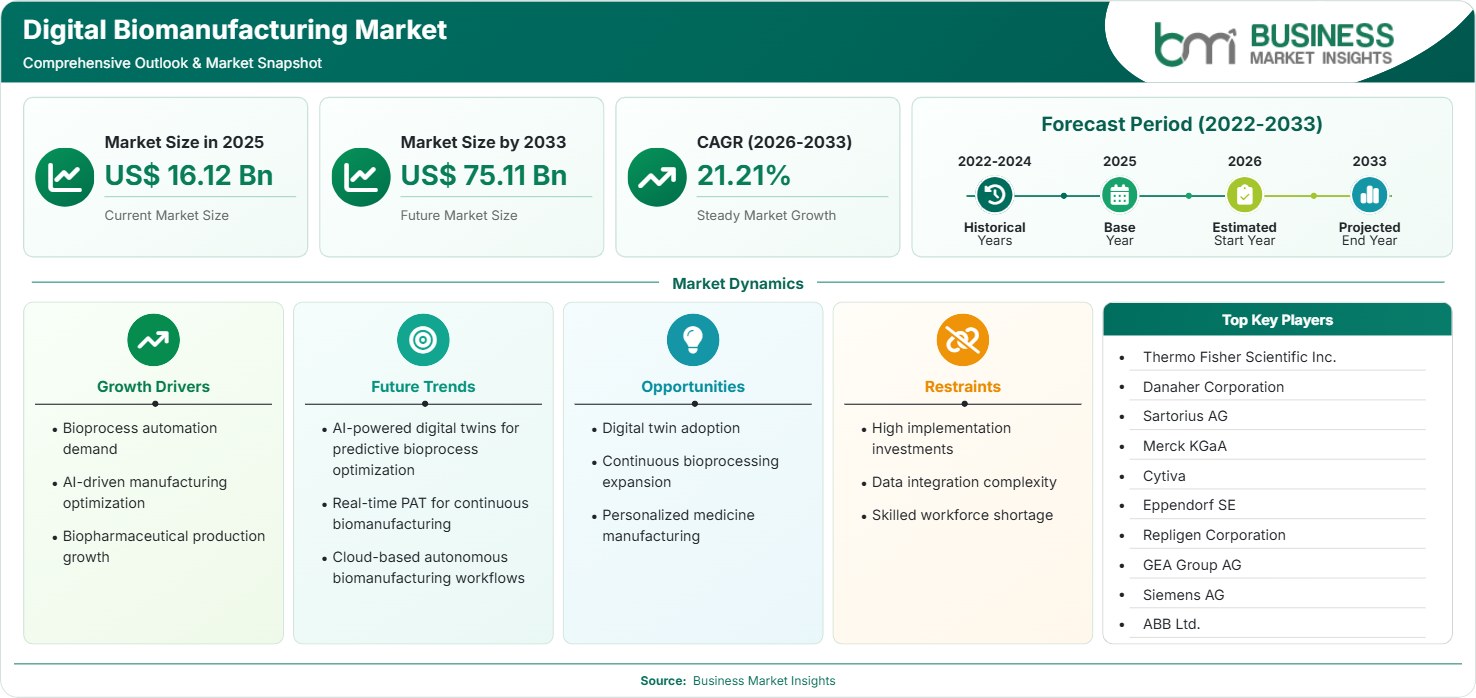
The Digital Biomanufacturing Market size was valued at US$ 16.12 billion in 2025 and is projected to reach US$ 75.11 billion by 2033, growing at a CAGR of 21.21% during 2026–2033. Market expansion is driven by increasing bioprocess automation adoption, AI-based manufacturing optimization, rising biopharmaceutical production, and growing demand for data-driven, scalable, and efficient manufacturing systems.

Report Coverage
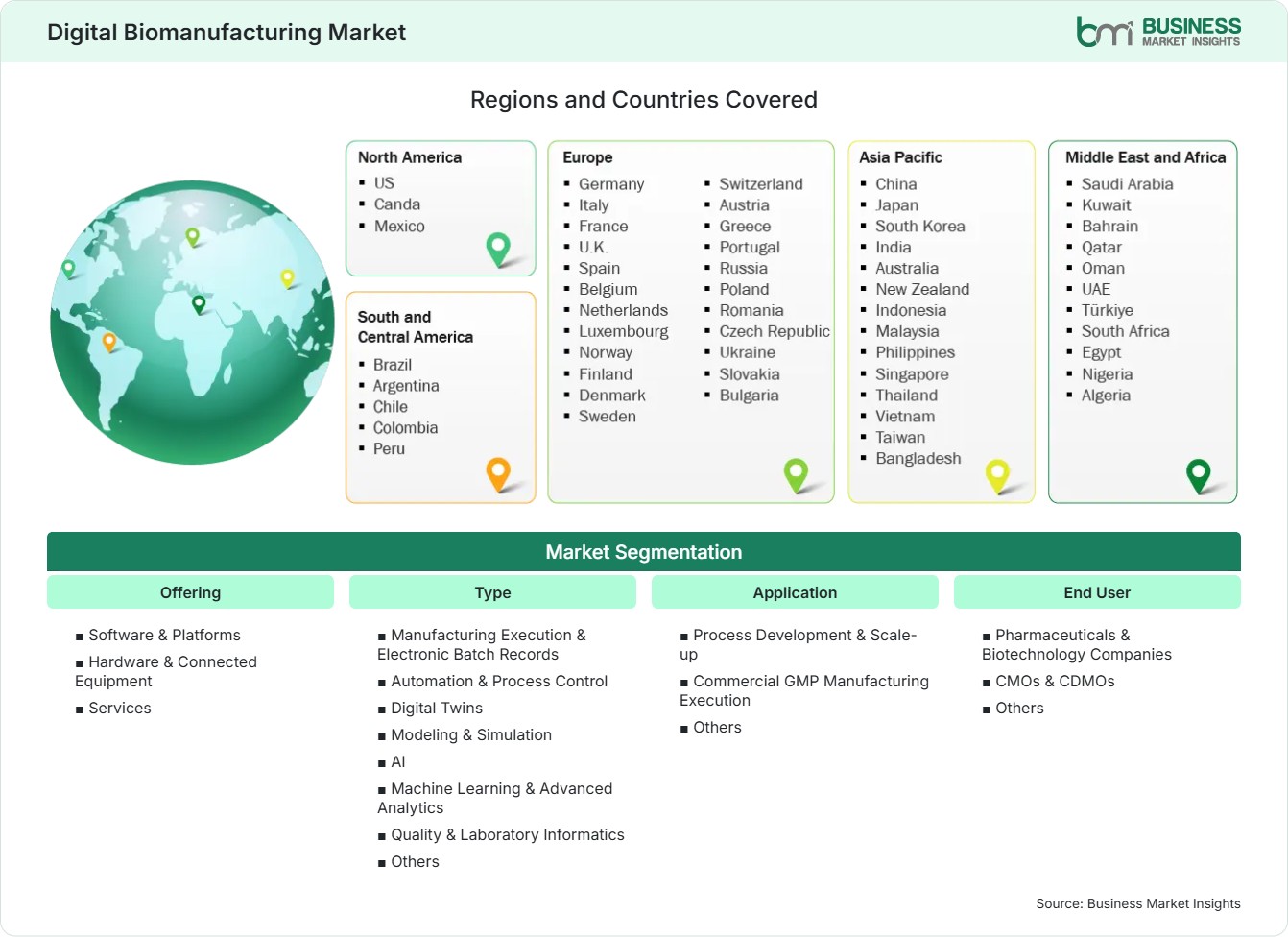
  • Offering: Software & Platforms, Hardware & Connected Equipment, Services
  • Type: Manufacturing Execution & Electronic Batch Records, Automation & Process Control, Digital Twins, Modeling & Simulation, AI, Machine Learning & Advanced Analytics, Quality & Laboratory Informatics, Others
  • Application: Process Development & Scale-up, Commercial GMP Manufacturing Execution, Others
  • End User: Pharmaceuticals & Biotechnology Companies, CMOs & CDMOs, Others
US$ 16.12 Bn Market size in 2025
US$ 75.11 Bn Market Size by 2033
21.21% CAGR, 2026 - 2033
2026-2033 Forecast Period

01 AI Overview

Digital Biomanufacturing Market Summary

  • North America Region: North America holds 38%–41% share in 2025 and is projected to expand at a 20%–22% CAGR during 2026–2033. Growth is supported by advanced pharmaceutical manufacturing infrastructure, strong biotechnology investments, automation adoption, and regulatory emphasis on quality-driven production. The U.S. market benefits from major biologics manufacturers, advanced digital technology adoption, and strong R&D investments, with growth projected at 20%–22% CAGR through 2033.
  • Fastest Growing Region: Asia Pacific represents 25%–28% of the Digital Biomanufacturing Market share in 2025 and is expected to grow at a 23%–25% CAGR during 2026–2033. Growth is driven by expanding biopharmaceutical manufacturing capacity, increasing CDMO investments, healthcare innovation, and adoption of advanced manufacturing technologies.
  • Leading Segment: Software & Platforms accounts for 45%–48% share in 2025 and is projected to grow at a 22%–23% CAGR during 2026–2033. Demand is supported by increasing use of manufacturing analytics, process monitoring platforms, electronic records, and digital workflow optimization.
  • High Growth Segment: AI, Machine Learning & Advanced Analytics represents 18%–21% share in 2025 and is expected to grow at a 24%–26% CAGR through 2033. Growth is driven by predictive manufacturing, process optimization, real-time decision-making, and improved production efficiency.
  • Key Market Opportunity: Digital twin technologies, continuous bioprocessing platforms, and personalized medicine manufacturing create significant opportunities by improving process visibility, reducing development timelines, and enabling flexible production models.
  • Major Market Players: Thermo Fisher Scientific Inc., Danaher Corporation, Sartorius AG, Merck KGaA, Cytiva, Eppendorf SE, Repligen Corporation, GEA Group AG, Siemens AG, ABB Ltd.
02 Strategic Insights

Digital Biomanufacturing Market: Strategic Insights

digital-biomanufacturing-market-market-strategic-framework
FREE PDF
Request your free sample
Request free sample
03 Stakeholder View

Key Takeaways

  • The value chain is shifting toward integrated digital ecosystems connecting equipment providers, software developers, biotechnology companies, and manufacturing service providers to enable smarter production environments.
  • Software platforms, AI analytics, and automation solutions represent high-value opportunities as manufacturers prioritize process optimization, operational visibility, and regulatory compliance.
  • Innovation is moving toward digital twins, predictive analytics, continuous processing technologies, and advanced modeling systems that improve manufacturing flexibility and efficiency.
  • Asia Pacific presents strong investment potential due to expanding biologics production capacity, growing CDMO networks, and increasing adoption of advanced manufacturing technologies.
  • Strategic partnerships, acquisitions, and technology collaborations are shaping competitive positioning as companies seek broader digital capabilities and integrated bioprocessing solutions.
  • Regulatory modernization and increasing demand for personalized therapies are encouraging manufacturers to adopt flexible digital infrastructure capable of supporting smaller, customized production batches.
04 Geographic Outlook

Digital Biomanufacturing Market Regional Highlights

North America Digital Biomanufacturing Market

North America accounted for 38%–41% share in 2025 and is projected to expand at a 20%–22% CAGR from 2026–2033. The region maintains market leadership due to advanced pharmaceutical infrastructure, high biotechnology investment, and early adoption of automation technologies. The Digital Biomanufacturing Market share reflects strong demand from biologics manufacturers, research institutions, and contract development organizations implementing connected production systems and advanced analytics.

  • The U.S. remains the largest contributor due to extensive biologics manufacturing capacity, strong technology adoption, and significant pharmaceutical research investments.
  • Pharmaceutical companies are accelerating digital transformation initiatives to improve process consistency, production efficiency, and regulatory compliance.
  • Contract manufacturing organizations are adopting connected platforms to increase flexibility and support growing biologics production requirements.
  • Advanced analytics and automation technologies are gaining adoption across commercial-scale manufacturing facilities and research environments.

US Digital Biomanufacturing Market

The U.S. market represented 34%–37% share in 2025 and is expected to grow at a 20%–22% CAGR between 2026–2033. The country benefits from a strong biotechnology ecosystem, established pharmaceutical manufacturers, and continuous investments in advanced manufacturing technologies. The Digital Biomanufacturing Market growth is supported by increasing biologics production, AI implementation, and demand for efficient GMP manufacturing processes.

  • Leading pharmaceutical companies are investing in digital manufacturing platforms to enhance production monitoring and operational decision-making.
  • Government and industry initiatives supporting advanced manufacturing are encouraging technology adoption across biopharmaceutical facilities.
  • Biotechnology companies are using predictive analytics and automation to improve process development and accelerate commercialization timelines.

Europe Digital Biomanufacturing Market

Europe held 26%–29% share in 2025 and is forecast to grow at a 19%–21% CAGR during 2026–2033. The region benefits from established pharmaceutical manufacturing capabilities, strong regulatory frameworks, and increasing focus on process efficiency. Germany, Switzerland, the United Kingdom, and France represent major markets, while Germany and Switzerland demonstrate strong adoption due to advanced life sciences infrastructure.

  • Germany supports market growth through pharmaceutical manufacturing expertise, automation adoption, and strong industrial technology capabilities.
  • Switzerland benefits from major biotechnology companies and investments in advanced biologics manufacturing infrastructure.
  • The United Kingdom is expanding digital bioprocessing adoption through research innovation and biotechnology ecosystem development.
  • France is increasing investments in pharmaceutical modernization and advanced manufacturing capabilities.

Asia Pacific Digital Biomanufacturing Market

Asia Pacific represented 25%–28% of the Digital Biomanufacturing Market share in 2025 and is projected to achieve a 23%–25% CAGR from 2026–2033, making it the fastest-growing regional market. The region benefits from expanding biotechnology manufacturing capacity, increasing healthcare investments, growing CDMO activities, and adoption of automation technologies. China, India, Japan, South Korea, and Singapore are key contributors.

  • China is expanding rapidly through biotechnology investments, pharmaceutical manufacturing growth, and modernization of production facilities.
  • India is increasing adoption through expanding biologics manufacturing, vaccine production capabilities, and growing CDMO infrastructure.
  • Japan supports market development through advanced pharmaceutical research and technology-driven manufacturing practices.
  • Singapore is strengthening its position as a biotechnology hub through investments in advanced manufacturing facilities.

Rest of World Digital Biomanufacturing Market

Rest of World accounted for 6%–8% share in 2025 and is expected to grow at a 18%–20% CAGR during 2026–2033. Latin America, the Middle East, and Africa are emerging markets supported by healthcare modernization, biotechnology investments, and increasing pharmaceutical manufacturing capabilities. Brazil, Saudi Arabia, UAE, and South Africa represent developing opportunities.

  • Brazil is improving biotechnology infrastructure through healthcare investments and pharmaceutical manufacturing expansion.
  • The UAE is supporting healthcare technology adoption through investments in advanced medical manufacturing capabilities.
  • Saudi Arabia is developing life sciences infrastructure as part of healthcare diversification initiatives.
  • South Africa is gradually adopting digital healthcare manufacturing solutions through biotechnology sector development.
  • Emerging markets provide opportunities for technology providers offering scalable and cost-efficient digital manufacturing platforms.
global-market-geography
FREE PDF
Request your free sample
Request free sample
05 Segment Analysis

Digital Biomanufacturing Market Segmentation

Offering

The Offering segment represents a major component of the Digital Biomanufacturing Market, driven by increasing demand for integrated digital ecosystems that combine software, connected equipment, and specialized services. Software & Platforms accounted for approximately 45%–48% share in 2025 and are projected to grow at a 22%–23% CAGR from 2026–2034. Growth is supported by increasing adoption of manufacturing analytics, digital workflows, automation integration, and real-time process monitoring solutions across biopharmaceutical facilities.

  • Software & Platforms: Software platforms are gaining strong adoption through manufacturing execution systems, analytics solutions, electronic records, and digital tools enabling improved process visibility and operational control.
  • Hardware & Connected Equipment: Connected equipment demand is increasing through adoption of smart bioprocessing systems, automated instruments, sensors, and integrated manufacturing technologies supporting real-time production monitoring.
  • Services: Services are expanding due to increasing requirements for implementation support, system integration, consulting, validation, maintenance, and digital transformation assistance.

Type

The Type segment is expanding as biopharmaceutical manufacturers adopt advanced digital technologies to improve production efficiency, quality management, and process scalability. AI, Machine Learning & Advanced Analytics accounted for approximately 18%–21% share in 2025 and are projected to grow at a 24%–26% CAGR from 2026–2034. Growth is supported by increasing use of predictive analytics, process optimization, automation intelligence, and data-driven manufacturing decisions.

  • Manufacturing Execution & Electronic Batch Records: These solutions improve production tracking, documentation accuracy, regulatory compliance, and operational efficiency across pharmaceutical manufacturing workflows.
  • Automation & Process Control: Automation technologies support consistent manufacturing performance through improved control systems, reduced manual intervention, and enhanced process reliability.
  • Digital Twins: Digital twin technologies are gaining adoption by enabling virtual process simulation, predictive monitoring, and optimization of complex biomanufacturing operations.
  • Modeling & Simulation: Modeling and simulation tools support process development, scale-up activities, risk assessment, and improved manufacturing decision-making.
  • AI, Machine Learning & Advanced Analytics: AI-driven solutions enable predictive insights, anomaly detection, process optimization, and improved resource utilization across production environments.
  • Quality & Laboratory Informatics: Quality and laboratory informatics solutions improve testing workflows, data management, compliance monitoring, and quality control operations.
  • Others: Other digital technologies support specialized manufacturing requirements through customized solutions for workflow management, connectivity, and operational improvements.

Application

The Application segment is driven by increasing adoption of digital technologies across the biopharmaceutical manufacturing lifecycle, from development through commercial production. Commercial GMP Manufacturing Execution accounted for approximately 42%–45% share in 2025 and is projected to grow at a 21%–22% CAGR from 2026–2034. Growth is supported by regulatory requirements, production scalability needs, and increasing focus on manufacturing efficiency.

  • Process Development & Scale-up: Digital solutions support faster development cycles, improved process understanding, simulation capabilities, and efficient transition from laboratory to commercial production.
  • Commercial GMP Manufacturing Execution: Commercial manufacturing applications benefit from digital monitoring, automated workflows, electronic documentation, and improved compliance management.
  • Others: Other applications include research operations, quality management, facility optimization, and specialized digital solutions supporting biopharmaceutical production activities.

End User

The End User segment is expanding as pharmaceutical organizations and manufacturing service providers invest in digital infrastructure to improve productivity and operational flexibility. Pharmaceuticals & Biotechnology Companies accounted for approximately 55%–58% of the market share in 2025 and are projected to grow at a 21%–22% CAGR from 2026–2034 in digital biomanufacturing market forecasts. Adoption is supported by the expansion of the biologics pipeline, manufacturing modernization, and demand for scalable production platforms.

  • Pharmaceuticals & Biotechnology Companies: These organizations are adopting digital manufacturing technologies to optimize biologics production, improve quality control, and accelerate therapeutic development.
  • CMOs & CDMOs: Contract manufacturers are implementing digital platforms to increase operational efficiency, improve client visibility, and support flexible multi-product manufacturing capabilities.
  • Others: Other users include research institutions, academic organizations, and specialized facilities adopting digital solutions for advanced bioprocessing activities.
06 Market Forces

Digital Biomanufacturing Market Dynamics

Key Market Drivers

Increasing Demand for Bioprocess Automation

Automation of bioprocesses has been a key driver of the market, as pharmaceutical and biotechnology firms seek more efficient, consistent, and scalable operations. Automation can reduce human involvement in the process and standardize it while ensuring compliance with the required high manufacturing standards. The Digital Biomanufacturing Market Trends show a growing use of automation tools, integrated systems, and real-time data collection platforms in biologics manufacturing plants.

AI-Based Manufacturing Optimization Adoption

The use of artificial intelligence and advanced analytics in biomanufacturing leads to more efficient decision-making, process optimization, and better resource utilization. The AI systems help analyze vast amounts of data related to manufacturing, recognize any variations, and optimize processes and manufacturing outcomes. Machine learning technology is currently widely used by pharmaceutical companies to increase manufacturing efficiency and minimize development risks. AI-based optimization increases the need for digital platforms that will be able to transform operational data into manufacturing information.

Growth in Biopharmaceutical Production Capacity

Rising biopharmaceutical production is accelerating demand for digital manufacturing technologies as companies expand facilities for biologics, vaccines, and advanced therapies. Increasing investments in biologics pipelines are creating requirements for scalable, reliable, and compliant production systems. Digital platforms support manufacturers by improving process visibility, enabling real-time quality monitoring, and enhancing production flexibility. Expansion of contract development and manufacturing organizations is also increasing adoption as service providers require advanced technologies to manage multiple client projects efficiently. Growing demand for complex biologics is expected to continue supporting investments in connected manufacturing infrastructure and digital process management solutions.

Key Market Opportunities

Expansion of Digital Twin Adoption

Digital twin technology represents a significant opportunity as biopharmaceutical manufacturers seek advanced methods for process simulation, optimization, and predictive monitoring. Digital twins create virtual representations of manufacturing processes, enabling companies to evaluate changes, identify potential issues, and improve operational decisions before implementation. Increasing process complexity and demand for efficient scale-up strategies are encouraging adoption among advanced manufacturing facilities. Companies developing integrated digital twin platforms combined with analytics, automation, and artificial intelligence capabilities can capture emerging opportunities. This technology can support faster development cycles, improved resource utilization, and enhanced manufacturing reliability across biopharmaceutical operations.

Growth of Continuous Bioprocessing Platforms

Continuous bioprocessing expansion creates opportunities for technology vendors as producers seek to increase the efficiency and flexibility of their manufacturing processes. Continuous systems require complex monitoring, automation, and data management technologies to ensure consistent quality and optimize processes. Technology platforms enable real-time process control, process understanding, and quick responses to production changes. With the growing strategic interest in cost reduction and facility utilization optimization in the pharmaceutical industry, continuous processing technologies are gaining significance. Tech vendors specializing in automation and process control systems are expected to benefit from the situation.

Personalized Medicine Manufacturing Opportunities

The field of personalized medicine production is creating room for digital biomanufacturing due to the need for flexible, small-batch production settings that require high levels of control. The advanced therapies that include cell and gene therapies need specific production processes, large amounts of data management, and quick adjustments in production. Digital tools can help meet these needs through automation, real-time analysis, and traceability. With the development of individualized therapies in the healthcare industry, companies are exploring technology that allows flexible manufacturing processes. Companies offering scalable digital tools can benefit from these emerging trends.

Market Restraints and Challenges

High Implementation Investments Increasing Adoption Barriers

Factor: Digital biomanufacturing implementation requires substantial investments in software platforms, connected equipment, automation systems, infrastructure upgrades, employee training, and validation processes. These costs can be high, particularly for smaller biotechnology companies and emerging manufacturing facilities with limited capital resources. Impact: High upfront investments may delay technology adoption and extend implementation timelines. Organizations must evaluate return on investment, operational benefits, and long-term efficiency gains before committing to large-scale digital transformation projects. Cost-effective deployment models, cloud-based solutions, and scalable platforms can help reduce barriers and improve accessibility across different manufacturing environments.

Complex Data Integration Challenges Across Systems

Factor: Data integration complexity remains a challenge due to the need to connect multiple systems, equipment platforms, laboratory technologies, and manufacturing databases while maintaining data accuracy and security. Biomanufacturing facilities often operate with diverse legacy systems that require advanced integration capabilities. Impact: Difficulties in achieving seamless interoperability can slow digital transformation efforts, reduce operational efficiency, and limit the effectiveness of analytics platforms. Companies must invest in standardized data architectures, cybersecurity measures, and integration expertise to maximize the value of digital technologies. Improved interoperability frameworks will be essential for accelerating adoption across complex manufacturing environments.

07 Company Analysis

Competitive Landscape

The Digital Biomanufacturing Market analysis highlights a competitive ecosystem driven by life sciences technology providers, automation specialists, laboratory solution companies, and industrial digitalization leaders. Market participants are focusing on integrated digital platforms, automation technologies, artificial intelligence capabilities, process analytics, and connected manufacturing solutions. Competitive differentiation is influenced by software capabilities, equipment integration, regulatory expertise, global service networks, and the ability to support pharmaceutical and biotechnology companies throughout the manufacturing lifecycle.

Company Name

Overview

Products and Services relevant to this market

Thermo Fisher Scientific Inc.

Global life sciences company providing advanced laboratory and bioprocessing technologies.

Digital bioprocess solutions, manufacturing software, automation systems, analytics platforms, and connected equipment.

Danaher Corporation

Global science and technology company with extensive life sciences and biotechnology capabilities.

Bioprocess automation, digital manufacturing platforms, analytics solutions, and integrated production technologies.

Sartorius AG

International life sciences company specializing in bioprocess and laboratory technologies.

Bioprocess software, automation solutions, process analytics, digital platforms, and connected manufacturing systems.

Merck KGaA

Global science and technology company supporting pharmaceutical and biotechnology production.

Digital biomanufacturing solutions, process technologies, laboratory informatics, and manufacturing optimization tools.

Cytiva

Life sciences technology provider focused on bioprocessing and advanced therapeutic manufacturing.

Bioprocess automation, digital workflow solutions, manufacturing platforms, and process monitoring technologies.

Eppendorf SE

Laboratory equipment company providing solutions for biotechnology and research applications.

Automated laboratory systems, bioprocess equipment, digital monitoring solutions, and workflow technologies.

Repligen Corporation

Biotechnology company specializing in advanced bioprocessing technologies.

Bioprocess components, process analytics solutions, manufacturing technologies, and production optimization products.

GEA Group AG

Industrial technology company providing processing solutions for pharmaceutical industries.

Automation systems, process engineering solutions, digital monitoring platforms, and manufacturing technologies.

Siemens AG

Industrial technology company offering digital transformation and automation solutions.

Industrial automation, digital twin technologies, process control systems, and manufacturing software.

ABB Ltd.

Global automation technology company supporting industrial digitalization.

Process automation, control systems, digital solutions, analytics tools, and connected manufacturing technologies.

08 Industry Activity

Recent Developments

July 2026

Autolomous and Cellular Origins integrated their respective platforms to create a connected and automated cell therapy manufacturing environment, combining the Constellation robotic platform with the autoloMATE digital platform to enable real-time data exchange across software, AI systems, and robotic platforms. The first deployment was completed at the Cell and Gene Therapy Catapult Testbeds in the UK.

May 2026

Curve and Digital Tvilling AB partnered to develop an AI-driven biomanufacturing platform for precision fermentation, combining Curve's bioproduction systems with Digital Tvilling's agentic AI and graph-based modeling to transform fragmented bioprocess data into a shared learning network and accelerate process optimization.

May 2026

Nucleus Biologics launched NB-Lux AI, a fully integrated digital ecosystem for media and buffer manufacturing that streamlines formulation design, feasibility analysis, quoting, ordering, manufacturing, and documentation into a single workflow, enabling GMP media delivery in as little as 4–6 weeks.

January 2026

WuXi Biologics launched PatroLab, a digital twin platform integrating Raman-based Process Analytical Technology (PAT) with predictive in-silico modeling to enable real-time monitoring of more than 40 process and product quality attributes, increasing batch data density by nearly 1,000 times compared to conventional methods and accelerating biologics development and manufacturing.

10 Trust & Transparency

Research Methodology

The market analysis combines proprietary research with secondary data from government agencies, company disclosures, regulatory filings, industry databases and expert interviews. Market estimates are validated through data triangulation, cross-market benchmarking and analyst review.

View Full Research Methodology

11 Questions Answered

Frequently Asked Questions

What does the Digital Biomanufacturing Market Report include?

The Market Report includes market sizing, segmentation analysis, regional trends, competitive landscape, growth drivers, opportunities, challenges, and future outlook through 2033.

How are CDMOs contributing to market expansion?

CMOs and CDMOs are adopting digital technologies to improve production flexibility, increase operational efficiency, support multiple client requirements, and enhance manufacturing transparency.

Which segment is leading the market?

Software and platforms represent the leading segment due to increasing adoption of manufacturing execution systems, analytics platforms, electronic records, and digital workflow solutions.

Why are digital twins important in biomanufacturing?

Digital twins enable virtual process modeling, predictive analysis, optimization of manufacturing parameters, and improved decision-making before implementing operational changes in production environments.

What is driving the market growth?

The market is driven by increasing bioprocess automation demand, AI-based manufacturing optimization, rising biopharmaceutical production, and the need for scalable and data-driven manufacturing processes.

Access the Full Digital Biomanufacturing Market Report

Get segment-level forecasts, regional estimates, competitive benchmarking, company profiles and downloadable Excel datasets.

Access the full Digital Biomanufacturing Market Report
350 pages PDF & Excel | 2026-07-30