
Digital Radiography Market Outlook: Size, Share, Trends, Growth Analysis, Competitive Landscape & Forecast, 2026–2033

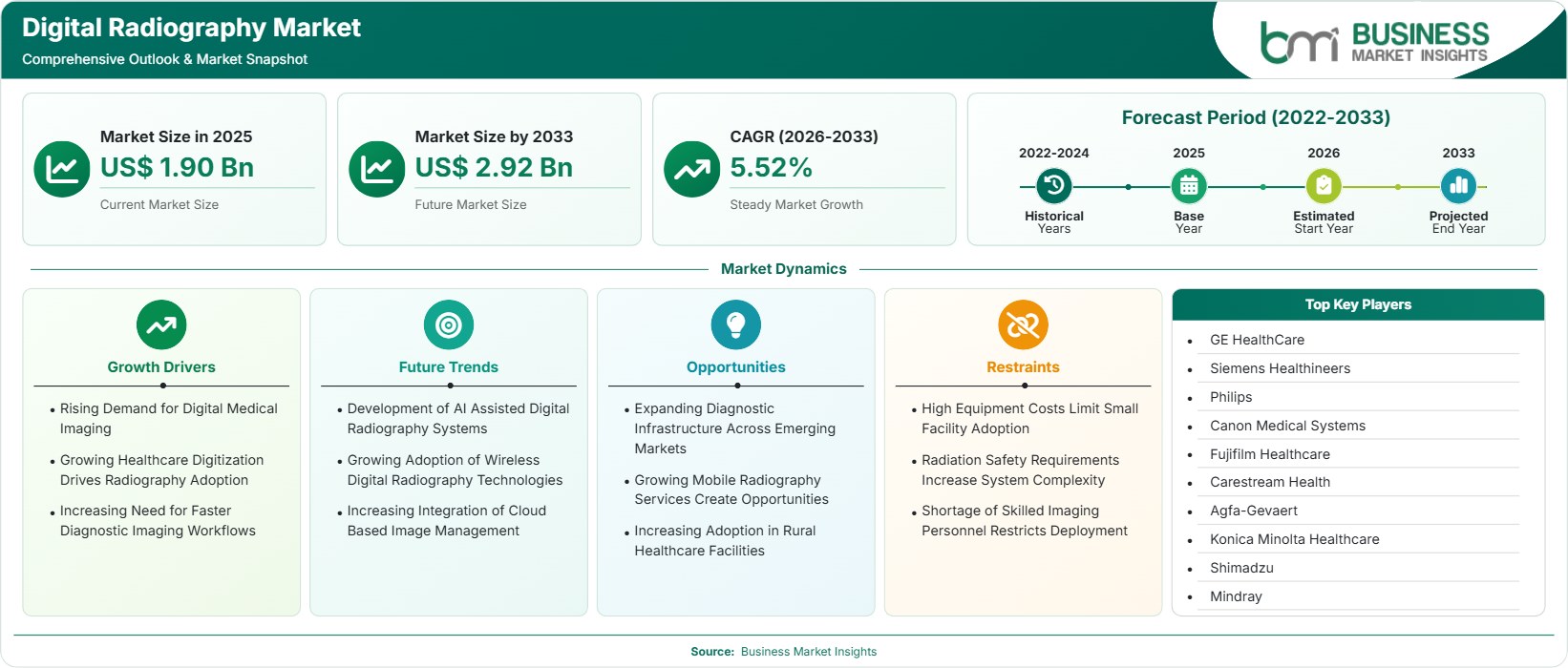
The Digital Radiography Market size was valued at US$ 1.90 billion in 2025 and is projected to reach US$ 2.92 billion by 2033, growing at a CAGR of 5.52% during 2026–2033, driven by healthcare digitization, faster workflows, diagnostic demand, and expanding imaging infrastructure.

Report Coverage
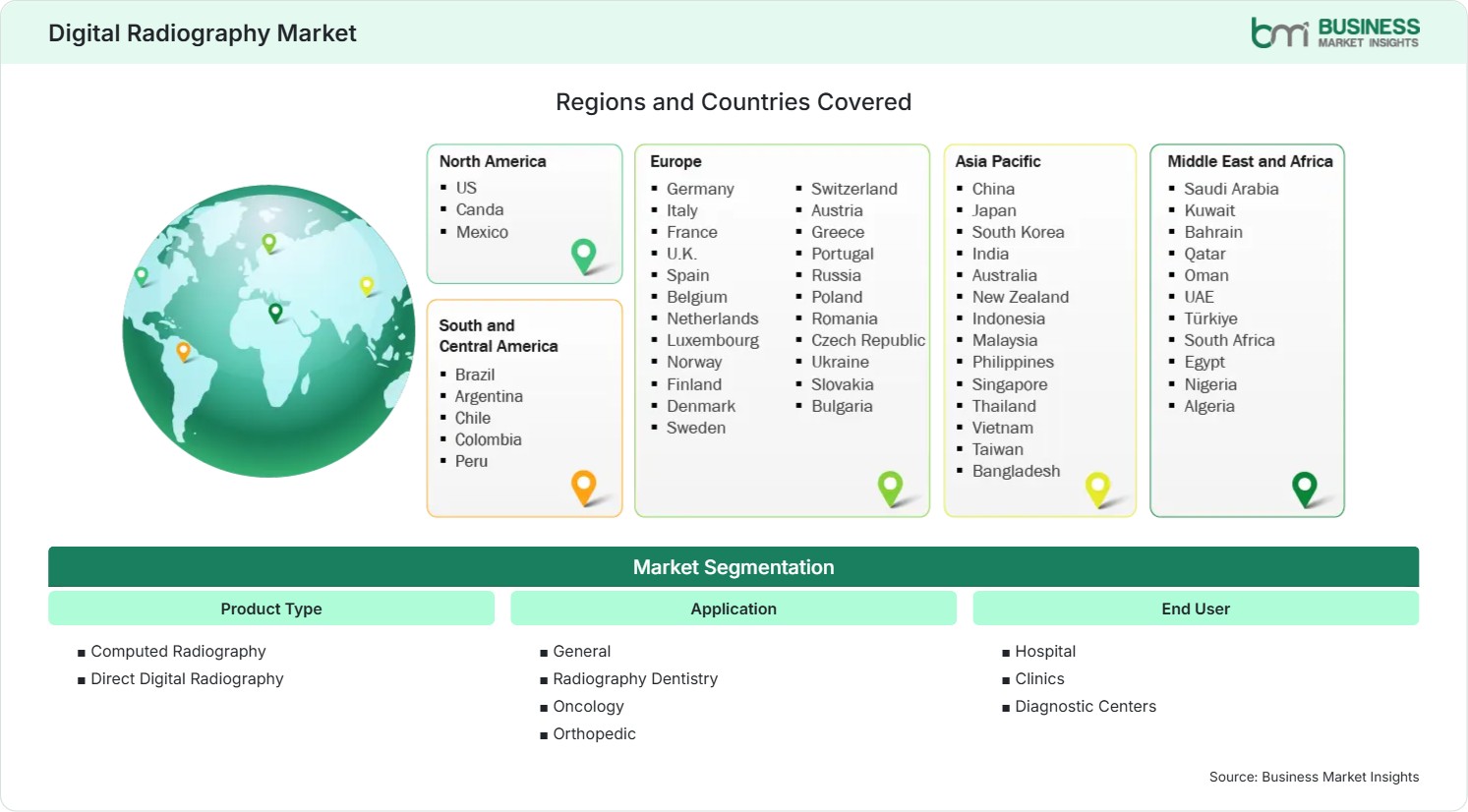
  • Product Type: Computed Radiography, Direct Digital Radiography
  • Application: General, Radiography Dentistry, Oncology, Orthopedic
  • End User: Hospital, Clinics, Diagnostic Centers
US$ 1.90 Bn Market size in 2025
US$ 2.92 Bn Market Size by 2033
5.52% CAGR, 2026 - 2033
2026-2033 Forecast Period

01 AI Overview

Digital Radiography Market Summary

  • North America Region: North America holds a 34%–37% share in 2025 and is projected to grow at a 4.8%–5.3% CAGR through 2033, supported by mature hospital infrastructure, replacement of legacy systems, digital workflow integration, and demand for efficient diagnostic imaging.
  • Fastest Growing Region: Asia Pacific holds a 24%–27% share in 2025 and is projected to expand at a 6.8%–7.4% CAGR. Expanding healthcare infrastructure, imaging accessibility, hospital modernization, and rural diagnostic investment support the region's stronger growth trajectory.
  • Leading Segment: Direct Digital Radiography holds a 68%–72% share in 2025 and is projected to grow at a 5.8%–6.3% CAGR, supported by workflow efficiency, rapid image availability, detector improvements, lower processing requirements, and integration with hospital information systems.
  • High Growth Segment: Clinics represent a high-growth end-user segment, holding an estimated 18%–21% share in 2025 and recording a 6.5%–7.1% CAGR, supported by decentralized diagnostics, outpatient imaging demand, and compact system deployment.
  • Key Market Opportunity: Emerging healthcare infrastructure, mobile imaging, rural diagnostics, workflow automation, cloud connectivity, and affordable detector technologies are widening access to digital radiography beyond large tertiary hospitals.
  • Major Market Players: GE HealthCare, Siemens Healthineers, Philips, Canon Medical Systems, Fujifilm Healthcare, Carestream Health, Agfa-Gevaert, Konica Minolta Healthcare, Shimadzu, and Mindray.
02 Strategic Insights

Digital Radiography Market: Strategic Insights

Digital Radiography Market Strategic Framework
FREE PDF
Request your free sample
Request free sample
03 Stakeholder View

Key Takeaways

  • The value chain is shifting toward integrated imaging ecosystems in which detectors, acquisition software, image management, connectivity, workflow tools, and service contracts increasingly influence purchasing decisions.
  • Direct digital configurations offer the clearest upgrade pathway for facilities seeking faster image availability and simpler workflows without maintaining film-processing or cassette-intensive processes.
  • Product development is increasingly focused on wireless detectors, automated positioning, image enhancement, dose optimization, artificial intelligence support, and connectivity with broader clinical information environments.
  • Emerging healthcare systems provide an attractive expansion pathway because diagnostic capacity remains uneven and facilities increasingly require scalable imaging technologies that can support outpatient and decentralized care.
  • Recurring service, software, detector replacement, refurbishment, and workflow upgrades can create additional revenue opportunities beyond the initial equipment sale and strengthen customer relationships.
  • Suppliers with flexible system configurations can address a wider range of facilities by adapting equipment size, detector configuration, mobility, software capabilities, and service arrangements to local operational requirements.
04 Geographic Outlook

Digital Radiography Market Regional Highlights

North America Digital Radiography Market

North America held a 34%–37% share in 2025 and is projected to expand at a 4.8%–5.3% CAGR through 2033. The region benefits from established diagnostic infrastructure, replacement cycles, advanced hospital IT environments, and strong demand for workflow automation. The U.S. remains the principal regional Digital Radiography Market.

  • Hospitals are replacing aging radiography equipment with systems offering wireless detectors, automated positioning, improved image processing, and stronger integration with enterprise imaging environments.
  • Outpatient facilities are expanding imaging capacity closer to patients, supporting demand for compact systems that require limited infrastructure modification.
  • Healthcare providers increasingly evaluate total ownership costs, service responsiveness, detector durability, software capabilities, and upgrade flexibility alongside image quality.
  • Advanced workflow and dose-management functions are becoming more important as providers seek consistency across radiography departments.

US Digital Radiography Market

The U.S. accounted for an estimated 30%–33% global share in 2025 and is projected to record a 4.7%–5.2% CAGR through 2033. Demand is supported by replacement of legacy radiography equipment, hospital modernization, outpatient imaging growth, and increasing integration between imaging systems and clinical IT platforms.

  • Large health systems favor standardized equipment platforms that simplify training, maintenance, interoperability, and workflow management across multiple facilities.
  • Outpatient imaging and ambulatory care support demand for compact equipment with fast acquisition and straightforward operation.
  • Procurement increasingly considers radiation dose optimization, cybersecurity, service availability, software functionality, and long-term upgrade pathways.

Europe Digital Radiography Market

Europe held an estimated 27%–30% share in 2025 and is projected to grow at a 4.9%–5.5% CAGR. Germany, the U.K., France, and Italy represent major demand centers, while Central and Eastern European healthcare modernization provides additional opportunities. Germany is projected at 5.3%–5.8% CAGR and the U.K. at 5.0%–5.5%.

  • Germany benefits from extensive hospital infrastructure and continued investment in efficient diagnostic workflows and replacement imaging equipment.
  • The U.K. provides opportunities through modernization of public healthcare imaging capacity and increasing emphasis on productivity and diagnostic access.
  • France and Italy support demand through hospital replacement programs, outpatient diagnostics, and continued digital transformation.
  • Central and Eastern Europe provide stronger expansion potential where healthcare facilities are upgrading legacy imaging infrastructure.

Asia Pacific Digital Radiography Market

Asia Pacific held a 24%–27% Digital Radiography Market share in 2025 and is projected to achieve a 6.8%–7.4% CAGR, making it the fastest-growing region. China, Japan, India, South Korea, and Southeast Asian economies are supporting expansion through healthcare infrastructure investment, modernization, and wider access to diagnostic services.

  • China combines large healthcare demand with domestic medical-equipment capabilities, supporting both replacement demand and local technology development.
  • India provides substantial opportunity as hospitals, diagnostic centers, and regional facilities expand imaging capacity and seek efficient digital alternatives.
  • Japan and South Korea offer mature markets where replacement cycles increasingly emphasize workflow efficiency, connectivity, and dose management.
  • Southeast Asian markets provide growth opportunities as private healthcare investment expands diagnostic infrastructure beyond major metropolitan centers.

Rest of World Digital Radiography Market

Rest of World represented an estimated 13%–16% share in 2025 and is projected to expand at a 5.2%–6.0% CAGR. Latin America, the Middle East, and Africa present varied opportunities based on healthcare investment, infrastructure availability, equipment affordability, and diagnostic access.

Brazil is projected at a 5.7%–6.3% CAGR, while selected Middle Eastern markets are estimated at 6.0%–6.7%. Equipment financing, distributor networks, and service availability remain important market-access considerations.

  • Brazil provides a comparatively developed diagnostic imaging environment, supported by private healthcare investment and replacement of older radiography systems.
  • Gulf countries offer opportunities for advanced imaging infrastructure where healthcare modernization and private-sector investment support technology adoption.
  • Africa presents longer-term potential as diagnostic access expands, although affordability, infrastructure, technical support, and power reliability can constrain deployment.
  • Latin American markets increasingly favor digital workflows as providers seek faster image transfer, easier storage, and reduced dependence on legacy processing methods.
Global Market Geography
FREE PDF
Request your free sample
Request free sample
05 Segment Analysis

Digital Radiography Market Segmentation

Product Type

Direct Digital Radiography remains the leading product category, holding a 68%–72% share in 2025 and projected to grow at a 5.8%–6.3% CAGR through 2034. Its workflow advantages, immediate image availability, wireless detector development, and integration capabilities support continued replacement of cassette-based approaches.

  • Computed Radiography: Computed radiography remains relevant where facilities seek gradual digitization while retaining existing X-ray infrastructure. Its lower transition barrier supports adoption in cost-sensitive and developing healthcare environments.
  • Direct Digital Radiography: Direct systems provide rapid image capture, streamlined workflows, and easier integration with digital imaging environments. Detector improvements and wireless configurations are strengthening adoption across hospitals and outpatient facilities.

Application

General radiography remains the principal application, supported by broad clinical utilization across routine examinations and emergency care. The category benefits from continuous equipment replacement, workflow digitization, and demand for rapid diagnostic access, while specialized applications create additional opportunities.

  • General: General radiography supports routine chest, abdominal, and trauma examinations, making workflow efficiency, image quality, patient throughput, and system versatility key purchasing considerations.
  • Radiography Dentistry: Dental imaging applications benefit from compact digital workflows, rapid image availability, and easier electronic record integration, supporting adoption across dental practices and specialized diagnostic facilities.
  • Oncology: Oncology applications require dependable imaging for assessment and follow-up, creating demand for consistent image quality, efficient workflows, dose management, and integration with broader clinical records.
  • Orthopedic: Orthopedic imaging generates recurring demand for high-quality skeletal images, with facilities increasingly prioritizing efficient positioning, repeat-exam reduction, and workflow consistency.

End User

Hospitals remain the leading end-user category, while clinics are positioned for faster expansion as decentralized diagnostics gain importance. Digital Radiography Market scope is broadening as outpatient facilities and diagnostic centers adopt compact systems that can provide faster imaging closer to patients.

  • Hospital: Hospitals require high-throughput systems supporting emergency, inpatient, trauma, orthopedic, and general examinations, making reliability, workflow automation, interoperability, and service support important selection factors.
  • Clinics: Clinics are increasingly adopting compact digital systems to provide local diagnostic services, improve referral efficiency, and reduce patient transfers to larger imaging facilities.
  • Diagnostic Centers: Diagnostic centers prioritize throughput, image consistency, connectivity, and equipment utilization, creating demand for systems capable of supporting multiple examination types efficiently.
06 Market Forces

Digital Radiography Market Dynamics

Key Market Drivers

Rising Demand for Digital Medical Imaging

As the demand for fast imaging increases among clinicians, they have been encouraged to adopt digital imaging to replace slow methods and make their processes more connected. Radiography continues to be an essential technique in diagnostics, as it allows for routine imaging in emergency cases, orthopedics, chest cases, and general cases. Digital imaging helps increase image accessibility and enables electronic transfer to radiologists and clinicians. The Digital Radiography Market growth depends on the increasing shift towards connected diagnostics among healthcare providers. It is driven by patient demand for faster diagnostics and by healthcare providers' efforts to avoid workflow delays.

Growing Healthcare Digitization Drives Radiography Adoption

The digital transformation of the healthcare sector is shifting radiography from simply procuring medical equipment to becoming part of the broader information workflow. Hospitals now require imaging solutions to be compatible with image archiving, electronic health records, reporting environment, and enterprise imaging solutions. This ensures that information access becomes easier and that fewer image-handling tasks need to be handled manually. Digital radiography makes it possible to interpret remotely and manage from one central location. Hence, the key factors influencing the Digital Radiography Market trend include interoperability, cybersecurity, software usability, and workflow integration. Manufacturers that integrate imaging equipment with reliable connectivity capabilities can enhance their value proposition through digital transformations in healthcare institutions.

Increasing Need for Faster Diagnostic Imaging Workflows

Healthcare practitioners face increasing pressure to enhance throughput while maintaining imaging quality and patient safety standards. Digital Radiography systems can help provide faster images, simpler workflows, and easier image transfer for interpretation. This is even more important in emergency care departments, hospital wards, outpatient departments, and busy diagnosis centers. Automation of positioning, image quality management, and wireless sensors could further decrease unnecessary workflow disruptions. The improved efficiencies will not only ensure proper utilization of the equipment but also faster clinical decisions. Systems are increasingly assessed on the role they play in the overall imaging process, not just their sensors’ performance.

Key Market Opportunities

Expanding Diagnostic Infrastructure Across Emerging Markets

Emerging markets offer plenty of opportunities, as there is a disparity in diagnostic infrastructure development between large cities and smaller towns. There is a need for healthcare institutions to adopt equipment that requires minimal infrastructure while still ensuring high-quality imaging and ease of use. Miniaturized equipment can help with gradual capacity expansion as new hospitals and clinics come up. This means the Digital Radiography Market Forecast should include infrastructure-based demand as well as replacement demand in advanced markets. Companies can enhance their standing by adopting service networks, distribution partnerships, financing, training, and product configurations based on different facility sizes.

Growing Mobile Radiography Services Create Opportunities

Mobile radiography offers an opportunity to make diagnostic imaging available to patients who lack easy access to stationary imaging rooms. Mobile radiography machines can be employed in various hospital settings, including intensive care units, emergency departments, inpatient units, and the patient's bedside. In addition, external service providers may employ mobile systems in order to increase imaging availability in decentralized facilities. With the development of wireless detectors and energy-efficient systems, mobile radiography workflows have become increasingly practical. There is high potential for growth in areas where healthcare providers want to offer flexible imaging capabilities without building new radiography rooms. This opportunity can be seized through lightweight technology, mobility, positioning, fast image transmission, and workflow software.

Increasing Adoption in Rural Healthcare Facilities

Rural health centers are one area of growth for the technology, as governments and health organizations attempt to address geographic disparities in diagnostic capabilities. Digital x-ray can be used for local examination and remote review when appropriate infrastructure is in place. Smaller machines and easier-to-manage processes can make setup easier than in the larger imaging environment found with other technologies. Providers can assist with uptake of the technology through financing, on-site maintenance, training, and remote technical assistance. Telemedicine networks can further enhance the clinical utility of rural imaging capacity by enabling remote reviews of examinations. The most attractive situations will be those in which the factors discussed are integrated into the procurement process.

Market Restraints and Challenges

High Equipment Costs Limit Small Facility Adoption

Factor: Digital imaging requires investment in X-ray machines, detectors, image processing systems, software, networks, installation, training, and maintenance. Impact: Small hospitals, clinics, and diagnostic centers may delay upgrades due to limited capital. Financial limitations will be particularly important for countries in their growth phase, where health-care institutions must invest in imaging in addition to other infrastructure needs. Vendors may counter this constraint with their entry-level systems, refurbishing, financing, leasing, modular upgrading, and services. Nonetheless, facilities may still evaluate digital imaging solutions vis-a-vis alternative solutions based purely on capital outlay.

Radiation Safety Requirements Increase System Complexity

Factor: radiography involves ionizing radiation, and justifications, optimization, maintenance, quality assurance, staff training, and other relevant safety measures have to be implemented. Impact: More controls could make the process more complicated and expensive for the installation, testing, and operation of such equipment. Contemporary technology can help address some of these challenges by providing dose management and exposure control tools, as well as quality assurance functions. Nonetheless, the facilities still need to implement proper procedures and professional oversight. There are also differences in regulatory requirements across regions, which is why manufacturers and suppliers have to assist with this process.

07 Company Analysis

Competitive Landscape

The competitive environment includes diversified medical-imaging companies, specialist radiography suppliers, healthcare technology businesses, and manufacturers with broad diagnostic portfolios. Digital Radiography Market analysis shows that differentiation increasingly depends on image quality, detector technology, workflow automation, interoperability, mobility, service capability, and lifecycle economics. Vendors are also expanding software functionality to strengthen the value of installed imaging platforms.

Company Name

Overview

Products and Services relevant to this market

GE HealthCare

Global medical technology company with an extensive diagnostic imaging portfolio and established radiography presence.

Fixed and mobile digital X-ray systems, wireless detectors, image processing, workflow automation, and imaging software.

Siemens Healthineers

Major healthcare technology provider with broad imaging capabilities and strong hospital relationships.

Digital radiography systems, mobile X-ray, detectors, imaging software, and workflow solutions.

Philips

Global healthcare technology company offering diagnostic imaging and connected clinical workflow solutions.

Digital radiography equipment, mobile imaging, image processing, workflow integration, and related services.

Canon Medical Systems

Medical imaging specialist with established X-ray and diagnostic imaging technologies.

Digital radiography systems, mobile X-ray solutions, detectors, image processing, and clinical workflow tools.

Fujifilm Healthcare

Imaging technology company with extensive healthcare expertise and digital radiography capabilities.

Digital X-ray systems, mobile radiography, detectors, image processing, and healthcare IT solutions.

Carestream Health

Healthcare imaging company focused on digital X-ray and diagnostic workflow technologies.

Digital radiography systems, detectors, imaging software, mobile solutions, and dental imaging technologies.

Agfa-Gevaert

Imaging technology group with established healthcare informatics and radiography expertise.

Digital radiography systems, detectors, image processing, enterprise imaging, and healthcare workflow solutions.

Konica Minolta Healthcare

Healthcare imaging provider specializing in diagnostic imaging and digital workflow technologies.

Digital radiography systems, wireless detectors, image processing, and healthcare IT integration.

Shimadzu

Japanese technology company with established medical imaging and diagnostic equipment capabilities.

Digital X-ray systems, radiography equipment, image-processing technologies, and diagnostic imaging solutions.

Mindray

Global medical technology company with growing diagnostic imaging and healthcare equipment capabilities.

Digital radiography systems, mobile imaging equipment, detectors, image processing, and healthcare technology solutions.

10 Trust & Transparency

Research Methodology

The market analysis combines proprietary research with secondary data from government agencies, company disclosures, regulatory filings, industry databases and expert interviews. Market estimates are validated through data triangulation, cross-market benchmarking and analyst review.

View Full Research Methodology

11 Questions Answered

Frequently Asked Questions

What does the Digital Radiography Market report indicate about future competition?

The report indicates that competition will increasingly focus on detector performance, workflow automation, connectivity, dose optimization, mobility, service support, and system affordability. Vendors able to combine hardware with software and lifecycle services can strengthen their competitive position.

Why are mobile radiography services creating new opportunities?

Mobile systems allow imaging to reach inpatient, emergency, rural, and other settings where fixed radiography infrastructure may be unavailable or inconvenient. Wireless connectivity and compact designs further improve flexibility and support decentralized diagnostic models.

How are advanced detector technologies influencing adoption?

Improved detectors are supporting faster image acquisition, wireless workflows, better image quality, and more flexible system configurations. These developments can reduce workflow interruptions and make digital radiography more practical across hospitals, clinics, mobile services, and diagnostic centers.

Which applications present the strongest opportunity in the market?

General radiography remains the broadest application, while orthopedic, oncology, dental, emergency, outpatient, and mobile imaging provide additional opportunities. Decentralized diagnostics are particularly relevant as healthcare providers seek faster access closer to patients.

What factors are improving Digital Radiography Market return on investment?

Workflow efficiency, faster image availability, reduced manual processing, improved interoperability, and easier image distribution can strengthen investment returns. Digital systems can also support higher equipment utilization and facilitate integration with broader hospital information environments.

Access the Full Digital Radiography Market Report

Get segment-level forecasts, regional estimates, competitive benchmarking, company profiles and downloadable Excel datasets.

Access the full Digital Radiography Market Report
350 pages PDF & Excel | 2026-08-20