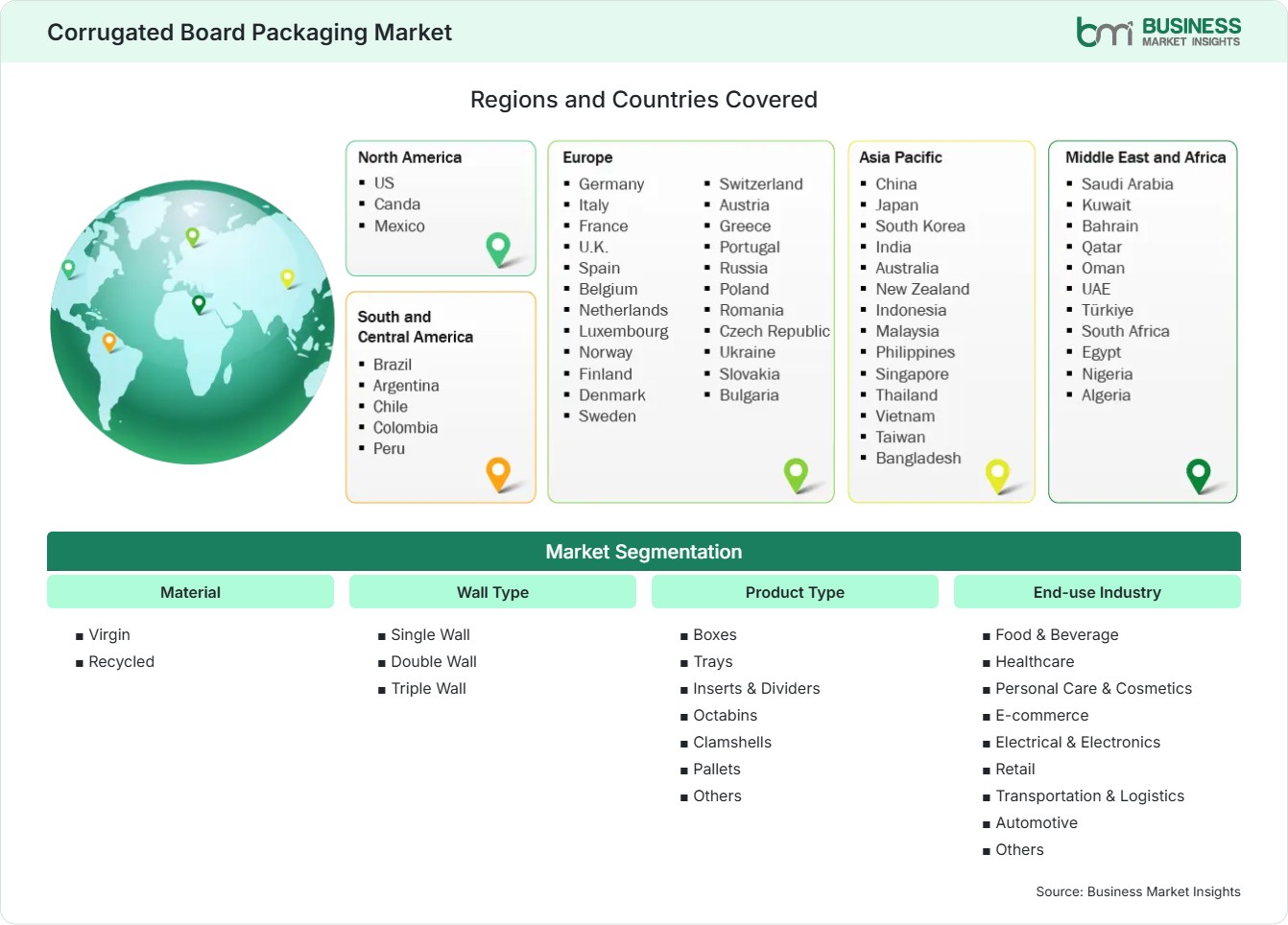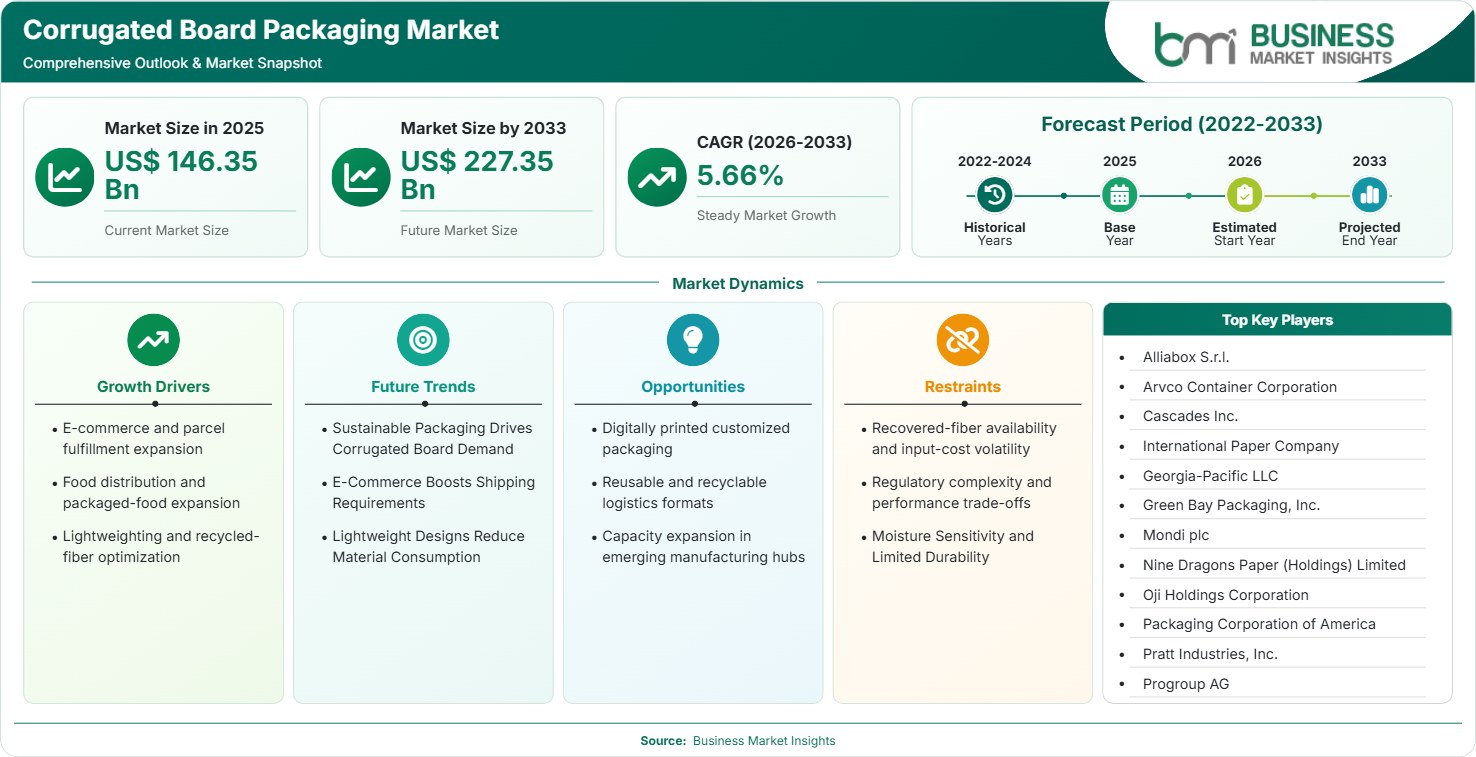
Corrugated Board Packaging Market Regional Highlights
North America Corrugated Board Packaging Market
North America will account for 24%–27% in 2025, growing at a CAGR of 4.8%–5.2% until 2033. Growth in corrugated board packaging is fueled by parcel delivery, grocery packaging, industrial shipping, and retail replenishment. Fiber recycling, lightweighting, automation, and reduced production cycles drive converter investments. The Corrugated Board Packaging market in the US is expected to remain the regional stalwart, while Canada is expected to see a boost from food processing and forestry, and sustainable packaging. Producers increasingly emphasize optimized board strength, downgauging, and efficient logistics to offset labor, energy, and transportation pressures.
- E-commerce fulfillment encourages right-sized boxes, automated packing, and protective inserts that reduce void space and improve transportation efficiency.
- Recycled containerboard remains strategically important as converters balance sustainability requirements, fiber availability, performance specifications, and procurement costs.
- Food and beverage shipments support steady demand for moisture-resistant, hygienic, stackable formats suitable for distribution and retail handling.
- Automation investments improve throughput, quality inspection, palletizing, and production consistency across high-volume converting facilities.
US Corrugated Board Packaging Market
In the United States, the market holds 78%-82% of North America’s 2025 share and exhibits a CAGR of 4.7%-5.1% in the Corrugated Board Packaging market up to 2033. The market is driven by strong demand across retail distribution, parcels, food processing, manufacturing, and consumer packaged goods. Large integrated manufacturers gain an advantage in scale in sourcing containerboard and converting. Regional converters leverage their quick response and ability to offer customized solutions with small runs and printing. Cost control increasingly centers on fiber yield, machine utilization, transportation density, automated handling, and customer-specific structural engineering.
- Retail replenishment and parcel shipping maintain high box utilization, encouraging standardized footprints alongside customized formats for premium products.
- Automated case forming and packing are improving labor productivity where converters face skilled-worker shortages and increasingly variable order profiles.
- Recycled-content programs are influencing board specifications, procurement strategies, and customer sustainability reporting requirements.
Europe Corrugated Board Packaging Market
Europe represents a 22%-25% share in 2025, with a CAGR of 4.9%-5.4% till 2033 in the Corrugated Board Packaging market. The five leading manufacturing and converting markets include Germany, Italy, France, the UK, and Poland, but Germany and Poland provide relatively attractive growth prospects with respective CAGRs of 5.2%-5.8% and 5.4%-6.0%. Regulatory pressure favors recycling designs, fiber utilization, and packaging simplicity. E-commerce, food logistics, and FMCG continue driving digital printing, converting automation, and integrated production systems.
- EU packaging regulation is strengthening design-for-recycling requirements and encouraging converters to reconsider coatings, adhesives, inks, and material combinations.
- Germany remains strategically important because of dense industrial activity, e-commerce distribution, and sophisticated converting infrastructure.
- Poland benefits from manufacturing relocation, export-oriented production, modern retail development, and growing logistics activity.
- Digital print and customized structural solutions support shorter production runs and premium shelf-ready packaging requirements.
Asia Pacific Corrugated Board Packaging Market
Asia Pacific region will account for 38%-41% in 2025, with a compound annual growth rate of 6.2%-6.7% between 2023 and 2033. The prominent regions are China, Japan, India, South Korea, and Southeast Asia. While China leads in packaging manufacturing, India and Southeast Asia offer greater growth prospects. Some of the major applications include export manufacturing, food processing, electronics, retail, and e-commerce. The other investment areas are local manufacturing, fiber recycling, automation, and logistics efficiency, which are now critical focus areas.
- China combines extensive manufacturing demand with a mature paper and packaging ecosystem, supporting large-scale containerboard and converting capacity.
- India benefits from organized retail expansion, packaged-food penetration, consumer goods distribution, and rising e-commerce fulfillment requirements.
- Southeast Asian economies are attracting manufacturing investment, increasing demand for export cartons and protective transport packaging.
- Japan emphasizes high-quality printing, structural precision, automation, resource efficiency, and specialized packaging for mature consumer markets.
Rest of World Corrugated Board Packaging Market
The South and Central American regions contribute to food exports, the agricultural supply chain, consumer goods, and retail modernization. Brazil and Mexico have become important manufacturing regions, while Colombia and Chile are areas for growth. Expansion will be stimulated by food export packaging, food processing, and improvements to the logistics network. Latin America is forecast to have a 5.0%-5.5% CAGR through 2033, driven by increasing packaging conversion and recycling.
Middle East and Africa region's demand is fueled by food distribution, beverage packaging, pharmaceuticals, retail development, and logistics infrastructure. Saudi Arabia, the United Arab Emirates, South Africa, and Egypt offer good pockets for investment, with certain markets projected at 5.5%–6.2% CAGR.
- Brazil's agricultural and food-processing industries create recurring requirements for strong transport cartons and export-oriented packaging.
- Mexico Corrugated Board Packaging market benefits from manufacturing supply chains, nearshoring, automotive production, and cross-border logistics demand.
- Gulf markets require durable packaging for imported food, beverages, consumer products, and distribution through modern retail channels.
- South Africa serves as a regional packaging and logistics hub, supporting food, beverage, industrial, and consumer applications.