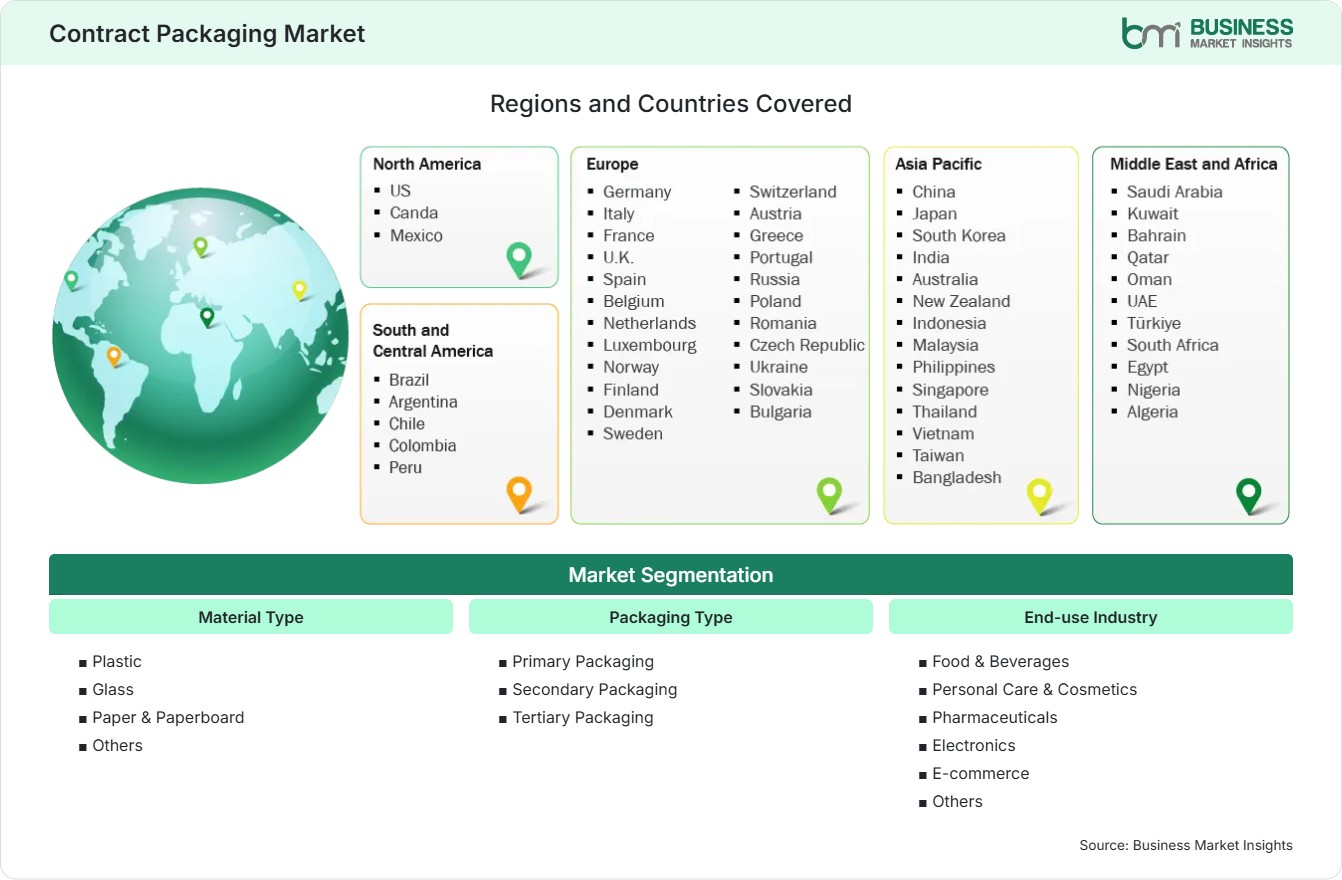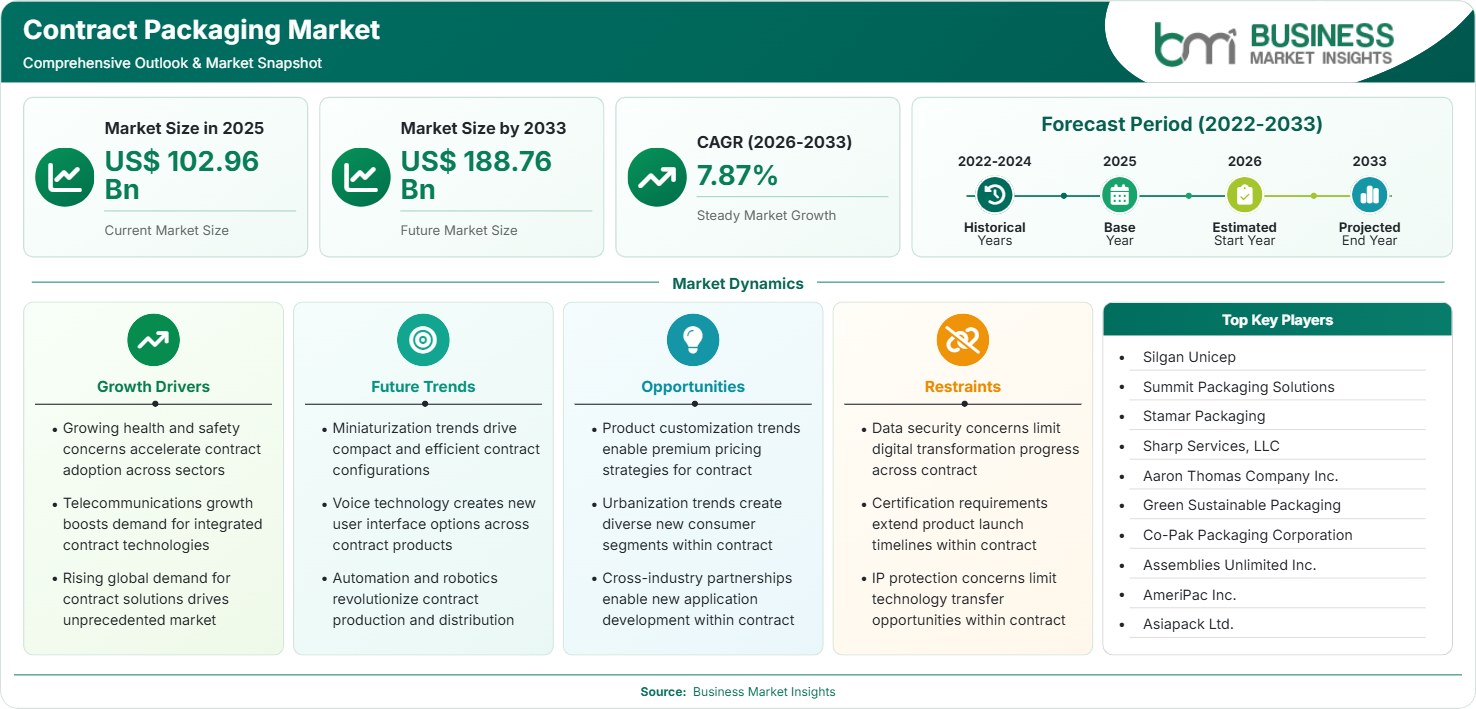
Contract Packaging Market Regional Highlights
North America Contract Packaging Market
North America held a 35%–38% Contract Packaging Market share in 2025 and is projected to expand at a 6.8%–7.6% CAGR through 2033. The region benefits from mature outsourcing practices, pharmaceutical packaging specialization, advanced automation, strong e-commerce fulfillment, and sophisticated brand-owner requirements. The US remains the dominant national contributor, while Canada provides opportunities in food, healthcare, and consumer packaged goods. Demand is increasingly shifting toward integrated packaging and fulfillment partnerships that reduce fixed labor requirements while improving launch flexibility and compliance performance.
- Pharmaceutical and biopharmaceutical outsourcing is strengthening demand for sterile, injectable, clinical-trial, and device assembly capabilities, particularly among companies seeking scalable capacity without building dedicated packaging infrastructure.
- E-commerce is increasing requirements for customized secondary packaging, protective formats, kitting, labeling, and direct-to-consumer fulfillment, encouraging providers to integrate packaging operations with warehousing and distribution services.
- Automation investment is addressing labor availability constraints while improving throughput, inspection accuracy, repeatability, and production economics across high-volume consumer and healthcare packaging programs.
- Sustainable packaging procurement is accelerating demand for lightweighting, recyclable structures, paper-based alternatives, and documented material sourcing as brands face increasing environmental expectations and regulatory scrutiny.
US Contract Packaging Market
The US represented 31%–34% of the overall 2025 share and is expected to grow at a 6.7%–7.5% CAGR through 2033. The country's mature outsourcing ecosystem, large pharmaceutical base, established consumer brands, and extensive fulfillment infrastructure support steady demand. Contract packagers are expanding capabilities around injectable devices, clinical supply, flexible formats, and omnichannel distribution. US packaging operations are also benefiting from companies seeking greater supply-chain resilience and diversified production footprints, although labor, compliance, and material costs continue influencing outsourcing decisions.
- The US benefits from pharmaceutical outsourcing and expanding biologics pipelines, creating demand for specialized assembly, labeling, serialization, cold-chain support, and commercial packaging services.
- E-commerce fulfillment continues to encourage contract packagers to provide integrated kitting, customized shipping configurations, returns handling, and inventory services alongside conventional packaging operations.
- Domestic capacity expansion is increasingly focused on flexible, automated facilities capable of supporting both clinical-scale programs and commercial production without lengthy equipment reconfiguration periods.
Europe Contract Packaging Market
Europe accounted for a 25%–29% share in 2025 and is forecast to register a 6.4%–7.3% CAGR through 2033. Germany, the UK, France, Italy, and the Netherlands remain leading countries, while Poland and Spain offer comparatively faster growth opportunities at 7.2%–8.4% CAGRs. Regulatory pressure is reshaping material choices and supplier qualification. The EU Packaging and Packaging Waste Regulation 2025/40 covers packaging composition, manufacturing, reuse, recyclability, and waste management, raising demand for compliance-oriented packaging partners.
- Germany and the UK maintain strong demand from pharmaceuticals, food, beverages, and consumer goods, supporting contract packaging providers with diversified sector exposure and advanced manufacturing infrastructure.
- Poland is emerging as a high-growth outsourcing location as manufacturers seek cost-efficient European production while maintaining proximity to major consumer markets and established logistics corridors.
- The Netherlands benefits from pharmaceutical logistics, cold-chain infrastructure, and cross-border distribution, supporting specialized packaging programs for clinical and commercial healthcare products.
- PPWR implementation is increasing demand for packaging redesign, recyclability assessment, material documentation, and supplier-level compliance capabilities across multinational brand portfolios.
Asia Pacific Contract Packaging Market
Asia Pacific held a 27%–31% share of the Contract Packaging Market in 2025 and is projected to achieve an 8.8%–10.0% CAGR through 2033, making it the fastest-growing regional opportunity. China, Japan, South Korea, India, and Australia are leading contributors, while India and Southeast Asia offer high-growth opportunities at 9.5%–11.0% CAGRs. Expanding consumer populations, export manufacturing, e-commerce, and pharmaceutical production are increasing demand for outsourced packaging. IATA reported Asia Pacific air-cargo demand growth of 8.4% in 2025, reinforcing the region's logistics relevance.
- China remains a major production and export hub, supporting contract packaging through integrated manufacturing, assembly, kitting, warehousing, and logistics capabilities.
- India is gaining momentum from pharmaceutical production, consumer spending, organized retail, and packaging investment, creating opportunities for providers serving domestic and export-oriented brands.
- Southeast Asia is attracting supply-chain diversification initiatives, increasing demand for localized packaging, final assembly, labeling, and fulfillment services close to manufacturing clusters.
- Rising e-commerce penetration is increasing requirements for secondary and tertiary packaging optimized for parcel delivery, damage reduction, customization, and efficient warehouse handling.
Rest of World Contract Packaging Market
South and Central America represented a 6%–8% Contract Packaging Market share in 2025 and is expected to grow at a 7.0%–8.2% CAGR through 2033. Brazil and Mexico lead regional demand, while Colombia and Chile offer faster opportunities at 8.0%–9.2% CAGRs. Food, beverages, personal care, and pharmaceuticals are key outsourcing applications, supported by expanding modern retail and regional manufacturing.
The Middle East and Africa contributed a 4%–6% share in 2025 and is projected to expand at a 7.2%–8.5% CAGR. Saudi Arabia, the UAE, and South Africa lead activity, while Egypt and Morocco offer higher-growth opportunities at 8.0%–9.5% CAGRs. Healthcare localization, food processing, and logistics investment are strengthening demand.
- Brazil and Mexico provide scale through large consumer populations, established food processing sectors, and growing requirements for flexible packaging and regional distribution.
- Middle Eastern logistics hubs are creating opportunities for contract packaging linked to re-export activity, pharmaceutical distribution, premium consumer products, and food supply chains.
- Africa offers longer-term potential through healthcare access initiatives, local manufacturing development, and increasing packaged food consumption, although infrastructure remains an important execution consideration.
- Regional providers can differentiate through multilingual labeling, local regulatory expertise, flexible batch sizes, and integrated warehousing capabilities tailored to fragmented customer bases.