
Connected Agriculture Market Outlook: Size, Share, Trends, Growth Analysis, Competitive Landscape & Forecast, 2026-2033

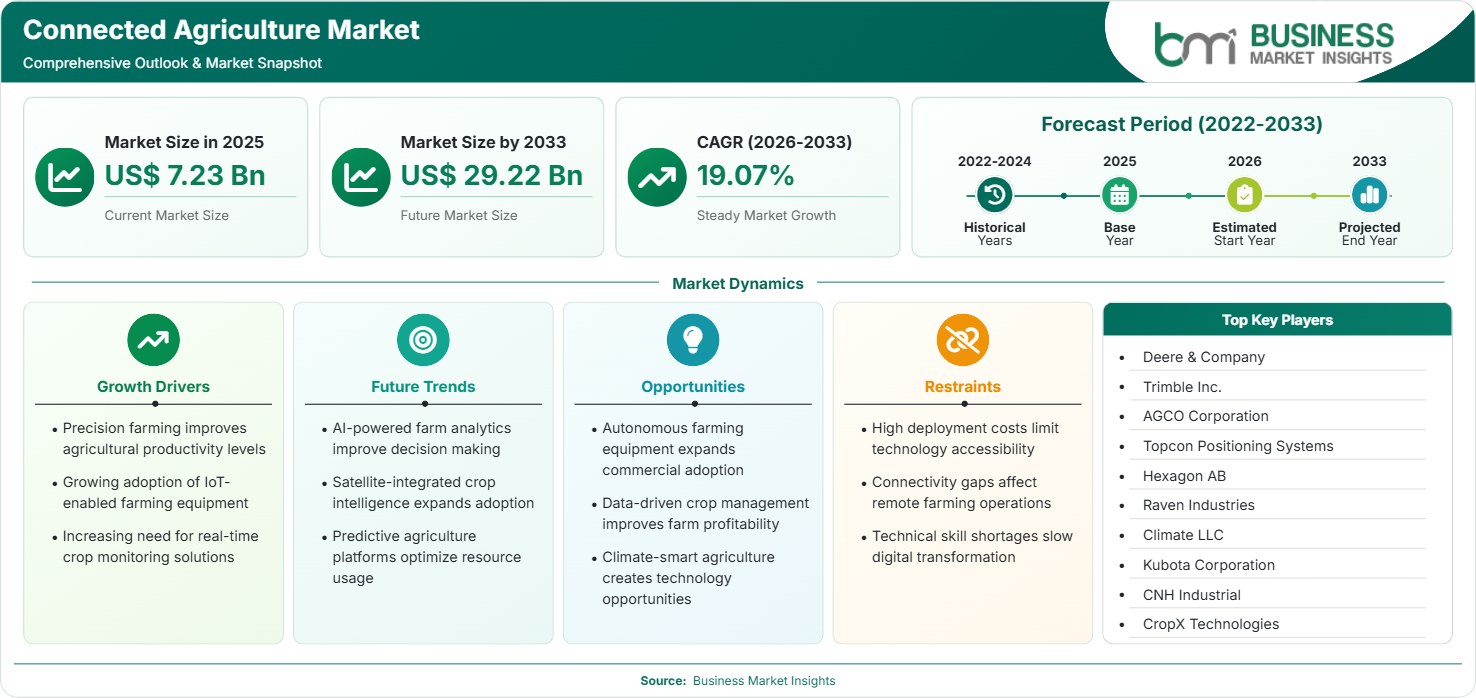
The Connected Agriculture Market size was valued at US$ 7.23 billion in 2025 and is projected to reach US$ 29.22 billion by 2033, growing at a CAGR of 19.07% during 2026–2033. Increasing adoption of precision agriculture technologies, expanding IoT-enabled farm operations, and rising investments in smart farming infrastructure continue supporting digital transformation across global agricultural value chains.

Report Coverage
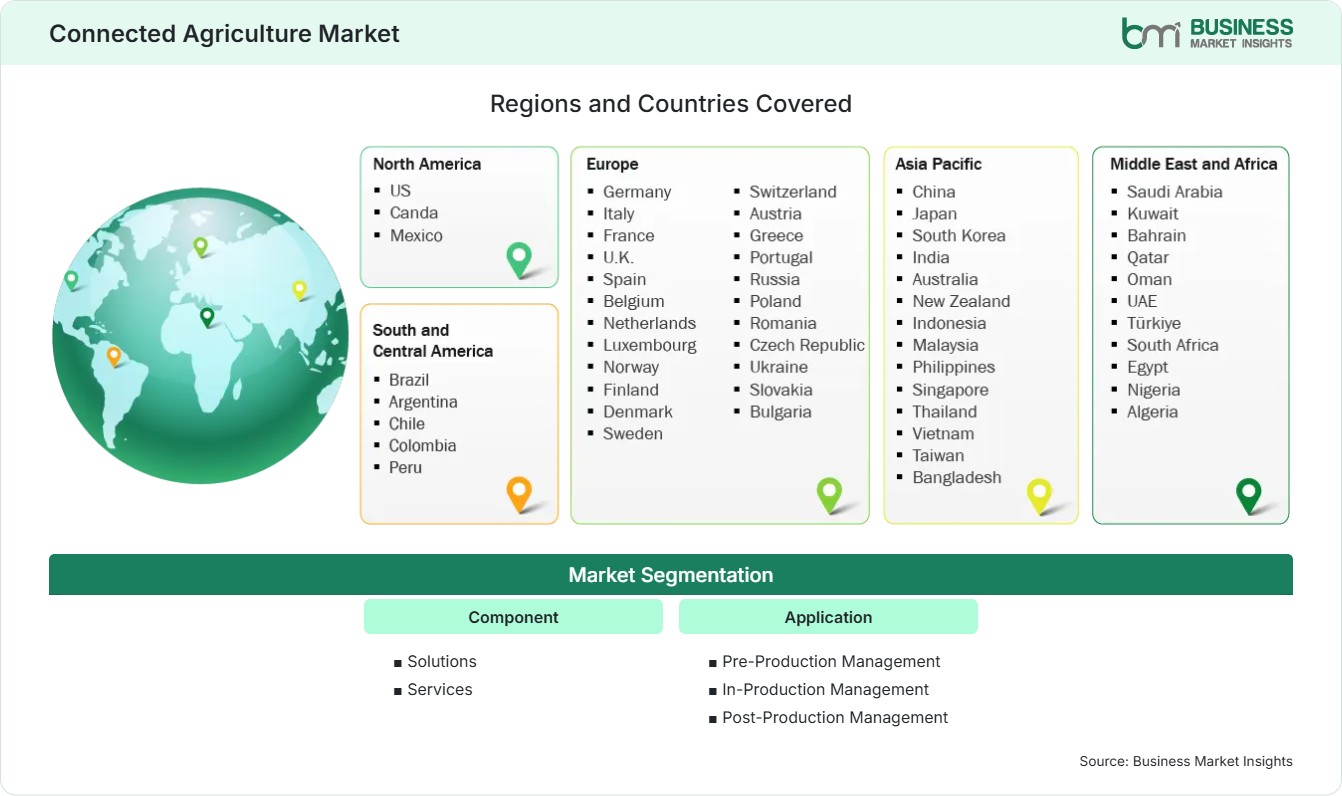
  • Component: Solutions, Services
  • Application: Pre-Production Management, In-Production Management, Post-Production Management
US$ 7.23 Bn Market size in 2025
US$ 29.22 Bn Market Size by 2033
19.07% CAGR, 2026 - 2033
2026-2033 Forecast Period

AI Overview

Connected Agriculture Market Summary

  • North America Region: North America holds 34%–37% market share in 2025 and is projected to register a CAGR of 18.1%–18.8% during 2026–2033. High adoption of precision farming, strong digital infrastructure, and increasing investments in autonomous agricultural equipment continue driving regional expansion. The U.S. remains the largest contributor, recording a CAGR of 18.3%–19.0% through widespread deployment of connected farming technologies.
  • Fastest Growing Region: Asia Pacific accounts for 27%–30% market share in 2025 and is expected to expand at a CAGR of 20.6%–21.4%, supported by government-backed digital agriculture initiatives, expanding smart irrigation projects, and growing mechanization across emerging farming economies.
  • Leading Segment: Solutions capture 63%–66% market share in 2025 and are projected to grow at a CAGR of 18.9%–19.6%, driven by increasing deployment of precision agriculture platforms, farm analytics software, and connected monitoring systems.
  • High Growth Segment: In-Production Management represents 45%–48% market share in 2025 and is anticipated to register a CAGR of 19.8%–20.5%, supported by rising demand for real-time monitoring, automated irrigation, and precision crop management solutions.
  • Key Market Opportunity: Growing investments in artificial intelligence, autonomous machinery, cloud-based farm management platforms, and climate-resilient agriculture continue creating long-term opportunities for connected farming technology providers.
  • Major Market Players: Deere & Company, Trimble Inc., AGCO Corporation, Topcon Positioning Systems, Hexagon AB, Raven Industries, Inc., The Climate Corporation, Kubota Corporation, CNH Industrial N.V., and CropX Technologies Ltd.
Strategic Insights

Connected Agriculture Market: Strategic Insights

Connected Agriculture Market Strategic Framework
FREE PDF
Request your free sample
Request free sample
Stakeholder View

Key Takeaways

  • Integrated digital farming ecosystems are becoming increasingly important as equipment manufacturers, software developers, and analytics providers collaborate to deliver comprehensive precision agriculture solutions.
  • In-production management applications continue presenting the strongest commercial opportunity because farmers increasingly depend on real-time operational visibility to improve yields and optimize resource utilization.
  • Artificial intelligence, remote sensing, predictive analytics, and autonomous machinery are reshaping farm management practices while improving decision-making across the agricultural production cycle.
  • Asia Pacific offers the strongest long-term investment potential due to expanding agricultural modernization programs, increasing mechanization, and rising government investments in digital farming technologies.
  • Strategic acquisitions, cloud platform development, and partnerships with telecommunications providers continue accelerating deployment of connected agriculture infrastructure worldwide.
  • Sustainability objectives and climate resilience initiatives are encouraging broader adoption of intelligent farming solutions capable of improving water efficiency, reducing fertilizer usage, and supporting long-term food security.
Geographic Outlook

Connected Agriculture Market Regional Highlights

North America Connected Agriculture Market

North America accounts for 34%–37% Connected Agriculture Market share in 2025 and is projected to grow at a CAGR of 18.1%–18.8% through 2033. Strong technology adoption, extensive mechanized farming, and advanced telecommunications infrastructure continue supporting connected farming deployments across commercial agriculture. Increasing investment in autonomous equipment, precision planting technologies, and cloud-based farm management platforms further strengthens regional competitiveness.

  • Precision farming technologies continue improving operational efficiency across large-scale commercial farms throughout the United States and Canada.
  • Growing deployment of connected tractors, drones, and autonomous agricultural machinery strengthens digital farming adoption.
  • Agricultural software providers increasingly integrate AI-driven analytics with real-time sensor networks for enhanced decision-making.
  • Investments in rural broadband infrastructure continue improving connectivity for precision agriculture applications.

US Connected Agriculture Market

The United States contributes 79%–82% of North American revenue and is projected to register a CAGR of 18.3%–19.0% during the forecast period. Strong research capabilities, advanced equipment manufacturing, and widespread adoption of precision agriculture continue supporting market leadership.

  • Large commercial farms increasingly invest in connected equipment and automated farm management systems.
  • AI-powered analytics improve crop planning, irrigation scheduling, and equipment maintenance efficiency.
  • Public and private investments continue accelerating development of digital agriculture infrastructure.
  • Technology providers expand integrated farm management platforms supporting sustainable agricultural practices.

Europe Connected Agriculture Market

Europe represents 25%–28% market share in 2025 and is expected to expand at a CAGR of 18.4%–19.1% during 2026–2033. Agricultural sustainability initiatives, precision farming incentives, and increasing digital transformation continue supporting technology adoption. Germany leads the regional market through advanced agricultural mechanization, while Spain records the fastest growth driven by precision irrigation investments and smart farming programs.

  • Government incentives encourage farmers to adopt precision agriculture technologies and connected monitoring systems.
  • Sustainable farming objectives increase demand for digital resource management platforms.
  • Agricultural equipment manufacturers continue expanding smart machinery portfolios across European markets.
  • Satellite imaging and IoT integration improve operational efficiency and environmental monitoring.

Asia Pacific Connected Agriculture Market

Asia Pacific accounts for 27%–30% market share in 2025 and is projected to register the fastest 20.6%–21.4% CAGR through 2033. Rising food demand, expanding agricultural mechanization, government-supported smart farming programs, and increasing digital infrastructure investments continue driving market expansion. China remains the largest regional market, while India records the fastest growth through rapid adoption of connected farming technologies.

  • National digital agriculture initiatives continue accelerating precision farming adoption across emerging economies.
  • Expansion of smart irrigation projects improves water efficiency and crop productivity.
  • Cloud-based agricultural platforms strengthen data-driven farm management capabilities.
  • Growing investment in agricultural drones and connected equipment supports market expansion.

Rest of World Connected Agriculture Market

The Rest of World region represents 8%–11% market share in 2025 and is expected to register a CAGR of 18.8%–19.5% during the forecast period. Agricultural modernization, expanding commercial farming operations, and increasing adoption of precision irrigation technologies continue supporting growth across Latin America, the Middle East, and Africa.

  • Brazil leads regional adoption through large-scale commercial agriculture and precision farming investments.
  • Gulf countries increasingly deploy connected agriculture technologies to improve water efficiency and food security.
  • Digital farm monitoring supports productivity improvements across emerging agricultural economies.
  • Technology partnerships continue expanding access to connected farming platforms in underserved rural regions.
Global Market Geography
FREE PDF
Request your free sample
Request free sample
Segment Analysis

Connected Agriculture Market Segmentation

Component

The component segment represents the technological foundation of connected farming ecosystems by combining digital platforms with implementation and support capabilities. It accounted for 63%–66% market share in 2025 and is projected to expand at a CAGR of 18.9%–19.6% during 2026–2033. Continuous investment in cloud-based platforms, AI-enabled analytics, and IoT infrastructure is expanding the Connected Agriculture Market scope, enabling farmers to improve operational visibility, automate field activities, and optimize resource utilization across diverse agricultural environments.

  • Solutions: Account for the largest revenue contribution due to increasing deployment of precision farming software, IoT platforms, farm management systems, remote sensing applications, and integrated analytics supporting data-driven agricultural decision-making.
  • Services: Demand continues increasing as agricultural enterprises require consulting, implementation, system integration, technical support, predictive maintenance, software upgrades, and training services to maximize returns from connected farming technologies.

Application

Application-based adoption continues expanding as digital technologies support agricultural activities throughout the farming lifecycle, from field preparation to post-harvest management. This segment accounted for 45%–48% market share in 2025 and is anticipated to register the fastest CAGR of 19.8%–20.5% through 2026–2033. Current Connected Agriculture Market trends highlight increasing reliance on intelligent monitoring systems, predictive analytics, and automated farm operations to improve productivity, sustainability, and long-term profitability.

  • Pre-Production Management: Digital planning tools, soil analysis platforms, weather forecasting systems, and precision field mapping help farmers optimize crop selection, land preparation, irrigation planning, and input allocation before cultivation begins.
  • In-Production Management: Represents the largest application through real-time monitoring of crops, irrigation, livestock, equipment performance, pest detection, fertilizer application, and environmental conditions using connected sensors and intelligent automation technologies.
  • Post-Production Management: Connected technologies improve storage monitoring, quality tracking, logistics coordination, inventory management, supply chain visibility, and traceability, helping producers reduce post-harvest losses while improving product quality and distribution efficiency.
Market Forces

Connected Agriculture Market Dynamics

Key Market Drivers

Precision farming improves agricultural productivity levels

Modern techniques for precision agriculture continue to revolutionize the agricultural process through the provision of timely information concerning the field using real time field data. Techniques such as GPS guided machinery, use of satellites, use of drones and monitoring systems utilizing sensors facilitate accurate analysis of crop health status, efficient utilization of fertilizers and reduced unnecessary usage of resources. According to FAO, the improvement in productivity of farms is crucial to meet future demands of food due to reduced availability of arable lands. These advancements continue supporting Connected Agriculture Market growth, particularly across large commercial farms adopting digital agriculture solutions.

Growing adoption of IoT-enabled farming equipment

IoT-enabled tractors, harvesters, irrigation systems, weather stations, and soil sensors are becoming integral components of modern farming operations. These interconnected devices gather continuous field data that is capable of predictive maintenance, equipment optimization, and decision automation. There have been increasing developments by agricultural equipment manufacturing companies incorporating cloud technology and artificial intelligence in machines, improving efficiency. As more rural areas become connected, there is increasing use of intelligent agricultural machines by commercial growers who require increased efficiency, cost reduction, and asset management.

Increasing need for real-time crop monitoring solutions

Climate fluctuations, water shortages, pest outbreaks, and environmental changes are among the reasons that have increased the need for real-time crop monitoring systems. Farmers are increasingly employing remote sensing techniques, drones, multispectral imagery, and networked farm sensors to track crop growth throughout the growing season. Continuous advancements in analytics platforms and cloud computing are strengthening Connected Agriculture Market trends, allowing agricultural enterprises to improve yields, optimize resource allocation, and support sustainable farming practices.

Key Market Opportunities

Autonomous farming equipment expands commercial adoption

Autonomous agricultural machinery is gaining commercial acceptance as producers seek solutions that improve labor efficiency and operational precision. Automated tractors, sprayers, harvesters, and other AI-driven agricultural machinery help reduce manual labor and ensure uniformity in farming processes. The development of new automated devices is supported by machine manufacturers through collaboration with farm management systems. Such innovations are supposed to be widely implemented by big agricultural firms due to increasing labor shortage and operational requirements worldwide.

Data-driven crop management improves farm profitability

Agricultural producers are turning towards data-based decision making in order to ensure optimal productivity with minimal wastage of money in unnecessary expenditures. In connected farms, the intelligence on weather, soil, equipment, and crops are used together to provide guidance on improving the yield quality and profitability. Artificial Intelligence in conjunction with predictive analytics enables agriculturalists to plant and water crops optimally. Connected Agriculture Market Forecasts indicate that growing demand for intelligent decision-support platforms will continue creating substantial investment opportunities for technology providers over the coming years.

Climate-smart agriculture creates technology opportunities

Climate-smart agriculture is becoming a strategic priority as governments and farming organizations seek resilient production systems capable of addressing changing environmental conditions.The benefits of connected technology include water management, carbon control, precision irrigation, and efficient use of nutrients while assisting the adaptation of farmers to the unpredictable weather conditions. Investments made by the government in sustainable agriculture together with international efforts to promote digital farming keep motivating the implementation of connected technology.

Market Restraints and Challenges

High deployment costs limit technology accessibility

Advanced connected agriculture solutions require significant investment in sensors, communication infrastructure, precision equipment, cloud software, and technical services. Factor: The heavy capital investment at the start tends to deter small and medium-scale farmers from adopting the technology. Impact: This leads to the slow diffusion of technology in the developing agricultural areas, even though the long-term advantages of connected agriculture are numerous.

Connectivity gaps affect remote farming operations

Reliable broadband and mobile network availability remain limited across many rural agricultural regions where connected technologies could deliver the greatest operational value. Factor: Inadequate digital infrastructure restricts continuous communication between connected devices, cloud platforms, and field monitoring systems. Impact: Interrupted data transmission, delayed analytics, and reduced automation capabilities limit technology effectiveness, making widespread deployment more challenging for farms operating in geographically remote locations.

Company Analysis

Competitive Landscape

Competition is centered on precision agriculture platforms, autonomous machinery, AI-powered analytics, IoT-enabled equipment, and cloud-based farm management solutions. Connected Agriculture Market analysis shows that leading companies are expanding their portfolios through digital innovation, strategic partnerships, acquisitions, and integrated hardware-software ecosystems that improve farm productivity, optimize resource utilization, and strengthen long-term sustainability across global agricultural operations.

Company Name

Overview

Products and Services Relevant to this Market

Deere & Company

Global agricultural equipment manufacturer offering advanced precision farming technologies and intelligent machinery for modern agricultural operations.

Autonomous tractors, precision planting systems, connected farm management software, GPS guidance, and smart agricultural equipment.

Trimble Inc.

Technology company specializing in positioning, connectivity, and digital agriculture solutions for precision farming.

Farm management software, GPS guidance systems, variable rate application technologies, precision agriculture platforms, and field analytics.

AGCO Corporation

Leading agricultural machinery manufacturer focused on smart farming technologies and connected equipment solutions.

Precision agriculture systems, autonomous equipment technologies, telemetry solutions, guidance systems, and digital farm management platforms.

Topcon Positioning Systems

Develops advanced positioning technologies supporting precision agriculture and automated farming applications.

GNSS positioning systems, precision spraying, automated steering, crop monitoring technologies, and agricultural software solutions.

Hexagon AB

Industrial technology company delivering digital reality and precision agriculture solutions through intelligent software platforms.

Farm analytics software, geospatial technologies, precision agriculture platforms, autonomous guidance systems, and connected data solutions.

Raven Industries, Inc.

Precision agriculture technology provider specializing in automation and intelligent field operation solutions.

Autonomous farming systems, field computers, precision spraying technologies, connected equipment, and machine control solutions.

The Climate Corporation

Digital agriculture company providing predictive analytics and farm intelligence solutions for commercial agriculture.

Climate FieldView platform, crop analytics, field monitoring, weather intelligence, and precision agriculture software.

Kubota Corporation

Global agricultural equipment manufacturer expanding connected farming capabilities through smart machinery and digital technologies.

Smart tractors, connected agricultural equipment, farm automation systems, telematics, and precision farming solutions.

CNH Industrial N.V.

Global manufacturer integrating digital technologies and precision farming solutions across agricultural equipment portfolios.

Connected tractors, combines, precision farming technologies, telematics platforms, and autonomous agricultural systems.

CropX Technologies Ltd.

Agri-tech company focused on soil intelligence and cloud-based farm management solutions.

Soil sensors, irrigation optimization software, farm analytics, connected monitoring platforms, and agronomic decision-support systems.

Trust & Transparency

Research Methodology

The market analysis combines proprietary research with secondary data from government agencies, company disclosures, regulatory filings, industry databases and expert interviews. Market estimates are validated through data triangulation, cross-market benchmarking and analyst review.

View Full Research Methodology

Questions Answered

Frequently Asked Questions

What does the Connected Agriculture Market Report include?

The Market Report provides detailed insights into market dynamics, competitive landscape, technology trends, regional performance, segmentation, investment opportunities, strategic developments, and long-term industry outlook.

Which region is expected to witness the highest growth?

Asia Pacific is expected to record the fastest expansion due to government-supported digital agriculture initiatives, increasing mechanization, smart irrigation projects, expanding rural connectivity, and rising investment in precision farming technologies.

Why is in-production management growing rapidly?

Farmers require continuous monitoring of crops, irrigation systems, weather conditions, equipment performance, and field activities to improve yields, reduce operational risks, and optimize the use of agricultural resources.

Which component holds the largest market share?

Solutions account for the largest share because farmers increasingly invest in precision agriculture software, cloud-based management platforms, IoT integration, predictive analytics, and intelligent monitoring systems that improve operational efficiency.

What is driving the Connected Agriculture Market?

The market is driven by precision farming adoption, increasing deployment of IoT-enabled agricultural equipment, expanding digital farm management platforms, growing automation, and rising demand for real-time crop monitoring technologies.

Access the Full Connected Agriculture Market Report

Get segment-level forecasts, regional estimates, competitive benchmarking, company profiles and downloadable Excel datasets.

Access the full Connected Agriculture Market Report
350 pages PDF & Excel | 2026-08-24
Similar Research

Related Market Reports