
Condiments Market Outlook: Size, Share, Trends, Growth Analysis, Competitive Landscape & Forecast, 2026-2033

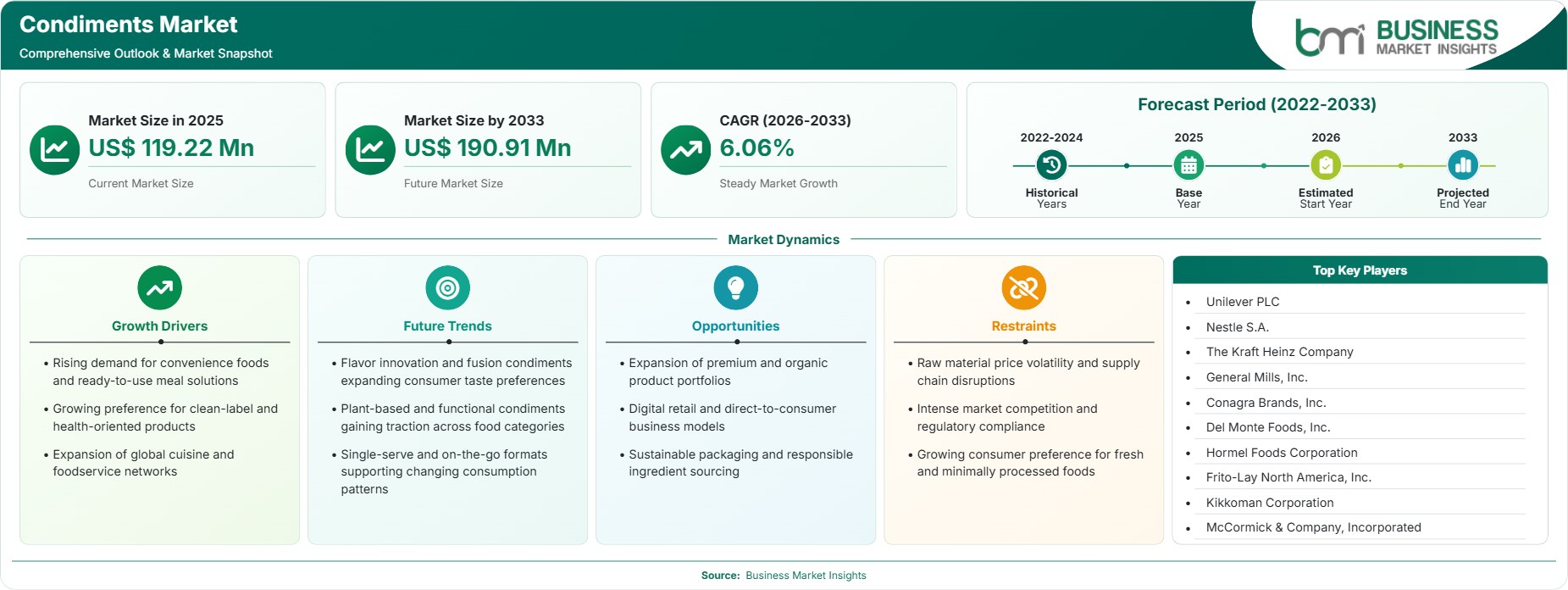
The Condiments Market size was valued at US$ 119.22 Billion in 2025 and is projected to reach US$ 190.91 Billion by 2033, growing at a CAGR of 6.06% during 2026–2033, driven by rising demand for convenience foods, premium flavor innovations, clean-label formulations, expanding foodservice consumption, and increasing consumer preference for international cuisines across developed and emerging economies.

Report Coverage
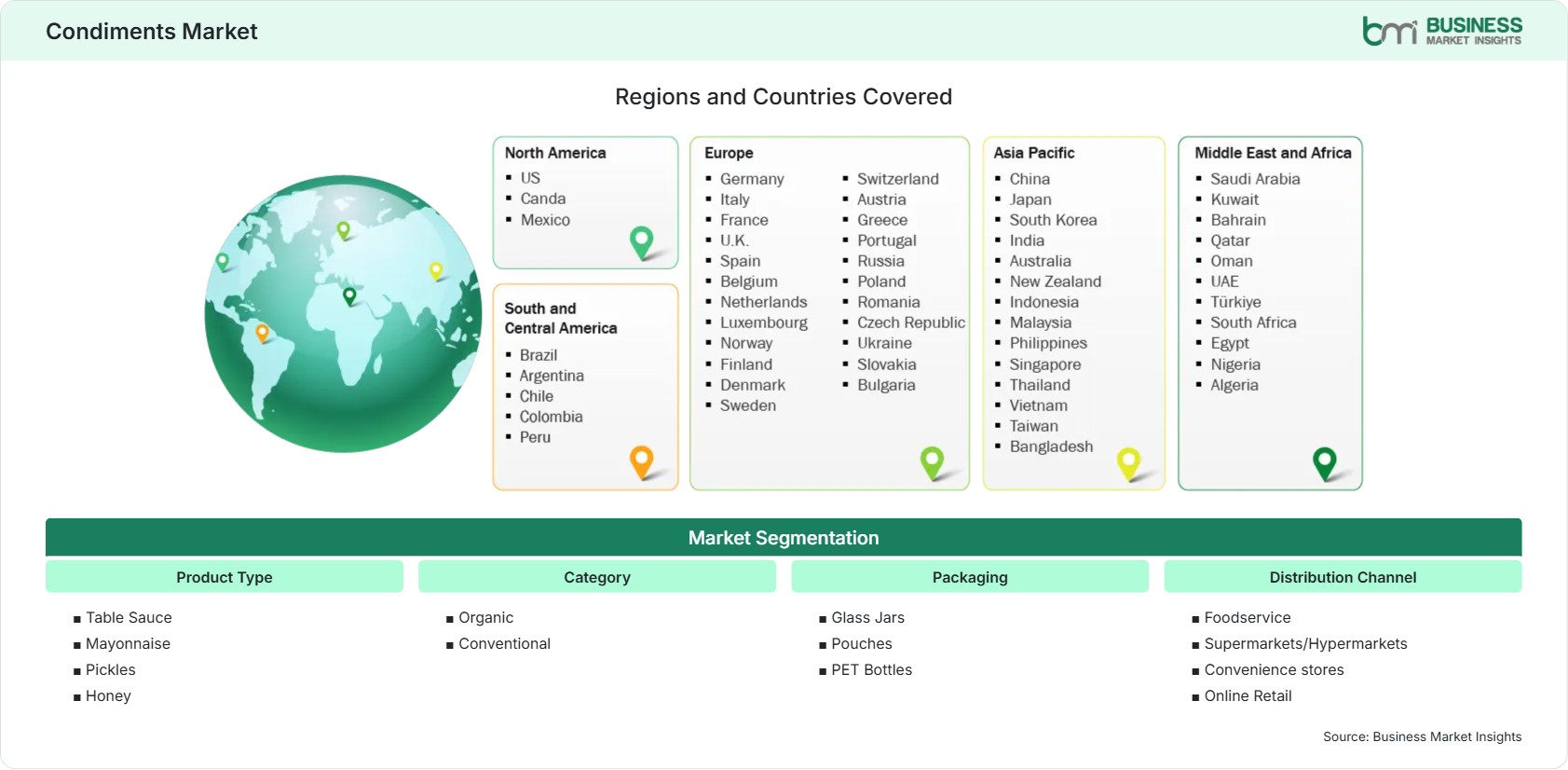
  • Product Type: Table Sauce, Mayonnaise, Pickles, Honey
  • Category: Organic, Conventional
  • Packaging: Glass Jars, Pouches, PET Bottles
  • Distribution Channel: Foodservice, Supermarkets/Hypermarkets, Convenience stores, Online Retail
US$ 119.22 Mn Market size in 2025
US$ 190.91 Mn Market Size by 2033
6.06% CAGR, 2026 - 2033
2026-2033 Forecast Period

AI Overview

Condiments Market Summary

  • North America Region: North America holds a 34%–37% share in 2025, growing with a 5.4%–5.9% CAGR during 2026–2033, supported by premium condiment innovation, strong retail penetration, expanding restaurant demand, healthier formulations, and digital grocery expansion creating sustainable consumption opportunities across households and commercial foodservice channels. The U.S. dominates regional demand through extensive retail distribution, premiumization, and strong foodservice innovation, advancing at an estimated 5.5%–6.0% CAGR.
  • Fastest Growing Region: Asia Pacific holds a 27%–30% share in 2025, expanding at a 7.2%–7.8% CAGR during 2026–2033, driven by urbanization, westernized eating habits, rising disposable incomes, expanding quick-service restaurants, local flavor innovation, and increasing organized retail investments across major developing economies.
  • Leading Segment: Table Sauce holds a 40%–43% share in 2025, progressing at a 5.8%–6.3% CAGR through 2026–2033, supported by frequent household usage, expanding foodservice applications, continuous product innovation, premium variants, healthier ingredients, and growing multicultural culinary preferences across domestic and commercial consumption environments.
  • High Growth Segment: Organic category accounts for 22%–25% share in 2025 while recording a 7.8%–8.4% CAGR during 2026–2033, supported by increasing clean-label awareness, natural ingredient preferences, sustainable farming initiatives, premium pricing acceptance, expanding specialty retail availability, and growing health-conscious consumer demographics globally.
  • Key Market Opportunity: Manufacturers are investing in functional ingredients, regional flavor customization, sustainable packaging, premium gourmet offerings, digital retail partnerships, and private-label collaborations to expand consumer engagement while improving profitability across mature and emerging food ecosystems worldwide.
  • Major Market Players: The Unilever PLC (U.K.), Nestlé S.A. (Switzerland), The Kraft Heinz Company (U.S.), General Mills, Inc. (U.S.), Conagra Brands, Inc. (U.S.), Del Monte Foods, Inc. (U.S.), Hormel Foods Corporation (U.S.), Frito-Lay North America, Inc. (U.S.), Kikkoman Corporation (Japan), and McCormick & Company, Incorporated (U.S.).
Strategic Insights

Condiments Market: Strategic Insights

Condiments Market Strategic Framework
FREE PDF
Request your free sample
Request free sample
Stakeholder View

Key Takeaways

  • The industry's value chain is becoming increasingly integrated, with ingredient suppliers, contract manufacturers, packaging companies, retailers, and foodservice operators collaborating to improve sourcing resilience, reduce production costs, and accelerate innovation cycles.
  • Premium sauces, organic formulations, and convenience-oriented retail formats present the strongest commercial opportunities as consumers increasingly demand healthier ingredients, authentic regional flavors, and ready-to-use culinary solutions.
  • Product innovation is shifting toward clean-label recipes, reduced sodium and sugar formulations, fermentation-based flavor enhancement, recyclable packaging, and AI-supported consumer preference analysis to accelerate product development.
  • Asia Pacific offers one of the most attractive long-term investment destinations because of expanding urban populations, rising processed food consumption, growing organized retail, and rapid quick-service restaurant expansion across India, China, Indonesia, and Southeast Asia.
  • Strategic acquisitions, portfolio diversification, manufacturing expansion, and partnerships with retail chains continue strengthening competitive positioning as established manufacturers seek premium product categories and faster access to emerging consumer segments.
  • Sustainability initiatives, including responsible ingredient sourcing, recyclable packaging materials, reduced food waste, and carbon-efficient manufacturing, are becoming important competitive differentiators influencing procurement decisions across retail and foodservice customers.
Geographic Outlook

Condiments Market Regional Highlights

North America Condiments Market

North America accounted for 34%–37% of the global revenue in 2025 and is projected to expand at a 5.4%–5.9% CAGR during 2026–2033. Strong consumer spending on packaged foods, extensive retail distribution, and a mature foodservice industry continue supporting regional expansion. Product innovation emphasizing clean-label ingredients, premium flavors, and healthier formulations further strengthens competitiveness. High household penetration of sauces, mayonnaise, and specialty condiments, coupled with advanced manufacturing capabilities, enables the region to maintain leadership in global consumption. The Condiments Market share remains the highest worldwide due to established multinational brands and continuous product diversification.

  • Strong supermarket and hypermarket penetration ensures broad product availability while supporting premium and private-label condiment brands through effective merchandising strategies and promotional campaigns that improve consumer engagement and repeat purchases.
  • Growing demand for organic, low-sodium, reduced-sugar, and preservative-free products encourages manufacturers to invest in clean-label innovations that align with evolving dietary preferences and stringent food safety standards.
  • Foodservice expansion across quick-service restaurants, casual dining chains, and institutional catering continues increasing bulk condiment demand while supporting customized product development for commercial kitchens and hospitality businesses.
  • Sustainable packaging initiatives, including recyclable PET bottles, lightweight glass containers, and refillable packaging formats, help manufacturers meet environmental objectives while strengthening consumer trust and regulatory compliance.
  • Digital retail platforms continue expanding premium product accessibility through subscription purchasing, targeted promotions, and wider availability of international condiment brands across urban and suburban consumer markets.

US Condiments Market

The United States contributes approximately 81%–84% of North American Condiments Market revenue and is anticipated to grow at a 5.5%–6.0% CAGR through 2033. Strong brand loyalty, advanced food manufacturing infrastructure, and widespread consumption of packaged meals sustain long-term demand. Product innovation, premiumization, and increasing multicultural food preferences continue expanding the market across both retail and foodservice channels. Investments in digital commerce, automated production, and healthier formulations further enhance competitiveness while supporting consistent product availability across nationwide distribution networks.

  • Consumers increasingly purchase globally inspired sauces, premium hot sauces, specialty mustard, and gourmet mayonnaise, encouraging manufacturers to diversify product portfolios while strengthening premium brand positioning.
  • Investments in advanced food processing technologies improve production efficiency, reduce manufacturing costs, and enable rapid commercialization of innovative flavor profiles tailored to changing consumer preferences.
  • Online grocery channels continue strengthening condiment sales through personalized recommendations, subscription services, and convenient access to imported and premium culinary products across the country.
  • Health-conscious households increasingly demand products containing natural ingredients, reduced preservatives, and transparent nutritional labeling, encouraging manufacturers to expand clean-label offerings across mainstream retail channels.

Europe Condiments Market

Europe represented approximately 26%–29% of global Condiments Market revenue during 2025 and is forecast to register a 5.3%–5.8% CAGR through 2033. The region benefits from established culinary traditions, high-quality food standards, and strong demand for premium condiment products. Germany, France, and the United Kingdom remain leading revenue contributors, while Spain and Poland exhibit comparatively faster growth owing to evolving consumer preferences, expanding organized retail, and increasing adoption of international cuisine across households and foodservice establishments.

  • Premium gourmet sauces, artisanal condiments, and authentic regional specialties continue gaining popularity among consumers seeking differentiated culinary experiences supported by premium retail channels.
  • European food labeling regulations encourage ingredient transparency, sustainable sourcing, and nutritional disclosure, strengthening consumer confidence while driving product reformulation and innovation.
  • Growing adoption of vegan, plant-based, and organic condiment products reflects changing dietary habits, encouraging manufacturers to introduce healthier alternatives without compromising flavor quality.
  • Hospitality recovery, tourism expansion, and restaurant diversification continue increasing commercial demand for premium sauces, marinades, and specialty condiments throughout Western and Central Europe.
  • Manufacturers increasingly invest in environmentally responsible packaging and carbon-efficient production processes to align with European sustainability objectives and retailer procurement requirements.

Asia Pacific Condiments Market

Asia Pacific accounted for approximately 27%–30% of global Condiments Market revenue in 2025 and is expected to record the fastest 7.2%–7.8% CAGR through 2033. Both China and Japan continue to be the biggest regional markets, whereas India, Indonesia, and Vietnam are experiencing the fastest growth due to urbanization, high incomes, growing consumption of packaged food, and development of organized retail formats. The impact of Western diets, international restaurant chains, and online grocery stores continues driving regional demand for condiments.

  • Rapid growth of quick-service restaurants significantly increases consumption of ketchup, mayonnaise, soy sauce, and specialty condiments while encouraging manufacturers to establish localized production facilities.
  • Expanding middle-class populations drive premium food purchasing behavior, creating opportunities for imported products, organic condiments, and value-added flavor innovations across metropolitan markets.
  • Government support for food processing industries and logistics infrastructure improves domestic production capabilities while attracting foreign direct investment into regional manufacturing operations.
  • Regional manufacturers increasingly combine traditional Asian ingredients with international recipes, creating innovative product portfolios that appeal to younger consumers seeking diverse culinary experiences.
  • E-commerce continues strengthening product accessibility by enabling consumers to purchase premium domestic and imported condiment brands through convenient digital platforms and subscription services.

Rest of World Condiments Market

The Rest of World region accounted for approximately 9%–12% of global Condiments Market revenue during 2025 and is projected to expand at a 6.1%–6.6% CAGR through 2033. Advantages in South & Central America include increased consumption of processed foods, greater coverage of supermarkets and increased demand for premium sauces. The Middle East & Africa is experiencing growth fueled by factors such as urbanization, tourism, investment in hospitality industry, modern retail development. Brazil and Mexico continue to be dominant in South & Central America. Saudi Arabia, United Arab Emirates and South Africa are attractive high growth markets.

  • Rising disposable incomes encourage consumers to purchase premium packaged foods and internationally recognized condiment brands through expanding supermarket and convenience store networks.
  • Tourism growth supports hotels, restaurants, and catering businesses, increasing demand for high-quality sauces, pickles, and specialty flavor products across commercial foodservice applications.
  • International manufacturers continue strengthening regional distribution through partnerships with local retailers, distributors, and foodservice operators while expanding manufacturing investments.
  • Local producers increasingly introduce products featuring indigenous ingredients and regional flavor preferences, strengthening competitiveness while preserving traditional culinary heritage.
  • Investments in food manufacturing, logistics infrastructure, and food safety regulations continue improving long-term business conditions and export opportunities across emerging economies.
Global Market Geography
FREE PDF
Request your free sample
Request free sample
Segment Analysis

Condiments Market Segmentation

Product type

The Product type segment accounted for approximately 52%–55% of the overall market revenue in 2025 and is anticipated to register a 5.9%–6.4% CAGR through 2033. Continuous innovation in flavors, expanding applications across household and commercial food preparation, and increasing demand for premium and healthier formulations support sustained growth. The Condiments Market scope continues expanding as manufacturers diversify portfolios to meet changing consumer preferences, regional taste profiles, and convenience-oriented purchasing behavior.

  • Table Sauce: Includes tomato ketchup, mustard sauce, soy sauce, and hot sauce. This sub-segment remains the largest owing to frequent household usage, extensive foodservice demand, product innovation, premium variants, and increasing popularity of international cuisines.
  • Mayonnaise: Strong demand from sandwiches, burgers, salads, and ready-to-eat meals supports consistent expansion. Flavored, reduced-fat, eggless, and plant-based variants continue attracting health-conscious consumers across retail and foodservice sectors.
  • Pickles: Traditional and gourmet pickle varieties maintain stable consumption due to regional culinary preferences, natural fermentation processes, longer shelf life, and growing interest in authentic ethnic food products worldwide.
  • Honey: Honey continues expanding as consumers increasingly prefer natural sweeteners with functional health benefits, encouraging premium positioning across retail shelves and wider culinary applications in beverages, bakery, and breakfast foods.

Category

The Category segment encompasses both organic and conventional products, reflecting evolving consumer purchasing behavior and health awareness. The segment is expected to progress at a 6.0%–6.5% CAGR through 2033, supported by ingredient transparency, sustainability initiatives, and growing preference for premium food products. Manufacturers continue balancing affordability with innovation while expanding certified product offerings across developed and emerging markets.

  • Organic: Organic condiments continue gaining popularity because of certified natural ingredients, sustainable agricultural practices, clean-label positioning, and increasing availability through supermarkets, specialty retailers, and online grocery platforms serving health-conscious consumers.
  • Conventional: Conventional products maintain dominant sales volumes through affordability, strong brand recognition, extensive product variety, established retail distribution, and continuous innovation addressing mainstream household consumption requirements.

Packaging

Packaging plays a vital role in product preservation, convenience, and brand differentiation. The segment is projected to grow at a 5.8%–6.3% CAGR during the forecast period, supported by increasing investments in sustainable materials, lightweight packaging, improved shelf-life technologies, and consumer-friendly dispensing solutions. Manufacturers continue optimizing packaging formats to improve transportation efficiency and environmental performance while enhancing shelf appeal.

  • Glass Jars: Glass jars remain preferred for premium sauces, pickles, and honey due to superior preservation, premium aesthetics, recyclability, and compatibility with environmentally conscious consumer preferences.
  • Pouches: Flexible pouch packaging continues witnessing strong adoption because of lightweight construction, lower transportation costs, reduced material consumption, refill convenience, and suitability for modern retail distribution.
  • PET Bottles: PET bottles dominate high-volume condiment sales owing to durability, affordability, ease of handling, excellent product visibility, and compatibility with automated large-scale filling and packaging operations.

Distribution Channel

Distribution Channel remains a fundamental component of Condiments Market expansion, with organized retail and foodservice collectively driving widespread product availability. The segment is anticipated to register a 6.2%–6.7% CAGR through 2033, supported by omnichannel retail growth, digital commerce, expanding supermarket networks, and increasing restaurant consumption. Manufacturers continue strengthening direct and indirect distribution strategies to maximize consumer reach and operational efficiency.

  • Foodservice: Hotels, restaurants, cafés, institutional kitchens, and quick-service restaurant chains generate substantial condiment demand through bulk procurement, customized formulations, and growing international menu offerings supporting commercial food preparation.
  • Retail (Supermarkets/Hypermarkets): Supermarkets and hypermarkets remain the leading retail distribution format because of extensive product assortment, promotional campaigns, premium shelf visibility, and convenient one-stop shopping experiences for consumers.
  • Retail (Convenience stores): Convenience stores support frequent household replenishment and impulse purchasing by offering compact packaging formats, neighborhood accessibility, and rapid availability of essential condiment products.
  • Retail (Online Retail): Online retail continues expanding through digital grocery platforms, subscription purchasing, personalized recommendations, broader premium product availability, and convenient home delivery services supporting changing consumer shopping preferences.
Market Forces

Condiments Market Dynamics

Key Market Drivers

Rising Demand for Convenience Foods and Ready-to-Use Meal Solutions

Urban lifestyles, dual-income households, and increasing consumption of packaged foods continue to stimulate condiment demand worldwide. The demand is rising for pre-packaged sauce, mayonnaise, and specialty flavors that help cut down preparation time but ensure uniformity of taste. According to global food industry tendencies, processed and convenience foods consumption keeps on growing in developed as well as emerging markets, resulting in constant demand for condiments with value addition. The growth of quick service restaurants and food delivery services helps to reinforce the trend of consumption through standard menu with the need for high-quality sauces and dressings.

Growing Preference for Clean-Label and Health-Oriented Products

Consumers increasingly evaluate ingredient transparency, nutritional value, and sustainability before purchasing food products. As a result, producers are focusing on launching condiment lines that are organic, contain no preservatives, have less sodium, sugar, and gluten content. There is high demand for such products from young people and premium retail consumers who prefer healthier options without sacrificing their quality. Producers are exploring natural preservatives, fermentation, and plant-based ingredients to create differentiation in the product line and adhere to changes in food labeling laws. This leads to increased customer trust, brand loyalty, and premium product ranges.

Expansion of Global Cuisine and Foodservice Networks

International travel, multicultural populations, and social media exposure have accelerated consumer interest in global cuisines. Asian sauces, Mediterranean dips, Latin American condiments, and gourmet hot sauces have been continuously growing in popularity in both retail and food service environments. Chains of restaurants have become more dependent on unique condiments to help them create their innovative menus and retain customers. Simultaneously, condiment makers work closely with food service companies to develop unique formulations that meet local tastes. Growth in the hospitality sector, tourism, and cloud kitchens have been playing an additional role in creating consistent commercial demand.

Key Market Opportunities

Expansion of Premium and Organic Product Portfolios

Premiumization represents one of the strongest investment opportunities as consumers increasingly purchase gourmet sauces, specialty condiments, and certified organic products. Premium products will see continuous growth through premiumization strategies, which involve producing premium product lines of products with authentic recipes from the regions, as well as sustainable sources. These include premium packaging, artisanship, and differentiated flavors. The Condiments Market Forecasts suggest that premium segments will enjoy favorable conditions due to increasing disposable incomes, urbanization trends, and increased consumer preference for healthier eating, and this should encourage long-term investment in all channels of distribution globally.

Digital Retail and Direct-to-Consumer Business Models

Fast growth of e-commerce sites opens up avenues for manufacturers to enhance customer interaction, personalization of marketing strategies, and development of unique products which could not be offered otherwise because of constraints of the traditional sales channels. The use of subscription buying programs, digital marketing techniques, and consumer analytics helps brands retain their customers and speed up premium products' adoption. At the same time, smaller companies specializing in manufacturing certain types of goods are able to increase their access to markets through digital sales channels without relying on traditional shelf space.

Sustainable Packaging and Responsible Ingredient Sourcing

Emerging Condiments Market Trends suggests that the environmental consciousness is still impacting the decisions that people make while purchasing goods, hence motivating the producers to use the packages that can be recycled, light-weight packages, refilling methods, and sustainable sources of agricultural raw material. Sustainable manufacturing will help organizations achieve compliance with regulations, as well as boost their environmental commitments. Organizations are more and more likely to be favored if they show commitment to sustainability, which gives them an opportunity to develop a premium image in the marketplace.

Market Restraints and Challenges

Raw Material Price Volatility and Supply Chain Disruptions

Factor: Fluctuating prices of agricultural commodities including tomatoes, mustard seeds, spices, edible oils, and honey significantly affect production economics. Impact: Firms face rising raw material prices, pricing pressures, and margin instability, especially where there is supply disruption due to bad weather, logistical difficulties, and geopolitical concerns. It becomes increasingly difficult for firms to ensure product quality while keeping their manufacturing costs under control under such circumstances. Hence, firms adopt diverse sourcing methods, build long-term relationships with suppliers, optimize inventory, and digitize supply chains.

Intense Market Competition and Regulatory Compliance

Factor: The presence of numerous multinational corporations, private-label brands, and regional manufacturers creates highly competitive pricing environments alongside increasingly stringent food safety and labeling regulations. Impact: The firm has to continually do research and reformulate its products, develop new packaging, and comply with regulations without losing profits. Small producers usually face more challenges because of the cost of certification, advertising, and lack of economies of scale. Continuous innovation and brand differentiation become necessary to remain competitive in the global marketplace.

Company Analysis

Competitive Landscape

The competitive environment reflects continuous product innovation, premiumization, sustainability initiatives, and geographic expansion. The Condiments Market analysis indicates that established multinational food companies maintain strong competitive advantages through extensive distribution networks, diversified product portfolios, strategic acquisitions, and significant investments in research, manufacturing, and branding.

Company Name

Overview

Products and Services relevant to this market

The Unilever PLC

Global consumer goods company with an extensive food portfolio, strong international distribution network, and continuous investment in sustainable product innovation.

Hellmann's mayonnaise, sauces, dressings, foodservice condiments, premium culinary solutions, and retail packaged products.

Nestlé S.A.

Multinational food manufacturer focused on nutrition, culinary solutions, and premium packaged food innovation across global markets.

Cooking sauces, seasoning solutions, culinary pastes, table sauces, and foodservice flavor products.

The Kraft Heinz Company

Leading global food manufacturer with strong condiment brands, extensive manufacturing capabilities, and worldwide retail presence.

Tomato ketchup, mustard, mayonnaise, sauces, dressings, and foodservice condiment solutions.

General Mills, Inc.

Diversified packaged food company expanding premium culinary offerings through established retail distribution and innovation capabilities.

Sauces, meal accompaniments, packaged culinary ingredients, and premium food products.

Conagra Brands, Inc.

North American packaged food producer emphasizing innovation, convenience foods, and expanding premium consumer offerings.

Condiments, sauces, cooking ingredients, frozen meal accompaniments, and retail food products.

Del Monte Foods, Inc.

Food manufacturer recognized for packaged fruits, vegetables, tomatoes, and complementary condiment product offerings.

Tomato ketchup, sauces, packaged vegetables, culinary ingredients, and foodservice products.

Hormel Foods Corporation

Global branded food company investing in value-added culinary products and diversified consumer food portfolios.

Specialty sauces, foodservice condiments, marinades, packaged meal solutions, and flavor-enhancing products.

Frito-Lay North America, Inc.

Major snack manufacturer leveraging complementary dip and condiment products across retail distribution channels.

Dips, salsa, cheese sauces, snack accompaniments, and complementary flavor solutions.

Kikkoman Corporation

International leader in naturally brewed soy sauce and authentic Asian seasoning products with strong global presence.

Soy sauce, teriyaki sauce, marinades, seasoning products, and Asian culinary condiments.

McCormick & Company, Incorporated

Global flavor company specializing in herbs, spices, seasonings, and premium condiment innovation supported by extensive research capabilities.

Mustard, hot sauce, seasoning blends, sauces, marinades, and flavor solutions for retail and foodservice.

Trust & Transparency

Research Methodology

The market analysis combines proprietary research with secondary data from government agencies, company disclosures, regulatory filings, industry databases and expert interviews. Market estimates are validated through data triangulation, cross-market benchmarking and analyst review.

View Full Research Methodology

Questions Answered

Frequently Asked Questions

What opportunities are expected to shape future industry expansion?

Growth opportunities include premium organic products, digital retail expansion, personalized flavor innovation, sustainable packaging technologies, emerging market penetration, and increasing investment in regional manufacturing facilities serving expanding consumer demand.

How is sustainability influencing the Condiments Market Report?

Sustainability is encouraging manufacturers to adopt recyclable packaging, responsibly sourced ingredients, cleaner production methods, and environmentally friendly supply chains while improving brand reputation and meeting evolving consumer expectations.

Which product segment leads the market?

Table Sauce remains the leading product segment due to its extensive household usage, widespread foodservice applications, continuous product innovation, and strong demand for tomato ketchup, mustard sauce, soy sauce, and hot sauce worldwide.

Which region dominates the market?

North America holds the largest regional share because of its mature food processing industry, strong retail infrastructure, established multinational manufacturers, and high household consumption of packaged sauces, mayonnaise, and specialty condiments.

What factors are driving the growth of the Condiments Market?

The market is primarily driven by increasing demand for convenience foods, expansion of quick-service restaurants, premium flavor innovation, growing clean-label preferences, and rising consumption of international cuisines across retail and foodservice sectors worldwide.

Access the Full Condiments Market Report

Get segment-level forecasts, regional estimates, competitive benchmarking, company profiles and downloadable Excel datasets.

Access the full Condiments Market Report
350 pages PDF & Excel | 2026-08-31
Similar Research

Related Market Reports