
Computational Chemistry Market Outlook: Size, Share, Trends, Growth Analysis, Competitive Landscape & Forecast, 2026–2033

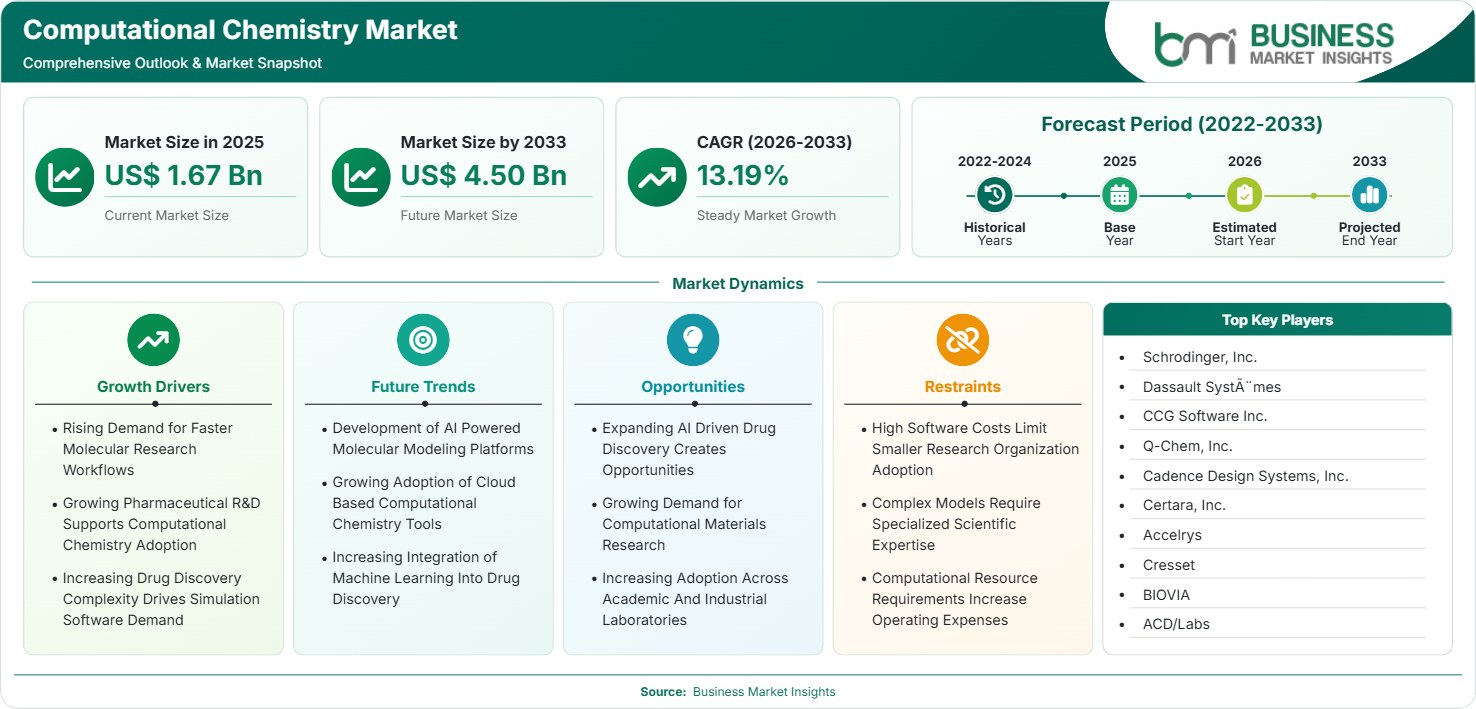
The Computational Chemistry Market size was valued at US$ 1.67 Billion in 2025 and is projected to reach US$ 4.50 Billion by 2033, growing at a CAGR of 13.19% during 2026–2033, driven by faster molecular research, complex drug discovery, AI-enabled modeling, and expanding materials research applications.

Report Coverage
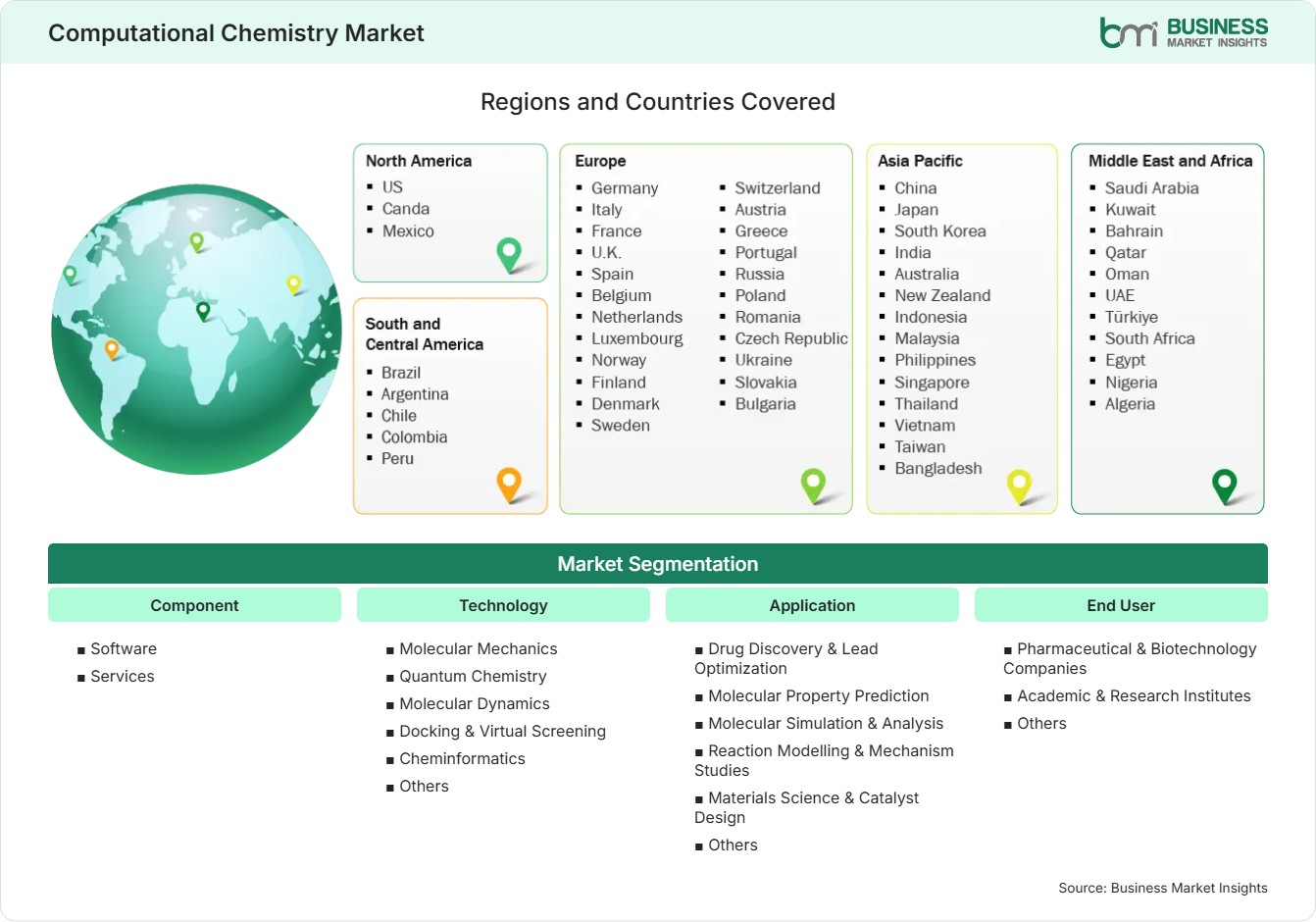
  • Component: Software, Services
  • Technology: Molecular Mechanics, Quantum Chemistry, Molecular Dynamics, Docking & Virtual Screening, Cheminformatics, Others
  • Application: Drug Discovery & Lead Optimization, Molecular Property Prediction, Molecular Simulation & Analysis, Reaction Modelling & Mechanism Studies, Materials Science & Catalyst Design, Others
  • End User: Pharmaceutical & Biotechnology Companies, Academic & Research Institutes, Others
US$ 1.67 Bn Market size in 2025
US$ 4.50 Bn Market Size by 2033
13.19% CAGR, 2026 - 2033
2026-2033 Forecast Period

AI Overview

Computational Chemistry Market Summary

  • North America: North America holds a 32%–35% share in 2025 and is advancing at a 12.4%–13.0% CAGR through 2033, supported by pharmaceutical research, advanced computing infrastructure, cloud adoption, virtual screening, and AI-enabled molecular design. The US Computational Chemistry Market accounts for a 78%–82% share of North American demand and is advancing at a 12.3%–12.9% CAGR through 2033.
  • Fastest Growing Region: Asia Pacific represents a 25%–28% share in 2025 and is advancing at a 14.5%–15.2% CAGR, supported by expanding pharmaceutical research, biotechnology investment, academic computing, scientific software adoption, and increasing computational modeling across emerging laboratories.
  • Leading Segment: Drug Discovery & Lead Optimization accounts for a 42%–46% share in 2025 and is advancing at a 13.4%–14.0% CAGR, supported by molecular docking, virtual screening, lead refinement, predictive modeling, and increasingly integrated discovery workflows.
  • High Growth Segment: Docking & Virtual Screening represents a 16%–19% share in 2025 and is advancing at a 15.0%–15.8% CAGR, supported by expanding chemical libraries, improved scoring methods, AI-assisted prioritization, cloud computing, and demand for faster candidate evaluation.
  • Key Market Opportunity: AI-enabled molecular design creates opportunities for integrated platforms combining generative chemistry, property prediction, docking, simulation, experimental feedback, and automated research workflows.
  • Major Market Players: Schrodinger, Inc., Dassault Systèmes, CCG Software Inc., Q-Chem, Inc., Cadence Design Systems, Inc., Certara, Inc., Accelrys, Cresset, BIOVIA, ACD/Labs
Strategic Insights

Computational Chemistry Market: Strategic Insights

Computational Chemistry Market Strategic Framework
FREE PDF
Request your free sample
Request free sample
Stakeholder View

Key Takeaways

  • The value chain is moving toward integrated scientific platforms that connect molecular databases, simulation engines, visualization, analytics, and experimental workflows within unified research environments.
  • Drug discovery provides the strongest commercial pathway because computational methods can prioritize compounds, evaluate molecular behavior, and refine candidates before extensive laboratory experimentation.
  • AI is reshaping molecular research by supporting generative design, predictive modeling, automated screening, data interpretation, and more efficient orchestration of computational workflows.
  • Asia Pacific offers an attractive expansion opportunity as pharmaceutical research, biotechnology capabilities, academic computing, and scientific software adoption broaden across major research economies.
  • Investment opportunities increasingly favor platforms combining proprietary scientific methods with cloud scalability, high-quality chemical datasets, workflow integration, and user-friendly research interfaces.
  • Competitive differentiation will increasingly depend on computational accuracy, interoperability, scientific validation, processing efficiency, ease of deployment, and the ability to convert modeling results into actionable research decisions.
Geographic Outlook

Computational Chemistry Market Regional Highlights

North America Computational Chemistry Market

North America holds a 32%–35% share in 2025 and is advancing at a 12.4%–13.0% CAGR through 2033. Its position reflects mature pharmaceutical research, advanced computing infrastructure, established academic capabilities, and broad adoption of molecular modeling.

  • Pharmaceutical research increasingly incorporates molecular modeling into target evaluation, screening, lead refinement, and candidate prioritization workflows.
  • Cloud computing is improving access to scalable resources for demanding molecular simulations and high-throughput computational workloads.
  • Academic and industrial collaboration supports development of advanced quantum chemistry, molecular dynamics, and machine learning methods.
  • Demand is shifting toward interoperable platforms connecting modeling, chemical information, visualization, and experimental research processes.

US Computational Chemistry Market

The US represents a 78%–82% share of North American demand and is advancing at a 12.3%–12.9% CAGR through 2033. Its research ecosystem combines pharmaceutical innovation, biotechnology, academic science, advanced computing, and specialized computational expertise.

  • Pharmaceutical discovery programs increasingly use computational screening to prioritize compounds before laboratory testing.
  • Cloud-based platforms support distributed research teams and flexible computational workloads across discovery programs.
  • Universities contribute methodological advances in quantum chemistry, molecular dynamics, machine learning, and computational materials research.

Europe Computational Chemistry Market

Europe represents a 27%–30% share in 2025 and is advancing at a 12.8%–13.4% CAGR through 2033. Germany, France, the United Kingdom, and Switzerland provide established pharmaceutical, chemical, academic, and materials research capabilities.
Germany is positioned at a 12.9%–13.5% CAGR, supported by industrial chemistry, pharmaceutical research, materials development, and scientific computing.

  • European research programs increasingly combine physics-based simulation with machine learning for molecular and materials applications.
  • Germany provides strong demand across pharmaceutical research, industrial chemistry, materials engineering, and academic computational science.
  • France and the United Kingdom maintain established research ecosystems supporting molecular modeling and computational drug discovery.
  • Materials-oriented computational applications are expanding across catalysts, energy materials, specialty chemicals, and advanced molecular systems.

Asia Pacific Computational Chemistry Market

Asia Pacific accounts for a 25%–28% share in 2025 and records the fastest regional growth at a 14.5%–15.2% CAGR through 2033. China, Japan, South Korea, and India are expanding pharmaceutical research, biotechnology, scientific computing, and academic modeling capabilities.

  • China is positioned at a 15.0%–15.7% CAGR, supported by pharmaceutical research, materials science, chemical development, and computational research investment.
  • Japan maintains mature capabilities across molecular simulation, quantum chemistry, pharmaceutical research, and materials modeling.
  • South Korea is strengthening computational capabilities alongside biotechnology and advanced materials research.
  • India offers strong expansion potential through pharmaceutical research, academic computing, biotechnology, and contract research activities.

Rest of World Computational Chemistry Market

Rest of World represents a 9%–12% share in 2025 and is advancing at an 11.0%–12.0% CAGR through 2033. Brazil and Mexico provide important opportunities in South and Central America as pharmaceutical, chemical, biotechnology, and academic research capabilities expand.

The Middle East and Africa present longer-term opportunities as universities, research centers, pharmaceutical organizations, and advanced materials programs increase computational capabilities. Saudi Arabia is positioned at a 13.0%–13.8% CAGR, supported by scientific infrastructure investment and technology-led research.

  • Brazil is positioned at a 12.0%–12.7% CAGR as pharmaceutical, biotechnology, academic, and chemical research capabilities develop.
  • Mexico provides opportunities through pharmaceutical research, industrial chemistry, and expanding computational laboratory capabilities.
  • Saudi Arabia offers opportunities linked to scientific infrastructure, advanced research programs, and technology-focused development initiatives.
  • The United Arab Emirates provides potential for cloud-based scientific platforms, collaborative research, and computational services.
Global Market Geography
FREE PDF
Request your free sample
Request free sample
Segment Analysis

Computational Chemistry Market Segmentation

Component

Software represents the dominant component, supported by recurring requirements for molecular simulation, visualization, screening, property prediction, and scientific data management. Software captures a 68%–72% Computational Chemistry Market share in 2025 and is advancing at a 12.8%–13.4% CAGR through 2033.

  • Software: Supports molecular modeling, simulation, screening, visualization, property prediction, and integrated scientific research workflows.
  • Services: Provides implementation, customization, consulting, training, technical support, and computational assistance for specialized research environments.

Technology

Technology adoption is increasingly centered on integrated workflows combining classical simulation with data-driven prediction and high-throughput screening.
Docking & Virtual Screening is the fastest-growing technology because researchers need to evaluate increasingly large chemical libraries efficiently.

  • Molecular Mechanics: Enables efficient molecular structure and interaction analysis for applications requiring repeated calculations and practical computational performance.
  • Quantum Chemistry: Examines electronic structures, molecular properties, interactions, and reaction behavior requiring detailed theoretical calculations.
  • Molecular Dynamics: Simulates molecular movement and structural behavior to investigate flexibility, stability, interactions, and dynamic mechanisms.
  • Docking & Virtual Screening: Prioritizes chemical compounds according to predicted molecular interactions, supporting faster evaluation of extensive libraries.
  • Cheminformatics: Organizes chemical information and supports molecular similarity, property analysis, database searching, and structured chemical data management.

Application

Drug Discovery & Lead Optimization remains the leading application, supported by molecular screening, target analysis, candidate prioritization, and iterative compound refinement. The segment accounts for a 42%–46% share in 2025 and is advancing at a 13.4%–14.0% CAGR through 2033.

  • Drug Discovery & Lead Optimization: Supports target evaluation, hit identification, compound prioritization, molecular design, and iterative lead refinement.
  • Molecular Property Prediction: Estimates molecular characteristics that help researchers filter candidates and prioritize structures for laboratory assessment.
  • Molecular Simulation & Analysis: Examines molecular structure, stability, interactions, and behavior to support scientific interpretation and research planning.
  • Reaction Modelling & Mechanism Studies: Investigates reaction pathways, intermediates, energy profiles, and mechanisms to improve understanding of chemical transformations.
  • Materials Science & Catalyst Design: Supports prediction of material properties and catalytic behavior while reducing experimental trial-and-error during development.

End User

Pharmaceutical & Biotechnology Companies represent the principal end-user group because computational tools directly support discovery productivity and molecular decision-making. Academic & Research Institutes maintain diversified demand across fundamental chemistry, materials research, biology, and methodological development.

  • Pharmaceutical & Biotechnology Companies: Apply computational tools across discovery, molecular screening, candidate evaluation, lead refinement, and research planning.
  • Academic & Research Institutes: Use computational platforms for fundamental research, teaching, method development, molecular investigation, and interdisciplinary scientific projects.
Market Forces

Computational Chemistry Market Dynamics

Key Market Drivers

Rising Demand for Faster Molecular Research Workflows

Research firms are now relying more on computations to decrease the number of molecules that need immediate evaluation through experimentation. Computations such as virtual screening, molecular dynamics, quantum computations, and property predictions can offer alternative evidence before any experimentation takes place. As such, the Computational Chemistry Market growth is no longer linked to software implementation alone but more to research effectiveness and efficiency. Workload needs can be scaled to meet the demands of projects through cloud computing, while the integration of different software programs decreases the transfer from one program to another. Adoption is highest when there is a possibility of integrating computational output into medicinal chemistry, materials development, and experimental design.

Growing Pharmaceutical R&D Supports Computational Chemistry Adoption

There is an ever-growing need in pharmaceutical R&D to examine molecular interactions, structure, properties, and behavior. Computational tools enable scientists to filter out and examine possible interactions before spending much time and effort on laboratory experiments. The usefulness of such tools becomes obvious in the context of cooperation between computational scientists and medicinal chemists, biologists, and data scientists who work together in the same environment. There is, thus, a growing need for software not only for simulation but also for reproducibility, visualization, chemical data management, and workflow integration. This trend is generating a need for systems that can handle more than one stage of discovery without compromising the scientific interpretation of the results.

Increasing Drug Discovery Complexity Drives Simulation Software Demand

There is a growing need in drug discovery projects to analyze the flexibility of molecules, binding, physicochemical characteristics, structural changes, and interactions. Computational modeling offers scientists more ways to explore such parameters through wider chemical spaces. Machine learning is helping to find correlations in big sets of molecular data, whereas proven physics-based methods are bringing science into the picture. Hence, the Computational Chemistry Market trends are increasingly oriented towards hybrid solutions merging simulation and prediction. It becomes easier for providers to respond to the challenge of effective exploration of molecules when these techniques are linked together in a research workflow.

Key Market Opportunities

Expanding AI Driven Drug Discovery Creates Opportunities

In this manner, the use of AI is opening new horizons in terms of computational chemistry by offering tools for generative design of molecules, property prediction, intelligent screening, and workflow automation. In combination with docking, molecular dynamics, quantum calculations, and experimental validation, AI has potential for assisting scientists to build an iterative discovery process, not just an isolated prediction step. The Computational Chemistry Market Forecasts rely heavily on the effective combination of AI and validated computational approaches. The best commercial prospects will be available for those who take care of the issues related to data quality, model validation, workflow compatibility, security, and scalable computation. Research establishments within enterprises are especially predisposed to look for controlled environments where AI-supported techniques can function together with existing scientific processes.

Growing Demand for Computational Materials Research

Materials science is an increasingly promising avenue apart from drug discovery. Computational approaches can explore molecule designs, properties, catalysis, reaction routes, and stability prior to actual synthesis. This approach could enable scientists to explore broader spaces and avoid repeated experiments. There are emerging prospects in the areas of catalysts, specialty chemicals, materials for energy, and advanced molecular designs. Property prediction using AI models would be helpful where enough data is available. Companies having the capability of working with both pharmaceuticals and materials scientists via computation could enable them to maximize their customer usage. Material modeling workflows, high-throughput computing, and data management workflows may further reinforce the competitive advantage of the company.

Increasing Adoption Across Academic And Industrial Laboratories

Accessible computing environments that allow for collaboration without significant infrastructure are being pursued by both academic and industrial labs. The cloud, subscriptions, technical services, and training may help overcome any obstacles posed by the specific computing environment and software used. Academic institutions can utilize these environments for education, research, and collaboration, whereas industrial labs will be able to employ them for research programs. Providers who offer modular computing environments with data format interoperability, workflow guidance, and technical support can fulfill diverse user needs. This would allow for an opportunity to consult and customize workflows for vendors, building a long-term relationship based on software deployment and scientific support.

Market Restraints and Challenges

High Software Costs Limit Smaller Research Organization Adoption

Factor: Advanced computational platforms can require substantial licensing, infrastructure, implementation, and maintenance expenditure, especially when users need several modeling technologies and high-performance computing resources. Impact: Smaller laboratories and institutions may limit adoption to selected projects or rely on shared infrastructure instead of comprehensive platforms. Cost considerations can restrict penetration beyond well-funded research organizations. Cloud consumption models, modular licensing, educational access, and flexible subscriptions can reduce some barriers, but premium scientific software can remain expensive because development and validation require specialized expertise. Vendors therefore need to demonstrate productivity improvements, workflow efficiencies, and research value that justify total ownership and operating costs.

Complex Models Require Specialized Scientific Expertise

Factor: Advanced molecular modeling requires knowledge of chemistry, physics, numerical methods, computational workflows, and model selection. Impact: Organizations without specialized personnel may encounter difficulties configuring simulations, evaluating assumptions, or interpreting computational outputs correctly. Incorrect parameters or unsuitable models can reduce the reliability of results even when the software itself is technically advanced. Vendors are addressing this challenge through automated workflows, guided interfaces, training, technical services, and AI-assisted configuration. Nevertheless, expert oversight remains important for research decisions where model limitations can influence experimental priorities. Market adoption will therefore depend partly on expanding scientific capabilities alongside software accessibility.

Company Analysis

Competitive Landscape

The Computational Chemistry Market analysis reflects competition among scientific software developers, modeling specialists, technology providers, and companies serving pharmaceutical, chemical, materials, and academic research. Competitive differentiation increasingly centers on simulation capabilities, AI integration, workflow interoperability, cloud deployment, scientific accuracy, and ease of use.

Company Name

Overview

Products and Services relevant to this market

Schrodinger, Inc.

Scientific software company focused on computational molecular discovery and advanced modeling workflows.

Molecular modeling, physics-based simulation, virtual screening, drug design, and computational discovery workflows.

Dassault Systèmes

Technology company providing scientific modeling, simulation, visualization, and collaborative digital environments.

Molecular modeling, simulation, materials research, chemistry workflows, and scientific data management.

CCG Software Inc.

Specialist provider focused on computational chemistry and molecular modeling applications for scientific researchers.

Molecular modeling, computational chemistry, visualization, structure analysis, and research workflow capabilities.

Q-Chem, Inc.

Scientific software developer specializing in electronic structure calculations and quantum chemistry.

Quantum chemistry, electronic structure modeling, density functional methods, and molecular property analysis.

Cadence Design Systems, Inc.

Technology company providing advanced computational and simulation capabilities across scientific applications.

Computational modeling, simulation technologies, materials-oriented workflows, and scientific research solutions.

Certara, Inc.

Life sciences technology company supporting model-based research and quantitative development workflows.

Pharmacology modeling, simulation, quantitative research, and computational drug development solutions.

Accelrys

Established scientific software portfolio associated with computational chemistry and materials research.

Molecular modeling, materials simulation, cheminformatics, visualization, and scientific workflow technologies.

Cresset

Specialist provider focused on molecular interaction analysis and ligand design.

Ligand design, molecular field analysis, virtual screening, computational chemistry, and drug discovery tools.

BIOVIA

Scientific software portfolio supporting molecular, materials, and chemical research workflows.

Molecular simulation, materials modeling, cheminformatics, visualization, and collaborative scientific environments.

ACD/Labs

Scientific software provider focused on chemical information and analytical research workflows.

Cheminformatics, property prediction, chemical structure handling, analytical data management, and scientific informatics.

Trust & Transparency

Research Methodology

The market analysis combines proprietary research with secondary data from government agencies, company disclosures, regulatory filings, industry databases and expert interviews. Market estimates are validated through data triangulation, cross-market benchmarking and analyst review.

View Full Research Methodology

Questions Answered

Frequently Asked Questions

What does the Computational Chemistry Market report indicate about future competition?

The report indicates that competition will increasingly focus on integrated modeling platforms, AI capabilities, scientific accuracy, interoperability, cloud deployment, user accessibility, and specialized support. Providers connecting multiple computational methods within practical research workflows can strengthen long-term customer relationships.

Why are cloud-based platforms creating new opportunities for computational research?

Cloud platforms provide scalable computing access without requiring organizations to maintain equivalent local infrastructure. They also support distributed collaboration, flexible workload allocation, centralized data access, and deployment of computational workflows across multidisciplinary research teams.

How are AI technologies influencing computational chemistry adoption?

AI technologies are improving generative molecular design, property prediction, virtual screening, data interpretation, and workflow automation. Their integration with established simulation methods allows researchers to combine rapid prediction with physics-based calculations and develop more connected computational research processes.

Which applications present the strongest opportunity in the market?

Drug discovery and lead optimization remain major opportunities, while materials science, catalyst design, molecular property prediction, and reaction modeling provide additional avenues. These applications benefit from broader chemical-space exploration, predictive research, and the growing need to improve experimental planning efficiency.

What factors are improving Computational Chemistry Market return on investment?

Faster molecular screening, reduced experimental iteration, scalable computing, improved workflow integration, and AI-assisted prediction are strengthening return on investment. Computational tools allow research teams to prioritize compounds, investigate molecular properties, and evaluate candidate structures before allocating extensive laboratory resources.

Access the Full Computational Chemistry Market Report

Get segment-level forecasts, regional estimates, competitive benchmarking, company profiles and downloadable Excel datasets.

Access the full Computational Chemistry Market Report
350 pages PDF & Excel | 2026-09-15
Similar Research

Related Market Reports