
Compostable Packaging Market Outlook: Size, Share, Trends, Growth Analysis, Competitive Landscape & Forecast, 2026-2033

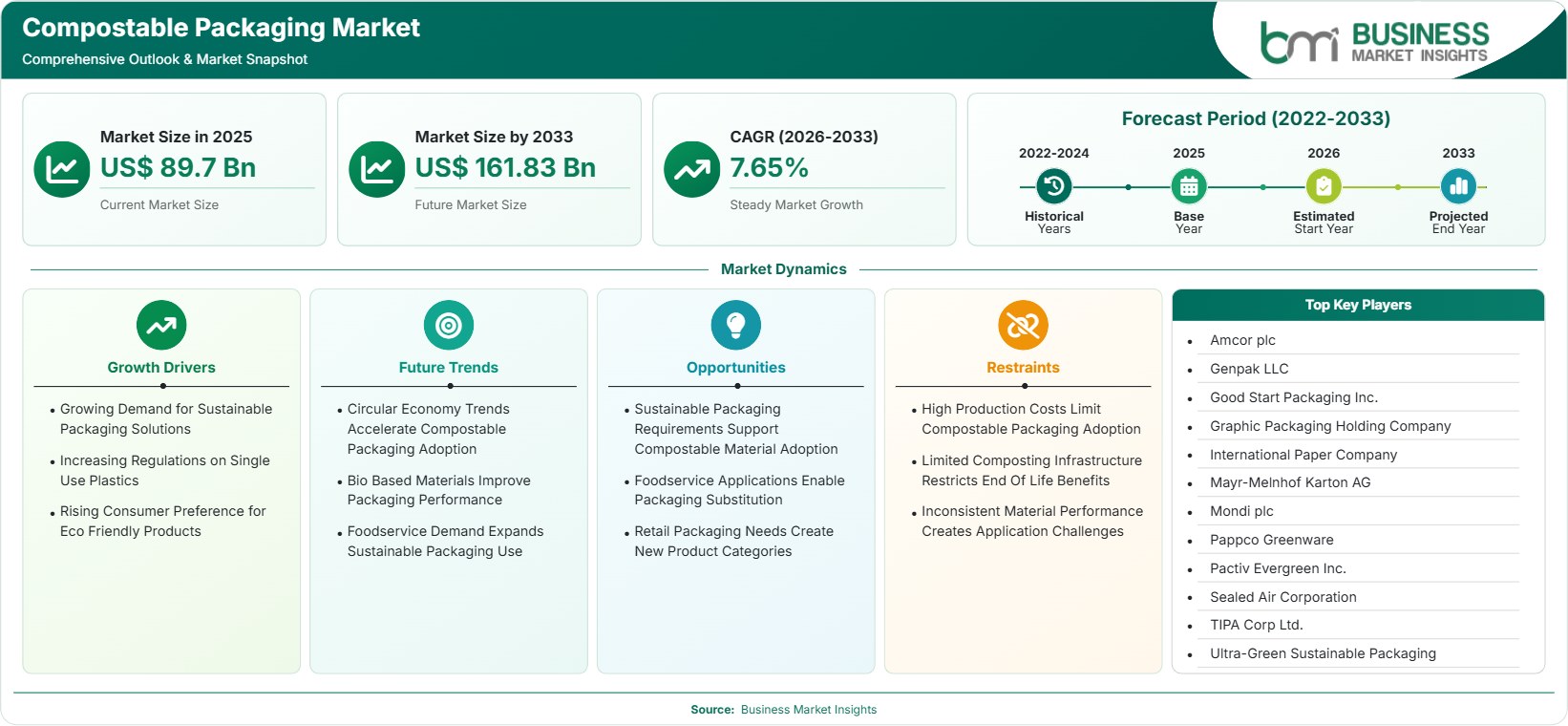
The Compostable Packaging Market was valued at US$ 89.7 Billion in 2025 and is projected to reach US$ 161.83 Billion by 2033, growing at a CAGR of 7.65% during 2026–2033. Rising regulatory restrictions on conventional plastics, increasing consumer preference for sustainable packaging, expanding foodservice applications, circular economy initiatives, and innovations in compostable materials are creating substantial growth opportunities across global packaging ecosystems.

Report Coverage
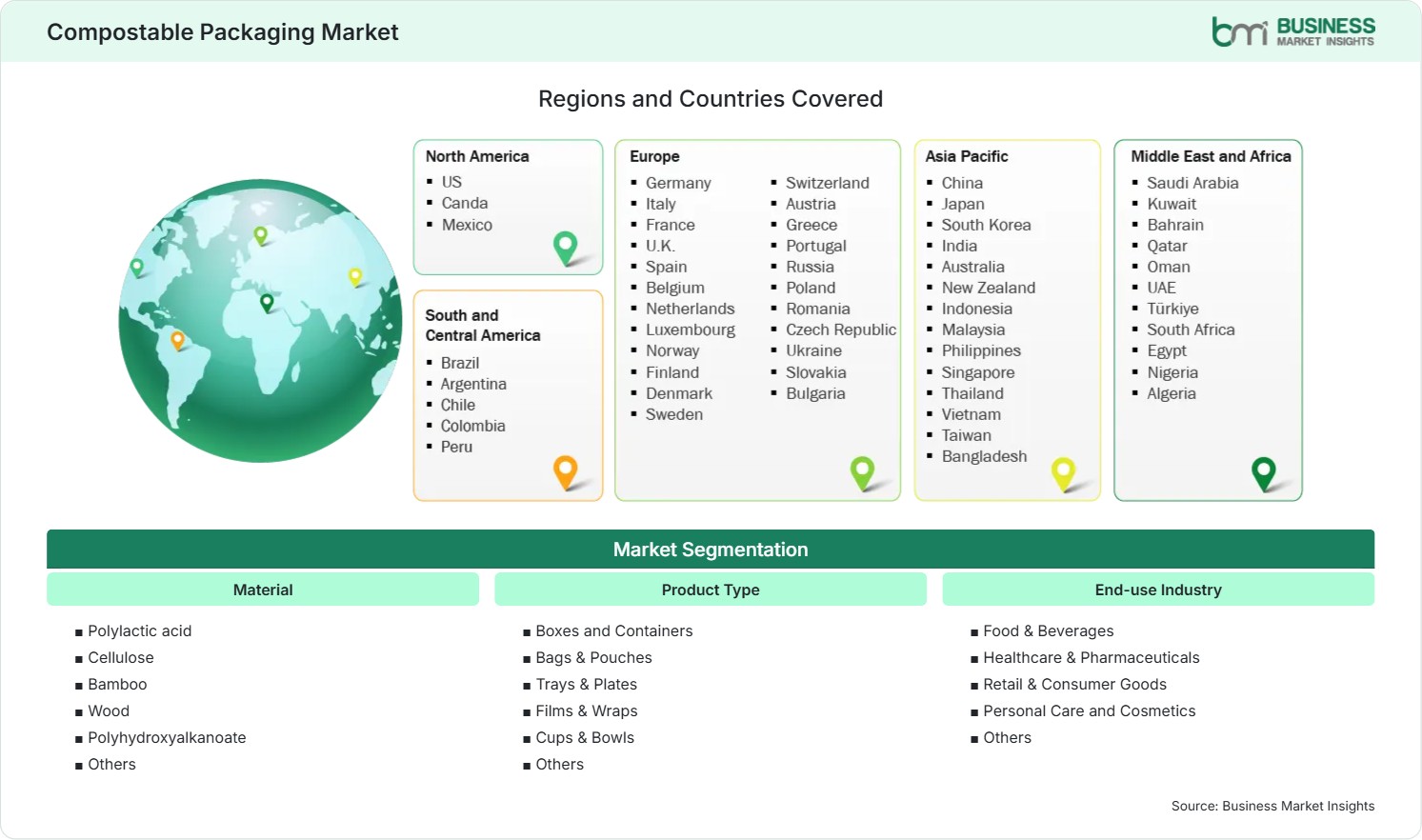
  • Material: Polylactic acid, Cellulose, Bamboo, Wood, Polyhydroxyalkanoate, Others
  • Product Type: Boxes and Containers, Bags & Pouches, Trays & Plates, Films & Wraps, Cups & Bowls, Others
  • End-use Industry: Food & Beverages, Healthcare & Pharmaceuticals, Retail & Consumer Goods, Personal Care and Cosmetics, Others
US$ 89.7 Bn Market size in 2025
US$ 161.83 Bn Market Size by 2033
7.65% CAGR, 2026 - 2033
2026-2033 Forecast Period

AI Overview

Compostable Packaging Market Summary

  • North America Region: North America holds a market share of 34%–37% in 2025 and is projected to grow at a CAGR of 6.8%–7.4% during 2026–2033. Strong sustainability mandates, foodservice adoption, corporate ESG commitments, composting infrastructure expansion, and investment in bio-based materials continue accelerating demand across packaging applications globally. The U.S. dominates regional demand, supported by sustainability regulations and commercial composting investments, advancing at 6.9%–7.5% CAGR.
  • Fastest Growing Region: Asia Pacific accounts for 24%–27% of the compostable packaging market share in 2025 and is expected to register a CAGR of 8.6%–9.3% during 2026–2033. Rapid urbanization, food delivery growth, sustainability regulations, manufacturing expansion, increasing environmental awareness, and investments in renewable materials are strengthening regional adoption across packaging value chains.
  • Leading Segment: Food & Beverages holds a market share of 41%–44% in 2025 and is anticipated to grow at a CAGR of 7.8%–8.4% during 2026–2033. Demand for disposable sustainable packaging, regulatory compliance, fresh food distribution, takeaway services, and environmentally responsible branding continues supporting segment leadership globally.
  • High Growth Segment: Polylactic acid (PLA) represents 28%–31% of the Compostable Packaging Market share in 2025 and is projected to expand at a CAGR of 8.5%–9.1% during 2026–2033. Improved processing characteristics, growing feedstock availability, expanding industrial composting facilities, packaging versatility, and compatibility with existing converting technologies accelerate adoption.
  • Key Market Opportunity: Growing integration of compostable packaging into e-commerce fulfillment, grocery delivery, institutional foodservice, and retail packaging systems creates opportunities for material innovation, brand differentiation, and circular waste management development.
  • Major Market Players: Amcor plc, Genpak LLC, Good Start Packaging Inc., Graphic Packaging Holding Company, International Paper Company, Mayr-Melnhof Karton AG, Mondi plc, Pappco Greenware, Pactiv Evergreen Inc., Sealed Air Corporation, TIPA Corp Ltd., Ultra-Green Sustainable Packaging, Vegware Ltd., WestRock Company, Baroda Rapids.
Strategic Insights

Compostable Packaging Market: Strategic Insights

Compostable Packaging Market Strategic Framework
FREE PDF
Request your free sample
Request free sample
Stakeholder View

Key Takeaways

  • The value chain is becoming increasingly integrated as material suppliers, converters, brand owners, waste processors, and certification agencies collaborate to improve compostability performance and circularity outcomes.
  • Foodservice packaging, online grocery distribution, and premium consumer goods applications offer some of the strongest revenue expansion opportunities due to rising sustainability requirements and consumer awareness.
  • Innovation is shifting toward advanced biopolymers, high-performance barrier solutions, fiber-based composites, and packaging designs optimized for industrial and home composting environments.
  • Asia Pacific presents a compelling investment case due to manufacturing scale advantages, increasing environmental regulations, expanding middle-class consumption, and rapid growth of food delivery services.
  • Strategic acquisitions and partnerships are increasingly focused on expanding sustainable packaging portfolios, improving material science capabilities, and strengthening regional manufacturing footprints.
  • Certification transparency and lifecycle assessment capabilities are emerging as important competitive differentiators influencing procurement decisions among multinational consumer brands.
Geographic Outlook

Compostable Packaging Market Regional Highlights

North America Compostable Packaging Market

North America accounts for 34%–37% of global revenue in 2025 and is projected to expand at a CAGR of 6.8%–7.4% through 2033. Strong regulatory support, widespread ESG adoption, and mature foodservice industries continue supporting regional demand. Commercial composting infrastructure development across major metropolitan areas improves end-of-life processing capabilities. Large consumer packaged goods manufacturers are increasing investments in sustainable packaging conversion programs. The Compostable Packaging Market share remains highest in this region due to advanced sustainability frameworks and extensive corporate adoption initiatives.

  • State-level restrictions on single-use plastics are accelerating replacement demand for certified compostable alternatives across foodservice, retail, and institutional applications while encouraging investments in sustainable packaging production capabilities.
  • Major restaurant chains and quick-service operators are adopting compostable packaging solutions to align with sustainability commitments, creating long-term demand visibility for packaging manufacturers and material suppliers.
  • Corporate ESG reporting requirements are encouraging multinational organizations to incorporate measurable packaging sustainability targets, increasing procurement volumes for certified compostable products across multiple industries.
  • Commercial composting infrastructure investments are improving waste diversion rates and strengthening confidence in compostable material adoption among municipalities, businesses, and consumers.
  • Growing demand for premium sustainable consumer experiences is encouraging brands to use environmentally responsible packaging solutions that support differentiation and regulatory compliance objectives.

US Compostable Packaging Market

The United States represents 74%–77% of North American revenue in 2025 and is expected to grow at a CAGR of 6.9%–7.5% through 2033. Strong participation from foodservice operators, consumer goods manufacturers, and retailers supports continued adoption. State legislation targeting packaging waste reduction and plastic alternatives remains a major demand catalyst. Investments in organic waste management systems and commercial composting facilities continue strengthening market accessibility and long-term sustainability outcomes across the country.

  • California, Washington, and New York continue influencing national adoption patterns through stricter sustainability regulations and procurement policies supporting certified compostable packaging solutions.
  • Food delivery and takeaway services remain major consumption channels, driving demand for compostable containers, trays, wraps, and related packaging products.
  • Consumer preference surveys consistently indicate stronger willingness to support environmentally responsible brands, encouraging broader adoption of sustainable packaging alternatives.
  • Investment in domestic biopolymer manufacturing and packaging conversion facilities is improving supply chain resilience and reducing dependence on imported materials.

Europe Compostable Packaging Market

Europe accounts for 29%-32% of total revenue in 2025 and is expected to register a CAGR of 7.1%-7.8% in terms of the Compostable Packaging Market during the forecast period. Various sustainability laws, circular economy principles, and extended producer responsibility programs help drive market growth. Germany is a leading country in terms of demand in Europe, whereas Italy stands out for having one of the highest growth rates, at 7.8%-8.4%. Strong consumer awareness and established compostable packaging standards continue to encourage adoption across the foodservice, retail, and consumer goods industries throughout the region.

  • The European Union’s sustainability objectives continue stimulating investments in compostable materials, recyclable alternatives, and packaging innovation platforms supporting circular economy targets.
  • Germany maintains leadership through strong industrial capabilities, advanced waste management systems, and widespread corporate sustainability initiatives.
  • Italy benefits from supportive regulatory frameworks and growing demand for compostable packaging solutions across foodservice and agricultural applications.
  • Consumer demand for environmentally responsible products remains a significant purchasing factor, encouraging brand owners to redesign packaging portfolios.
  • Retailers are increasingly introducing sustainability requirements for suppliers, accelerating commercialization of compostable packaging technologies throughout European markets.

Asia Pacific Compostable Packaging Market

The Compostable Packaging Market in Asia Pacific accounts for 24%–27% of global revenue in 2025 and is projected to achieve the fastest CAGR of 8.6%–9.3% through 2033. Rapid urbanization, manufacturing expansion, and growth in organized retail support strong demand. China remains the largest regional market, while India demonstrates the highest growth potential with a CAGR of 9.2%–9.8%. Rising environmental awareness and increasing restrictions on plastic waste are accelerating regional adoption across multiple end-use industries and packaging applications.

  • Expanding food delivery ecosystems across China, India, and Southeast Asia are increasing consumption of compostable containers, cups, trays, and flexible packaging products.
  • Government initiatives promoting waste reduction and sustainable materials are encouraging investments in compostable packaging manufacturing facilities and research programs.
  • India benefits from rising environmental awareness, expanding retail networks, and increasing adoption of eco-friendly packaging solutions among domestic brands.
  • Growing middle-class populations continue supporting packaged food consumption, creating substantial opportunities for sustainable packaging suppliers across the region.
  • Regional manufacturing advantages and feedstock availability support cost-efficient production of compostable packaging materials for domestic and export markets.

Rest of World Compostable Packaging Market

Compostable Packaging Market in Rest of World held 9% to 12% market share of total global revenue in 2025 and is projected to grow at a CAGR of 7.4% to 8.0% till 2033. The regions are witnessing growing adoption due to sustainable initiatives and the growth of the food service industry. In the Middle East & Africa, the market is growing due to increased tourism, development in the hospitality sector, and environmental policies. Brazil is leading the regional consumption, whereas the UAE has one of the fastest-growing markets with a CAGR of 8.1% to 8.7%.

Growing awareness of sustainable waste management practices is encouraging adoption across institutional and commercial sectors. Infrastructure investments and regulatory modernization are expected to improve market accessibility over the forecast period.

  • Brazil continues leading adoption through expanding food packaging demand, sustainability initiatives, and increasing investments in environmentally responsible packaging alternatives.
  • Gulf countries are incorporating sustainability objectives into national development strategies, creating new opportunities for compostable packaging suppliers and converters.
  • Hospitality and tourism industries are increasingly adopting sustainable packaging products to align with environmental commitments and customer expectations.
  • International consumer brands operating in emerging markets are extending global sustainability strategies, accelerating local adoption of compostable packaging solutions.
  • Expanding waste management infrastructure and environmental awareness campaigns are supporting long-term market development across multiple regional economies.
Global Market Geography
FREE PDF
Request your free sample
Request free sample
Segment Analysis

Compostable Packaging Market Segmentation

Material

The Material segment accounted for 44% to 47% of the market's total revenue in 2025 and is expected to expand at a CAGR of 7.8% to 8.4% through 2033. Material innovation still plays a vital role in product differentiation due to its emphasis on compostability, barriers, durability, and feedstock. The scope of the Compostable Packaging Market will continue to widen owing to the use of biopolymers and renewable fiber materials, which enhance functionality while supporting regulatory compliance and circular economy objectives.

  • Polylactic acid (PLA): Widely adopted across food packaging and consumer goods applications due to transparency, processability, and compatibility with existing converting technologies, supporting growing commercial adoption across global markets.
  • Cellulose: Increasingly utilized in films, wraps, and flexible packaging formats where biodegradability, renewable sourcing, and favorable compostability characteristics support sustainability-focused packaging strategies.
  • Bamboo: Growing demand for bamboo-based packaging reflects preference for rapidly renewable resources, particularly in foodservice and retail applications seeking durable and environmentally responsible alternatives.
  • Wood: Wood-derived compostable materials continue gaining traction in molded fiber packaging, offering strength, sustainability advantages, and compatibility with industrial composting infrastructure.
  • Polyhydroxyalkanoate (PHA): Emerging biopolymer technology attracts interest for marine biodegradability potential, enhanced sustainability characteristics, and expanding applicability across flexible and rigid packaging formats.

Product Type

The product type segment accounted for a revenue share of 33% to 36% in 2025 and is expected to witness a CAGR of 7.6% to 8.2% during the forecast period 2026-2033. Innovations in the product segment are centered around better performance, ease of use, and end-of-life management. Compostable Packaging Market trends show an increasing need for application-specific, sustainable packages.

  • Boxes and Containers: Strong adoption in takeaway meals, meal kits, and retail food packaging due to structural integrity, branding opportunities, and growing sustainability expectations.
  • Bags & Pouches: Increasing use across grocery, e-commerce, and consumer goods sectors reflects demand for lightweight, flexible packaging solutions with improved environmental profiles.
  • Trays & Plates: Foodservice operators continue adopting compostable trays and plates to reduce plastic dependency and align with institutional sustainability commitments.
  • Films & Wraps: Technological advancements in barrier performance and durability are expanding applications across fresh produce, bakery, and packaged food categories.
  • Cups & Bowls: Rapid consumption growth within beverage services, quick-service restaurants, and event catering environments supports expanding market penetration for compostable alternatives.

End-use Industry

End-use industries accounted for 41%-44% of total market revenue in 2025 and are expected to register a CAGR of 7.8%-8.4% between 2024 and 2033 in the Compostable Packaging Market. The need for compostable packaging varies by industry, depending on factors such as sustainability requirements, environmental regulations, consumer expectations, and operational considerations. Food & Beverage applications continue to dominate in terms of volume, and stringent restrictions on plastic usage.

  • Food & Beverages: Extensive utilization across takeaway packaging, fresh food distribution, beverage services, and retail packaging supports continued dominance within the overall industry landscape.
  • Healthcare & Pharmaceuticals: Sustainable packaging initiatives and increasing environmental commitments are encouraging adoption of compostable packaging solutions in selected healthcare applications.
  • Retail & Consumer Goods: Brand differentiation strategies and sustainability commitments are accelerating adoption of environmentally responsible packaging across retail channels.
  • Personal Care and Cosmetics: Premium product positioning and eco-conscious consumer preferences continue supporting increased utilization of compostable packaging formats.
Market Forces

Compostable Packaging Market Dynamics

Key Market Drivers

Government Restrictions on Conventional Plastic Packaging

Regulatory measures have been one of the most effective growth drivers in the packaging sector. Restrictive measures such as policies limiting the use of single-use plastics, extended producer responsibility, and packaging waste reduction are being introduced by governments in Europe, North America, and Asia Pacific. Such measures are driving the adoption of compostable packaging, which can help organizations meet their compliance needs. Waste reduction efforts and circular economy initiatives are also boosting the procurement of sustainable packaging products. The Compostable Packaging Market growth is increasingly dependent on policy-driven demand for packaging products that meet legislative criteria, sustainability reporting requirements, and consumer expectations regarding responsible material usage and waste management practices.

Expansion of Sustainable Foodservice and Delivery Ecosystems

The rapid expansion of food delivery platforms, takeaway services, and institutional catering operations is creating substantial demand for environmentally responsible packaging products. The use of sustainable packaging materials is becoming more common among restaurants, cafes, and foodservice operators as demand for functional products with a reduced environmental footprint grows. Compostable trays, containers, cups, bowls, and wrappings offer alternatives to petroleum-based products. There is an ever-growing number of food deliveries worldwide, especially in urban regions, where sustainability factors influence purchase decisions. Leading foodservice companies are developing packaging transition initiatives that align with their sustainability goals, supporting the broader adoption of compostable materials throughout the supply chain and accelerating the deployment of sustainable packaging across commercial food distribution channels.

Advancements in Biopolymer and Fiber-Based Technologies

Continuous innovation in material science is improving the performance, scalability, and economic viability of compostable packaging solutions. Advances in PLA, PHA, cellulose, and molded fiber technologies are enhancing durability, barrier performance, heat resistance, and processing efficiency. Moreover, there is an investment in renewable sources and innovative coatings that enhance product performance while still adhering to compostability standards. This trend is narrowing the performance gap between compostable and traditional products. With increased manufacturing efficiency and greater availability of raw materials, sustainable packaging solutions have become more popular among brand owners across countries seeking to meet their environmental goals.

Key Market Opportunities

Integration into E-Commerce and Direct-to-Consumer Packaging

E-commerce continues to influence trends in packaging consumption. The need for eco-friendly options for shipping and packaging protection is increasing in the digital retail sector. Compostable packaging is an option that can help minimize the environmental impact of the increase in shipped parcels. Companies that pursue sustainability initiatives are reviewing compostable mailers, cushioning, and secondary packaging solutions to help achieve their sustainability goals. The Compostable Packaging Market forecasts takes into account e-commerce as a promising application segment, expanding digital commerce ecosystems, increasing regulatory scrutiny of packaging waste, and consumer expectations regarding sustainable purchasing experiences across online retail environments

Development of Commercial Composting Infrastructure

Investment in commercial composting plants offers great potential for the packaging value chain. Increasing processing capacity creates greater certainty about the results of end-of-life scenarios for companies, government officials, and consumers. Municipalities have begun promoting the use of organic waste collection and composting to enhance the efficiency of recycling compostable materials. Increased infrastructure capacity creates an environment conducive to innovation in product packaging and material selection. As more composting facilities become available globally, adoption barriers will diminish, and new applications will emerge, thereby contributing to the commercialization of compostable packaging.

Emerging Demand from Healthcare and Personal Care Industries

There has been increased use of sustainable practices in procurement and packaging by companies in the health care and personal care sectors. There has been increased consumer consideration of sustainable products in sectors such as well-being, cosmetics, and healthcare. The use of compostable packaging offers chances for increased sustainability and brand differentiation. Product innovation tailored to individual sector needs will create new growth avenues. Increased regulation of waste packaging and corporate sustainability reports make a compelling case for using compostable packaging.

Market Restraints and Challenges

Limited Composting Infrastructure and Collection Systems

Factor: The lack of proper composting infrastructure in industrial settings remains a significant problem in many locations. Many local authorities lack the proper collection and processing facilities needed to handle compostable packaging materials. Consumer uncertainty about disposal methods contributes to difficulties in achieving desirable outcomes in terms of end-of-life management.

Impact: Insufficient infrastructure hinders the achievement of desirable outcomes and reduces certain companies' willingness to use compostable packaging. Companies are likely to refrain from adopting compostable packaging when they lack certainty about their ability to invest in waste-management infrastructure that supports circular packaging ecosystems.

Higher Material and Production Costs Compared with Plastics

Factor: Compostable materials usually entail higher costs for feedstocks, production processes, certifications, and supply chains than traditional petro-based plastics. The production volume is still relatively low for several material types.

Impact: Higher prices may prevent price-sensitive industries from using such materials. Companies that try to combine their sustainability and profitability goals may hesitate to switch to new materials as long as the price difference is high. Such a factor affects purchasing decisions and hinders substitution. This problem highlights the need for innovation and optimization of production processes.

Company Analysis

Competitive Landscape

The Compostable Packaging Market analysis indicates a competitive environment characterized by material innovation, strategic sustainability partnerships, compostability certification initiatives, and investments in renewable feedstocks. Leading companies are focusing on product diversification, geographic expansion, advanced biopolymer development, and circular economy solutions to strengthen their market positions.

Company Name

Overview

Products and Services relevant to this market

Amcor plc

Global packaging leader with extensive sustainability programs and investments in recyclable and compostable packaging technologies serving multiple industries.

Compostable flexible packaging, bio-based materials, food packaging solutions, sustainable packaging development services, and packaging innovation platforms.

Genpak LLC

North American foodservice packaging manufacturer focused on sustainable packaging alternatives and operational efficiency improvements.

Compostable food containers, trays, plates, takeout packaging solutions, and environmentally responsible foodservice packaging products.

Good Start Packaging Inc.

Specialized provider of sustainable foodservice packaging solutions serving restaurants, retailers, and institutional customers.

Compostable cups, containers, utensils, food packaging products, and customized sustainability-focused packaging solutions.

Graphic Packaging Holding Company

Global paperboard packaging company emphasizing renewable materials and sustainable packaging innovation.

Fiber-based packaging, compostable paper packaging, foodservice solutions, and sustainable consumer packaging systems.

International Paper Company

Major paper and packaging manufacturer with broad sustainable packaging capabilities and global production footprint.

Renewable fiber packaging, compostable packaging formats, corrugated solutions, and sustainable packaging services.

Mayr-Melnhof Karton AG

European packaging producer recognized for cartonboard innovation and sustainability-focused product development.

Fiber-based packaging materials, sustainable cartons, renewable packaging formats, and environmentally responsible packaging products.

Mondi plc

International packaging and paper company advancing circular economy solutions through sustainable material innovation.

Compostable packaging films, paper packaging, flexible packaging products, and sustainable packaging technologies.

Pappco Greenware

India-based sustainable packaging specialist serving foodservice and retail sectors with eco-friendly alternatives.

Compostable tableware, food containers, trays, cups, and biodegradable packaging solutions.

Pactiv Evergreen Inc.

Packaging manufacturer supplying foodservice and food packaging markets across North America.

Compostable containers, food packaging systems, beverage packaging products, and sustainable packaging offerings.

Sealed Air Corporation

Global packaging solutions company emphasizing resource efficiency and sustainability-driven innovation.

Protective packaging, compostable packaging technologies, food packaging solutions, and packaging optimization services.

TIPA Corp Ltd.

Specialist developer of compostable flexible packaging materials designed for organic waste streams.

Compostable films, pouches, flexible packaging products, and certified compostable packaging technologies.

Ultra-Green Sustainable Packaging

Sustainable packaging provider focused on renewable and compostable product portfolios.

Compostable packaging materials, foodservice packaging products, and eco-friendly packaging alternatives.

Vegware Ltd.

Recognized provider of compostable foodservice packaging products with strong commercial composting focus.

Compostable cups, containers, catering packaging, foodservice solutions, and waste diversion support services.

WestRock Company

Global paper and packaging company investing in sustainable materials and circular packaging initiatives.

Fiber-based packaging, compostable packaging solutions, consumer packaging products, and renewable material technologies.

Baroda Rapids

Indian sustainable packaging manufacturer supporting environmentally responsible packaging applications.

Compostable packaging products, molded fiber solutions, food packaging materials, and sustainable packaging systems.

Trust & Transparency

Research Methodology

The market analysis combines proprietary research with secondary data from government agencies, company disclosures, regulatory filings, industry databases and expert interviews. Market estimates are validated through data triangulation, cross-market benchmarking and analyst review.

View Full Research Methodology

Questions Answered

Frequently Asked Questions

What does the Compostable Packaging Market Report indicate about future innovation priorities?

The market report highlights material science advancements, improved barrier technologies, renewable feedstocks, compostability certification, and scalable manufacturing processes as critical innovation priorities shaping future competitiveness.

Which region is expected to experience the fastest growth through 2033?

Asia Pacific is projected to register the strongest expansion due to rapid urbanization, increasing sustainability regulations, manufacturing investments, and growing demand from foodservice, retail, and consumer goods industries.

How does compostable packaging differ from biodegradable packaging?

Compostable packaging is designed to break down into non-toxic organic matter under defined composting conditions, whereas biodegradable materials may degrade over varying timeframes and conditions without necessarily producing compost-quality outputs.

Which end-use industry generates the highest demand for compostable packaging?

Food and beverages remain the largest end-use industry due to high packaging consumption volumes, sustainability regulations, growing takeaway services, and increasing consumer preference for environmentally responsible packaging alternatives.

What factors are driving adoption of compostable packaging globally?

Government restrictions on plastic waste, corporate sustainability commitments, growth in food delivery services, consumer environmental awareness, and expanding composting infrastructure are collectively increasing demand for compostable packaging solutions across multiple industries.

Access the Full Compostable Packaging Market Report

Get segment-level forecasts, regional estimates, competitive benchmarking, company profiles and downloadable Excel datasets.

Access the full Compostable Packaging Market Report
350 pages PDF & Excel | 2026-09-16
Similar Research

Related Market Reports