
Commercial Seaweed Market Outlook: Size, Share, Trends, Growth Analysis, Competitive Landscape & Forecast, 2026–2033

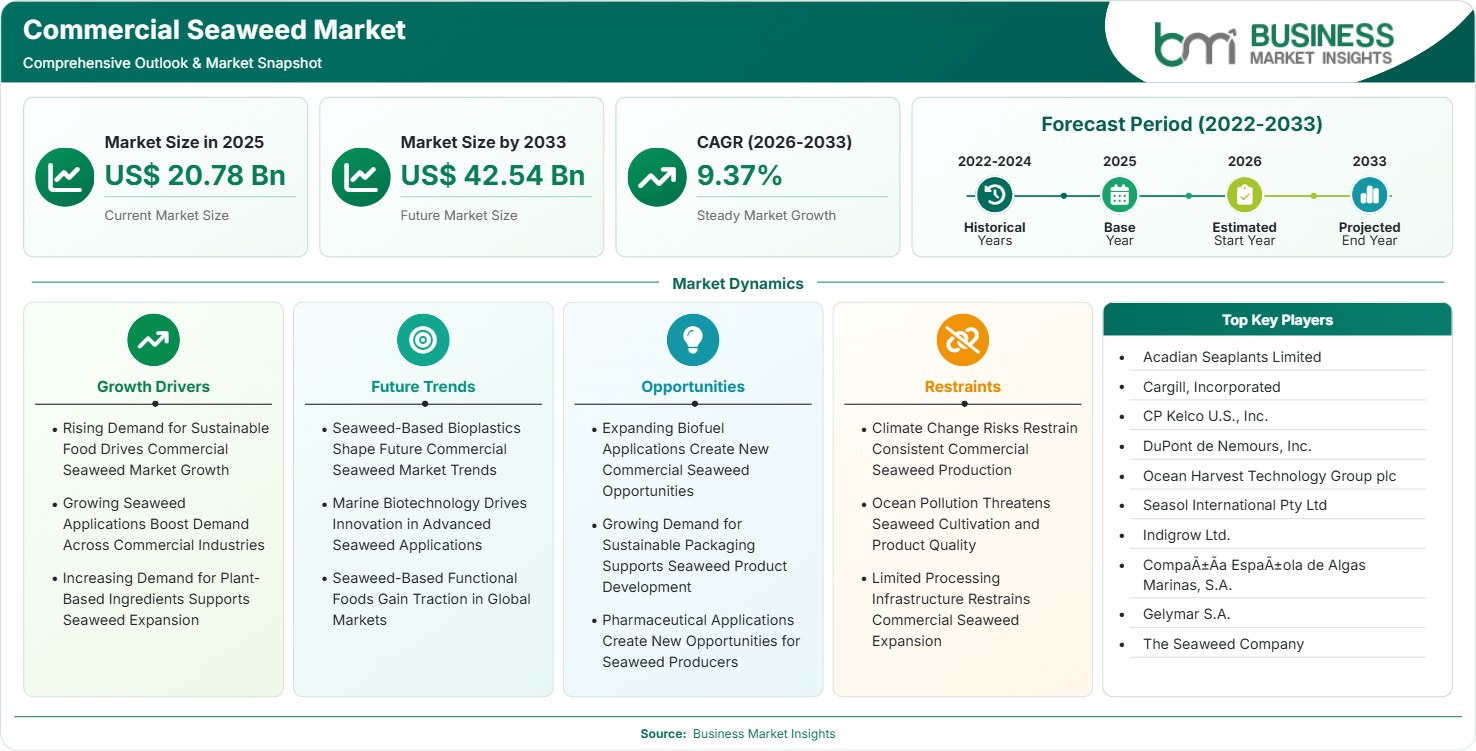
The Commercial Seaweed Market size was valued at US$ 20.78 Billion in 2025 and is projected to reach US$ 42.54 Billion by 2033, growing at a CAGR of 9.37% during 2026–2033, driven by sustainable food demand, biofuels, sustainable packaging, and pharmaceutical innovation.

Report Coverage
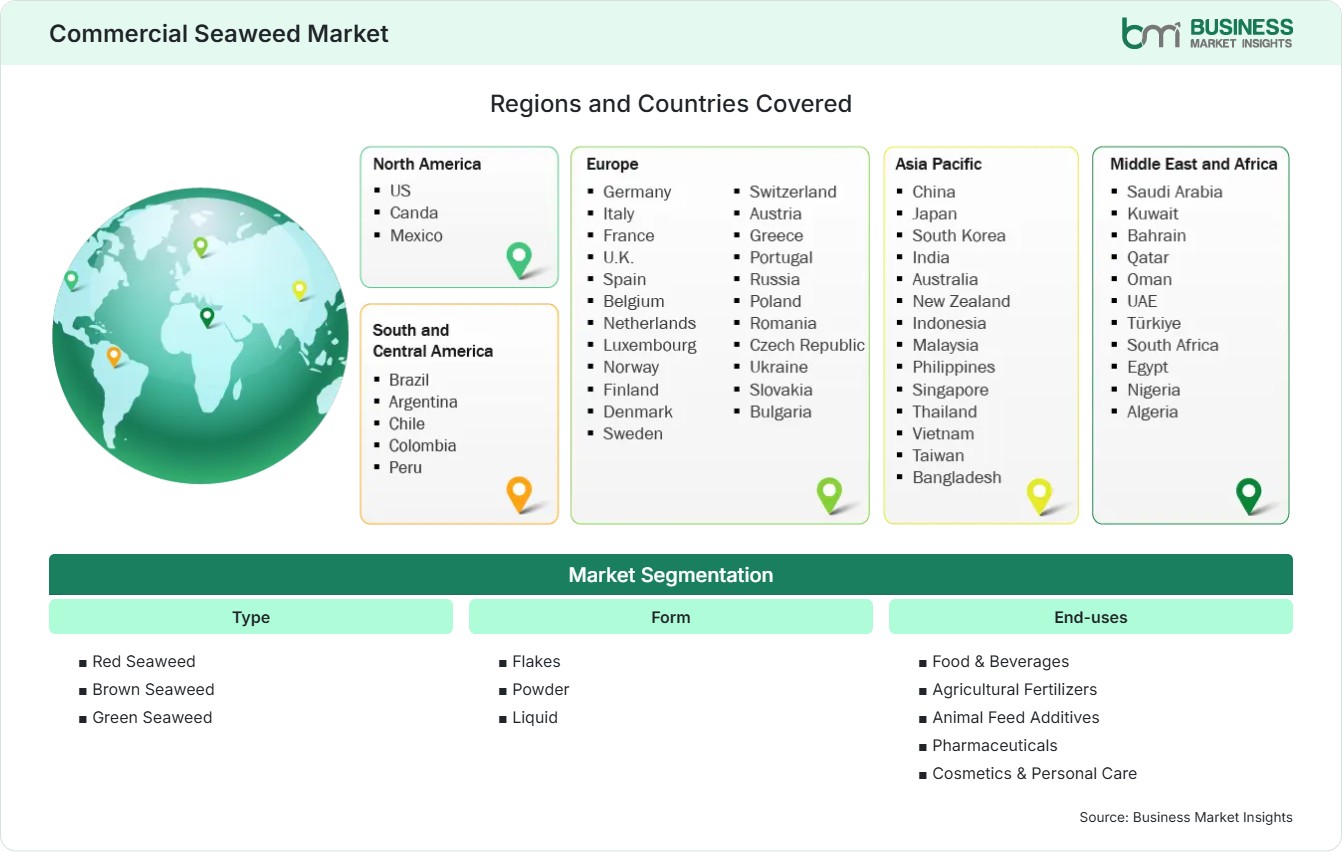
  • Type: Red Seaweed, Brown Seaweed, Green Seaweed
  • Form: Flakes, Powder, Liquid
  • End-uses: Food & Beverages, Agricultural Fertilizers, Animal Feed Additives, Pharmaceuticals, Cosmetics & Personal Care
US$ 20.78 Bn Market size in 2025
US$ 42.54 Bn Market Size by 2033
9.37% CAGR, 2026 - 2033
2026-2033 Forecast Period

AI Overview

Commercial Seaweed Market Summary

  • North America Region: North America holds market share of 16%–20% in 2025, growing with a CAGR of 8.50%–9.50% influenced by functional foods, agricultural biostimulants, and investment in domestic seaweed cultivation. The US represents the region's largest market, with a CAGR of 8.80%–9.80% from 2026 to 2033, supported by food innovation, and growing interest in domestic marine biomass supply chains.
  • Fastest Growing Region: Asia Pacific holds market share of 48%–52% in 2025, growing with a CAGR of 10.00%–11.00% driven by established cultivation ecosystems, expanding food applications, agricultural biostimulants, and increasing investment in higher-value seaweed processing and extraction technologies.
  • Leading Segment: Red Seaweed holds market share of 42%–46% in 2025, growing with a CAGR of 9.50%–10.50% driven by hydrocolloid demand, carrageenan production, cosmetics formulations, and expanding commercial cultivation across established and emerging seaweed-producing regions.
  • High Growth Segment: Liquid form holds market share of 25%–29% in 2025, growing with a CAGR of 10.50%–11.50% driven by agricultural biostimulants, liquid extracts, convenient formulation, and increasing demand for concentrated seaweed-based commercial products.
  • Key Market Opportunity: Commercial producers can capture value by moving beyond raw biomass into standardized extracts, biomaterials, and other higher-margin applications.
  • Major Market Players: Acadian Seaplants Limited, Cargill, Incorporated, CP Kelco U.S., Inc., DuPont de Nemours, Inc., Ocean Harvest Technology Group plc, Seasol International Pty Ltd, Indigrow Ltd., Compania Espanola de Algas Marinas, S.A., Gelymar S.A., The Seaweed Company.
Strategic Insights

Commercial Seaweed Market: Strategic Insights

Commercial Seaweed Market Strategic Framework
FREE PDF
Request your free sample
Request free sample
Stakeholder View

Key Takeaways

  • The value chain is transitioning from raw seaweed cultivation toward vertically integrated models incorporating harvesting, drying, extraction, purification, formulation, and specialized ingredient production.
  • Food and beverages remain a major demand center, while agricultural fertilizers, biostimulants, animal feed, cosmetics, and pharmaceutical applications provide diversification and higher-value growth pathways.
  • Processing innovation is becoming increasingly important, particularly in extraction and fractionation technologies that enable producers to develop standardized compounds and application-specific formulations.
  • Asia Pacific remains the strongest investment geography because of established cultivation expertise, extensive coastal production ecosystems, and growing domestic demand across food and industrial applications.
  • Strategic partnerships between cultivators, ingredient manufacturers, food companies, biotechnology firms, and agricultural input providers can accelerate commercialization and reduce dependence on commodity biomass sales.
  • Climate resilience and environmental monitoring will increasingly influence investment decisions as producers seek cultivation systems capable of managing temperature changes, disease exposure, pollution, and changing marine conditions.
Geographic Outlook

Commercial Seaweed Market Regional Highlights

North America Commercial Seaweed Market

North America accounts for 16%–20% share in 2025 and commercial seaweed market forecast to grow at a CAGR of 8.50%–9.50% through 2033. The region is developing commercial cultivation alongside demand for sustainable food ingredients, agricultural biostimulants, animal nutrition, cosmetics, and biomaterials. Commercial Seaweed Market share remains smaller than Asia Pacific but benefits from growing domestic production initiatives.

  • US and Canadian producers are expanding interest in domestic seaweed farming to diversify coastal economies and establish localized sources of renewable marine biomass for commercial applications.
  • Food companies are exploring seaweed-derived ingredients for functional nutrition, flavor enhancement, texture modification, and plant-based formulations, supporting demand for consistent processed biomass.
  • Agricultural applications are gaining attention as seaweed extracts are increasingly positioned as biostimulants supporting crop resilience, nutrient efficiency, and sustainable farming practices.

US Commercial Seaweed Market

The US commercial seaweed market represents approximately 70%–75% of North American demand in 2025 and is projected to grow at a CAGR of 8.80%–9.80% through 2033. Domestic cultivation remains developing, but demand for sustainable ingredients and agricultural inputs is expanding. Food innovation, regenerative aquaculture, and biomaterial research are supporting commercial activity.

  • Domestic aquaculture initiatives are supporting the development of seaweed farms along coastal regions, creating new opportunities for biomass supply and rural economic diversification.
  • Food manufacturers are increasingly evaluating seaweed as a functional ingredient, supporting opportunities in snacks, seasonings, plant-based foods, and nutritional products.

Europe Commercial Seaweed Market

Europe commercial seaweed market holds 13%–17% share in 2025 and is expected to grow at a CAGR of 9.00%–10.00%. France, Norway, the United Kingdom, Spain, and Ireland represent leading markets, while Northern Europe offers strong cultivation potential. The United Kingdom is estimated at 9.50%–10.50% CAGR, supported by aquaculture development and sustainable ingredient demand.

  • European producers are increasingly exploring seaweed as a renewable biomass source for food, agriculture, cosmetics, packaging, and bio-based materials.
  • Sustainability regulations and circular economy initiatives are encouraging companies to investigate marine biomass as an alternative to selected fossil-derived or land-intensive inputs.
  • Nordic countries offer favorable conditions for commercial cultivation and marine biotechnology, with opportunities to develop integrated value chains around higher-value extracts.
  • European food and personal-care companies are evaluating seaweed-derived ingredients to meet consumer demand for natural, plant-based, and environmentally responsible product formulations.

Asia Pacific Commercial Seaweed Market

Asia Pacific commercial seaweed market accounts for 48%–52% share in 2025 and is projected to record the fastest regional CAGR of 10.00%–11.00%. China, Indonesia, South Korea, Japan, and the Philippines are leading markets, while India and Southeast Asia offer strong expansion potential. India is positioned at 11.00%–12.00% CAGR, driven by expanding food, agriculture, nutraceutical, and pharmaceutical applications.

  • China remains a major commercial ecosystem due to established cultivation capacity, processing infrastructure, and extensive downstream demand for food, hydrocolloids, fertilizers, and industrial products.
  • Indonesia's extensive coastal cultivation base creates opportunities for processing investments that can increase value capture through refined extracts and specialized commercial ingredients.
  • India offers expansion potential as seaweed cultivation initiatives, coastal livelihoods, agricultural applications, and interest in nutraceutical ingredients support commercial development.
  • Japan and South Korea maintain sophisticated food markets where seaweed is integrated into established consumption patterns, while innovation is expanding applications into functional foods and specialized ingredients.
  • Southeast Asian producers are increasingly focused on improving farm productivity, post-harvest handling, processing quality, and supply-chain consistency to serve international markets.

Rest of World Commercial Seaweed Market

South and Central America account for 6%–8% share in 2025 and are projected to expand at a CAGR of 8.00%–9.50%. Chile, Brazil, and Peru lead regional activity, supported by coastal resources and growing interest in marine biotechnology. Chile is estimated at 9.00%–10.00% CAGR, driven by aquaculture expertise and processing opportunities. The Middle East and Africa represent 4%–6% share in 2025 and are projected to grow at a CAGR of 9.50%–11.00%. South Africa, Morocco, and selected Gulf markets offer commercial potential, supported by coastal resources and sustainability initiatives.

  • Chile offers opportunities for expanding seaweed processing and value-added products, supported by established marine aquaculture capabilities and access to international export markets.
  • Latin American producers can benefit from rising demand for sustainable agricultural inputs by developing seaweed-based biostimulants tailored to regional crop production systems.
  • Morocco's marine resources and growing interest in biotechnology create opportunities for commercial cultivation and downstream processing, particularly for agriculture and industrial applications.
  • South Africa offers potential for seaweed-based agricultural and cosmetic products, although investment in cultivation infrastructure and processing capabilities remains essential for scaling.
Global Market Geography
FREE PDF
Request your free sample
Request free sample
Segment Analysis

Commercial Seaweed Market Segmentation

Type

Red Seaweed leads with 42%–46% share in 2025 and a CAGR of 9.50%–10.50% between 2026–2033. Demand is supported by hydrocolloids, food stabilization, cosmetics, and pharmaceutical applications. Brown and green seaweeds offer additional opportunities through agricultural extracts, functional ingredients, animal nutrition, and biomaterials.

  • Red Seaweed: Strong demand for carrageenan, agar, food stabilization, cosmetics, and pharmaceutical applications supports commercial cultivation and downstream processing of red seaweed varieties.
  • Brown Seaweed: Brown seaweed supports agricultural biostimulants, fertilizers, animal nutrition, food ingredients, and biomaterial applications due to its diverse bioactive compounds.
  • Green Seaweed: Green seaweed is gaining commercial attention across food, agriculture, nutraceutical, and environmental applications, supported by interest in alternative biomass and functional compounds.

Form

Liquid form holds 25%–29% share in 2025 and is projected to grow at a CAGR of 10.50%–11.50% between 2026–2033. Demand is supported by agricultural biostimulants, concentrated extracts, and convenient application formats. The market scope is expanding as processing technologies improve extract consistency and formulation performance.

  • Flakes: Flakes are widely used in food applications as seasonings, toppings, and ingredients, supported by consumer interest in natural flavors and nutrient-rich marine foods.
  • Powder: Powdered seaweed enables convenient incorporation into food, animal feed, agricultural formulations, cosmetics, and nutraceutical products requiring consistent dosing and storage.
  • Liquid: Liquid extracts are increasingly used in agricultural biostimulants and specialty formulations because they offer convenient application, rapid dispersion, and concentrated functional compounds.

End-uses

Food & Beverages represent the largest end-use category, while agricultural fertilizers and pharmaceuticals provide attractive expansion opportunities. Demand is supported by plant-based ingredients, sustainable agricultural inputs, functional foods, and bioactive compounds. Producers are investing in extraction and formulation technologies to address specialized requirements across agriculture, animal nutrition, pharmaceuticals, and personal care.

  • Food & Beverages: Seaweed is used in snacks, seasonings, functional foods, hydrocolloids, and plant-based products, supported by nutrition, flavor, texture, and sustainability attributes.
  • Agricultural Fertilizers: Seaweed extracts are increasingly formulated as agricultural biostimulants and fertilizer additives supporting crop resilience, nutrient efficiency, and sustainable farming practices.
  • Animal Feed Additives: Seaweed-based feed additives are being explored for nutritional enhancement, functional benefits, and sustainable feed formulations as livestock and aquaculture producers seek alternative inputs.
  • Pharmaceuticals: Bioactive compounds derived from seaweed are supporting pharmaceutical research and specialized formulations, creating opportunities for higher-value extraction, purification, and commercialization.
  • Cosmetics & Personal Care: Seaweed extracts are used in skincare and personal-care products because of their functional compounds, natural positioning, moisturizing properties, and consumer preference for marine-derived ingredients.
Market Forces

Commercial Seaweed Market Dynamics

Key Market Drivers

Rising Demand for Sustainable Food Drives Commercial Seaweed Market Growth

The rising consumer concern for sustainable food systems is bringing increased business focus on seaweed as a marine-derived material that does not require conventional agricultural land and uses less freshwater than most crops grown on land. Food companies are exploring the use of seaweed for snacks, seasonings, functional foods, hydrocolloids, and alternative protein products. The demand is shifting from traditional markets for seaweed as food companies look to develop more sustainable ingredients with functional health benefits. Commercial Seaweed Market trends increasingly emphasize traceability, and the development of new food formats that can broaden seaweed's commercial relevance.

Growing Seaweed Applications Boost Demand Across Commercial Industries

There is increased demand for seaweed due to its versatility, whereby the same biomass can be used across various sectors. Extracts and compounds have applications in biostimulants, livestock feed supplements, cosmetics, pharmaceuticals, industrial raw materials, among others. The wide array of applications reduces dependence on a single end-user category and increases the need for investments in specialized processing technologies. There are innovations in extraction, purification, and formulation that help increase efficiency in producing customized ingredients for commercial use. Agricultural uses are especially appealing since the products may be incorporated into sustainable farming practices.

Increasing Demand for Plant-Based Ingredients Supports Seaweed Expansion

The trend toward the use of natural and plant-derived ingredients creates potential for seaweed in the areas of food, nutrition, cosmetic and personal care. Companies are seeking substitutes for certain synthetic and animal-derived ingredients, while consumers are becoming more interested in product labeling and sourcing. Seaweed possesses functional properties such as texture, stabilizer, flavoring, and bioactivity, which make it applicable to a variety of formulation types. Producers are responding by investing in improved cultivation, drying, extraction, and formulation technologies.

Key Market Opportunities

Expanding Biofuel Applications Create New Commercial Seaweed Opportunities

Seaweed represents a potential renewable biomass source for biofuel development because cultivation does not directly compete with conventional agricultural land in the same manner as many terrestrial energy crops. Research and pilot-scale initiatives are evaluating conversion pathways for marine biomass into bioenergy and bio-based chemicals. Commercial viability remains dependent on cultivation productivity, harvesting economics, preprocessing, conversion efficiency, and infrastructure availability. However, improvements in integrated biorefinery models could allow multiple products to be recovered from the same biomass, improving overall economics.

Growing Demand for Sustainable Packaging Supports Seaweed Product Development

Sustainable packaging represents an emerging opportunity as brands and consumers seek alternatives to conventional fossil-derived materials. Seaweed-based polymers, films, coatings, and composite materials are being investigated for applications where biodegradability and renewable sourcing provide competitive advantages. Commercialization will depend on material performance, production costs, shelf-life requirements, manufacturing scalability, and compatibility with existing packaging infrastructure. Producers with access to reliable biomass and advanced extraction capabilities may develop differentiated materials for food packaging and specialty applications.

Pharmaceutical Applications Create New Opportunities for Seaweed Producers

Pharmaceutical research is creating opportunities to extract and commercialize bioactive compounds derived from seaweed. Polysaccharides, antioxidants, pigments, and other marine-derived compounds are being investigated for potential applications across therapeutic and health-related fields. The opportunity is attractive because pharmaceutical-grade products can generate substantially higher value than commodity biomass, although development requires extensive research, clinical validation, regulatory approvals, and consistent raw-material quality. Producers can strengthen their position by establishing controlled cultivation systems and advanced extraction capabilities that support traceability and standardized composition.

Market Restraints and Challenges

Climate Change Risks Restrain Consistent Commercial Seaweed Production

Factor: Rising ocean temperatures, changing marine conditions, extreme weather, and disease pressures can disrupt seaweed growth cycles and reduce biomass productivity across cultivation regions. Impact: Production variability can increase supply-chain uncertainty, raise cultivation and insurance costs, and make it difficult for downstream manufacturers to secure consistent volumes and quality for commercial processing.

Ocean Pollution Threatens Seaweed Cultivation and Product Quality

Factor: Marine pollution from plastics, heavy metals, agricultural runoff, and industrial contaminants can affect cultivation environments and introduce quality concerns into harvested seaweed biomass. Impact: Contamination risks can restrict cultivation locations, increase testing and processing requirements, and limit the suitability of biomass for sensitive food, pharmaceutical, cosmetic, and nutraceutical applications.

Company Analysis

Competitive Landscape

The Commercial Seaweed Market analysis reflects competition between vertically integrated cultivators, ingredient suppliers, hydrocolloid manufacturers, agricultural input companies, and marine biotechnology specialists. Competitive advantage increasingly depends on cultivation scale, species expertise, processing technology, quality consistency, downstream product development, geographic reach, and the ability to convert biomass into higher-value ingredients serving multiple industries.

Company Name

Overview

Products and Services relevant to this market

Acadian Seaplants Limited

Major seaweed cultivation and processing company with extensive expertise in marine biomass and value-added seaweed products.

Seaweed extracts, agricultural biostimulants, animal nutrition products, food ingredients, and marine biomass solutions.

Cargill, Incorporated

Global food and agricultural company with broad ingredient capabilities and exposure to sustainable food and agricultural input markets.

Food ingredients, hydrocolloid-related solutions, agricultural products, animal nutrition, and sustainable ingredient technologies.

CP Kelco U.S., Inc.

Global hydrocolloid and specialty ingredient producer serving food, beverage, personal care, and industrial applications.

Carrageenan, hydrocolloids, texture solutions, stabilizers, and specialty ingredients derived from marine and other sources.

DuPont de Nemours, Inc.

Diversified science and technology company with expertise in food ingredients, nutrition, biotechnology, and specialty materials.

Food ingredients, functional formulations, biotechnology solutions, specialty materials, and application development capabilities.

Ocean Harvest Technology Group plc

Marine ingredient company focused on developing sustainable seaweed-based products for commercial applications.

Seaweed-based animal feed ingredients, functional marine biomass products, nutritional solutions, and sustainable feed technologies.

Seasol International Pty Ltd

Australian company specializing in seaweed-based agricultural products and plant health solutions.

Seaweed concentrates, liquid plant tonics, soil health products, fertilizers, and agricultural biostimulant solutions.

Indigrow Ltd.

Agricultural input company developing plant nutrition and biostimulant solutions incorporating seaweed-based ingredients.

Biostimulants, crop nutrition products, seaweed extracts, plant health solutions, and agricultural formulations.

Compania Espanola de Algas Marinas, S.A.

Spanish seaweed ingredient specialist serving food and industrial markets through marine biomass processing and product development.

Seaweed extracts, hydrocolloids, food ingredients, carrageenan-related products, and specialty marine ingredients.

Gelymar S.A.

Chilean producer specializing in hydrocolloids and seaweed-derived ingredients for global food and industrial customers.

Carrageenan, hydrocolloids, texture systems, stabilizers, and seaweed-derived specialty ingredients.

The Seaweed Company

European-focused seaweed company developing cultivation, processing, and value-added applications across sustainable food and industrial markets.

Seaweed cultivation, food ingredients, agricultural applications, sustainable biomass, and development of higher-value seaweed products.

Trust & Transparency

Research Methodology

The market analysis combines proprietary research with secondary data from government agencies, company disclosures, regulatory filings, industry databases and expert interviews. Market estimates are validated through data triangulation, cross-market benchmarking and analyst review.

View Full Research Methodology

Questions Answered

Frequently Asked Questions

Why are higher-value seaweed applications important for producers?

Higher-value applications can improve profitability compared with selling raw biomass by generating revenue from standardized extracts, hydrocolloids, pharmaceutical compounds.

What is the potential of seaweed for sustainable packaging?

Seaweed-derived polymers, films, and coatings are being investigated as renewable alternatives for selected packaging applications.

How is seaweed used in agriculture?

Seaweed is processed into extracts and formulations used as agricultural biostimulants and fertilizer additives. These products are marketed for applications including crop resilience, nutrient efficiency, plant growth support, and stress management.

Which seaweed type has the strongest commercial position?

Red seaweed maintains a leading position because of its extensive use in hydrocolloids, carrageenan, food stabilization, cosmetics, and pharmaceutical applications. Its established processing ecosystem supports continued commercial demand.

What is driving demand for commercial seaweed market report?

Demand is being supported by sustainable food ingredients, plant-based formulations, agricultural biostimulants, animal nutrition, cosmetics, pharmaceuticals, and emerging biomaterial applications.

Access the Full Commercial Seaweed Market Report

Get segment-level forecasts, regional estimates, competitive benchmarking, company profiles and downloadable Excel datasets.

Access the full Commercial Seaweed Market Report
350 pages PDF & Excel | 2026-08-25
Similar Research

Related Market Reports