
Colorectal Cancer Screening Market Outlook: Size, Share, Trends, Growth Analysis, Competitive Landscape & Forecast, 2026–2033

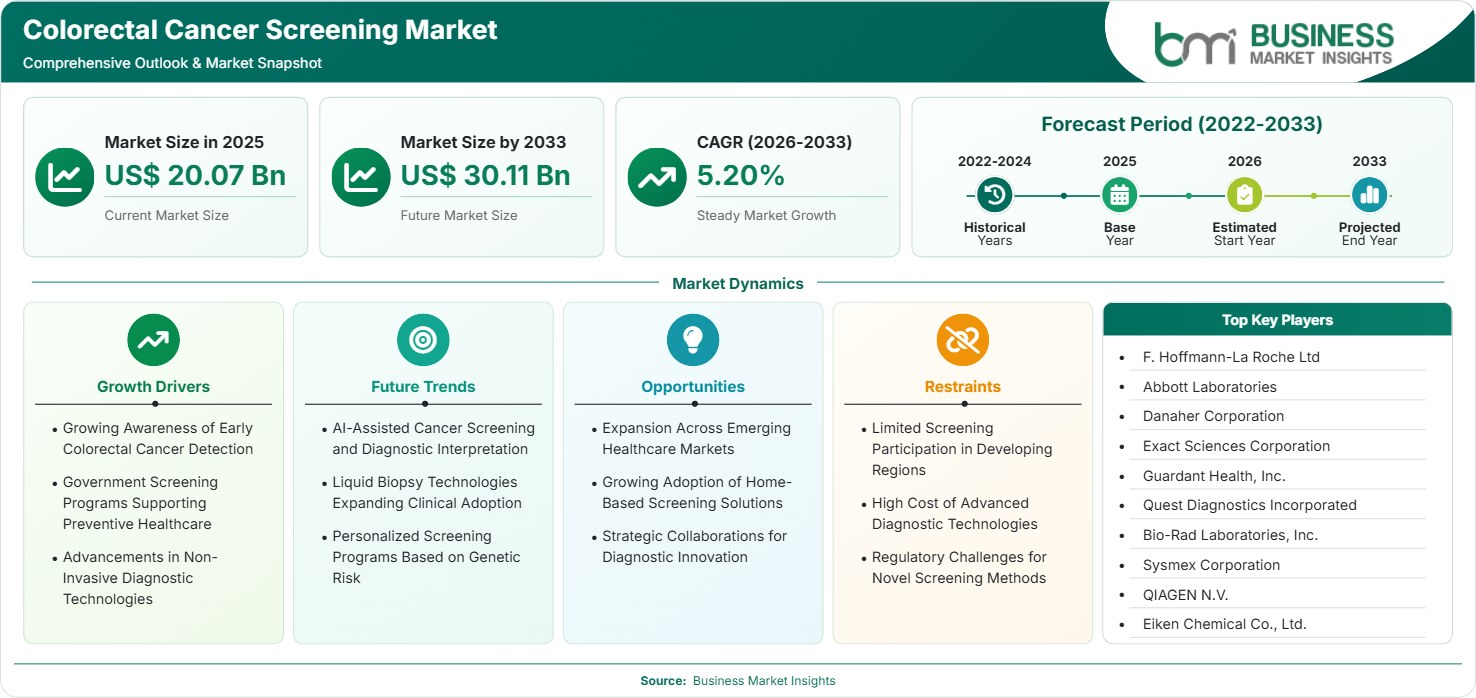
The Colorectal Cancer Screening Market size was valued at US$ 20.07 Billion in 2025 and is projected to reach US$ 30.11 Billion by 2033, growing at a CAGR of 5.20% during 2026–2033. Rising awareness of early cancer detection, government screening initiatives, preventive healthcare adoption, and advancements in non-invasive diagnostic technologies are supporting market expansion.

Report Coverage
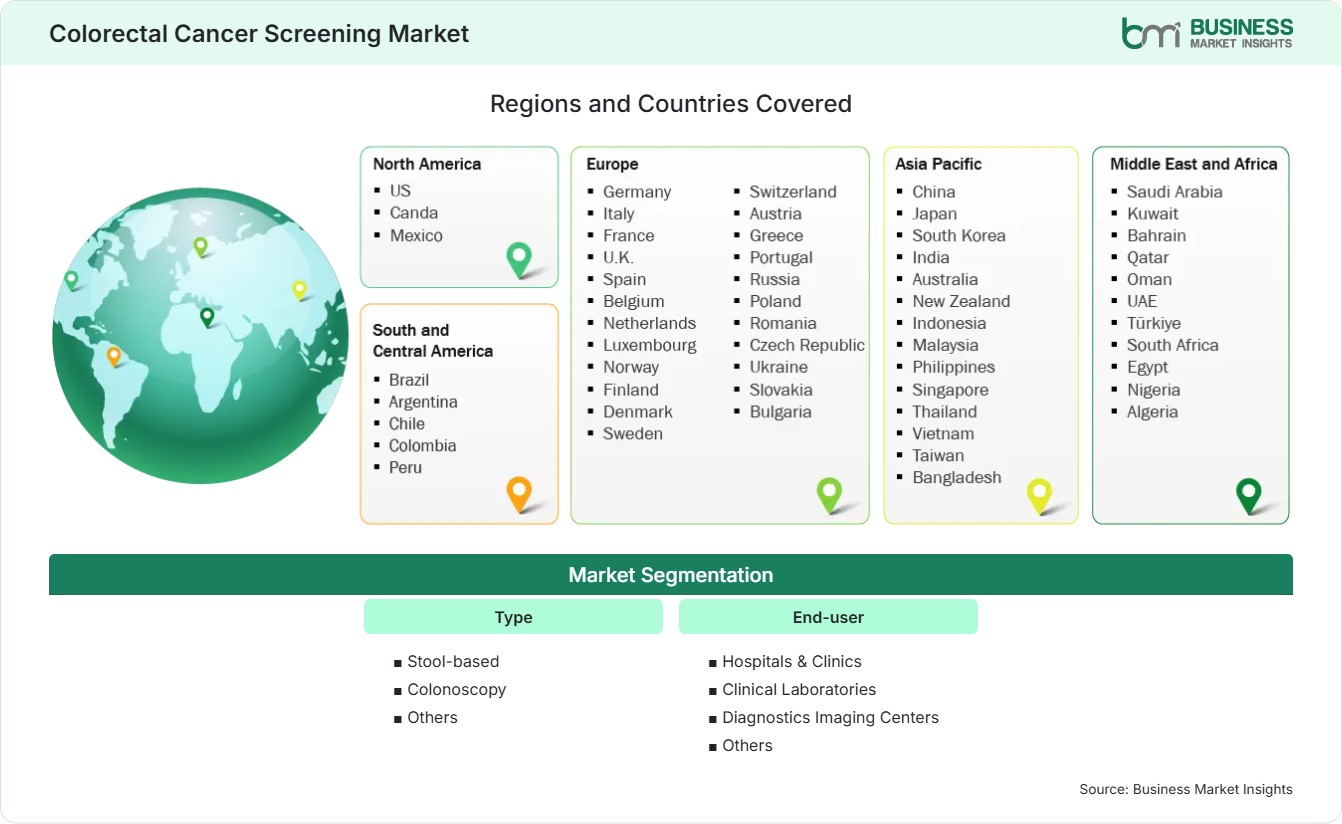
  • Type: Stool-based, Colonoscopy, Others
  • End-user: Hospitals & Clinics, Clinical Laboratories, Diagnostics Imaging Centers, Others
US$ 20.07 Bn Market size in 2025
US$ 30.11 Bn Market Size by 2033
5.20% CAGR, 2026 - 2033
2026-2033 Forecast Period

AI Overview

Colorectal Cancer Screening Market Summary

  • North America Region: North America holds 42%–45% market share in 2025 and is projected to grow at a 4.8%–5.4% CAGR during 2026–2033. Strong healthcare infrastructure, established screening guidelines, high diagnostic adoption, and reimbursement support are driving regional growth. The U.S. dominates the regional landscape due to widespread colorectal cancer screening programs, advanced laboratory networks, and increasing adoption of molecular diagnostic tests, growing at approximately 5.0%–5.5% CAGR.
  • Fastest Growing Region: Asia Pacific accounts for 22%–25% market share in 2025 and is expected to expand at a 6.0%–6.8% CAGR through 2033. Increasing healthcare investments, improving diagnostic infrastructure, rising cancer awareness, and expanding access to preventive screening services are accelerating regional adoption.
  • Leading Segment: Colonoscopy holds 46%–49% market share in 2025 and is projected to grow at a 4.5%–5.0% CAGR during 2026–2033. High diagnostic accuracy, clinical acceptance, and established use in healthcare systems continue supporting segment leadership.
  • High Growth Segment: Stool-based Screening represents 28%–31% market share in 2025 and is expected to grow at a 6.2%–6.8% CAGR. Increasing preference for non-invasive testing, home-based screening options, and improved molecular stool tests are driving adoption.
  • Key Market Opportunity: Expansion of screening programs in emerging healthcare markets, increasing adoption of home-based diagnostic solutions, and collaborations for advanced biomarker-based technologies are creating new growth opportunities.
  • Major Market Players: F. Hoffmann-La Roche Ltd, Abbott Laboratories, Danaher Corporation, Exact Sciences Corporation, Guardant Health, Inc., Quest Diagnostics Incorporated, Bio-Rad Laboratories, Inc., Sysmex Corporation, QIAGEN N.V., Eiken Chemical Co., Ltd.
Strategic Insights

Colorectal Cancer Screening Market: Strategic Insights

Colorectal Cancer Screening Market Strategic Framework
FREE PDF
Request your free sample
Request free sample
Stakeholder View

Key Takeaways

  • Screening ecosystem development is increasingly influenced by collaboration between diagnostic companies, healthcare providers, laboratories, and government health programs focused on improving early cancer detection rates.
  • Non-invasive stool-based screening solutions represent a major opportunity area due to increasing patient preference for convenient testing methods and improved molecular diagnostic capabilities.
  • Innovation priorities are shifting toward advanced biomarkers, genomic testing, artificial intelligence-assisted diagnostics, and technologies that improve screening accuracy and patient compliance.
  • Asia Pacific offers significant investment potential due to rising healthcare expenditure, expanding diagnostic infrastructure, increasing cancer awareness, and government initiatives supporting preventive healthcare.
  • Strategic partnerships, product launches, and technology collaborations are shaping competitive dynamics as diagnostic companies expand their screening portfolios and strengthen global presence.
  • Healthcare accessibility improvements and decentralized diagnostic approaches are expected to influence future adoption by enabling screening availability beyond traditional clinical settings.
Geographic Outlook

Colorectal Cancer Screening Market Regional Highlights

North America Colorectal Cancer Screening Market

North America accounts for 42%–45% of the Colorectal Cancer Screening Market share in 2025 and is projected to grow at a 4.8%–5.4% CAGR during 2026–2033. The region maintains market leadership due to established screening guidelines, strong healthcare infrastructure, advanced diagnostic laboratories, and high awareness regarding preventive cancer detection. The United States represents the largest contributor, supported by organized screening programs, reimbursement availability, and adoption of molecular diagnostic technologies. Increasing focus on improving screening participation rates continues supporting regional expansion.

  • Government-supported colorectal cancer screening initiatives are improving early diagnosis rates by encouraging preventive testing among eligible populations across North American healthcare systems.
  • Diagnostic companies are investing in advanced molecular and non-invasive testing solutions to improve screening accuracy, accessibility, and patient participation.
  • Hospitals and clinical laboratories are expanding screening capabilities through adoption of automated diagnostic platforms and advanced testing technologies.
  • Rising healthcare expenditure and insurance coverage support wider adoption of colorectal cancer screening procedures across developed healthcare markets.

US Colorectal Cancer Screening Market

The United States contributes approximately 85%–88% of North American demand and is projected to grow at a 5.0%–5.5% CAGR through 2033. The country benefits from established preventive healthcare frameworks, extensive laboratory networks, and strong adoption of advanced diagnostic technologies. Increasing awareness campaigns, improved screening recommendations, and growing demand for non-invasive testing methods are supporting market growth.

  • Increasing adoption of at-home screening solutions is improving patient convenience and encouraging participation among populations hesitant toward traditional procedures.
  • Clinical laboratories are expanding diagnostic capabilities through automated testing platforms and advanced colorectal cancer detection technologies.
  • Healthcare organizations are emphasizing early detection strategies to reduce treatment costs and improve long-term patient outcomes.
  • Partnerships between diagnostic companies and healthcare providers are supporting innovation in screening methodologies and patient engagement programs.

Europe Colorectal Cancer Screening Market

Europe represents approximately 27%–30% market share in 2025 and Europe Colorectal Cancer Screening Market forecast to grow at a 4.5%–5.2% CAGR during 2026–2033. Germany, the United Kingdom, France, and Italy are among the leading markets due to established healthcare systems and government-supported cancer screening programs. European countries are increasingly adopting organized colorectal cancer screening initiatives and improving diagnostic accessibility.

  • Germany is strengthening colorectal cancer screening adoption through advanced healthcare infrastructure and increasing utilization of preventive diagnostic services.
  • The United Kingdom is expanding screening programs through organized national initiatives focused on improving early cancer detection rates.
  • France and Italy are investing in diagnostic modernization and improving access to colorectal cancer testing services.
  • European healthcare providers are adopting non-invasive screening technologies to improve patient acceptance and screening participation.
  • Regulatory emphasis on preventive healthcare is encouraging innovation in molecular diagnostics and screening technologies.

Asia Pacific Colorectal Cancer Screening Market

Asia Pacific Colorectal Cancer Screening Market holds 22%–25% market share in 2025 and is forecast to achieve the fastest growth at a 6.0%–6.8% CAGR through 2033. Increasing healthcare expenditure, rising cancer awareness, expanding diagnostic infrastructure, and government healthcare initiatives are driving regional adoption. China, Japan, India, and South Korea are major contributors due to growing healthcare investments and increasing focus on early disease detection.

  • China is expanding cancer screening infrastructure through healthcare modernization programs and increasing investments in diagnostic technologies.
  • India is witnessing rising demand for affordable screening solutions due to growing cancer awareness and expanding healthcare access.
  • Japan and South Korea are adopting advanced diagnostic methods supported by developed healthcare systems and technology-focused medical innovation.
  • Southeast Asian countries are improving screening accessibility through public healthcare programs and private healthcare investments.
  • Increasing partnerships between global diagnostic companies and regional healthcare providers are accelerating technology adoption.

Rest of World Colorectal Cancer Screening Market

The Rest of World region accounts for approximately 6%–8% market share in 2025 and is projected to grow at a 5.8%–6.5% CAGR during 2026–2033. Latin America, the Middle East, and Africa are experiencing gradual adoption due to improving healthcare infrastructure, increasing disease awareness, and expanding diagnostic services. Latin American countries are improving diagnostic capabilities through healthcare investments and increasing adoption of preventive cancer screening approaches. Middle Eastern markets are expanding healthcare infrastructure through government-led modernization programs.

  • Brazil and Mexico are increasing screening adoption through expanding healthcare networks and growing awareness of early cancer detection benefits.
  • Middle Eastern countries are investing in advanced diagnostic infrastructure and preventive healthcare initiatives.
  • African markets are developing screening capabilities through international healthcare partnerships and improved laboratory access.
  • Private healthcare providers are expanding diagnostic services to address increasing demand for cancer screening.
  • Healthcare modernization programs are creating opportunities for diagnostic companies to expand across emerging markets.
Global Market Geography
FREE PDF
Request your free sample
Request free sample
Segment Analysis

Colorectal Cancer Screening Market Segmentation

Type

The Type segment accounted for approximately 96%–98% market share in 2025 and is projected to grow at a 5.1%–5.6% CAGR during 2026–2033. The segment includes stool-based screening, colonoscopy, and other diagnostic approaches used for colorectal cancer detection. The Colorectal Cancer Screening Market scope is expanding as healthcare systems focus on improving screening accessibility and patient participation.

  • Stool-based: Stool-based screening methods are gaining adoption due to non-invasive testing advantages, improved patient convenience, home-based availability, and increasing use in population-level screening programs.
  • Colonoscopy: Colonoscopy remains widely utilized due to high diagnostic accuracy, direct visualization capabilities, and ability to support both cancer detection and preventive polyp removal procedures.

End-user

The End-user segment represented approximately 61%–64% Colorectal Cancer Screening Market share in 2025 and is expected to expand at a 5.3%–5.8% CAGR through 2033. Healthcare providers, diagnostic laboratories, and imaging centers are adopting advanced screening technologies to improve colorectal cancer detection efficiency. Hospitals and clinics maintain a strong position due to comprehensive diagnostic capabilities and availability of specialized medical professionals.

  • Hospitals & Clinics: Hospitals and clinics represent major adoption centers due to availability of specialist expertise, diagnostic infrastructure, screening procedures, and integrated patient care services.
  • Clinical Laboratories: Clinical laboratories are expanding colorectal screening capabilities through automated testing platforms, molecular diagnostics, and large-scale screening support for healthcare providers.
  • Diagnostics Imaging Centers: Diagnostic imaging centers are supporting colorectal cancer detection through advanced imaging technologies, specialized procedures, and improved accessibility outside traditional hospital settings.
Market Forces

Colorectal Cancer Screening Market Dynamics

Key Market Drivers

Growing Awareness of Early Colorectal Cancer Detection

Growing awareness about the importance of early detection of colorectal cancer is driving up the demand for colorectal cancer screening methods in both developed and developing healthcare segments. Public awareness campaigns, health education programs, and healthcare practitioner advice are prompting people to go for regular screenings, especially the high-risk age groups. Healthcare providers are concentrating on boosting up the process of screening using efficient diagnosis and better communication techniques with patients. This Colorectal Cancer Screening Market trend includes growing awareness about preventive healthcare, increasing cancer burden, and early disease identification.

Government Screening Programs Supporting Preventive Healthcare

The government-led colorectal cancer screening programs have been very important in the enhancement of early diagnosis and in offering preventive healthcare services. There are national health care systems which are implementing structured screening programs for encouraging population testing and reducing the burden of colorectal cancer. Such efforts are enhancing the demand for diagnostic tests, clinical laboratory services and screening facilities. The efforts have been helping in enhancing the capacity of the healthcare systems, and increasing participation through structured screening programs.

Advancements in Non-Invasive Diagnostic Technologies

Technological developments in non-invasive diagnostics are revolutionizing colorectal cancer screening through convenience, accuracy, and patient acceptability. Stool-based molecular tests, biomarkers-based diagnostics, and laboratory innovations are helping detect colorectal cancer early, and all this without invasive techniques. The companies are developing new techniques through research and development activities, and thus the increased acceptance of digital healthcare and home-testing techniques is shaping future trends in the market.

Key Market Opportunities

Expansion Across Emerging Healthcare Markets

Emerging healthcare markets present significant growth opportunities as governments and private healthcare providers invest in improving cancer screening infrastructure. Rising healthcare expenditure, increasing disease awareness, and expanding diagnostic networks are creating favorable conditions for market expansion. Countries across Asia Pacific, Latin America, and the Middle East are strengthening preventive healthcare systems through screening programs and healthcare modernization initiatives. Increasing focus on early detection and preventive medicine is expected to create long-term opportunities across underserved markets.

Growing Adoption of Home-Based Screening Solutions

The relevance of home-based screening solutions is increasing due to the fact that patients are preferring diagnostic options which are more convenient and non-invasive. Stool-based screening technologies enable people to perform screening tests from the comfort of their homes without having to rely much on clinical visits. Medical systems are adopting home-based screening technologies in order to increase participation rates amongst people who have poor access to healthcare institutions.

Strategic Collaborations for Diagnostic Innovation

Strategic collaborations among diagnostic companies, healthcare providers, research institutions, and technology developers are creating opportunities for innovation in colorectal cancer screening. Partnerships are supporting development of advanced biomarkers, molecular testing platforms, and improved diagnostic workflows. Companies are combining scientific expertise with healthcare distribution networks to accelerate commercialization and expand market reach. Collaborative research initiatives are also focusing on improving test accuracy, reducing costs, and developing next-generation screening technologies. These collaborations are expected to accelerate innovation and improve accessibility of advanced screening solutions globally.

Market Restraints and Challenges

Limited Screening Participation in Developing Regions

Factor: Limited awareness, inadequate healthcare infrastructure, cultural barriers, and restricted access to diagnostic facilities affect colorectal cancer screening participation in developing regions. Impact: Low participation rates can limit market penetration and delay early disease detection, reducing the adoption potential of screening technologies. Many developing healthcare systems face challenges related to insufficient screening programs, limited trained professionals, and restricted availability of advanced diagnostic facilities.

High Cost of Advanced Diagnostic Technologies

Factor: Advanced colorectal cancer screening technologies, including molecular diagnostics, biomarker-based tests, and automated laboratory systems, require significant research, infrastructure, and operational investments. Impact: High costs associated with advanced diagnostic solutions can restrict adoption among healthcare providers and patients, particularly in price-sensitive markets. Hospitals and laboratories may face challenges in balancing technology investments with reimbursement limitations and healthcare budget constraints. Expensive testing procedures can reduce accessibility and delay widespread implementation of innovative screening methods.

Company Analysis

Competitive Landscape

The competitive landscape includes diagnostic technology companies, laboratory service providers, biotechnology firms, and healthcare solution developers focusing on improving colorectal cancer detection accuracy and accessibility. Colorectal Cancer Screening Market analysis indicates that leading companies are investing in molecular diagnostics, non-invasive testing platforms, biomarker discovery, automation, and strategic partnerships to strengthen their market position.

Company Name

Overview

Products and Services Relevant to this Market

F. Hoffmann-La Roche Ltd

Global healthcare company specializing in diagnostics, pharmaceuticals, and advanced medical technologies for disease detection.

Molecular diagnostic solutions, laboratory testing platforms, cancer diagnostics, biomarkers, and technologies supporting colorectal cancer screening workflows.

Abbott Laboratories

Global healthcare company providing diagnostic systems, medical devices, and laboratory solutions across healthcare sectors.

Diagnostic testing platforms, molecular diagnostics, laboratory instruments, and solutions supporting cancer detection and screening programs.

Danaher Corporation

Global science and technology company offering diagnostics, life science, and healthcare innovation solutions.

Diagnostic platforms through subsidiaries, molecular testing technologies, laboratory automation, and precision diagnostics solutions.

Exact Sciences Corporation

Molecular diagnostics company focused on cancer screening and early detection technologies.

Cologuard colorectal cancer screening test, molecular diagnostics, cancer detection technologies, and precision screening solutions.

Guardant Health, Inc.

Biotechnology company specializing in liquid biopsy, genomic testing, and precision oncology solutions.

Blood-based cancer detection technologies, genomic profiling, liquid biopsy platforms, and advanced diagnostic testing solutions.

Quest Diagnostics Incorporated

Diagnostic information services provider offering laboratory testing and healthcare diagnostic solutions.

Colorectal cancer screening tests, laboratory services, molecular diagnostics, and population health screening support.

Bio-Rad Laboratories, Inc.

Life science and diagnostics company developing laboratory instruments and testing technologies.

Clinical diagnostic systems, immunoassay technologies, laboratory platforms, and research solutions supporting cancer diagnostics.

Sysmex Corporation

Healthcare technology company specializing in diagnostic instruments and laboratory information solutions.

Hematology and diagnostic systems, laboratory automation, clinical testing technologies, and healthcare data solutions.

QIAGEN N.V.

Molecular diagnostics company providing sample preparation, molecular testing, and biotechnology solutions.

Molecular diagnostic kits, PCR technologies, genomic testing solutions, and cancer screening-related diagnostic platforms.

Eiken Chemical Co., Ltd.

Japanese diagnostics company specializing in molecular testing and clinical laboratory technologies.

Molecular diagnostic systems, LAMP-based testing technologies, and laboratory solutions supporting disease detection applications.

Trust & Transparency

Research Methodology

The market analysis combines proprietary research with secondary data from government agencies, company disclosures, regulatory filings, industry databases and expert interviews. Market estimates are validated through data triangulation, cross-market benchmarking and analyst review.

View Full Research Methodology

Questions Answered

Frequently Asked Questions

How are companies improving colorectal cancer screening accessibility?

Companies are improving accessibility through affordable diagnostic solutions, strategic partnerships, decentralized testing models, and expansion of screening technologies across emerging healthcare markets.

What role do clinical laboratories play in colorectal cancer screening market report?

Clinical laboratories provide advanced testing capabilities, automation, molecular diagnostics, and large-scale screening support for healthcare providers and population health programs.

Which screening method is expected to experience stronger adoption in the future?

Stool-based screening methods are expected to gain adoption due to convenience, home-based testing capabilities, improved diagnostic performance, and increasing acceptance among patients.

How are non-invasive screening technologies changing colorectal cancer detection?

Non-invasive technologies such as stool-based molecular tests improve patient convenience, increase screening participation, and enable healthcare systems to expand preventive testing programs.

Why is early colorectal cancer screening becoming increasingly important?

Early colorectal cancer screening helps identify disease at initial stages, improves treatment outcomes, supports preventive healthcare strategies, and reduces the impact of advanced-stage cancer diagnosis.

Access the Full Colorectal Cancer Screening Market Report

Get segment-level forecasts, regional estimates, competitive benchmarking, company profiles and downloadable Excel datasets.

Access the full Colorectal Cancer Screening Market Report
350 pages PDF & Excel | 2026-08-25
Similar Research

Related Market Reports