
Collaborative Robots Market Outlook: Size, Share, Trends, Growth Analysis, Competitive Landscape & Forecast, 2026-2033

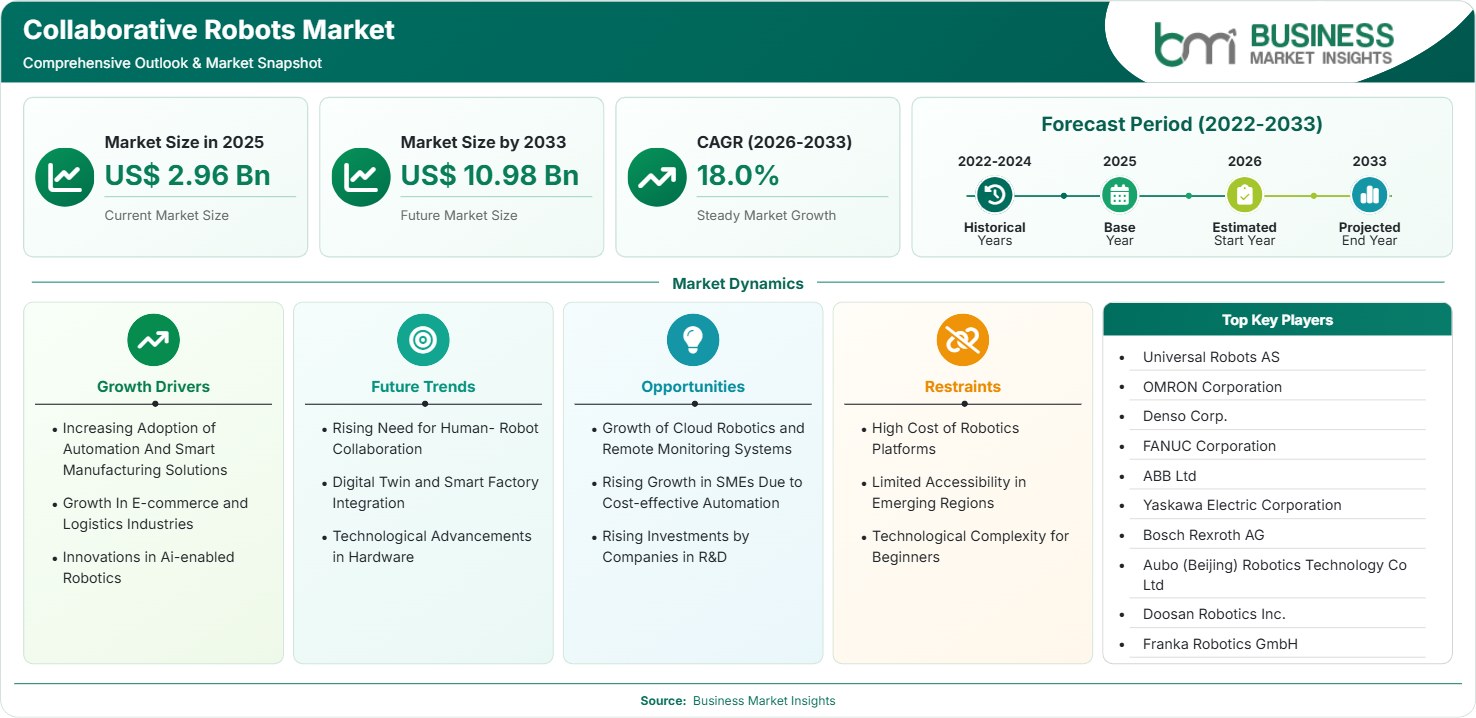
The Collaborative Robots Market size was valued at US$ 2.96 Billion in 2025 and is projected to reach US$ 10.98 Billion by 2033, growing at a CAGR of 18.0% during 2026–2033. Increasing adoption of automation and smart manufacturing solutions, growing demand from e-commerce and logistics industries, and rapid innovations in AI-enabled robotics are accelerating deployment. Expanding cloud robotics capabilities and rising automation investments among SMEs create significant market opportunities.

Report Coverage
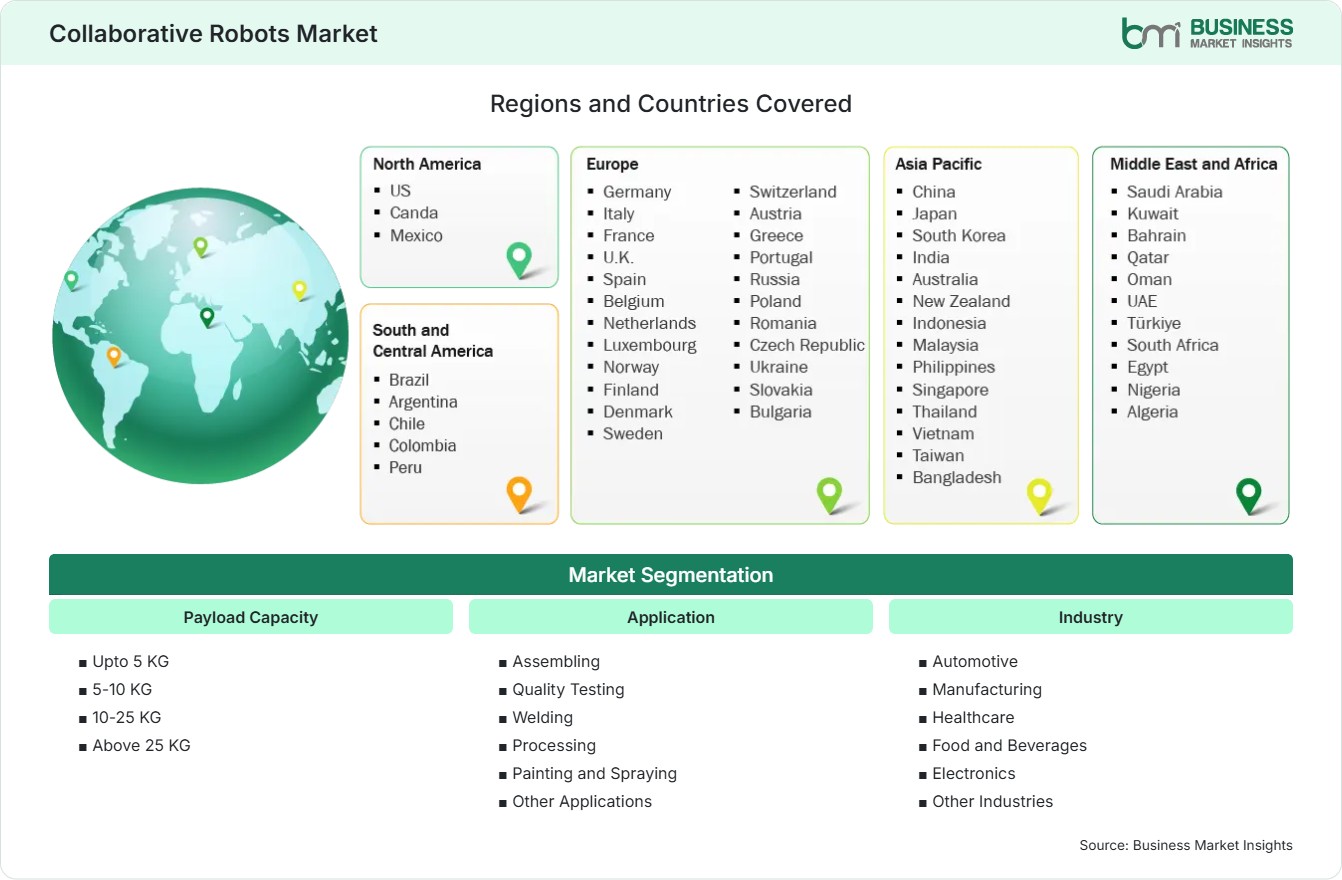
  • Payload Capacity: Upto 5 KG, 5-10 KG, 10-25 KG, Above 25 KG
  • Application: Assembling, Quality Testing, Welding, Processing, Painting and Spraying, Other Applications
  • Industry: Automotive, Manufacturing, Healthcare, Food and Beverages, Electronics, Other Industries
US$ 2.96 Bn Market size in 2025
US$ 10.98 Bn Market Size by 2033
18.0% CAGR, 2026 - 2033
2026-2033 Forecast Period

AI Overview

Collaborative Robots Market Summary

  • North America Region: North America holds 13.4% share in 2025, growing at a CAGR of 11.2% during 2026–2033. Growing warehouse automation, increasing deployment of human-machine collaboration systems, smart factory investments, and labor shortage concerns continue driving adoption. The US market benefits from advanced manufacturing investments, warehouse automation expansion, and robotics integration initiatives, growing at a CAGR of 11.8%.
  • Fastest Growing Region: Asia Pacific accounts for 48.5% share in 2025 and is projected to expand at a CAGR of 21.0% during 2026–2033. Expanding industrial automation programs, electronics manufacturing growth, labor optimization initiatives, and increasing robotics investments support strong market momentum.
  • Leading Segment: Upto 5 KG accounts for 37.7% share in 2025 and is expected to grow at a CAGR of 15.7 % during 2026–2033. Lightweight collaborative robots remain preferred for assembly operations, electronics production, and workplace flexibility requirements.
  • High Growth Segment: 10–25 KG accounts for 25.5% share in 2025 and is forecast to grow at a CAGR of 21.8 % during 2026–2033. Manufacturers increasingly adopt higher-payload solutions for material handling, welding, and advanced production processes.
  • Key Market Opportunity: Rising investments in cloud robotics, AI-driven automation platforms, and affordable robotic systems for small and medium enterprises are creating new commercial opportunities across industrial sectors.
  • Major Market Players: Universal Robots A/S, OMRON Corporation, DENSO Corporation, FANUC Corporation, ABB Ltd., Yaskawa Electric Corporation, Bosch Rexroth AG, AUBO (Beijing) Robotics Technology Co., Ltd., Doosan Robotics Inc., and Franka Robotics GmbH.
Strategic Insights

Collaborative Robots Market: Strategic Insights

Collaborative Robots Market Strategic Framework
FREE PDF
Request your free sample
Request free sample
Stakeholder View

Key Takeaways

  • Collaborative automation is driving a shift towards production environments that are more flexible and enable humans and robots to cooperate effectively, without the need for numerous safety barriers.
  • Welding, handling, and assembly activities remain promising areas for application due to substantial productivity improvements and labor shortages.
  • Integration of AI, machine vision, sophisticated sensors, and cloud connectivity allows collaborative robots to handle more complex operations.
  • The region that offers the greatest opportunity for investment is the Asia-Pacific region because of rapid industrialization and automation and expansion of electronics manufacturing.
  • Partnerships among companies that manufacture robotics, software, and automation are driving innovation in technology development and use.
  • Increasing adoption of automation systems by small- to medium-sized enterprises increases the potential market for technology.
Geographic Outlook

Collaborative Robots Market Regional Highlights

North America Collaborative Robots Market

North America accounted for 13.4% Collaborative Robots Market share in 2025 and is projected to expand at a CAGR of 11.2% during 2026–2033. The emergence of labor shortages, rising investment in warehouse automation, and Industry 4.0 adoption keeps encouraging collaborative robots usage. Manufacturers are prioritizing flexible automation systems that increase efficiency while ensuring cooperation with the workforce. The area enjoys technological infrastructure, high integration skills in robotics, and high demand in industries such as automotive, logistics, electronics, and healthcare.

  • The rise of automation initiatives in warehouses is driving the adoption of collaborative robots in logistics facilities for picking, sorting, packing, and materials handling.
  • Manufacturers in the automotive sector continue to use collaborative robots on their production lines to enhance efficiency and precision.
  • With AI-based robotics technologies, it has become possible to implement machine vision and maintenance optimization features.
  • Healthcare organizations are increasingly using collaborative robots in their laboratories to handle devices.
  • The investments in smart manufacturing are driving faster adoption among both large companies and small manufacturers.

US Collaborative Robots Market

The United States accounted for approximately 75.09% of North American revenue in 2025 and is expected to grow at a CAGR of 11.8% during 2026–2033. Strong automation spending, rapid digitalization of manufacturing facilities, and growing adoption of robotics among SMEs support market expansion. Industries increasingly deploy collaborative robots to improve efficiency, minimize repetitive labor tasks, and enhance production flexibility. Technological advancements in AI, machine vision, and cloud-connected robotics are further strengthening market growth across industrial applications.

• Companies are using collaborative robots to perform assembly jobs, welding operations, and quality checking tasks.

• Companies in logistics are continually investing in robot automation to overcome the shortage of workers and increased need for order fulfillment.

• Robotic solutions using the cloud facilitate remote monitoring and operational improvement.

• Small and medium-sized businesses are adopting affordable robotic systems to gain a competitive advantage.

Europe Collaborative Robots Market

Europe held 27.1% share in 2025 and is projected to register a CAGR of 14.3% during 2026–2033. The continuous growth in industrial automation, emphasis on advanced manufacturing, and the increasing need for worker safety will keep the market demand strong. Collaborative robots have become very relevant in automotive, electronic, and industrial manufacturing sectors. The market leader is Germany due to its widespread adoption of automation, whereas Italy has become a fast-growing market due to its heavy investments in smart manufacturing.

  • Automotive producers will keep using collaborative robotics in order to increase productivity, flexibility, and quality control during assembling process.
  • Workplace safety policies stimulate using human-robot collaboration in production facilities.
  • Germany is the leading region due to the high level of automation technology and increasing smart factory investments.
  • Italy shows higher adoption rate because of manufacturing modernization and implementation of Industry 4.0 technology.
  • Electronics and precision manufacturing industries continue expanding collaborative robot deployments for high-accuracy production environments.

Asia Pacific Collaborative Robots Market

Asia Pacific accounted for 48.5% share in 2025 and is anticipated to grow at a CAGR of 21.0% during 2026–2033, making it both the leading and fastest-growing regional market. Growing industrialization, rapid electronics manufacturing, and high robotics investments further continue to aid in broad acceptance. Efforts are underway to accelerate factory automation by governments and organizations to improve competitiveness in international markets. China continues to lead other countries in this region, while India is emerging as an increasingly important country owing to investments in manufacturing and automation.

  • The use of collaborative robots is becoming common among electronics companies in order to boost production efficiencies and quality as well as flexibility of operations.
  • China has maintained its dominance thanks to large scale industrial automation and significant robotics investments within the country.
  • In India, there is increased use of collaborative robots due to the growth in manufacturing, government support, and awareness on automation.
  • E-commerce activities are contributing to increased demand for collaborative robots in logistics.

Rest of World Collaborative Robots Market

In Rest of World contributes approximately 5.5% Market share in 2025 and is projected to expand at 18.3% CAGR. The MEA represented 5.9% share in 2025 and is expected to expand at a CAGR of 17.7% during 2026–2033. The Middle East & Africa region is increasingly deploying collaborative robotic solutions to support smart manufacturing and industrial diversification. The UAE and Saudi Arabia are attracting investments in advanced automation and robotics technologies.

South & Central America represented 5.1% share in 2025 and is expected to expand at a CAGR of 19.0% during 2026–2033 is experiencing increasing robotics adoption across manufacturing and food processing industries. Brazil remains the leading market due to industrial modernization initiatives and growing automation investments.

  • Manufacturing modernization initiatives continue supporting collaborative robot adoption across emerging industrial economies.
  • Brazil benefits from increasing automation investments and rising demand for productivity-enhancing manufacturing technologies.
  • Middle Eastern economies are investing in smart factories and advanced industrial automation infrastructure.
  • Food processing and packaging industries are expanding deployment of collaborative robots to improve efficiency and product quality.
  • Growing awareness of automation benefits is encouraging adoption among regional SMEs and industrial enterprises.
Global Market Geography
FREE PDF
Request your free sample
Request free sample
Segment Analysis

Collaborative Robots Market Segmentation

Payload Capacity

Payload capacity remains a key factor influencing collaborative robot selection across industrial applications. The Upto 5 KG segment held the largest share of approximately 37.7% in 2025 and is projected to grow at a CAGR of 15.7% during 2026–2033. The Collaborative Robots Market scope continues expanding as manufacturers seek flexible automation systems capable of supporting assembly, testing, and light material-handling operations while ensuring workplace safety and operational efficiency.

  • Upto 5 KG: Lightweight collaborative robots remain widely adopted for electronics assembly, packaging activities, laboratory operations, and precision manufacturing environments.
  • 5–10 KG: This category is increasingly utilized for assembly, inspection, machine tending, and moderate payload material handling requirements.
  • 10–25 KG: Growing demand from welding, palletizing, and industrial handling applications is driving rapid adoption of medium-payload collaborative robots.
  • Above 25 KG: Higher-capacity systems support heavy-duty industrial applications requiring enhanced lifting capability, process automation, and production efficiency.

Application

Application demand is expanding as manufacturers increasingly utilize collaborative robots to enhance production flexibility, quality, and operational efficiency. Welding emerged as the leading application with approximately 25.2% share in 2025 and is expected to grow at a CAGR of 21.9 % during 2026–2033. The Collaborative Robots Market trends indicate increasing deployment across assembly, inspection, processing, and material-handling operations as enterprises prioritize automation, consistency, and workforce productivity improvements.

  • Assembling: Collaborative robots are extensively used in assembly operations to improve throughput, reduce repetitive manual tasks, enhance precision, and support flexible manufacturing environments.
  • Quality Testing: Increasing adoption of machine vision and AI-based inspection systems is supporting deployment in quality testing and defect detection applications.
  • Welding: Growing demand from automotive, metal fabrication, and industrial manufacturing sectors is driving rapid adoption of collaborative welding robots.
  • Processing: Manufacturers utilize collaborative robots for cutting, polishing, deburring, and machining support activities requiring precision and consistency.
  • Painting and Spraying: Collaborative robots enable improved coating consistency, reduced material wastage, and enhanced worker safety in painting operations.

Industry

Industry adoption continues expanding as organizations pursue automation strategies that improve productivity while maintaining workforce collaboration. Manufacturing accounted for the largest share at approximately 26.1% in 2025 and is projected to grow at a CAGR of 12.4% during 2026–2033. Electronics represents the fastest-growing industry segment with a CAGR of 22.9%, supported by increasing precision manufacturing requirements and growing demand for advanced automation solutions.

  • Automotive: Automotive manufacturers utilize collaborative robots for assembly, welding, material handling, inspection, and component installation processes requiring flexibility and high accuracy.
  • Manufacturing: General manufacturing remains the largest adopter due to increasing demand for productivity improvement, operational flexibility, and cost-effective automation deployment.
  • Healthcare: Healthcare organizations increasingly deploy collaborative robots in laboratory automation, pharmaceutical handling, medical device manufacturing, and support operations.
  • Food and Beverages: Food manufacturers adopt collaborative robots for packaging, sorting, palletizing, processing, and quality inspection applications while maintaining hygiene standards.
  • Electronics: Electronics producers increasingly deploy collaborative robots for precision assembly, component handling, quality testing, and semiconductor manufacturing operations.
Market Forces

Collaborative Robots Market Dynamics

Key Market Drivers

Increasing Adoption of Automation and Smart Manufacturing Solutions

Manufacturers worldwide are accelerating investments in automation technologies to improve productivity, operational flexibility, and production efficiency. Collaborative robots support smart manufacturing initiatives by enabling safe human-robot interaction while reducing operational bottlenecks. The Collaborative Robots Market growth is being driven by increasing adoption of Industry 4.0 technologies, digital production systems, and intelligent manufacturing environments. Unlike traditional industrial robots, collaborative systems require lower deployment complexity and can be integrated into existing workflows more easily. Companies across automotive, electronics, healthcare, and consumer goods industries continue expanding collaborative automation strategies to improve quality, consistency, and profitability. These factors collectively support sustained demand growth through the forecast period.

Growth in E-commerce and Logistics Industries

Rapid expansion of e-commerce activities is generating strong demand for warehouse automation and intelligent material-handling solutions. Collaborative robots are increasingly deployed for picking, packaging, sorting, palletizing, and inventory management operations. Growing order volumes and rising consumer expectations for faster fulfillment are encouraging logistics providers to invest in automation technologies. The Collaborative Robots Market benefits from the ability of collaborative systems to operate alongside human workers while improving throughput and reducing repetitive labor requirements. Warehousing operators are particularly attracted to the scalability and flexibility offered by collaborative robotics solutions. Continued expansion of global e-commerce networks is expected to remain a significant growth catalyst.

Innovations in AI-enabled Robotics

Artificial intelligence is significantly expanding collaborative robot capabilities by enabling adaptive learning, machine vision, predictive analytics, and autonomous decision-making functions. AI-powered systems can perform increasingly complex tasks while improving accuracy and operational efficiency. The Collaborative Robots Market is benefiting from advancements in sensor technology, intelligent software, and real-time data processing capabilities. Manufacturers are developing robots capable of recognizing objects, adjusting workflows dynamically, and optimizing production performance. These innovations increase application versatility across industries while reducing programming complexity and deployment costs. As AI adoption continues accelerating, collaborative robotics solutions are expected to deliver greater value to industrial users.

Key Market Opportunities

Growth of Cloud Robotics and Remote Monitoring Systems

Cloud robotics is transforming industrial automation by enabling centralized data management, predictive analytics, remote monitoring, and real-time performance optimization. Collaborative robots connected through cloud platforms can access operational insights, software updates, and advanced analytics without extensive on-site infrastructure requirements. The Collaborative Robots Market Forecasts indicate growing demand for connected robotic ecosystems that improve scalability and operational efficiency. Cloud-based systems are being opted by more manufacturers because they offer easy installation and low maintenance, as well as better fleet management options. Remote monitoring features also enable predictive maintenance, reducing downtime and enhancing efficiency. As industrial companies become more digital through their transformations, there is great potential for cloud robotics.

Rising Growth in SMEs Due to Cost-effective Automation

The rising investment in collaborative robots by small and medium enterprises is due to falling costs and increased accessibility of such systems. Compared to traditional industrial robots, collaborative systems require minimal programming skills, are compact, and involve minimal infrastructure changes. The market is experiencing growth due to increasing awareness among SMEs of productivity enhancement, labor efficiency, and flexibility. The entry of manufacturers of modular robotic platforms, automated services on a subscription basis, and enhanced capabilities for integration is helping meet the needs of SMEs. In view of the stiff competition in the manufacturing industry, SMEs will emerge as a significant clientele segment during the forecast period.

Rising Investments by Companies in R&D

The producers of robots are still devoting substantial investments to research and development to make robots more intelligent, flexible, safe, and versatile. Innovations are being made in such areas as machine vision, sensors, use of artificial intelligence, human-robot interaction, and autonomy. The growth of the Market will be driven by ongoing technological improvements that will expand the range of possible applications for robots across various industries. Improvements in precision, learning ability, and ease of programming will provide additional benefits to end-users. Specialized solutions for healthcare, electronics, logistics, and food production are also being developed.

Market Restraints and Challenges

High Cost of Robotics Platforms

Factor: Despite declining costs, collaborative robot deployment often requires substantial investments in robotic hardware, software integration, employee training, vision systems, and end-of-arm tooling. Impact: High upfront expenditure can delay purchasing decisions, particularly among budget-constrained organizations and smaller manufacturers. The Collaborative Robots Market continues to face challenges where companies carefully evaluate return on investment before automation implementation. Additional expenses associated with customization and process redesign may further increase deployment costs. Although long-term productivity benefits can offset initial investments, cost considerations remain an important barrier affecting adoption rates across various industries.

Limited Accessibility in Emerging Regions

Factor: Several emerging economies face limitations related to technical expertise, robotics infrastructure, integration capabilities, and awareness of collaborative automation technologies. Impact: Restricted access to advanced automation solutions may slow adoption and reduce market penetration in developing industrial regions. The Collaborative Robots Market can experience uneven growth patterns where local support networks, training resources, and technology ecosystems remain underdeveloped. Organizations may also encounter challenges related to maintenance services and skilled workforce availability. While industrial modernization programs are improving adoption prospects, accessibility constraints continue influencing deployment rates across certain emerging markets.

Company Analysis

Competitive Landscape

The Collaborative Robots Market analysis reveals an increasingly competitive environment characterized by technological innovation, AI integration, machine vision advancements, and expanding automation applications. Market participants are focused on product innovation, payload enhancement, software development, and strategic partnerships to strengthen their competitive positions.

Company Name

Overview

Products and Services Relevant to this Market

Universal Robots A/S

Pioneer in collaborative robotics with extensive global deployment across manufacturing and industrial sectors.

Collaborative robotic arms, automation software, training services, application integration solutions, and ecosystem support.

OMRON Corporation

Automation specialist offering intelligent robotics and industrial automation technologies.

Collaborative robots, machine vision systems, factory automation solutions, and industrial control technologies.

DENSO Corporation

Global automation company with strong expertise in robotics and industrial manufacturing systems.

Collaborative robots, assembly automation systems, manufacturing solutions, and robotic integration services.

FANUC Corporation

Leading industrial robotics provider serving multiple manufacturing industries globally.

Collaborative robots, robotic automation systems, CNC solutions, and advanced manufacturing technologies.

ABB Ltd.

Technology company focused on industrial automation, robotics, and digital manufacturing solutions.

Collaborative robots, machine automation systems, robotics software, and smart factory technologies.

Yaskawa Electric Corporation

Major robotics manufacturer with extensive expertise in automation and motion control technologies.

Collaborative robots, industrial robotics systems, automation platforms, and motion control solutions.

Bosch Rexroth AG

Industrial automation supplier providing robotics and smart manufacturing solutions worldwide.

Collaborative robotics platforms, automation software, control systems, and factory optimization technologies.

AUBO (Beijing) Robotics Technology Co., Ltd.

Collaborative robotics company serving industrial and commercial automation requirements.

Collaborative robot arms, automation solutions, robotic controllers, and integration support services.

Doosan Robotics Inc.

Specialized collaborative robot developer with expanding international market presence.

Cobots, robotic automation platforms, intelligent monitoring solutions, and manufacturing applications.

Franka Robotics GmbH

Robotics innovator focusing on flexible and intelligent human-machine collaboration technologies.

Collaborative robotic systems, AI-enabled robotics platforms, research solutions, and automation software.

Trust & Transparency

Research Methodology

The market analysis combines proprietary research with secondary data from government agencies, company disclosures, regulatory filings, industry databases and expert interviews. Market estimates are validated through data triangulation, cross-market benchmarking and analyst review.

View Full Research Methodology

Questions Answered

Frequently Asked Questions

What does a Collaborative Robots Market Report typically evaluate?

A Report assesses market size, segment performance, competitive dynamics, growth opportunities, technology developments, application trends, and regional outlook throughout the forecast period.

Why are collaborative robots gaining popularity among SMEs?

Collaborative robots offer lower integration complexity, reduced safety infrastructure requirements, easier programming, and cost-effective automation benefits compared with traditional industrial robotic systems.

Which payload capacity segment holds the largest share?

The Upto 5 KG segment maintains the leading position because of extensive deployment in assembly, packaging, testing, and electronics manufacturing applications.

Which region dominates the global market?

Asia Pacific leads the market due to strong industrial automation investments, expanding electronics manufacturing activities, and widespread adoption of robotic technologies across production facilities.

What is driving adoption of collaborative robots across industries?

Growing labor shortages, increasing automation requirements, Industry 4.0 implementation, and demand for flexible manufacturing solutions are encouraging businesses to deploy collaborative robotic technologies.

Access the Full Collaborative Robots Market Report

Get segment-level forecasts, regional estimates, competitive benchmarking, company profiles and downloadable Excel datasets.

Access the full Collaborative Robots Market Report
400 pages PDF & Excel | 2026-10-06
Similar Research

Related Market Reports