
Cold Chain Packaging Materials Market Outlook: Size, Share, Trends, Growth Analysis, Competitive Landscape & Forecast, 2026-2033

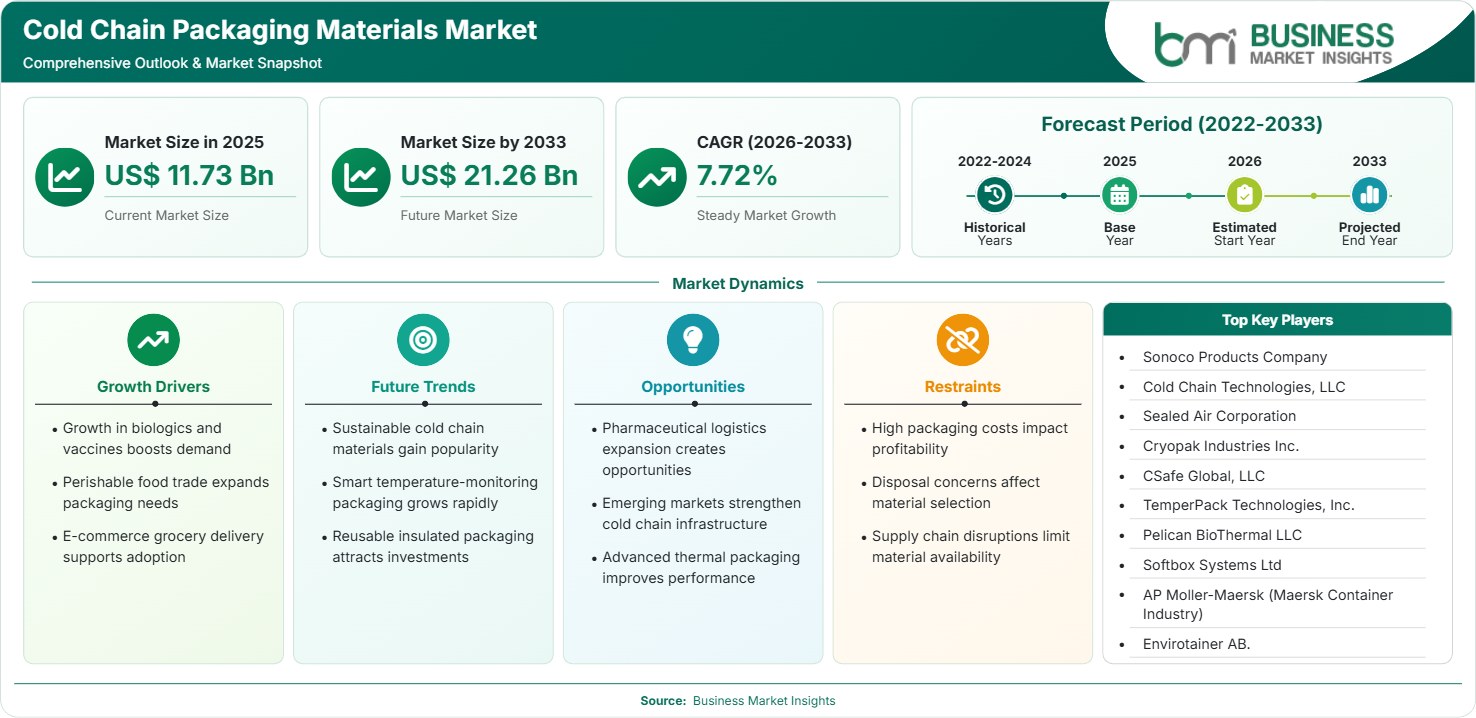
The Cold Chain Packaging Materials Market size was valued at US$ 11.73 Billion in 2025 and is projected to reach US$ 21.26 Billion by 2033, growing at a CAGR of 7.72% during 2026–2033, driven by pharmaceutical cold-chain expansion, biologics distribution, food safety regulations, sustainable insulation innovation, e-commerce grocery growth, and rising investments in temperature-controlled logistics infrastructure.

Report Coverage
  • Materials: Expanded Polystyrene, Polyurethane, Paper & Paperboard, Others
  • Application: Food, Pharmaceutical and Industrial
US$ 11.73 Bn Market size in 2025
US$ 21.26 Bn Market Size by 2033
7.72% CAGR, 2026 - 2033
2026-2033 Forecast Period

AI Overview

Cold Chain Packaging Materials Market Summary

  • North America Region: Holds a share of 35%–38% in 2025 and grows at a CAGR of 6.8%–7.2% through 2033. Drivers include pharmaceutical distribution compliance, vaccine logistics, reusable shipper adoption, and food safety requirements. Opportunities stem from smart packaging integration and sustainable insulation materials. The U.S. market benefits from biologics demand and advanced healthcare logistics, expanding at 6.9%–7.3% CAGR.
  • Fastest Growing Region: Asia Pacific holds 26%–29% share in 2025 and records 8.8%–9.4% CAGR. Growth is supported by pharmaceutical manufacturing expansion, cold-food trade, healthcare investments, and organized retail penetration. Opportunities emerge from regional cold-chain infrastructure modernization.
  • Leading Segment: Pharmaceutical accounts for 44%–47% share in 2025 and advances at 8.0%–8.5% CAGR. Growth is supported by biologics, vaccines, specialty therapeutics, compliance requirements, temperature validation standards, and increasing international healthcare shipments requiring packaging reliability.
  • High Growth Segment: Paper & Paperboard holds 18%–21% share in 2025 and expands at 9.2%–9.8% CAGR. Growth reflects sustainability objectives, recyclability advantages, regulatory pressure on plastics, and innovation in fiber-based thermal packaging performance.
  • Key Market Opportunity: Expansion of reusable and recyclable temperature-controlled packaging platforms creates opportunities for cost reduction, emissions mitigation, regulatory compliance, and improved lifecycle economics across pharmaceutical and food distribution networks globally.
  • Major Market Players: Sonoco Products Company, Cold Chain Technologies, LLC, Sealed Air Corporation, Cryopak Industries Inc., CSafe Global, LLC, TemperPack Technologies, Inc., Pelican BioThermal LLC, Softbox Systems Ltd, AP Moller-Maersk (Maersk Container Industry), and Envirotainer AB.
Strategic Insights

Cold Chain Packaging Materials Market: Strategic Insights

Cold Chain Packaging Materials Market Strategic Framework
FREE PDF
Request your free sample
Request free sample
Stakeholder View

Key Takeaways

  • The value chain increasingly integrates material suppliers, thermal engineering specialists, packaging manufacturers, logistics providers, and monitoring technology vendors to ensure end-to-end temperature integrity.
  • Pharmaceutical applications present the strongest long-term revenue opportunity due to biologics, specialty medicines, and vaccine transportation requirements.
  • Innovation is shifting toward recyclable insulation, vacuum-insulated technologies, reusable transport systems, and sensor-enabled packaging visibility platforms.
  • Asia Pacific offers one of the most compelling investment cases due to pharmaceutical production growth and expanding temperature-controlled food logistics networks.
  • Strategic acquisitions continue to focus on thermal packaging capabilities, reusable container fleets, and digital cold-chain monitoring technologies.
  • Sustainability performance is becoming a purchasing criterion alongside thermal efficiency, influencing product design and procurement decisions globally.
Geographic Outlook

Cold Chain Packaging Materials Market Regional Highlights

North America Cold Chain Packaging Materials Market

North America accounts for approximately 35%–38% of global revenue in 2025 and is expected to expand at 6.8%–7.2% CAGR through 2033. The region benefits from advanced pharmaceutical distribution systems, established cold-storage networks, and strict product integrity regulations. Cold Chain Packaging Materials Market share remains highest in this region because biologics distribution and vaccine transportation require validated thermal performance. Food safety compliance and sustainable packaging adoption further strengthen demand across healthcare and food applications.

  • Strong pharmaceutical logistics spending supports adoption of qualified thermal packaging solutions.
  • Reusable shipper deployments help reduce lifecycle costs and packaging waste.
  • Growth in specialty therapies increases demand for extended-duration thermal protection.
  • Digital temperature monitoring integration enhances shipment visibility and compliance.

US Cold Chain Packaging Materials Market

The United States accounts for about 78% to 82% of demand in North America and is growing at a 6.9% to 7.3% CAGR. Strong pharmaceutical production, biologics export, health care expenditure, and distribution network favor the demand environment. High qualification standards promote high-performance materials and systems.

  • Biopharmaceutical production remains a core demand catalyst.
  • GDP-certified transport requirements support adoption of validated packaging.
  • Reusable packaging programs gain traction across healthcare supply chains.
  • Sustainability goals encourage recyclable insulation alternatives.

Europe Cold Chain Packaging Materials Market

Europe accounts for 27% to 30% market share and shows a CAGR of 6.9% to 7.5%. Environmental policies and pharmaceutical exports drive the market demand in this region. Germany is the dominant market in Europe, and the countries showing faster growth are Eastern European.

  • Germany leads regional revenues through strong pharmaceutical manufacturing.
  • France and the United Kingdom remain important healthcare logistics hubs.
  • Circular-economy policies encourage recyclable material development.
  • Eastern Europe records accelerated adoption of temperature-controlled solutions.
  • Cross-border pharmaceutical trade sustains packaging innovation demand.

Asia Pacific Cold Chain Packaging Materials Market

The Asia Pacific region holds 26%–29% market share and has the highest growth rate, with an 8.8%–9.4% CAGR till 2033. China dominates regional consumption, and India displays impressive growth on account of pharmaceuticals manufacturing and healthcare logistics modernization. Higher disposable income levels facilitate the distribution of premium cold foods.

  • China remains the largest regional contributor by volume.
  • India ranks among the fastest-growing national markets.
  • Market growth benefits from vaccine exports and biologics manufacturing.
  • Organized retail expansion stimulates cold-food packaging requirements.
  • Logistics infrastructure investment supports long-term demand.

Rest of World Cold Chain Packaging Materials Market

Rest of World accounts for 10%–13% market share and grows at 7.8%–8.4% CAGR. South and Central America benefit from food exports, while Middle East and Africa markets gain momentum through healthcare infrastructure investments. Brazil leads Latin America, whereas Gulf countries demonstrate stronger adoption of pharmaceutical cold-chain systems.

  • Brazil drives demand linked to food export activities.
  • GCC countries invest heavily in healthcare logistics modernization.
  • Vaccine distribution initiatives increase thermal packaging utilization.
  • Refrigerated trade routes strengthen regional adoption.
  • Infrastructure improvements expand addressable demand across emerging economies.
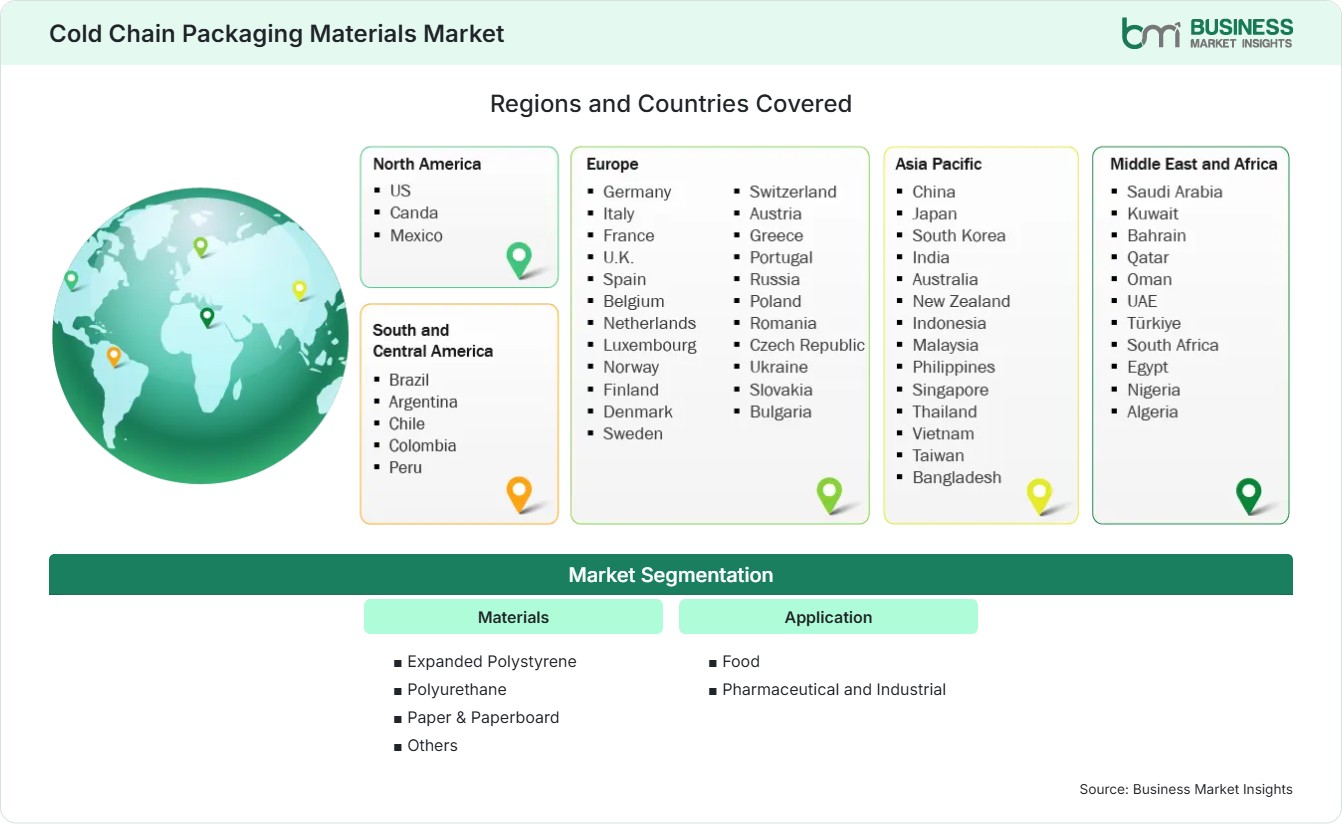
Global Market Geography
FREE PDF
Request your free sample
Request free sample
Segment Analysis

Cold Chain Packaging Materials Market Segmentation

Materials

Materials are an intrinsic value element in this industry, encompassing packaging effectiveness and regulatory compliance. This submarket accounted for around 52%–55% of the market share in 2025 and is estimated to grow at a 7.6%–8.1% CAGR. The scope of the Cold Chain Packaging Materials Market continues to expand because sustainability and thermal efficiency have become simultaneous procurement priorities.

  • Expanded Polystyrene: Widely used due to thermal insulation capability, lightweight structure, cost efficiency, and suitability for food and pharmaceutical transportation requirements.
  • Polyurethane: Preferred for high-performance thermal retention and long-duration shipments requiring stringent temperature maintenance across healthcare and industrial applications.
  • Paper & Paperboard: Adoption accelerates through sustainability commitments, recyclability advantages, and innovation in fiber-based insulated packaging designs.

Application

The key drivers of application demand include healthcare and pharmaceutical logistics, which account for an estimated 45%-48% market share in 2025 and are growing at a CAGR of 8.0%-8.5%. The demands of end-users have become increasingly focused on performance validation, product protection, and environmental sustainability. Cold Chain Packaging Materials Market trends indicate rising demand from regulated industries.

  • Food: Demand is supported by frozen foods, fresh produce, dairy distribution, meal delivery, and expanding refrigerated e-commerce ecosystems.
  • Pharmaceutical: Growth reflects biologics, vaccines, cell therapies, specialty medicines, and regulatory requirements governing temperature-sensitive healthcare products.
  • Industrial: Utilized for specialty chemicals, laboratory materials, and other temperature-sensitive industrial products requiring controlled transport conditions.
Market Forces

Cold Chain Packaging Materials Market Dynamics

Key Market Drivers

Expansion of Biologics and Specialty Pharmaceutical Distribution

Cold chain logistics for biologics, vaccines, and advanced therapies must ensure temperature compliance during shipping. The recommendations issued by WHO and IATA emphasize temperature-compliant logistics solutions, thereby increasing demand for high-performance materials. There has been an expansion of pharmaceutical companies' global reach through international distribution networks, which has led to greater demand for longer shelf lives and thermal stability of products. With increasing investments in production capacity for healthcare products in North America, Europe, and Asia, demand for packaging is rising. Such developments help ensure demand growth for pharmaceutical cold chains.

Growth of Temperature-Sensitive Food Logistics Networks

Due to the rising popularity of frozen products, gourmet seafood, fresh product exports, and online grocery shopping, there has been an increased need for temperature-controlled transport services. There is increasing emphasis on food safety laws that ensure quality from the source through to delivery. There has been investment in protective packaging that extends product shelf life and reduces waste. This is especially required when the supply chain spans larger geographic areas. There has also been a growing need for lightweight materials that balance insulation performance and transportation efficiency. These factors are strengthening adoption across food packaging applications globally.

Sustainability-Focused Packaging Transformation

New corporate sustainability objectives and changes in packaging laws are changing procurement policies. The organization is considering alternative packages, such as those that are recyclable, reusable, and have a lower environmental impact than thermal packages. Research and development activities support the manufacture of fiber insulation material and packaging systems with little waste. Customers are increasingly taking performance across the package life cycle into account when choosing their suppliers. The use of sustainable cold chains has become economically viable due to recycling and reuse programs. With increasing environmental objectives in many industries, material developments continue to grow.

Key Market Opportunities

Commercialization of Reusable Thermal Packaging Platforms

Reusable packaging solutions can be appealing for benefits such as waste prevention, reduced costs, and improved sustainability outcomes. Recovery-based solutions have been gaining popularity among pharmaceutical distribution companies because they can support numerous shipments. Technological developments improve the performance and durability of solutions, making them economically beneficial for customers. The global healthcare supply chain offers substantial opportunities for fleet-based reusable packaging solutions. The Cold Chain Packaging Materials Market forecasts indicate growing customer demand for compliant, sustainable, and cost-optimized solutions.

Fiber-Based Insulation Innovation and Circular Packaging

The increasing constraints on plastic waste and emissions have created an environment that promotes investment in paper-based thermal packaging. Scientific developments are increasing the efficiency of the insulation process while preserving the properties needed for recycling. Increasingly, end-users demand packaging solutions that meet their needs in line with sustainability reporting. Food and healthcare companies have begun exploring the possibilities of using fiber-based solutions as substitutes for existing ones in certain applications. The areas of commercialization will span developed and developing nations, where environmental policies influence purchasing decisions.

Digital Cold Chain Visibility Solutions

Integration of sensors, data loggers, and connectivity monitoring technologies opens up possibilities for developing additional-value packaging solutions. Real-time transparency enhances compliance, decreases product loss, and allows predictive logistics management. Temperature assurance documentation becomes increasingly important for pharmaceutical clients throughout the transportation process. Packaging companies that offer monitoring options can gain a competitive advantage and position their products in the premium segment. The development of digitalization programs in logistics chains can facilitate usage. A combination of thermal protection and shipment monitoring is expected to bring new sources of income.

Market Restraints and Challenges

High Cost of Advanced Thermal Packaging Systems

Factor: Premium insulation materials, validation requirements, and reusable-system infrastructure increase capital and operating costs. Impact: Smaller distributors and regional manufacturers may delay adoption despite performance advantages. Cost sensitivity remains particularly relevant in emerging markets and lower-value product categories. Qualification testing, reverse logistics, and regulatory documentation add further expenses. Organizations frequently evaluate total ownership costs before transitioning from conventional packaging solutions. While premium systems reduce product loss risks, price considerations can constrain penetration rates and limit deployment across certain end-use segments.

Material Recovery and Reverse Logistics Complexity

Factor: Reusable and sustainability-focused packaging programs depend on effective collection, recovery, and processing infrastructure. Impact: Operational complexity can diminish expected environmental and economic benefits. International supply chains often face uneven infrastructure availability, creating implementation challenges. Product returns, tracking requirements, and cleaning procedures increase management burdens. Organizations must coordinate multiple stakeholders across logistics networks to maintain performance and compliance standards. These challenges may slow adoption rates, particularly in geographically fragmented markets where reverse-logistics capabilities remain underdeveloped.

Company Analysis

Competitive Landscape

Cold Chain Packaging Materials Market analysis indicates competition is centered on thermal performance, sustainability, qualification capability, reusable systems, and pharmaceutical logistics expertise.

Company Name

Overview

Products and Services relevant to this market

Sonoco Products Company

Global packaging leader with strong presence in temperature-assured healthcare logistics solutions.

Insulated containers, reusable shippers, thermal packaging systems, pharmaceutical distribution solutions.

Cold Chain Technologies, LLC

Specialized provider focused on temperature-controlled shipping for healthcare products.

Thermal packaging, phase-change systems, parcel shippers, validation services.

Sealed Air Corporation

Packaging company emphasizing protection, efficiency, and temperature-sensitive logistics.

Insulated packaging materials, thermal liners, sustainable protection solutions.

Cryopak Industries Inc.

Developer of cold-chain packaging and temperature-monitoring technologies.

Gel packs, insulated shippers, monitoring devices, thermal packaging systems.

CSafe Global, LLC

Healthcare-focused provider serving pharmaceutical transport applications globally.

Active and passive containers, parcel shippers, cold-chain services.

TemperPack Technologies, Inc.

Innovator in sustainable thermal packaging materials and insulation systems.

Fiber-based insulation, recyclable shipping solutions, cold-chain packaging.

Pelican BioThermal LLC

Specialist in reusable and single-use temperature-controlled packaging.

Reusable containers, thermal shippers, healthcare transport solutions.

Softbox Systems Ltd

Provides temperature-control packaging for pharmaceutical distribution.

Passive thermal containers, parcel shippers, packaging engineering services.

AP Moller-Maersk (Maersk Container Industry)

Logistics and container specialist supporting cold-chain transportation.

Refrigerated transport technologies, temperature-controlled logistics systems.

Envirotainer AB

Global provider of temperature-controlled air freight solutions.

Active containers, pharmaceutical logistics solutions, monitoring services.

Trust & Transparency

Research Methodology

The market analysis combines proprietary research with secondary data from government agencies, company disclosures, regulatory filings, industry databases and expert interviews. Market estimates are validated through data triangulation, cross-market benchmarking and analyst review.

View Full Research Methodology

Questions Answered

Frequently Asked Questions

What insights does a Cold Chain Packaging Materials Market Report provide?

It evaluates market size, competitive positioning, regional demand patterns, technology developments, regulatory influences, growth opportunities, and strategic risks affecting industry participants.

How is sustainability influencing material selection?

End users increasingly prefer recyclable, reusable, and lower-impact insulation solutions. This is accelerating adoption of paper-based thermal packaging and circular business models.

Which region offers the highest growth potential?

Asia Pacific presents the strongest growth outlook, supported by healthcare investments, pharmaceutical manufacturing expansion, improving logistics infrastructure, and growing consumption of refrigerated products.

Which application segment leads industry revenue?

The pharmaceutical segment leads due to stringent temperature requirements, increasing biologics production, and growing international distribution of sensitive healthcare products.

What is driving demand for cold-chain packaging materials?

Demand is primarily driven by biologics, vaccines, frozen foods, fresh produce distribution, regulatory compliance requirements, and the expansion of temperature-controlled logistics networks worldwide.

Access the Full Cold Chain Packaging Materials Market Report

Get segment-level forecasts, regional estimates, competitive benchmarking, company profiles and downloadable Excel datasets.

Access the full Cold Chain Packaging Materials Market Report
350 pages PDF & Excel | 2026-08-31
Similar Research

Related Market Reports