
Chip Resistor Market Outlook: Size, Share, Trends, Growth Analysis, Competitive Landscape & Forecast, 2026-2033

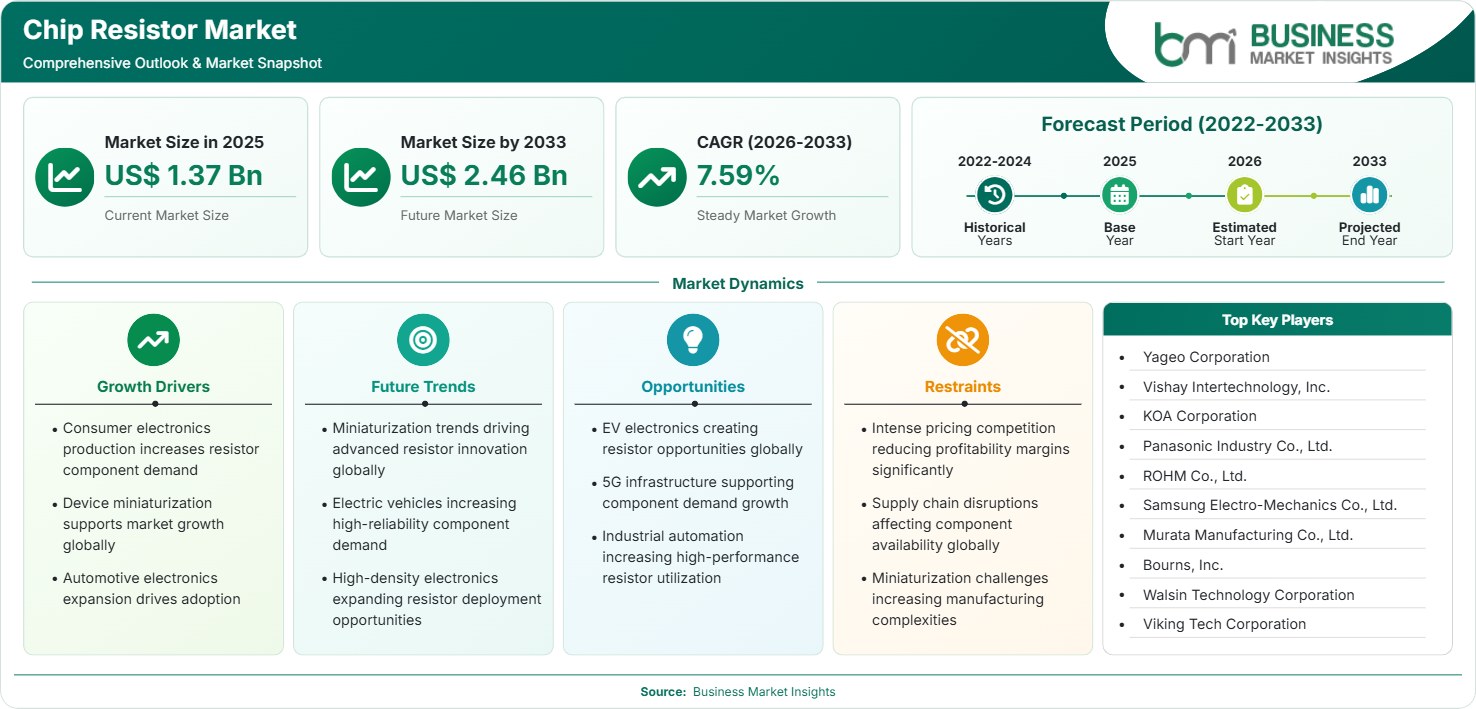
The Chip Resistor Market size was valued at US$ 1.37 Billion in 2025 and is projected to reach US$ 2.46 Billion by 2033, growing at a CAGR of 7.59% during 2026–2033. Rising electronics miniaturization, accelerating electric vehicle adoption, expanding 5G infrastructure, industrial automation investments, and growing demand for high-performance circuit protection solutions are creating strong opportunities across multiple end-use industries.

Report Coverage
  • Type: Thick Chip Resistor, Thin Chip Resistor, Current-sensing Resistor, General Purpose Chip Resistor
  • Application: Consumer Electronics, Industrial, Automotive & Transportation, Medical, Telecommunication, Aerospace & Defense
  • Shape: Square, Rectangular
US$ 1.37 Bn Market size in 2025
US$ 2.46 Bn Market Size by 2033
7.59% CAGR, 2026 - 2033
2026-2033 Forecast Period

AI Overview

Chip Resistor Market Summary

  • North America Region: North America holds a market share of 24%–27% in 2025, growing with a CAGR of 6.5%–7.2% during 2026–2033, supported by semiconductor manufacturing investments, automotive electronics adoption, defense modernization programs, and advanced industrial automation deployments. The U.S. benefits from expanding domestic semiconductor investments and advanced vehicle electronics demand, supporting a CAGR of 6.8%–7.4%.
  • Fastest Growing Region: Asia Pacific accounts for a 39%–43% share in 2025 and expands at a CAGR of 8.4%–9.2% during 2026–2033, driven by electronics manufacturing concentration, electric vehicle production growth, telecommunications infrastructure expansion, and increasing semiconductor ecosystem investments across regional economies.
  • Leading Segment: General-purpose chip resistors command a 40%–45% share in 2025 and advance at a 7.0%–7.8% CAGR, supported by broad integration across consumer devices, industrial controls, communication equipment, automotive electronics, and cost-efficient circuit design requirements.
  • High Growth Segment: Automotive & Transportation represents 20%–24% Chip Resistor Market share in 2025 and records 8.8%–9.6% CAGR, supported by vehicle electrification, advanced driver assistance systems, battery management modules, autonomous technologies, and increasing electronic content per vehicle.
  • Key Market Opportunity: Growing electrification across transportation, energy, and industrial sectors is increasing demand for precision passive components, creating opportunities for advanced current-sensing products, localized manufacturing expansion, and supply-chain diversification strategies.
  • Major Market Players: Yageo Corporation, Vishay Intertechnology, Inc., KOA Corporation, Panasonic Industry Co., Ltd., ROHM Co., Ltd., Samsung Electro-Mechanics Co., Ltd., Murata Manufacturing Co., Ltd., Bourns, Inc., Walsin Technology Corporation, Viking Tech Corporation.
Strategic Insights

Chip Resistor Market: Strategic Insights

Chip Resistor Market Strategic Framework
FREE PDF
Request your free sample
Request free sample
Stakeholder View

Key Takeaways

  • The industry value chain is increasingly integrated with semiconductor manufacturing, printed circuit board production, contract electronics manufacturing services, and automotive supply ecosystems, creating greater emphasis on secure sourcing and inventory management.
  • Automotive electrification and advanced industrial automation applications present the most attractive long-term revenue opportunities due to increasing electronic system complexity and higher component content requirements per system.
  • Product innovation is shifting toward ultra-miniature designs, high-power-density configurations, precision current-sensing solutions, and enhanced thermal stability technologies supporting next-generation electronic architectures.
  • Asia Pacific continues to offer the strongest investment case because of concentrated electronics manufacturing capacity, expanding EV production, favorable industrial policies, and growing domestic technology consumption.
  • Strategic acquisitions, manufacturing partnerships, and capacity expansion projects are accelerating as suppliers seek improved scale, technological differentiation, and geographic diversification.
  • Supply-chain localization initiatives across critical industries are encouraging investment in regional production capabilities, reducing sourcing risks while improving delivery flexibility for OEM customers.
Geographic Outlook

Chip Resistor Market Regional Highlights

North America Chip Resistor Market

North America represents approximately 24%–27% of global revenue in 2025 and is expected to expand at a CAGR of 6.5%–7.2% between 2026 and 2033. Strong demand originates from aerospace, defense, industrial automation, data center infrastructure, and advanced automotive manufacturing activities. Investments supporting semiconductor self-sufficiency strengthen procurement activity across the region. Chip Resistor Market share remains supported by high-value applications requiring reliability, precision, and compliance with stringent performance standards across mission-critical electronic systems.

  • Defense electronics modernization programs are increasing demand for highly reliable passive components capable of performing within extreme environmental and operational conditions while supporting military communications and radar applications.
  • Industrial automation deployment continues to accelerate across manufacturing facilities, increasing component consumption within motor drives, programmable logic controllers, sensors, and machine monitoring systems.
  • Semiconductor investment initiatives are encouraging localized supply ecosystems and strengthening demand throughout equipment manufacturing chains connected to fabrication facility expansion projects.
  • Electrification trends within transportation sectors support increasing integration of precision circuit management components across battery systems and vehicle control architectures.

US Chip Resistor Market

The United States accounts for approximately 78%–82% of regional revenue and is projected to record a CAGR of 6.8%–7.4% during 2026–2033. Demand remains concentrated within aerospace, defense, telecommunications infrastructure, automotive electronics, and industrial digitalization programs. Major investments in domestic semiconductor capacity strengthen procurement activity across supply chains. Growing deployment of AI-enabled infrastructure and high-performance computing equipment further supports consumption requirements throughout advanced electronic system markets.

  • Data center expansion and AI infrastructure deployment continue increasing requirements for precision electronic components supporting power management and signal integrity functions.
  • Defense procurement modernization supports additional demand from communication systems, surveillance technologies, navigation electronics, and advanced military equipment production.
  • Expanded EV manufacturing investments encourage adoption across battery management systems, onboard charging modules, and advanced vehicle electronics platforms.
  • Telecommunications operators continue network modernization projects supporting broader component demand across connectivity infrastructure deployments.

Europe Chip Resistor Market

Europe captures approximately 22%–25% of global Chip Resistor Market revenue in 2025 and is forecast to grow at a CAGR of 6.8%–7.6% through 2033. Automotive production capacities, use of industrial automation, and energy transition policies drive market growth. The market leader by country is Germany, while production centers in Eastern Europe attract investment inflows. Demand is driven by modern manufacturing approaches, transportation infrastructure developments, and increased demand for electronics in various industries.

  • Germany leads regional demand due to automotive electronics manufacturing strength and extensive industrial digitization programs supporting component integration.
  • Poland and Hungary emerge as faster-growing locations benefiting from electronics manufacturing expansion and investment inflows into regional supply-chain infrastructure.
  • Renewable energy deployment accelerates installations requiring electronic control systems, monitoring technologies, and power management architectures.
  • Industry 4.0 initiatives continue supporting adoption of automation technologies across manufacturing environments and logistics operations.
  • Medical electronics innovation strengthens opportunities for precision and reliability-focused component suppliers throughout healthcare device ecosystems.

Asia Pacific Chip Resistor Market

Asia Pacific accounts for approximately 39%–43% of global revenue in 2025 and is expected to advance at a CAGR of 8.4%–9.2% through 2033. The region remains the manufacturing center for consumer electronics, telecommunications equipment, and semiconductor production. China leads overall demand while India records among the strongest expansion rates. Chip Resistor Market growth is further reinforced by EV production growth, digital infrastructure investments, and increasing domestic technology consumption across emerging economies.

  • China maintains leadership through extensive electronics manufacturing capacity and integrated semiconductor supply-chain ecosystems supporting large-scale production activity.
  • India demonstrates strong expansion potential due to electronics manufacturing incentives, digital infrastructure investment, and increasing domestic technology consumption trends.
  • South Korea and Japan remain critical innovation centers focused on advanced electronics, automotive technologies, and semiconductor ecosystem development.
  • Rapid 5G deployment expands demand throughout telecommunications equipment manufacturing and network infrastructure installation projects.
  • Electric vehicle production growth increases utilization across battery systems, sensors, control units, and power management architectures.

Rest of World Chip Resistor Market

The Rest of World region contributes approximately 10%–13% of global revenue in 2025 and is projected to grow at a CAGR of 7.2%–8.0% through 2033. South and Central America benefit from electronics assembly activities and automotive manufacturing investments.

The Middle East and Africa are regions where rising demand is evident in telecommunications development, industrialization, and smart infrastructure programs. Leading opportunities are available in Brazil across Latin America, whereas the UAE is an example of technological growth opportunity through digital transformation investments.

  • Brazil benefits from domestic industrial production, automotive manufacturing activities, and gradual modernization of electronics supply chains across industrial sectors.
  • The United Arab Emirates is emerging as a technology investment hub supported by smart city developments and digital infrastructure initiatives.
  • Telecommunications connectivity projects continue supporting component demand across network expansion and modernization programs.
  • Industrial diversification policies encourage technology adoption and electronic equipment deployment across multiple sectors.
  • Infrastructure modernization initiatives increasingly integrate connected technologies requiring advanced electronic control and monitoring capabilities.
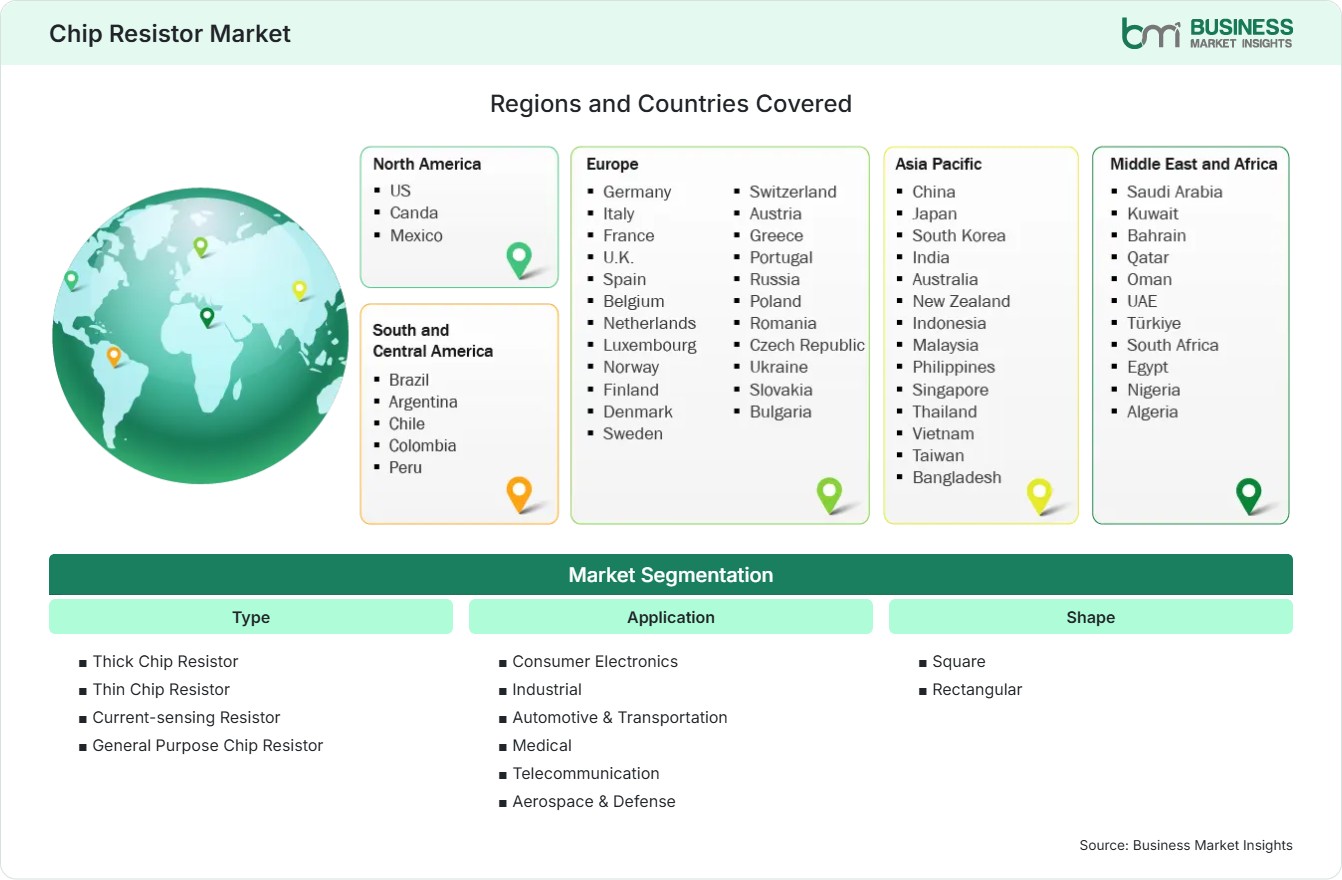
Global Market Geography
FREE PDF
Request your free sample
Request free sample
Segment Analysis

Chip Resistor Market Segmentation

Type

The type segment continues to be significant in product differentiation, and General-purpose chip resistors account for about 40%–45% of the market share in 2025, with an annual growth rate of 7.0%–7.8% by 2033. The demand is driven by increased production of electronics, electric vehicles, and telecommunication networks. The Chip Resistor Market scope has been expanding due to the development of small-size, high-accuracy, and thermally stable resistors for electronic devices.

  • Thick chip Resistor: Widely utilized across consumer electronics and industrial equipment because of cost efficiency, durability, and high production scalability. Adoption remains strong in high-volume applications requiring dependable resistance performance.
  • Thin chip Resistor: Preferred in precision-oriented applications requiring tight resistance tolerance and low temperature coefficients. Growing demand from telecommunications, medical devices, and advanced industrial systems supports continued market expansion.
  • Current-sensing Resistor: Increasingly adopted within battery management systems, power control units, and electric vehicles. Growth is driven by the need for precise current monitoring and improved energy efficiency.
  • General-purpose chip resistors: Represent the broadest application base, serving consumer devices, industrial controls, communication equipment, and automotive electronics while benefiting from standardized manufacturing processes and widespread availability.

Application

This application section is characterized by the increasing use of electronic content in various industries. The consumer electronics industry holds a share of around 30%-34% in 2025, whereas the Automotive & Transportation industry shows the fastest growth rate, with a CAGR of 8.8%-9.6% in 2026-2033. Increased penetration of connected devices, digitization, and vehicle electrification further reinforces market trends in the chip resistor industry.

  • Consumer electronics: Smartphones, tablets, wearables, gaming systems, and smart home devices support sustained demand as manufacturers pursue miniaturization, performance optimization, and energy-efficient designs.
  • Industrial: Automation systems, robotics, sensors, programmable controllers, and process monitoring equipment increasingly require reliable passive components to support operational efficiency and equipment performance.
  • Automotive & Transportation: Electrification, advanced driver assistance systems, infotainment technologies, and battery management solutions are accelerating component integration throughout modern vehicle architectures.
  • Medical: Diagnostic equipment, patient monitoring devices, imaging systems, and portable healthcare technologies create demand for high-reliability products with precise electrical characteristics and operational stability.
  • Telecommunication: Network infrastructure, base stations, routers, signal processing units, and 5G deployment projects contribute significantly to adoption across advanced communication ecosystems.
  • Aerospace & Defense: Mission-critical electronics require high-performance passive components capable of operating reliably under demanding environmental conditions and stringent quality standards.

Shape

The choice of shape affects board usage, the assembly process, and the feasibility of application. Rectangular shapes are preferred, constituting about 68%-72% of the market share by 2025, and are forecast to sustain demand until 2033. New product designs have been evolving to become smaller, easier to mount, and better thermal conductors.

  • Square: Utilized in specialized designs requiring compact layouts and optimized component positioning. Adoption is supported by miniaturized electronic systems and space-constrained assemblies.
  • Rectangular: Most widely used configuration due to compatibility with automated assembly processes, efficient board utilization, and broad applicability across consumer, industrial, telecommunications, and automotive products.
Market Forces

Chip Resistor Market Dynamics

Key Market Drivers

Rising Electronic Content in Electric Vehicles

The transition toward electric and hybrid vehicles is substantially increasing component intensity per vehicle. The current generation of electric cars is equipped with a battery management system, an onboard charger, an infotainment system, a powertrain control system, and many other driver-assist systems, all of which rely on thousands of passive components. The rising trend in electric car adoption, according to data from the International Energy Agency, is increasing demand for automotive electronics. Chip Resistor Market growth will depend greatly on this trend, as proper current management and circuit protection are crucial in any automobile. Due to the higher electronic content in cars, production capabilities are increasing, and automotive-grade solutions are being introduced to meet stringent thermal and operational requirements.

Expansion of Global Industrial Automation

Industrial facilities continue investing in digitalization, robotics, machine vision, predictive maintenance, and smart manufacturing systems. These technologies depend upon sensors, controllers, communication modules, and power management circuits, requiring dependable passive components. Modernization of manufacturing in North America, Europe, and Asia ensures continuous procurement. The growing adoption of the Industry 4.0 framework has facilitated the acceptance of higher-quality components that can operate in challenging industrial conditions. Growing investments in factory automation solutions, together with increased focus on efficiency, have helped ensure growing demand. The complexity of electronics systems is on the rise in manufacturing plants.

Accelerating 5G and Connectivity Infrastructure Investments

Telecommunications operators are rapidly enhancing network capabilities through 5G infrastructure deployment, fiber expansion, edge-computing integration, and data processing investments. Such projects require highly advanced radio transmitters, network devices, routers, and communication modules that incorporate multiple passive electronic components. Chip Resistor Market trends will become even more dependent on connectivity spending because network operations rely on stable signal processing and power regulation systems. Rising data usage, cloud service development, and IoT implementations will continue improving infrastructure needs across the globe. Such suppliers will always have regular demand cycles driven by telecommunications modernization projects.

Key Market Opportunities

Advanced Current-Sensing Solutions for Electrification

Electrification is not limited to the automotive segment; it also has implications for commercial transport, renewable energy applications, industrial machinery, and energy storage infrastructure. Current sensing is crucial for managing efficiency, safety, and power consumption. Suppliers that can provide a reliable solution in terms of precision, thermal stability, and miniaturization will be well-placed to capitalize on the trend. New development efforts are focused on devices designed to operate at higher temperatures and power densities. Electrification across many industries simultaneously presents a significant revenue opportunity for current-sensing applications.

Regional Manufacturing Diversification Initiatives

Government and industry are working to mitigate risks associated with supply chain concentration through increased manufacturing capacity domestically and regionally. The establishment of new manufacturing facilities for electronic, semiconductor, and automotive components in India, Southeast Asia, North America, and Europe has created buying opportunities for component suppliers. Chip Resistor Market Forecasts suggest that diversified manufacturing locations will enable improved resilience, reduced logistics exposure, and better localization of customer needs. Suppliers who can establish a presence near strategic growth areas will be better equipped to improve response times and strengthen customer relationships.

Growth of High-Reliability Medical Electronics

Connected monitoring equipment, diagnostic instruments, imaging solutions, and portable medical devices have become increasingly popular in healthcare infrastructure. All of them need electronic designs with high reliability that maintain accurate performance under continuous operation. Product development is now oriented toward designing specialized product lines that meet the qualifications for medical applications and have a long operational lifespan. The growing number of elderly people, greater availability of healthcare, and increased investment in digital health technologies are all driving demand. Innovation in reliability, miniaturization, and energy efficiency will remain an area of opportunity throughout the medical electronics value chain.

Market Restraints and Challenges

Raw Material Price Volatility

Factor: Price fluctuations in the metal, ceramic, conductive film, and manufacturing materials markets introduce pricing risks for producers. Impact: Companies face a margin squeeze and struggle to maintain competitive pricing without compromising their quality standards. Any supply chain disruptions or increases in commodity prices can affect procurement and inventory management practices. Small suppliers are at a disadvantage because they have less negotiating power when it comes to purchases compared to large manufacturers. Persistent volatility may lead customers to renegotiate contracts or diversify sourcing strategies, affecting revenue predictability and operational performance across parts of the industry.

Intense Pricing Competition Across High-Volume Segments

Factor: Electronics in high demand usually prioritize cost-effectiveness, resulting in intense pricing pressure on existing vendors and local manufacturers. Impact: Pricing competition may lead to low profitability and insufficient financial resources for research and development and capacity expansion. Therefore, while striving to achieve production efficiency, manufacturers need to invest in innovation. Since buyers are looking to reduce costs at purchase, differentiation now depends on reliability, performance, quality assurance, and logistics, rather than on pricing alone. Organizations unable to maintain operational efficiency may face long-term challenges sustaining market position amid intensifying global competition.

Company Analysis

Competitive Landscape

The competitive environment remains moderately consolidated, with leading suppliers focusing on product miniaturization, precision improvements, automotive-grade certifications, and manufacturing scale expansion. Chip Resistor Market analysis indicates that market leaders benefit from extensive distribution networks, vertical integration capabilities, and diverse end-market exposure across consumer electronics, industrial automation, automotive, and telecommunications sectors.

Company Name

Overview

Products and Services relevant to this market

Yageo Corporation

Global passive component manufacturer with extensive production capacity and strong presence across automotive, industrial, and consumer electronics markets.

Thick-film resistors, thin-film resistors, current-sensing resistors, automotive-grade chip resistors, passive component solutions, and circuit protection products.

Vishay Intertechnology, Inc.

Major electronic component supplier serving automotive, industrial, telecommunications, aerospace, and healthcare sectors through diversified product portfolios.

Surface-mount resistors, precision chip resistors, high-power resistors, current-sensing solutions, automotive-qualified resistors, and electronic components.

KOA Corporation

Japan-based manufacturer specializing in precision resistor technologies and advanced passive electronic component development.

Chip resistors, current-sensing products, precision resistors, automotive resistors, thermal management components, and circuit solutions.

Panasonic Industry Co., Ltd.

Leading electronics supplier emphasizing reliability, miniaturization, and advanced component innovation for global OEM customers.

Thick-film resistors, thin-film resistors, automotive components, industrial electronics solutions, and high-performance passive devices.

ROHM Co., Ltd.

Semiconductor and electronic component provider with strong capabilities in automotive, industrial, and power management applications.

Chip resistors, precision resistors, current-sensing devices, automotive-grade products, and integrated electronic component solutions.

Samsung Electro-Mechanics Co., Ltd.

Diversified electronics component manufacturer serving communications, automotive, consumer devices, and industrial sectors worldwide.

Chip resistors, multilayer passive components, electronic modules, high-density components, and advanced circuit solutions.

Murata Manufacturing Co., Ltd.

Global passive component leader recognized for innovation in miniaturized and high-performance electronic devices.

Surface-mount resistors, passive components, communication solutions, automotive electronics products, and industrial electronic components.

Bourns, Inc.

Electronic component supplier with expertise in circuit protection, sensing, and reliability-focused applications.

Chip resistors, current-sense components, protection technologies, power resistors, and industrial electronic solutions.

Walsin Technology Corporation

Major passive component producer with extensive manufacturing capabilities supporting global electronics supply chains.

Thick-film resistors, chip resistors, automotive-grade passive components, telecommunications products, and industrial electronics solutions.

Viking Tech Corporation

Specialist resistor manufacturer focused on precision technologies and advanced electronic application requirements.

Thin-film resistors, current-sensing resistors, precision chip resistors, automotive solutions, and custom resistor technologies.

Trust & Transparency

Research Methodology

The market analysis combines proprietary research with secondary data from government agencies, company disclosures, regulatory filings, industry databases and expert interviews. Market estimates are validated through data triangulation, cross-market benchmarking and analyst review.

View Full Research Methodology

Questions Answered

Frequently Asked Questions

What technological developments are shaping future competition?

Manufacturers are focusing on miniaturization, improved thermal stability, precision current sensing, automotive-grade reliability, and higher power-density designs. These innovations help meet emerging requirements across advanced industrial, automotive, and communication systems.

What does the Chip Resistor Market Report highlight for investors?

The Market Report highlights opportunities linked to vehicle electrification, industrial automation, telecommunications upgrades, regional manufacturing diversification, and next-generation precision resistor technologies serving advanced electronic applications.

Which region is expected to offer the strongest growth opportunities?

Asia Pacific is expected to maintain the strongest expansion due to concentrated electronics manufacturing, growing semiconductor investments, expanding telecommunications infrastructure, and rapid electric vehicle production across major economies including China and India.

How is vehicle electrification influencing market development?

Electric vehicles require significant quantities of passive components for battery management, charging systems, power electronics, safety modules, and advanced driver assistance technologies. This trend increases demand for high-reliability and current-sensing resistor solutions.

What are the primary applications driving industry demand?

Demand is primarily supported by consumer electronics, automotive electronics, industrial automation, telecommunications infrastructure, medical devices, and aerospace systems. Increasing electronic content in connected and electrified products is expanding component utilization across these sectors.

Access the Full Chip Resistor Market Report

Get segment-level forecasts, regional estimates, competitive benchmarking, company profiles and downloadable Excel datasets.

Access the full Chip Resistor Market Report
350 pages PDF & Excel | 2026-11-03
Similar Research

Related Market Reports