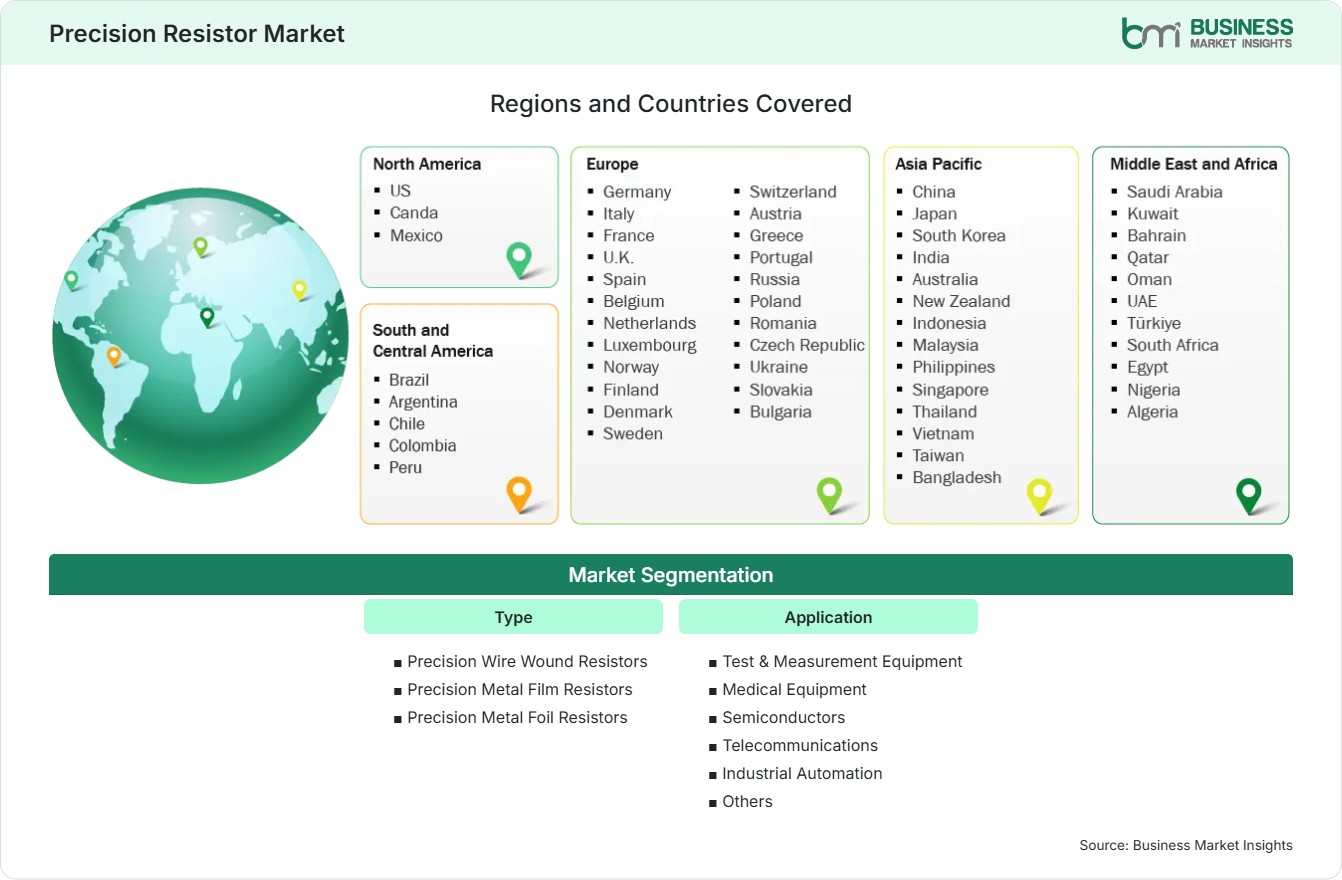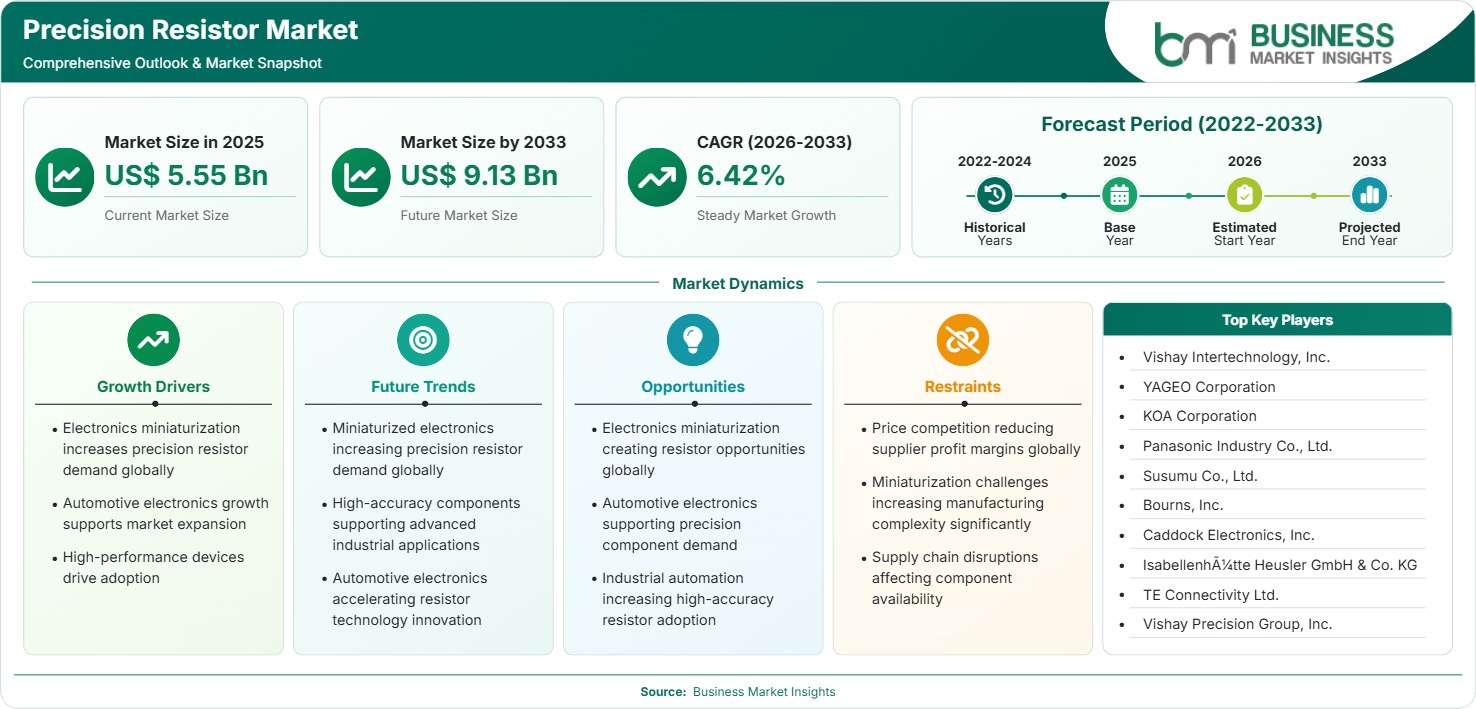
Precision Resistor Market Regional Highlights
North America Precision Resistor Market
North America represents 30%–34% share in 2025 and is projected to grow at 5.8%–6.4% CAGR during 2026–2033. The region benefits from semiconductor equipment, medical technology, aerospace electronics, defense systems, data infrastructure, and industrial automation. The Precision Resistor Market share reflects strong demand for components with documented reliability and tight electrical tolerances.
- Manufacturers of semiconductor equipment are now more frequently requiring the use of precision resistors in measurement, calibration, feedback, protection, and in automated testing systems since thermal stability has a direct impact on measurement repeatability.
- The demand for medical equipment has led to the development of specialized resistor designs for use in monitoring, imaging, diagnostic instrumentation, power management, and signal conditioning, since component drift can have an effect on system accuracy.
- In the aerospace and defense electronics industries, there is a strong emphasis on traceability, environmental stability, ensuring long-term availability, and having complete qualification documentation, with a preference given to suppliers who are able to keep their specifications consistent over the course of long production programs.
- The greater the investment in industrial automation, the higher the demand for precise components in motor controls, programmable systems, robotics, sensors, measurement equipment, and process-control architectures that require reliable resistance characteristics.
US Precision Resistor Market
The US accounts for approximately 70%–74% of North American demand in 2025 and is projected to grow at 5.9%–6.4% CAGR through 2033. The Precision Resistor Market share is supported by engineering-intensive applications where tolerance, temperature coefficient, reliability, and traceability influence component selection.
- Investment in semiconductor manufacturing increases the demand for high-precision components such as those used in wafer testing, process instrumentation, automated test equipment, and power-control assemblies.
- When producing medical technology, manufacturers place a high priority on using components that are extremely stable for use in patient-monitoring equipment, imaging systems, laboratory instruments, diagnostic systems, and compact electronic modules.
- In the field of defense and aerospace, there is a preference for components that are qualified and have electrical characteristics that are predictable, along with a long availability period, resistance to environmental factors, and documented manufacturing controls.
Europe Precision Resistor Market
Europe represents 22%–26% Precision Resistor Market share in 2025 and expands at 5.4%–6.1% CAGR during 2026–2033. Germany leads regional consumption through industrial automation, automotive electronics, instrumentation, and machinery, while France, the United Kingdom, Italy, and the Netherlands maintain important aerospace, medical, telecommunications, and semiconductor-related demand.
- There is a constant demand in Germany for precise resistive components as a result of the country's industrial automation ecosystem, which applies to control systems, factory equipment, measurement platforms, robotics, and industrial power electronics.
- Because of the concentration of semiconductor equipment in the Netherlands, there are opportunities for the production of precision components for use in testing, sensing, instrumentation, process control, and in high-reliability electronic assemblies.
- France and the United Kingdom have a demand in the fields of aerospace, defense, medical electronics, telecommunications, and advanced instrumentation, where the reliability of components usually takes precedence over the consideration of low cost.
- The requirements relating to sustainability and hazardous substances in Europe lead suppliers to keep records of the composition of their materials, ensure that their methods of manufacturing are compliant, and carry out transparent management of the product's entire lifecycle.
Asia Pacific Precision Resistor Market
Asia Pacific holds 40%–44% Precision Resistor Market share in 2025 and records the fastest regional expansion at 7.0%–7.7% CAGR. China, Japan, South Korea, Taiwan, and India form the core demand base through semiconductor production, electronics manufacturing, telecommunications, industrial automation, and automotive electronics.
- China gains from its large-scale production in electronics, industrial automation, telecommunications equipment, electric mobility, and semiconductor investment, which in turn meets both the volume and the ever more sophisticated demand for resistors.
- Japan is still important in the fields of high-precision thin-film technologies, industrial instrumentation, automotive electronics, medical equipment, and advanced manufacturing, particularly because of the high electrical specifications that require premium positioning of components.
- Both South Korea and Taiwan enjoy the advantages of semiconductor and electronics ecosystems, which require precision components for use in test equipment, process control, networking hardware, and high-density electronic assemblies.
- India presents a growing opportunity for expansion since the rise of domestic electronics manufacturing, its semiconductor programs, its telecommunications infrastructure, and its industrial digitization are increasing the demand for precision components that are available locally.
Rest of World Precision Resistor Market
The rest of the world represents approximately 4%–8% Precision Resistor Market share in 2025 and grows at 5.5%–6.3% CAGR through 2033. South and Central America benefit from industrial modernization, telecommunications deployment, medical infrastructure, and electronics distribution.
- The modernization of Brazil's industrial and healthcare sectors enables the production of precision resistors for use in instrumentation, automation, medical electronics, telecommunications, and power-control systems.
- The integration of Mexico into North American manufacturing provides opportunities for suppliers who support the assembly of electronics, industrial equipment, automotive systems, and telecommunications infrastructure.
- The economies of the Gulf are boosting their investment in technology-intensive infrastructure, which in turn creates a demand for reliable components used in energy management, communications, transportation, and industrial automation systems.
- There are developing opportunities in South Africa and other parts of Africa as a result of expanding telecommunications, the digitization of healthcare, industrial modernization, and the development of distributed energy infrastructure.