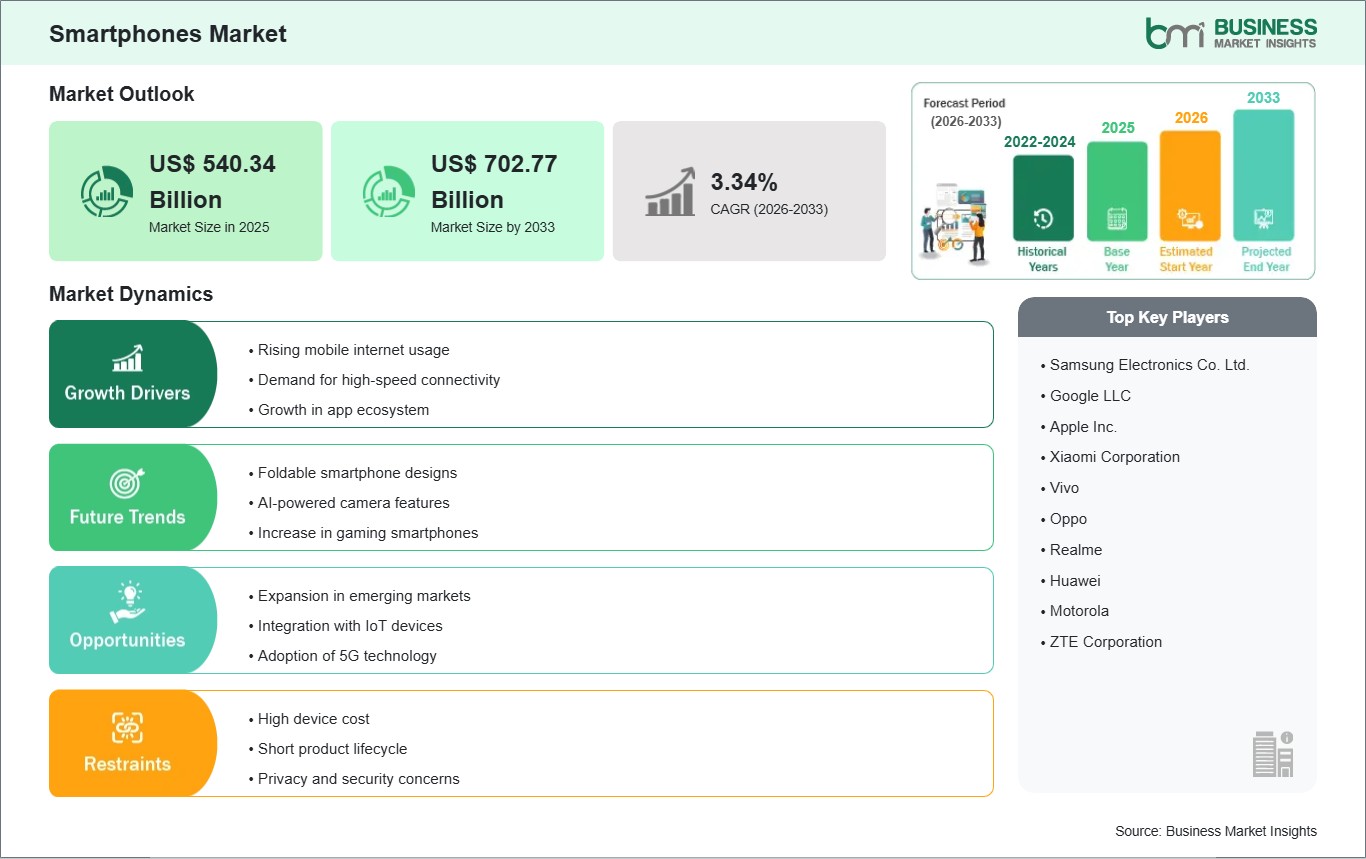
Market Summary
Executive Summary and Global Market Analysis
Smartphones are an important part of the overall communication ecosystem with high-speed connectivity capabilities, high computing power, and the most sought-after functionality in modern-day life. The benefits that smartphones provide include quick access to knowledge, cameras that help in mobile photography, and the ability to conduct professional tasks while on the move. Also, increasing worldwide penetration of the internet and the advent of the 5G network are adding to the growth of the smartphone market. Further, the development in the area of artificial intelligence in smartphones and other technical enhancements is improving the functionality of smartphones.
However, several challenges can restrain market growth, such as high component costs, lengthening replacement cycles in mature markets, and regulatory complexities regarding data privacy. The industry is also sensitive to supply chain disruptions, such as semiconductor shortages and geopolitical tensions. Despite these hurdles, the market holds significant opportunities driven by rising demand for AI-integrated handsets, expansion of digital infrastructure in developing countries, and the increased adoption of smartphones as primary devices for entertainment and gaming. Investment in sustainable manufacturing and refurbished device ecosystems is also expected to open new avenues for market expansion.
Segment Analysis
Smartphones Market Segmentation
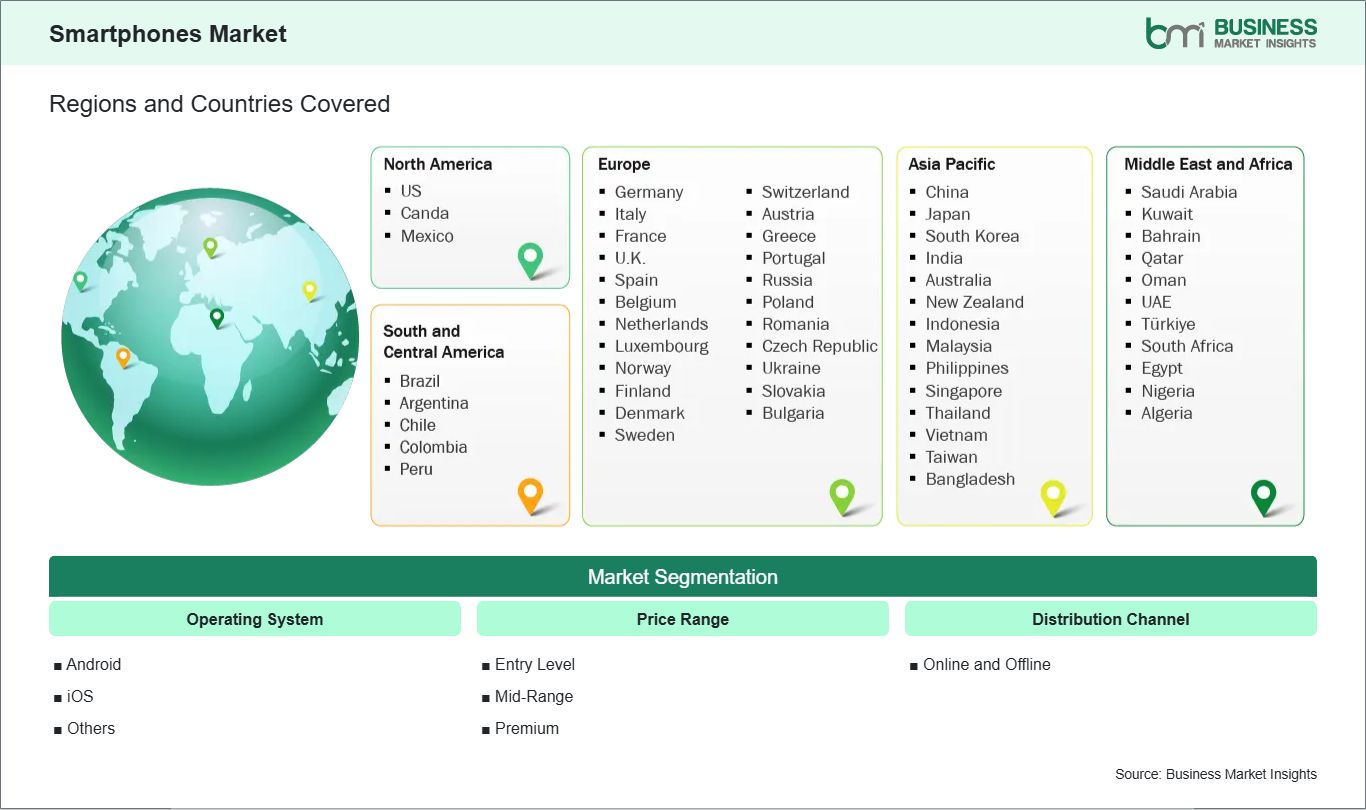
Key segments that contributed to the derivation of the Smartphones market analysis are operating system, price range, and distribution channel.
- By Operating System, the market is segmented into Android, iOS, and Others.
- By Price Range, the market is segmented into Entry Level, Mid-Range, and Premium.
- By Distribution Channel, the market is segmented into Online and Offline.
Market Forces
Smartphones Market Drivers and Opportunities
Integration of On-Device Generative Artificial Intelligence (GenAI)
The rapid integration of Generative AI into mobile chipsets has emerged as a pivotal factor positively driving the smartphones market. With the digitalization of daily tasks and the increasing preference for personalized user experiences, consumers now expect smarter automation, real-time language translation, and advanced computational photography, making on-device AI a critical component of the value proposition.
Major technology giants such as Samsung, Google, and Apple have not only expanded their AI features but have also significantly influenced consumer behavior by demanding high-processing capabilities for "Agentic AI" assistants. Smartphones, known for their ubiquity and personal nature, are uniquely positioned to meet these evolving demands. Unlike previous generations of software, on-device AI enables the movement of sensitive data processing away from the cloud, which is essential for the privacy-conscious premium sector that thrives on secure, real-time fulfillment.
Expansion of Foldable and Multi-Form-Factor Devices
The constant development of display technology has itself become a major opportunity for the smartphones market. As companies improve the resilience of the hinge and decrease the visible creases on the display, the foldables and tri-fold variants of smartphones are shifting away from being niche prototypes and becoming more of a mainstay for businesses to tap the lucrative consumer base seeking the functionality of a tablet computer in a pocketable form factor. In the past few years, advancements in ultra-thin glass and decreased production costs have brought down the price segments for more foldables entering emerging markets.
High-end and time-critical applications like mobile multitasking, video conferencing, and professional content generation are being performed on these devices because they present higher display real estate. These devices are marketed as symbols of status and productivity, emphasizing the requirement for a reliable high-end hardware ecosystem. In addition, multinational corporations also exhibit diversification trends within their product lines in response to the saturation of markets. This can be attributed to the requirement for novel form factors that can assist with advanced and professional tasks. With industry leaders adjusting to demand-driven manufacturing paradigms and attempting to differentiate themselves within the saturated markets, the requirement for foldable and flexible display smartphone devices is also likely to increase annually by double-digit figures because Apple has reportedly planned its foray into this segment.
Size and Share Analysis
Smartphones Market Size and Share Analysis
The smartphones market demonstrates steady growth, with size and share analysis revealing evolving trends and competitive positioning among key players. The report further examines subsegments categorized within operating system, price range, and distribution channel, offering insights into their contribution to overall market performance.
For instance, Android operating system devices are typically used for a wide range of consumer needs and are widely utilized across various price tiers due to their accessibility and diverse hardware options. Premium smartphones involve devices priced above US$ 600 and play a vital role in supporting brand loyalty and technological leadership. This segment benefits from increasing "premiumization" trends and the rising demand for sophisticated camera systems and AI features. Online distribution channels utilize e-commerce platforms and digital storefronts for selling devices and have seen a surge in share due to the convenience of home delivery, competitive pricing, and festive season sales.
Report Coverage
Smartphones Market Report Coverage and Deliverables
The "Smartphones Market Size and Forecast (2022 - 2033)" report provides a detailed analysis of the market covering below areas:
- Smartphones market size and forecast at global, regional, and country levels for all the key market segments covered under the scope
- Smartphones market trends, as well as market dynamics such as drivers, restraints, and key opportunities
- Smartphones market analysis covering key market trends, global and regional framework, major players, regulations, and recent market developments
- Industry landscape and competition analysis covering market concentration, heat map analysis, prominent players, and recent developments for the Smartphones market
- Detailed company profiles, including SWOT analysis
Geographic Insights
Smartphones Market Geographic Insights
The geographical scope of the Smartphones market report is divided into five regions: North America, Asia Pacific, Europe, Middle East & Africa, and South & Central America.
The Asia-Pacific Smartphones market is segmented into China, Japan, South Korea, India, Australia, New Zealand, Indonesia, Malaysia, the Philippines, Singapore, Thailand, Vietnam, Taiwan, Bangladesh, and the Rest of Asia. The Asia-Pacific smartphone market is experiencing robust growth, driven by the rapid expansion of 5G infrastructure, growing disposable income, and the rising demand for high-spec budget devices. Major economies like China and India are leading the way, fueled by massive local manufacturing, strategic government investments, and the development of large retail ecosystems.
The region is also witnessing increased adoption of advanced mobile technologies, including high-refresh-rate displays, fast-charging systems, and AI-integrated camera software, particularly relevant for the massive mobile gaming and social media sectors. Smartphone capacity expansion, alongside brand diversification efforts by regional players, is enhancing market penetration and reducing replacement cycles. Additionally, the surge in digital payment adoption and the mobile-first services is positioning Asia-Pacific as the primary hub in the global mobile technology ecosystem.
Industry Activity
Recent Developments
The Smartphones market is evaluated by gathering qualitative and quantitative data post primary and secondary research, which includes important corporate publications, association data, and databases. A few of the key developments in the smartphones market are:
- In December 2025, Samsung Electronics announced the launch of Galaxy Z TriFold, further expanding Samsung’s leadership in new form factors for the mobile AI era. Built on a decade of foldable category innovation, Galaxy Z TriFold showcases engineering mastery with its most advanced foldable technologies optimized for the unique demands of a multi-folding design. Its slim profile ensures the portability of a premium phone that provides ultra performance, and, when unfolded twice, it reveals an immersive 10-inch display1 that elevates productivity and cinematic viewing, offering a best-in-class mobile experience never before seen in any other form factor.
- In September 2025, Apple announced iPhone 17, featuring the new Center Stage front camera that takes selfies to the next level; a powerful 48MP Fusion Main camera with an optical-quality 2x Telephoto; and a new 48MP Fusion Ultra Wide camera that captures expansive scenes and macro photography in more detail. The 6.3-inch Super Retina XDR display with ProMotion is bigger and brighter, enabling supersmooth scrolling, immersive gaming, and improved efficiency. With the new Ceramic Shield 2, the front cover is tougher than any smartphone glass or glass-ceramic, with 3x better scratch resistance than the previous generation and reduced glare. It is all powered by the latest-generation A19 chip for higher performance and longevity.
Trust & Transparency
Research Methodology
The market analysis combines proprietary research with secondary data from government agencies, company disclosures, regulatory filings, industry databases and expert interviews. Market estimates are validated through data triangulation, cross-market benchmarking and analyst
review.
View Full Research Methodology
Key Sources Referred:
World Bank - Global Trade IndicatorsWorld Trade Organization (WTO)International Monetary Fund (IMF)International Trade Administration (ITA)Company WebsitesCompany Annual ReportsCompany Investor Presentations