Market Summary
Executive Summary and Global Market Analysis
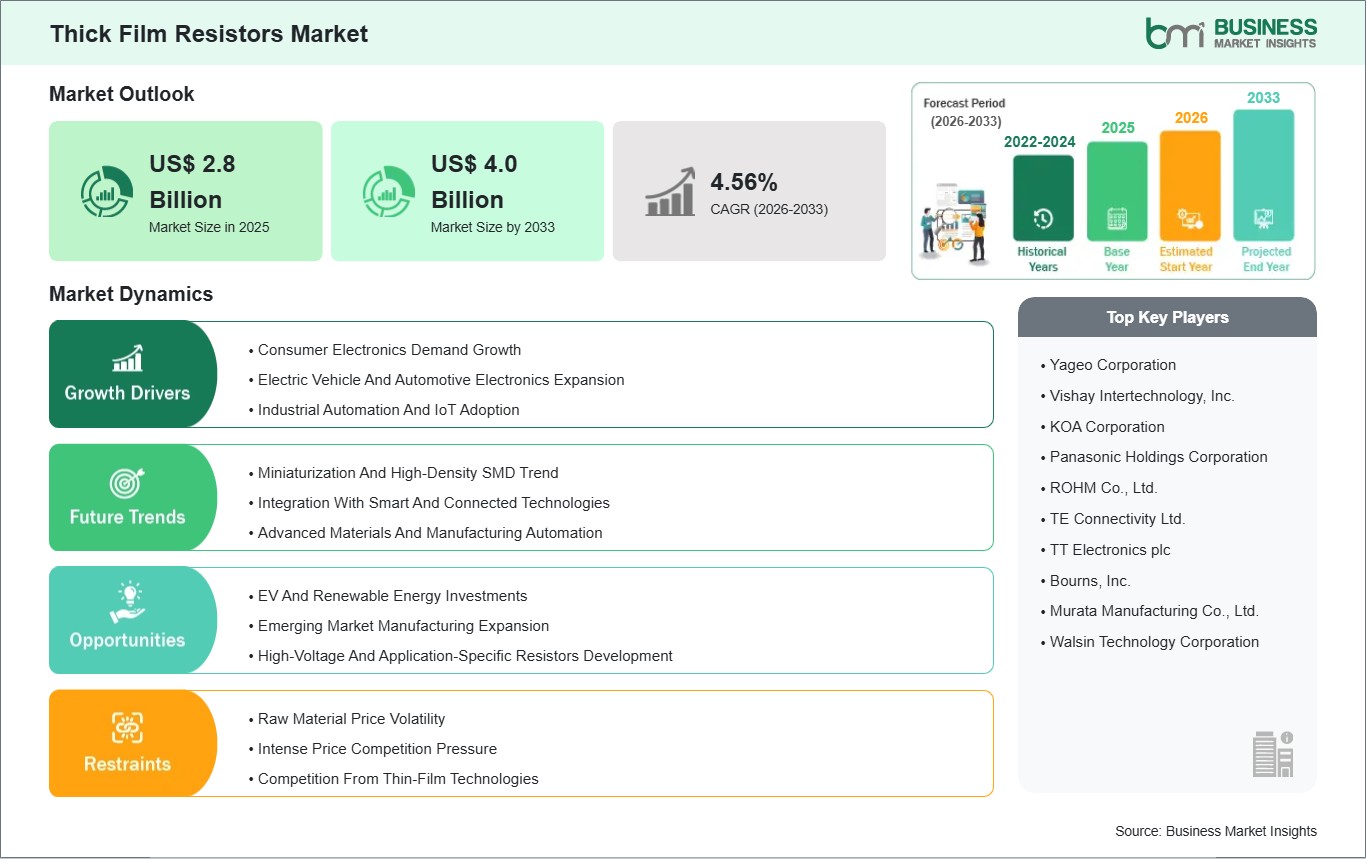
Thick-film resistors are passive electronic components produced by screen-printing a resistive paste, usually a blend of glass and metal oxides such as ruthenium dioxide (RuO₂), onto a ceramic substrate, then firing at high temperatures. This process creates a resistive layer significantly thicker than that of thin-film resistors. Market growth is driven by the rapid expansion of Electric Vehicle (EV) powertrains, the rollout of 5G telecommunications infrastructure, and the ongoing miniaturization of consumer wearables. In addition, the adoption of AEC-Q200 qualified components, which provide the reliability required for automotive safety systems, is raising performance standards across the industry.
However, several challenges can restrain market growth: commodity price volatility, specifically the fluctuating cost of ruthenium and silver used in resistive pastes, can lead to sudden margin compression for manufacturers. Intense price competition from large-scale manufacturers in the Asia-Pacific region has led to the "commoditization" of standard chip resistors, forcing companies to compete on razor-thin margins. Additionally, the industry faces constraints due to technical limitations in high-frequency applications, where the inherent parasitic capacitance of thick-film designs can deter their use in favor of more expensive thin-film or foil alternatives.
Despite these challenges, the market offers significant opportunities due to the global shift toward green energy, where thick-film shunts are vital for solar inverters and battery management systems. Growth is also expected from the expansion of Industrial IoT (IIoT), smart factory upgrades, and the development of lead-free (RoHS-compliant) thick-film chemistries.
Segment Analysis
Thick Film Resistors Market Segmentation
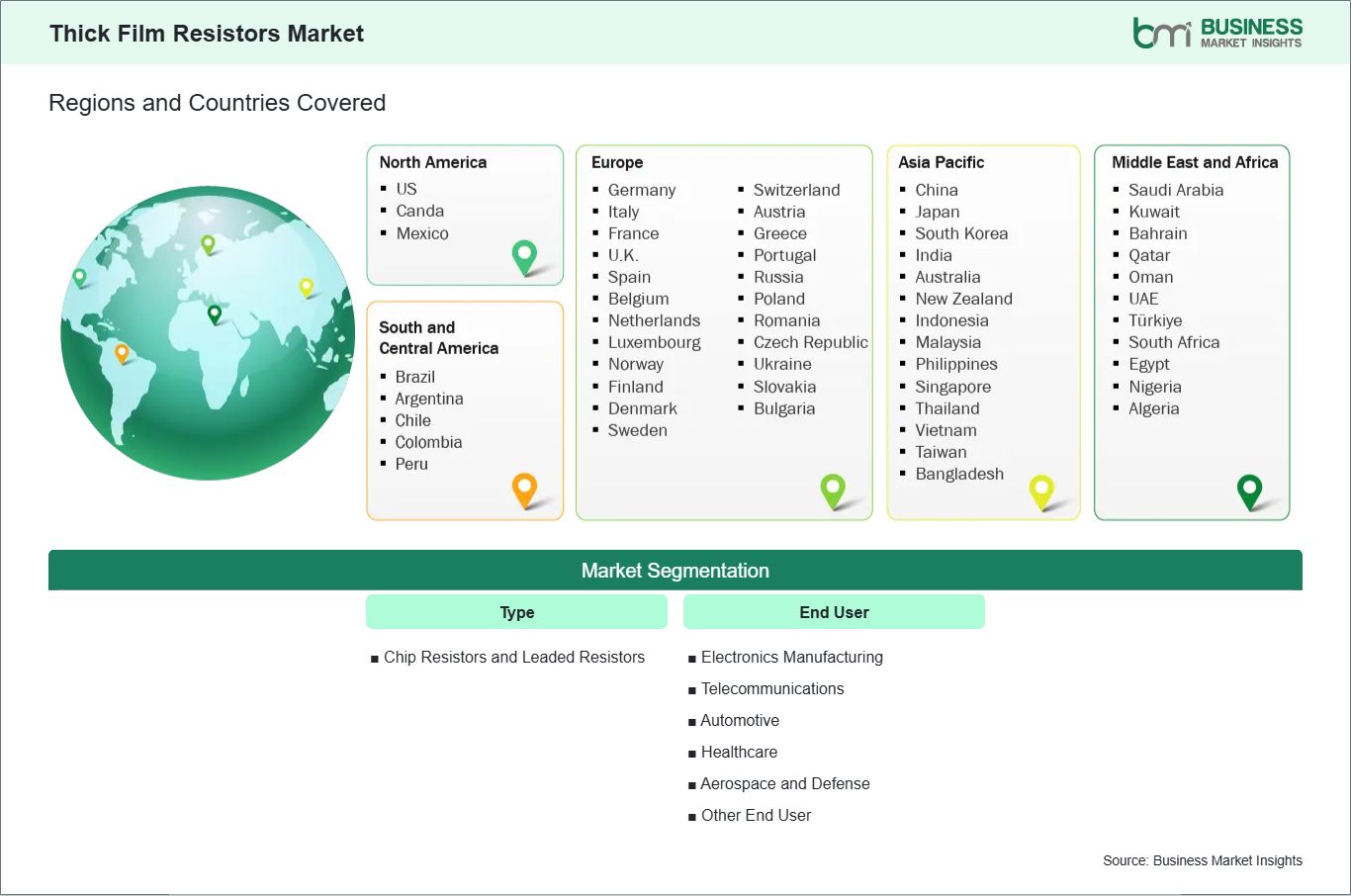
Key segments that contributed to the derivation of the Thick Film Resistors market analysis are type and end user.
- By Type, the market is segmented into Chip Resistors and Leaded Resistors.
- By End User, the market is categorized into Electronics Manufacturing, Telecommunications, Automotive, Healthcare, Aerospace and Defense, andOthers.
Market Forces
Thick Film Resistors Market Drivers and Opportunities
Advancing Automotive Electrification and 5G Infrastructure Deployment
The primary driver for the Thick Film Resistors Market is the accelerating transition toward electric vehicles (EVs) and the global expansion of 5G telecommunications infrastructure. In the automotive sector, the move from internal combustion engines to battery-electric and hybrid powertrains has made thick film resistors non-discretionary for power management. These components are essential in battery management systems (BMS), onboard chargers, and inverters due to their robust ability to handle high power densities and withstand harsh environmental conditions, including extreme temperature fluctuations and mechanical vibrations.
Simultaneously, the deployment of 5G networks is fueling demand for high-reliability resistors in base stations and RF modules, where they are used for signal processing and power distribution. This momentum is further amplified by the relentless miniaturization of consumer electronics, such as smartphones, wearables, and AR/VR headsets, which requires ultra-compact resistor case sizes to pack more functionality into smaller form factors. Together, these cross-industry shifts toward electrification and high-speed connectivity ensure a sustained and high-velocity growth path for thick film technology.
AI-Driven Industrial Automation and Sustainable Material Innovation
A significant high-value opportunity lies in the convergence of Thick Film Resistors with Industry 4.0 and AI-powered industrial automation. As manufacturing plants integrate sophisticated robotics and smart control systems, there is a burgeoning market for high-precision thick film resistors that can manage complex electrical loads and provide stable performance in automated motor drives. There is also a major growth frontier in the development of Environmentally Friendly and Lead-Free Resistor Materials. As global regulatory frameworks like RoHS and REACH tighten, manufacturers who pioneer lead-free glass and ceramic formulations, without sacrificing electrical performance or pulse-withstand capabilities, are positioned to lead the market`s sustainability transition.
Furthermore, the expansion of the Renewable Energy Sector presents a lucrative opportunity for specialized high-voltage resistors designed for solar inverters and wind turbine pitch control systems. Manufacturers who focus on "anti-sulfur" and moisture-resistant coatings for harsh industrial and coastal environments are particularly well-poised to capture the most resilient and high-margin segments of the global electronic component landscape.
Size and Share Analysis
Thick Film Resistors Market Size and Share Analysis
The Thick Film Resistors market demonstrates steady growth, with size and share analysis revealing evolving trends and competitive positioning among key players. The report further examines subsegments categorized within type and end user, offering insights into their contribution to overall market performance.
Based on type, the Chip Resistors subsegment holds the dominant market share. Chip resistors are indispensable for the Electronics Manufacturing and Telecommunications sector, where their compact, leadless design allows for high-speed automated assembly on printed circuit boards (PCBs). A notable trend in 2026 is the surge in the Leaded Resistors subsegment for high-power industrial applications. While leaded variants are declining in consumer electronics, they remain the preferred choice for power supplies and heavy machinery in the Aerospace and Defense sector, where their robust mechanical mounting provides superior resistance to extreme vibrations and thermal cycling.
Report Coverage
Thick Film Resistors Market Report Coverage and Deliverables
The "Thick Film Resistors Market Size and Forecast (2022 - 2033)" report provides a detailed analysis of the market covering below areas:
- Thick Film Resistors market size and forecast at global, regional, and country levels for all the key market segments covered under the scope
- Thick Film Resistors market trends, as well as market dynamics such as drivers, restraints, and key opportunities
- Thick Film Resistors market analysis covering key market trends, global and regional framework, major players, regulations, and recent market developments
- Industry landscape and competition analysis covering market concentration, heat map analysis, prominent players, and recent developments for the Thick Film Resistors market
- Detailed company profiles, including SWOT analysis
Geographic Insights
Thick Film Resistors Market Geographic Insights
The geographical scope of the Thick Film Resistors market report is divided into five regions: North America, Asia Pacific, Europe, Middle East and Africa, and South and Central America.
The Asia-Pacific Thick Film Resistors Market is segmented into China, Japan, South Korea, India, Australia, New Zealand, Indonesia, Malaysia, the Philippines, Singapore, Thailand, Vietnam, Taiwan, Bangladesh, and the Rest of Asia. In 2026, this region is the global growth hotspot, driven by the rapid expansion of electric vehicle (EV) production and 5G infrastructure. China and India lead the regional surge, supported by massive investments in telecommunications and local semiconductor manufacturing. While the region benefits from a dense and integrated supply chain, recent "China Plus One" strategies have spurred a wave of new production capacity in Vietnam and India, as manufacturers seek to diversify their sourcing and mitigate trade risks.
Growth is further bolstered by a significant shift toward ultra-miniaturized surface-mount chip resistors among consumer electronics OEMs. The integration of high-precision printing and AI-driven quality inspection in regional factories, alongside the rising demand for anti-sulfur and high-surge variants for automotive and industrial power stages, solidifies Asia-Pacific as a critical hub for innovation and the future scaling of the Thick Film Resistors industry.
Industry Activity
Recent Developments
The Thick Film Resistors market is evaluated by gathering qualitative and quantitative data post primary and secondary research, which includes important corporate publications, association data, and databases. A few of the key developments in the Thick Film Resistors market are:
- In April 2025, Vishay Intertechnology launched the ISOA200 AEC‑Q200 qualified thick film power resistor with an optional integrated NTC thermistor and thermal interface material. The new resistor series is designed for high power dissipation, robust performance, and reduced board space, making it ideal for automotive, industrial, telecommunications, and aerospace applications. This product launch highlights continued innovation in thick film resistors and is expected to support increased adoption across key end-user segments.
- In November 2025, Bourns, Inc. expanded its Riedon™ High Power Thick Film Resistor line with four new series (PSD220S, PSD227, PSD126, PSD220T-50) offering power ratings from 25 to 200 W and resistance values from 20 mΩ to 100 kΩ. These resistors feature low inductance, excellent pulse handling, and reliable thermal performance, making them ideal for power supplies, motor drives, test equipment, and other demanding applications. The new series supports increased power dissipation and reliability, enhancing options for high-performance electronic designs.
Trust & Transparency
Research Methodology
The market analysis combines proprietary research with secondary data from government agencies, company disclosures, regulatory filings, industry databases and expert interviews. Market estimates are validated through data triangulation, cross-market benchmarking and analyst
review.
View Full Research Methodology
Key Sources Referred:
World Bank - Global Trade Indicators World Trade Organization (WTO) International Monetary Fund (IMF) International Trade Administration (ITA) Company website Company annual reports Company investor presentations