Market Summary
Executive Summary and Global Market Analysis
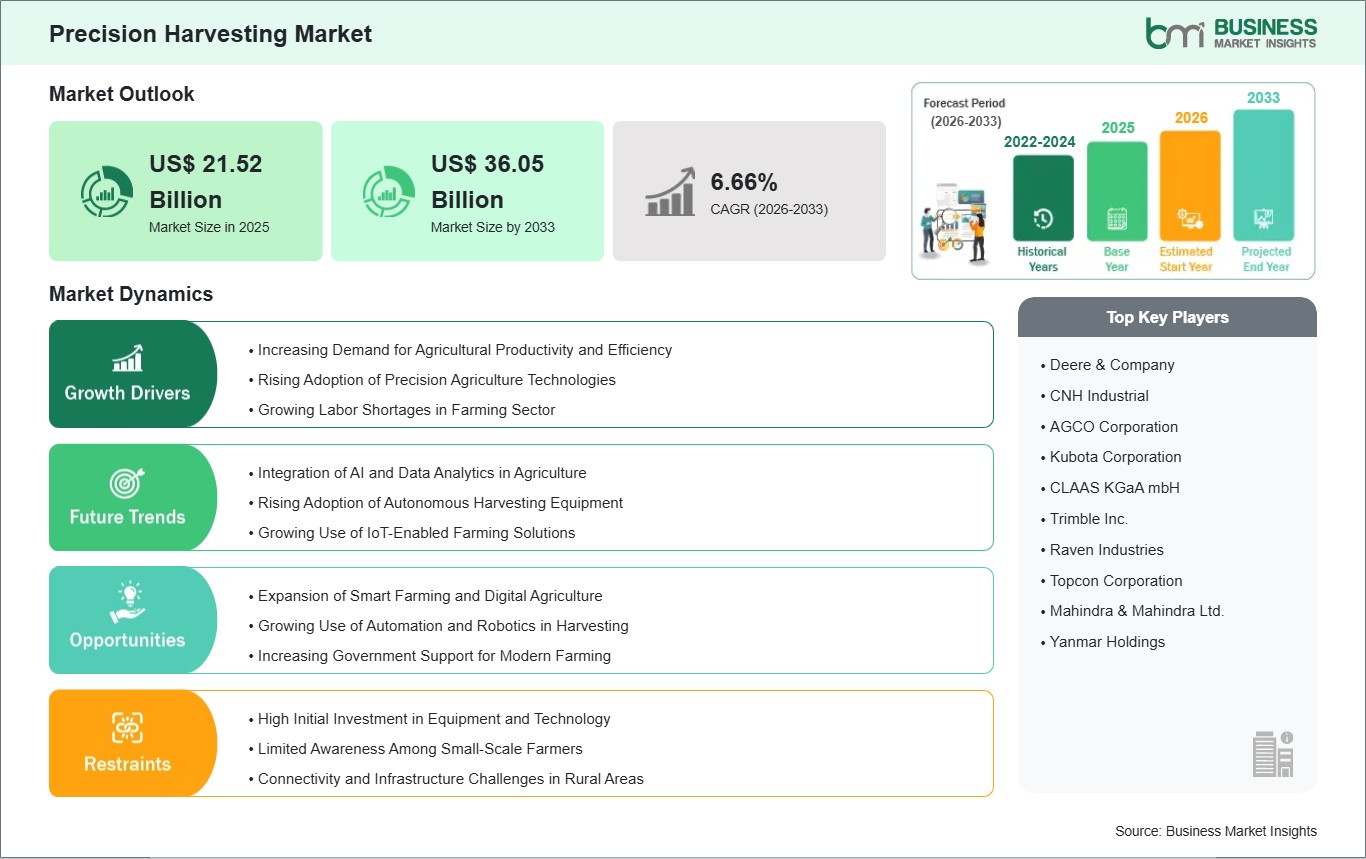
The precision harvesting market is experiencing significant growth driven by increasing demand for efficient and sustainable agricultural practices. Precision harvesting involves the use of advanced technologies such as GPS systems, sensors, automation, and data analytics to optimize harvesting operations. These solutions help improve crop yield, reduce wastage, and enhance overall farm productivity. With rising global food demand and limited arable land, farmers are increasingly adopting precision technologies to maximize output and improve efficiency.
The market is also benefiting from advancements in automation, robotics, and digital agriculture. Technologies such as autonomous harvesters and AI-based systems are transforming traditional farming practices by enabling accurate and efficient harvesting. Additionally, government initiatives supporting smart farming and increasing investments in agricultural technology are driving market growth. As the agriculture sector continues to modernize and adopt digital solutions, the precision harvesting market is expected to witness strong growth during the forecast period.
Segment Analysis
Precision Harvesting Market Segmentation
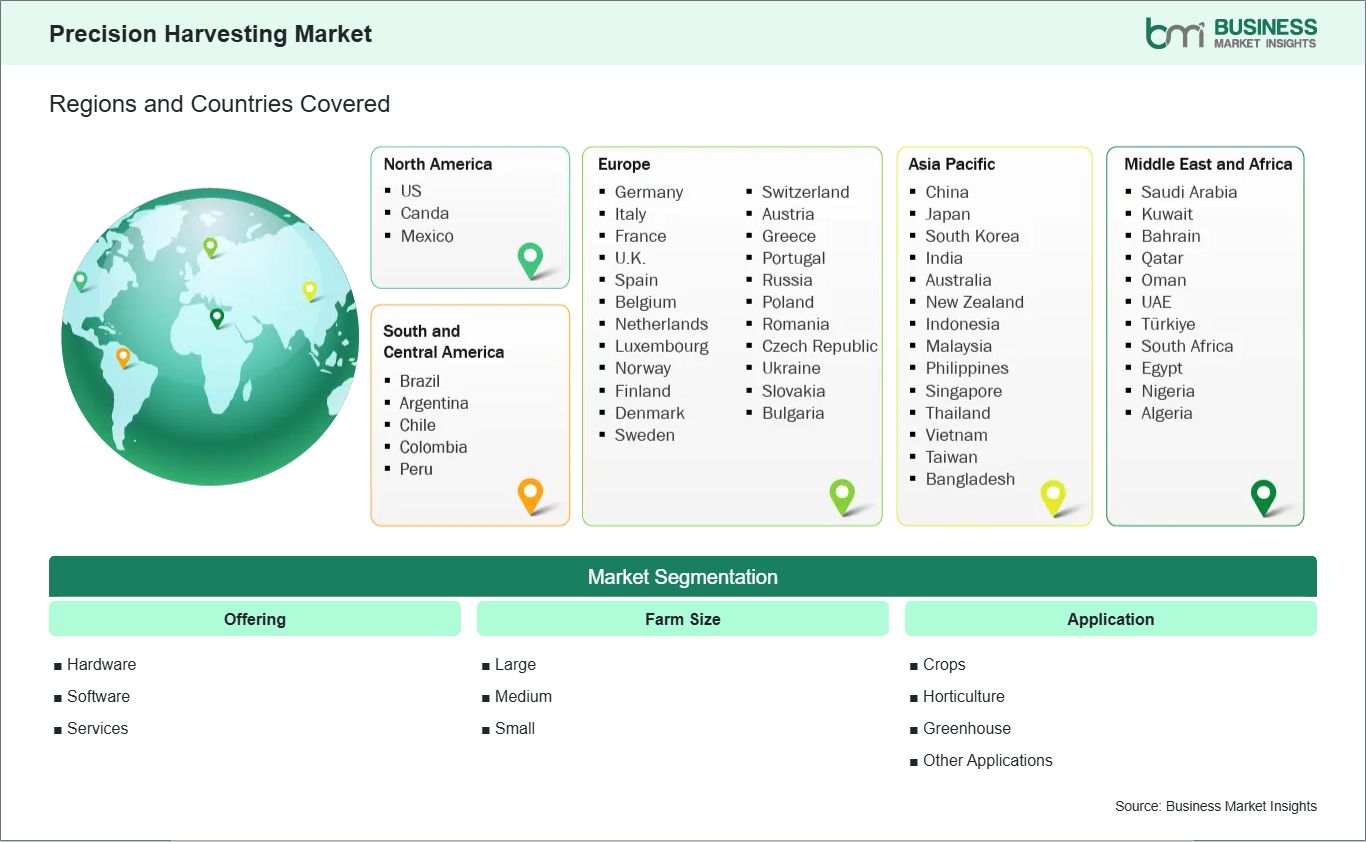
Key segments that contributed to the derivation of the Precision Harvesting market analysis are offering, farm size, and application.
- By offering, the precision harvesting market is segmented into Hardware, Software, and Services. The Hardware segment dominated the market in 2025.
- By farm size, the precision harvesting market is segmented into Large, Medium, and Small. The Large segment dominated the market in 2025.
- By application, the precision harvesting market is segmented into Crops, Horticulture, Greenhouse, and Other Applications. The Crops segment dominated the market in 2025.
Market Forces
Precision Harvesting Market Drivers and Opportunities
Increasing Demand for Agricultural Productivity and Efficiency
The demand for increased productivity and efficiency in the field of agriculture is the major growth factor that is boosting the precision harvesting market. With the rise in the world population, the need of the hour is to increase the productivity of the land that is available for agriculture. Farmers are increasingly adopting advanced harvesting technologies that help them increase crop yield, reducing the overall wastage of the crops, and increasing the efficiency of the operations carried out in the field of agriculture.
Precision harvesting technologies help farmers harvest the crops at the right time, ensuring the maximum quality of the crops obtained. These technologies help the farmers obtain the best results by analyzing the conditions of the crops, determining the right time for harvesting, and reducing the overall dependence on the workforce that is hired by the farmers. With the rise of advanced technologies in the field of agriculture, the demand for precision harvesting is expected to rise in the future, not only in developed countries but also in developing countries.
Growing Use of Automation and Robotics in Harvesting
The increased trend of using automation and robotics in the harvesting of crops creates a great opportunity for the precision harvesting market. Farming activities are adopting various advanced technologies, such as automated harvesters, robotics, and AI technology, for efficient and effective operations, replacing traditional methods of depending on manual labor. This technology has helped in the efficient and speedy harvesting of crops, especially in large-scale farming activities.
Robotics in the harvesting of crops has helped in the identification of crops, selective harvesting, and continuous operation with little or no human intervention. This has helped in efficient productivity, reducing the operational costs associated with manual labor. The development of machine vision and AI technology has made it possible for robotics in the harvesting of crops to become efficient and cost-effective. The integration of automation technology with IoT technology has helped in efficient decision-making in the agriculture sector. The sector has adopted digital transformation, and the trend of adopting automated and robotics technology in the harvesting of crops is expected to rise in the near future.
Size and Share Analysis
Precision Harvesting Market Size and Share Analysis
The global Precision Harvesting market is experiencing steady growth, with market size and share analysis reflecting evolving treatment preferences and competitive dynamics among key players. The report evaluates important subsegments categorized within offering, farm size, and application, highlighting their respective contributions to overall market performance.
By offering, the Hardware subsegment dominated the market in 2025 due to widespread use of automated harvesters, GPS systems, sensors, and machinery required for precision harvesting, enabling improved efficiency, reduced labor dependency, and enhanced yield management across large-scale farming operations globally.
By farm size, the Large subsegment dominated the market in 2025 due to higher investment capacity, greater adoption of advanced harvesting technologies, need for operational efficiency, and ability to implement large-scale automation solutions across extensive agricultural land areas effectively.
By application, the Crops subsegment dominated the market in 2025 due to extensive global cultivation, high demand for staple food production, need for efficient harvesting processes, and increasing adoption of precision technologies to improve productivity, reduce losses, and enhance overall farm output.
Report Coverage
Precision Harvesting Market Report Coverage and Deliverables
The "Precision Harvesting Market Size and Forecast (2022 - 2033)" report provides a detailed analysis of the market covering below areas:
- Precision Harvesting market size and forecast at the regional and country levels for segments covered under the scope
- Precision Harvesting market trends, as well as drivers, restraints, and opportunities
- Precision Harvesting market analysis covering key trends, regional framework, major players, regulations, and recent developments
- Industry landscape and competition analysis covering market concentration, heat map analysis, prominent players, and recent developments for the Precision Harvesting market
- Detailed company profiles, including SWOT analysis
Geographic Insights
Precision Harvesting Market Geographic Insights
The geographical scope of the Precision Harvesting market report is divided into: North America, Asia Pacific, Europe, Middle East & Africa, and South & Central America. North America held the largest share in 2025.
North America dominated the precision harvesting market due to early adoption of advanced agricultural technologies and strong focus on improving farm productivity. The region has large-scale farming operations and high awareness regarding precision agriculture solutions, supporting widespread implementation of harvesting technologies. The United States and Canada are leading in the use of automation, GPS-guided equipment, and data-driven farming practices. Government support, availability of advanced infrastructure, and presence of key market players are further driving adoption. Additionally, labor shortages in agriculture are encouraging farmers to invest in automated harvesting solutions. With continuous technological advancements and strong investment in smart farming, North America is expected to maintain its dominant position in the global precision harvesting market.
Industry Activity
Recent Developments
The Precision Harvesting market is evaluated by gathering qualitative and quantitative data post primary and secondary research, which includes important corporate publications, association data, and databases. A few of the key developments in the Precision Harvesting market are:
- In February 2024, Deere & Company announced one of its largest product launches, introducing next-generation combines and precision harvesting technologies with automation features to improve grain quality, reduce losses, and enhance operational efficiency.
- In October 2025, Deere & Company announced new Harvest Automation solutions including Predictive Ground Speed Automation and Harvest Settings Automation to optimize combine performance using cameras and satellite data for precision harvesting.
- In August 2024, Deere & Company announced continued investment in its Production & Precision Agriculture segment, focusing on advanced harvesting technologies and digital solutions to enhance productivity and precision across farming operations.
Trust & Transparency
Research Methodology
The market analysis combines proprietary research with secondary data from government agencies, company disclosures, regulatory filings, industry databases and expert interviews. Market estimates are validated through data triangulation, cross-market benchmarking and analyst
review.
View Full Research Methodology
Key Sources Referred:
International Electrotechnical Commission Institute of Electrical and Electronics Engineers International Organization for Standardization Bureau of Indian Standards Central Electricity Authority Ministry of Power Indian Electrical and Electronics Manufacturers' Association European Committee for Electrotechnical Standardization VDE Association for Electrical Electronic & Information Technologies Company Websites Company Annual Reports Company Investor Presentations