Market Summary
Executive Summary and Global Market Analysis
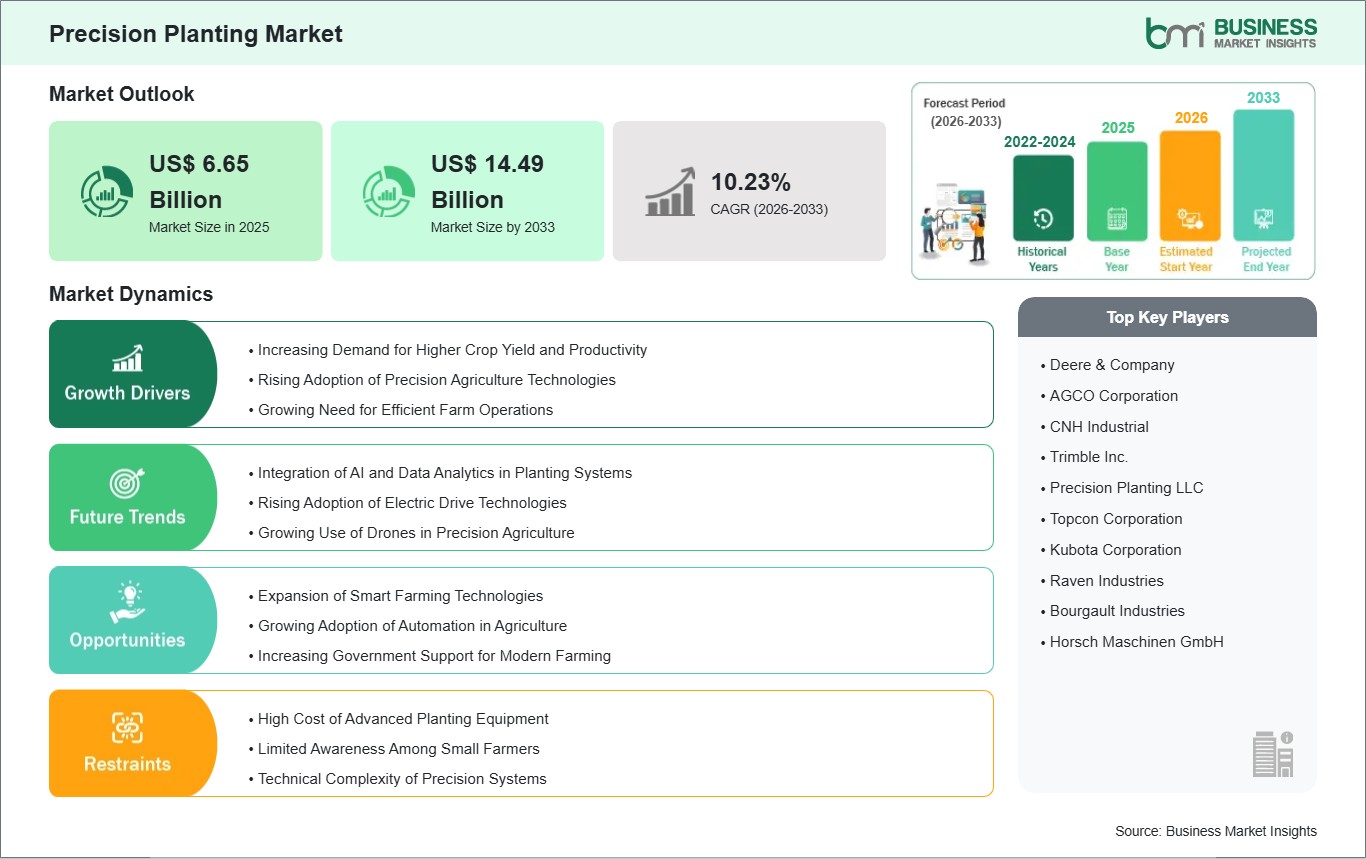
The precision planting market is witnessing strong growth driven by increasing demand for efficient and high-yield agricultural practices. Precision planting involves the use of advanced technologies such as GPS, sensors, automation, and data analytics to optimize planting operations. These systems ensure accurate seed placement, proper spacing, and uniform depth, which are essential for improving crop productivity and reducing resource wastage. With growing pressure on the agriculture sector to meet rising food demand, farmers are increasingly adopting precision planting technologies.
The market is also benefiting from advancements in smart farming and digital agriculture. Technologies such as IoT, artificial intelligence, and automation are enhancing the capabilities of planting systems, enabling real-time monitoring and decision-making. Electric drive systems and high-speed planting equipment are further improving efficiency and accuracy. Additionally, government initiatives supporting modern farming practices and increasing investments in agricultural technology are driving market growth. As the agriculture sector continues to evolve toward sustainability and efficiency, the precision planting market is expected to expand significantly during the forecast period.
Segment Analysis
Precision Planting Market Segmentation
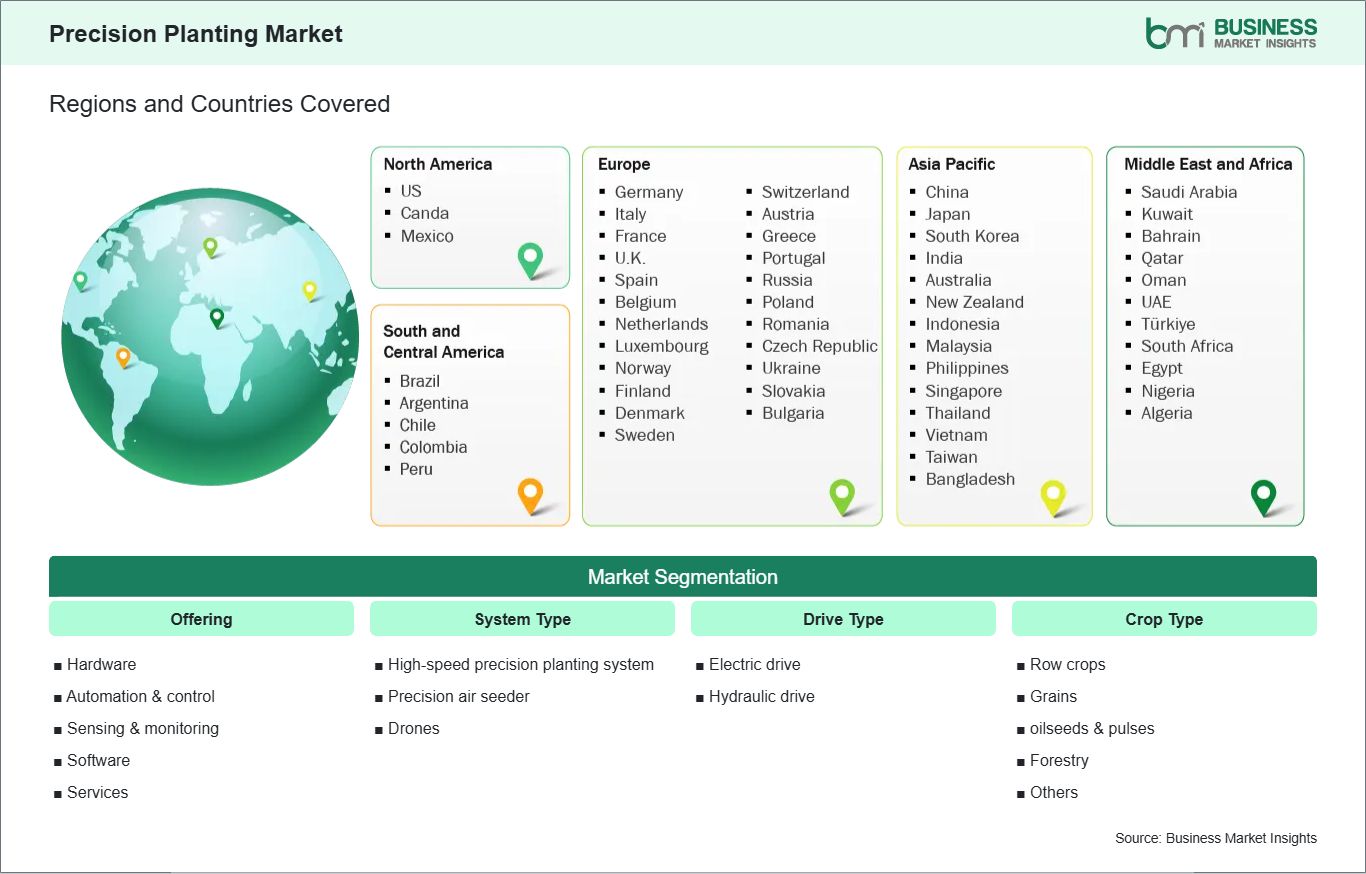
Key segments that contributed to the derivation of the Precision Planting market analysis are offering, system type, drive type, and crop type.
- By offering, the precision planting market is segmented into Hardware, Automation & Control, Sensing & Monitoring, Software, and Services. The Hardware segment dominated the market in 2025.
- By system type, the precision planting market is segmented into High-speed Precision Planting System, Precision Air Seeder, and Drones. The High-speed Precision Planting System segment dominated the market in 2025.
- By drive type, the precision planting market is segmented into Electric Drive and Hydraulic Drive. The Electric Drive segment dominated the market in 2025.
- By crop type, the precision planting market is segmented into Row Crops, Grains, Oilseeds & Pulses, Forestry, and Others. The Row Crops segment dominated the market in 2025.
Market Forces
Precision Planting Market Drivers and Opportunities
Increasing Demand for Higher Crop Yield and Productivity
The growing need to improve crop yield and productivity is one of the major drivers of the precision planting market. The growing global population and food demand are key factors contributing to the need to improve crop productivity from the available agricultural land. Precision planting technologies play a significant role in improving crop performance and yield by ensuring precise seed placement, spacing, and depth. These are important factors in improving crop performance and yield. The technologies used in precision planting help improve seed utilization by reducing wastage.
The advanced technologies used in planting, such as sensors, automation, and GPS, help improve crop performance by monitoring the conditions of the fields and improving efficiency in the planting process. The technologies used in precision planting improve efficiency by reducing the cost of input used in agriculture. The growing need to improve efficiency in agriculture by adopting data-driven technologies will improve the demand for precision planting technologies.
Expansion of Smart Farming Technologies
The growth of smart farming technologies has created tremendous opportunities for the precision planting market. Smart farming is an innovative concept that utilizes advanced technologies, including IoT, automation, and data analytics, to improve the efficiency of the farming process. Precision planting is an important aspect of smart farming, as it helps improve the decision-making process by utilizing data analytics. Advanced technologies, including connected technologies, real-time monitoring, and AI-based analytics, are transforming the traditional farming process. Farmers are now using these technologies to improve the efficiency of the planting process by analyzing the soil, weather, and crop conditions before making the final decision.
In addition, the introduction of drones and automated machinery is transforming the traditional farming process, reducing the dependency on laborers. The governments of various countries, as well as the agriculture ministries, are promoting smart farming, encouraging the implementation of advanced technologies in the agriculture sector. The growth of digital transformation in the agriculture industry is expected to create tremendous opportunities for the precision planting market.
Size and Share Analysis
Precision Planting Market Size and Share Analysis
The global Precision Planting market is experiencing steady growth, with market size and share analysis reflecting evolving treatment preferences and competitive dynamics among key players. The report evaluates important subsegments categorized within offering, system type, drive type, and crop type, highlighting their respective contributions to overall market performance.
By offering, the Hardware subsegment dominated the market in 2025 due to widespread use of advanced planting equipment, seed meters, and machinery essential for precision planting operations, enabling accurate seed placement, improved spacing, and enhanced crop yield across large-scale farming environments globally.
By system type, the High-speed Precision Planting System subsegment dominated the market in 2025 due to its ability to maintain planting accuracy at higher speeds, improving operational efficiency, reducing planting time, and enabling farmers to cover larger field areas within limited planting windows.
By drive type, the Electric Drive subsegment dominated the market in 2025 due to superior precision, better control over seed placement, reduced maintenance requirements, and compatibility with advanced automation systems, enabling improved planting efficiency and accuracy compared to traditional hydraulic systems.
By crop type, the Row Crops subsegment dominated the market in 2025 due to extensive cultivation of crops such as corn and soybeans, high adoption of precision planting technologies, and need for accurate seed placement to maximize yield and improve overall farm productivity.
Report Coverage
Precision Planting Market Report Coverage and Deliverables
The "Precision Planting Market Size and Forecast (2022 - 2033)" report provides a detailed analysis of the market covering below areas:
- Precision Planting market size and forecast at the regional and country levels for segments covered under the scope
- Precision Planting market trends, as well as drivers, restraints, and opportunities
- Precision Planting market analysis covering key trends, regional framework, major players, regulations, and recent developments
- Industry landscape and competition analysis covering market concentration, heat map analysis, prominent players, and recent developments for the Precision Planting market
- Detailed company profiles, including SWOT analysis
Geographic Insights
Precision Planting Market Geographic Insights
The geographical scope of the Precision Planting market report is divided into: North America, Asia Pacific, Europe, Middle East & Africa, and South & Central America. North America held the largest share in 2025.
North America accounted for the highest share of the global precision planting market due to the early adoption of advanced agricultural technologies. The region has a strong emphasis on improving agricultural productivity. The region boasts large-scale farming operations and a high level of awareness of precision agriculture solutions. The United States and Canada are leading in the adoption of GPS-guidance technology, automation, and data-driven farming practices.
The government provides incentives to the agricultural sector, and the region offers advanced infrastructure and major agricultural equipment manufacturers. In addition, the region faces a labor shortage in agriculture, leading to the adoption of automation technologies for planting purposes. Therefore, with continuous technological developments and smart farming, the region will maintain its dominant position in the global precision planting market.
Industry Activity
Recent Developments
The Precision Planting market is evaluated by gathering qualitative and quantitative data post primary and secondary research, which includes important corporate publications, association data, and databases. A few of the key developments in the Precision Planting market are:
- In January 2024, Precision Planting announced that it launched the CornerStone planting system, a fully custom factory-built solution integrating mechanical and digital technologies to optimize planting performance and improve field efficiency.
- In April 2024, AGCO Corporation announced the launch of the PTx precision agriculture portfolio, combining Precision Planting and PTx Trimble technologies to deliver integrated, mixed-fleet precision planting and farming solutions globally.
Trust & Transparency
Research Methodology
The market analysis combines proprietary research with secondary data from government agencies, company disclosures, regulatory filings, industry databases and expert interviews. Market estimates are validated through data triangulation, cross-market benchmarking and analyst
review.
View Full Research Methodology
Key Sources Referred:
International Electrotechnical Commission Institute of Electrical and Electronics Engineers International Organization for Standardization Bureau of Indian Standards Central Electricity Authority Ministry of Power Indian Electrical and Electronics Manufacturers' Association European Committee for Electrotechnical Standardization VDE Association for Electrical Electronic & Information Technologies Company Websites Company Annual Reports Company Investor Presentations