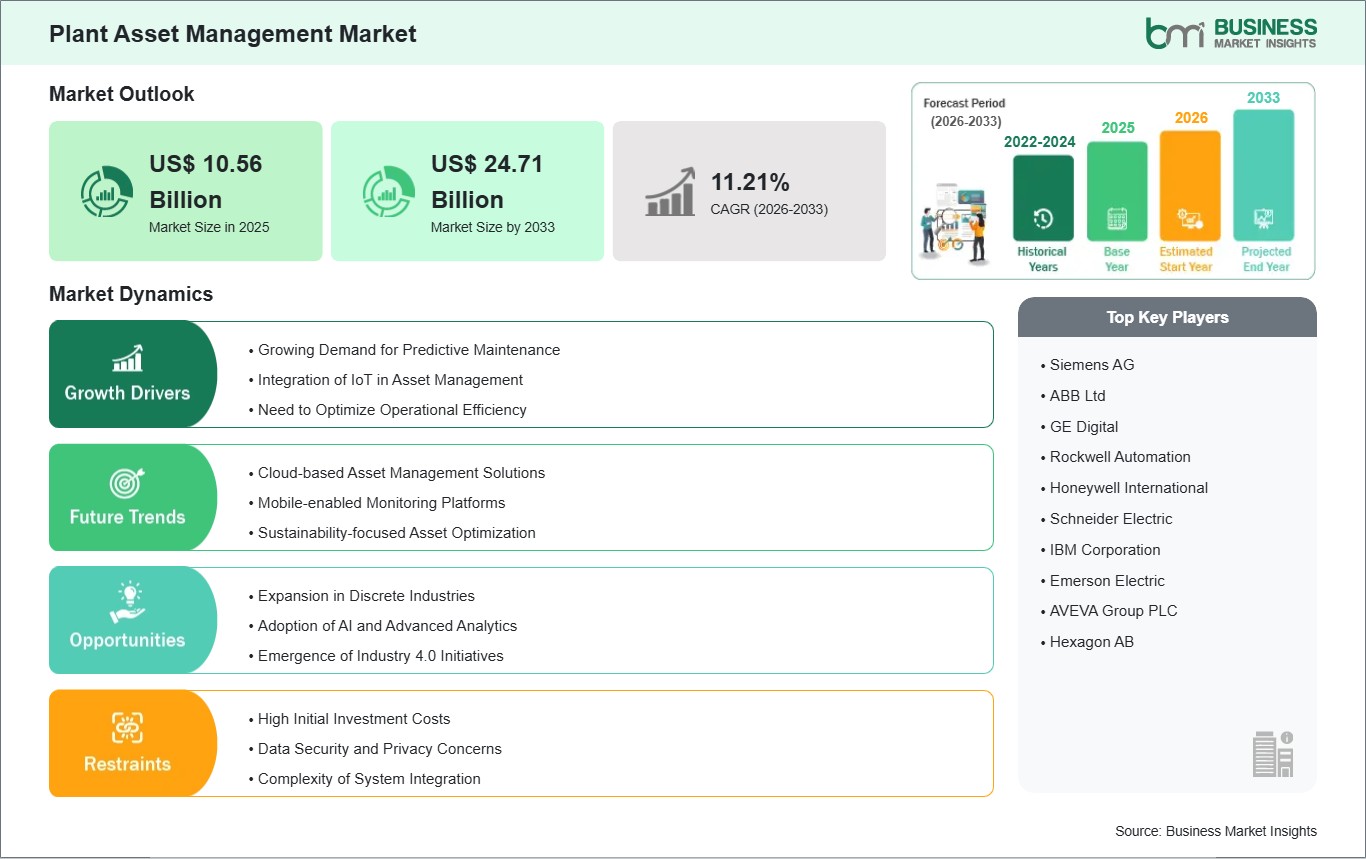
The Plant Asset Management Market size is expected to reach US$ 24.71 billion by 2033 from US$ 10.56 billion in 2025. The market is estimated to record a CAGR of 11.21% from 2026 to 2033.
The market for plant asset management is growing at a considerable rate due to the rising demand for predictive maintenance, efficiency, and real-time monitoring of key industrial assets. The solutions have become a necessity as they help organizations maximize asset performance, minimize downtime, and maintain adherence to safety and regulatory requirements. Cloud deployment has also fueled the adoption of the market by providing scalability, lower capital expenses, and smooth integration with IoT and analytics solutions. The process industries, including the chemical, oil & gas, and pharmaceutical sectors, are the key end-users of the market due to the complexity of their processes and the vital need for continuous monitoring. The discrete industries are also emerging as a promising market with the advent of smart factories and Industry 4.0 initiatives.
The market is also fueled by the convergence of AI, predictive maintenance, and IoT-based monitoring, but high capital expenditure, system integration issues, and data security issues are acting as market deterrents.

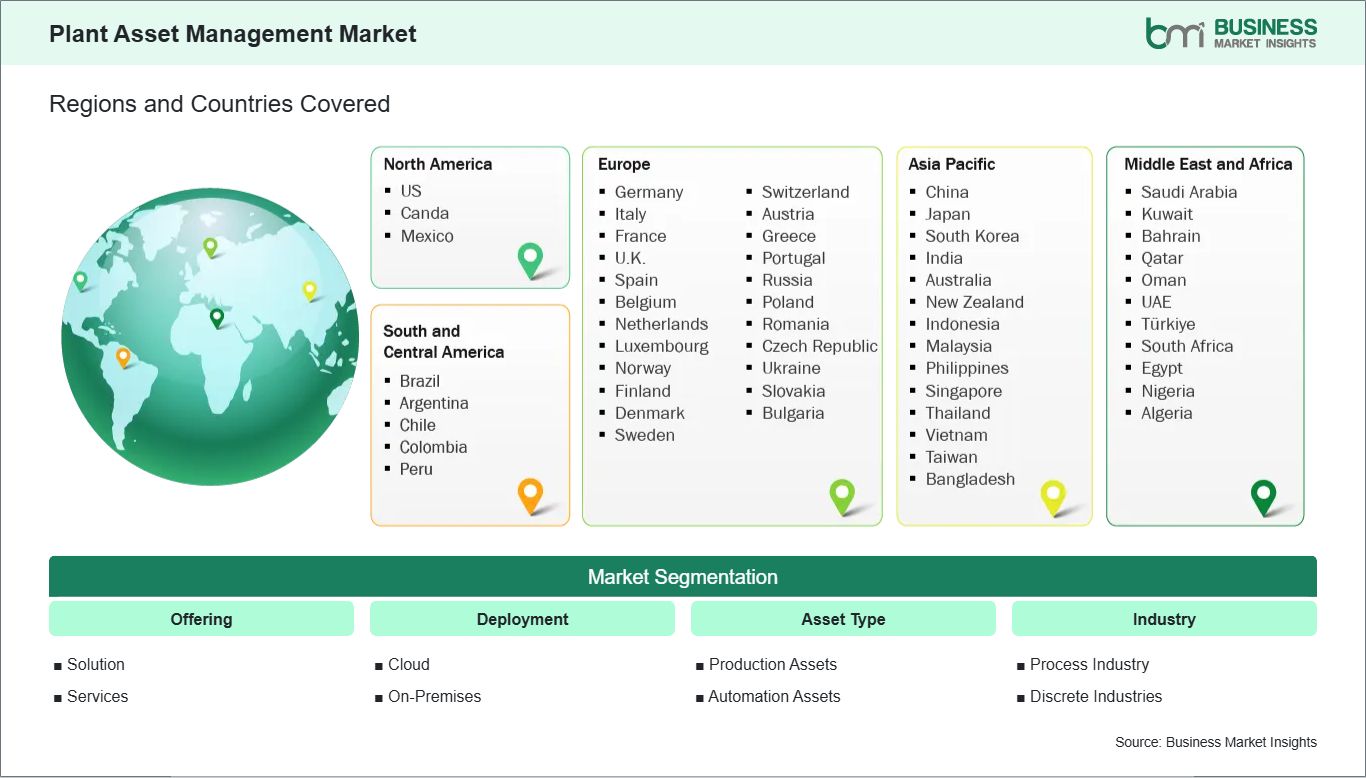
Key segments that contributed to the derivation of the Plant Asset Management market analysis are offering, deployment, asset type outlook, industry.
Predictive maintenance has emerged as a key driver in the plant asset management market. Organizations are increasingly adopting solutions that monitor equipment conditions in real time and predict potential failures before they occur. This proactive approach reduces unplanned downtime, improves equipment lifespan, and lowers maintenance costs.
The increasing complexity of industrial machinery and production processes makes traditional reactive maintenance approaches inefficient and costly. Predictive maintenance powered by IoT sensors, cloud analytics, and machine learning algorithms enables companies to schedule maintenance activities based on actual equipment conditions, avoiding unnecessary interventions and optimizing resource allocation.
Moreover, regulatory compliance, safety standards, and operational reliability requirements in sectors like chemicals, oil & gas, and pharmaceuticals amplify the importance of predictive maintenance. Companies leveraging predictive capabilities can enhance operational efficiency, reduce risks, and improve overall productivity. Consequently, the growing demand for predictive maintenance is a significant factor fueling the adoption of plant asset management solutions globally.
Discrete industries such as automotive, electronics, machinery, and aerospace are increasingly investing in plant asset management solutions. The complexity of discrete production processes, which often involve multiple assembly lines, robotics, and automated systems, requires real-time asset monitoring and process optimization to maintain high efficiency.
As discrete manufacturers focus on reducing downtime, improving quality, and optimizing resource utilization, cloud-based and AI-enabled asset management solutions offer significant advantages. These solutions provide predictive analytics, remote monitoring, and integration with existing enterprise systems, allowing manufacturers to make data-driven decisions and enhance operational performance.
Furthermore, the shift toward smart factories and Industry 4.0 initiatives in discrete manufacturing is accelerating the adoption of advanced asset management platforms. This expansion presents a major growth opportunity for vendors to provide scalable, technology-driven solutions tailored to the unique requirements of discrete industries, enabling improved productivity and competitiveness.

The global Plant Asset Management market is experiencing steady growth, with market size and share analysis reflecting evolving treatment preferences and competitive dynamics among key players. The report evaluates important subsegments categorized within offering, deployment, asset type outlook, industry, highlighting their respective contributions to overall market performance.
By offering, the solution subsegment dominated in 2025 because it provided end-to-end monitoring, predictive maintenance, and operational optimization. Comprehensive data analytics allowed organizations to proactively identify issues, reduce downtime, enhance efficiency, and optimize overall operational performance across diverse industrial environments.
By deployment, the cloud subsegment dominated in 2025 due to its unmatched scalability, cost efficiency, and accessibility. Organizations benefited from real-time data monitoring, remote management, and rapid integration without heavy upfront infrastructure investment, enabling faster decision-making and flexible adaptation to evolving industrial and operational demands.
By asset type outlook, the production assets subsegment dominated in 2025 as predictive maintenance, performance tracking, and real-time alerts ensured operational continuity, safety, and improved asset lifespan across high-value manufacturing and processing environments.
By industry, the process industry subsegment dominated in 2025 due to high adoption in chemical, oil & gas, and pharmaceutical sectors. These industries rely on continuous process monitoring for safety, regulatory compliance, quality assurance, and efficiency, driving widespread deployment of advanced monitoring and optimization solutions.
| Report Attribute | Details |
|---|---|
| Market size in 2025 | US$ 10.56 Billion |
| Market Size by 2033 | US$ 24.71 Billion |
| Global CAGR (2026 - 2033) | 11.21% |
| Historical Data | 2022-2024 |
| Forecast period | 2026-2033 |
| Segments Covered | By Offering
|
|
Regions and Countries Covered
| |
| North America | US, Canada, Mexico |
| Europe | Belgium, Austria, Finland, Denmark, Greece, Poland, Romania, Russia, Ukraine, Czech Republic, Slovakia, Bulgaria, Italy, Luxembourg, Germany, Switzerland, France, Netherlands, Norway, Portugal, Spain, Sweden, United Kingdom |
| Asia-Pacific | Australia, China, India, Japan, South Korea, Indonesia, Malaysia, Philippines, Singapore, Thailand, Vietnam, Bangladesh, New Zealand, Taiwan |
| South and Central America | Brazil, Argentina, Peru, Chile, Colombia |
| Middle East and Africa | Bahrain, Kuwait, Oman, Qatar, Saudi Arabia, United Arab Emirates, Turkiye, South Africa, Egypt, Algeria, Nigeria |
| Market leaders and key company profiles |
|
The "Plant Asset Management Market Size and Forecast (2022 - 2033)" report provides a detailed analysis of the market covering below areas:
The geographical scope of the Plant Asset Management market report is divided into: North America, Asia Pacific, Europe, Middle East & Africa, and South & Central America. North America held the largest share in 2025.
North America leads the plant asset management market due to advanced industrial infrastructure, early adoption of digital solutions, and strong presence of leading software and service providers. The United States drives regional growth through widespread implementation of cloud-based asset management platforms, predictive maintenance solutions, and integration with IoT and analytics systems across manufacturing, chemical, and energy sectors. Canada also contributes through adoption in process-heavy industries and continuous innovation in smart factory initiatives.
Additionally, North American industries prioritize operational efficiency, safety, and compliance, which supports high adoption of asset management solutions. Industry 4.0 initiatives, growing industrial automation, and government incentives for digital transformation enhance regional market penetration. Vendors offering scalable, cloud-enabled, and AI-integrated solutions are gaining traction, positioning North America as the dominant region in the global plant asset management market and a key driver of technological advancement in industrial asset management practices.

The Plant Asset Management market is evaluated by gathering qualitative and quantitative data post primary and secondary research, which includes important corporate publications, association data, and databases. A few of the key developments in the Plant Asset Management market are:
The Plant Asset Management Market is valued at US$ 10.56 Billion in 2025, it is projected to reach US$ 24.71 Billion by 2033.
As per our report Plant Asset Management Market, the market size is valued at US$ 10.56 Billion in 2025, projecting it to reach US$ 24.71 Billion by 2033. This translates to a CAGR of approximately 11.21% during the forecast period.
The Plant Asset Management Market report typically cover these key segments-
The historic period, base year, and forecast period can vary slightly depending on the specific market research report. However, for the Plant Asset Management Market report:
The Plant Asset Management Market is populated by several key players, each contributing to its growth and innovation. Some of the major players include:
The Plant Asset Management Market report is valuable for diverse stakeholders, including:
Essentially, anyone involved in or considering involvement in the Plant Asset Management Market value chain can benefit from the information contained in a comprehensive market report.
Please tell us your area of interest
(Market Segments/ Regions and Countries/ Companies)