Market Summary
Executive Summary and Global Market Analysis
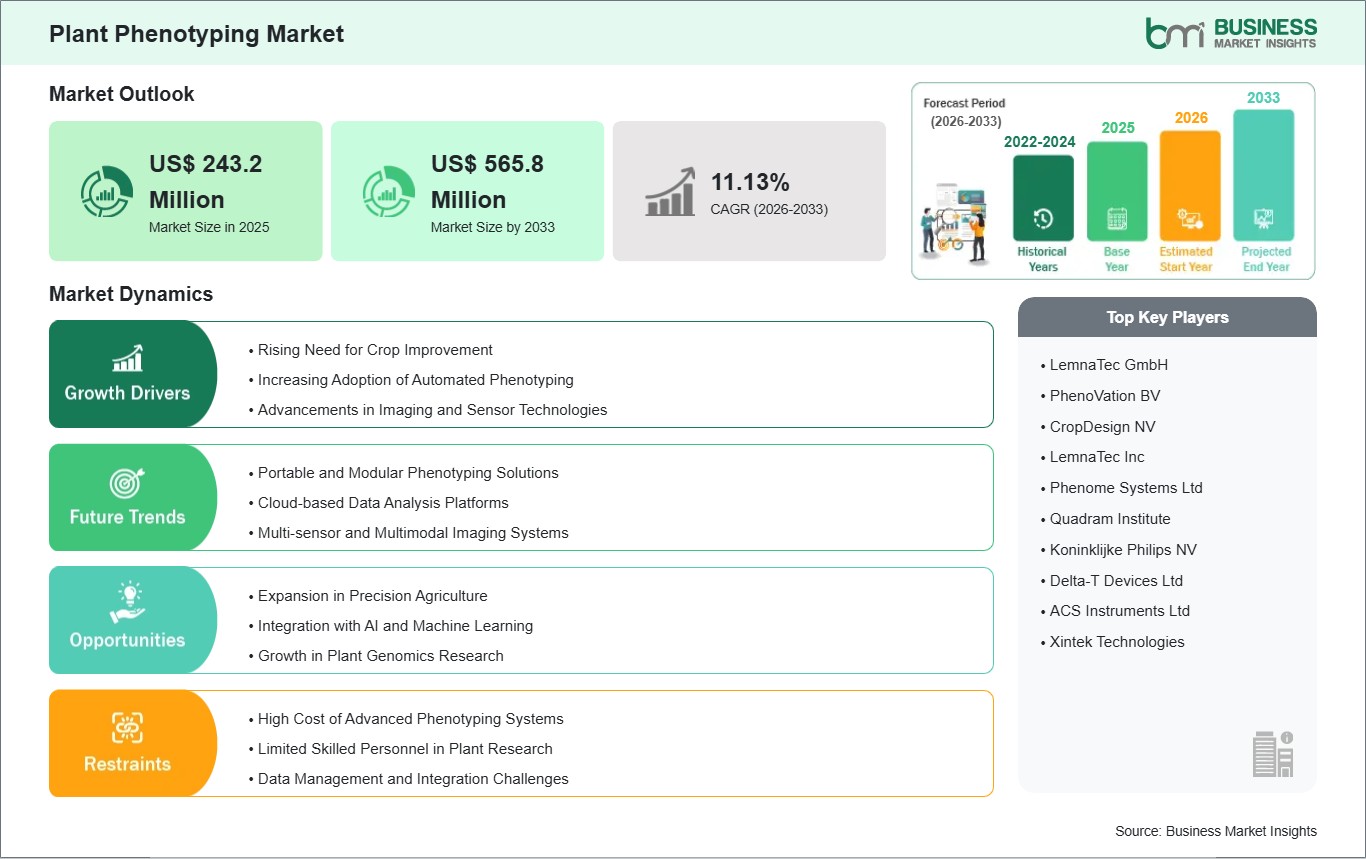
The Plant Phenotyping Market is experiencing rapid growth due to increasing demand for improved crop varieties, efficient breeding programs, and precision agriculture solutions. Advanced equipment, sensors, software, and services are being adopted to enable large-scale, accurate, and automated measurement of plant traits across diverse environments.
Technological advancements in imaging systems, robotic platforms, and high-throughput screening solutions are enhancing the efficiency and precision of plant phenotyping processes. Integration with cloud-based analytics, artificial intelligence, and machine learning is further improving data-driven decision-making, enabling researchers and farmers to optimize crop selection, growth performance, and stress tolerance.
Additionally, global initiatives in sustainable agriculture, plant genomics research, and smart farming practices are fueling the market’s expansion. The need to address food security, climate challenges, and resource-efficient crop production is driving investments in innovative phenotyping solutions. Overall, the market is poised for continued growth, supported by technological innovation, adoption in research and commercial agriculture, and increasing emphasis on productivity, sustainability, and crop quality.
Segment Analysis
Plant Phenotyping Market Segmentation
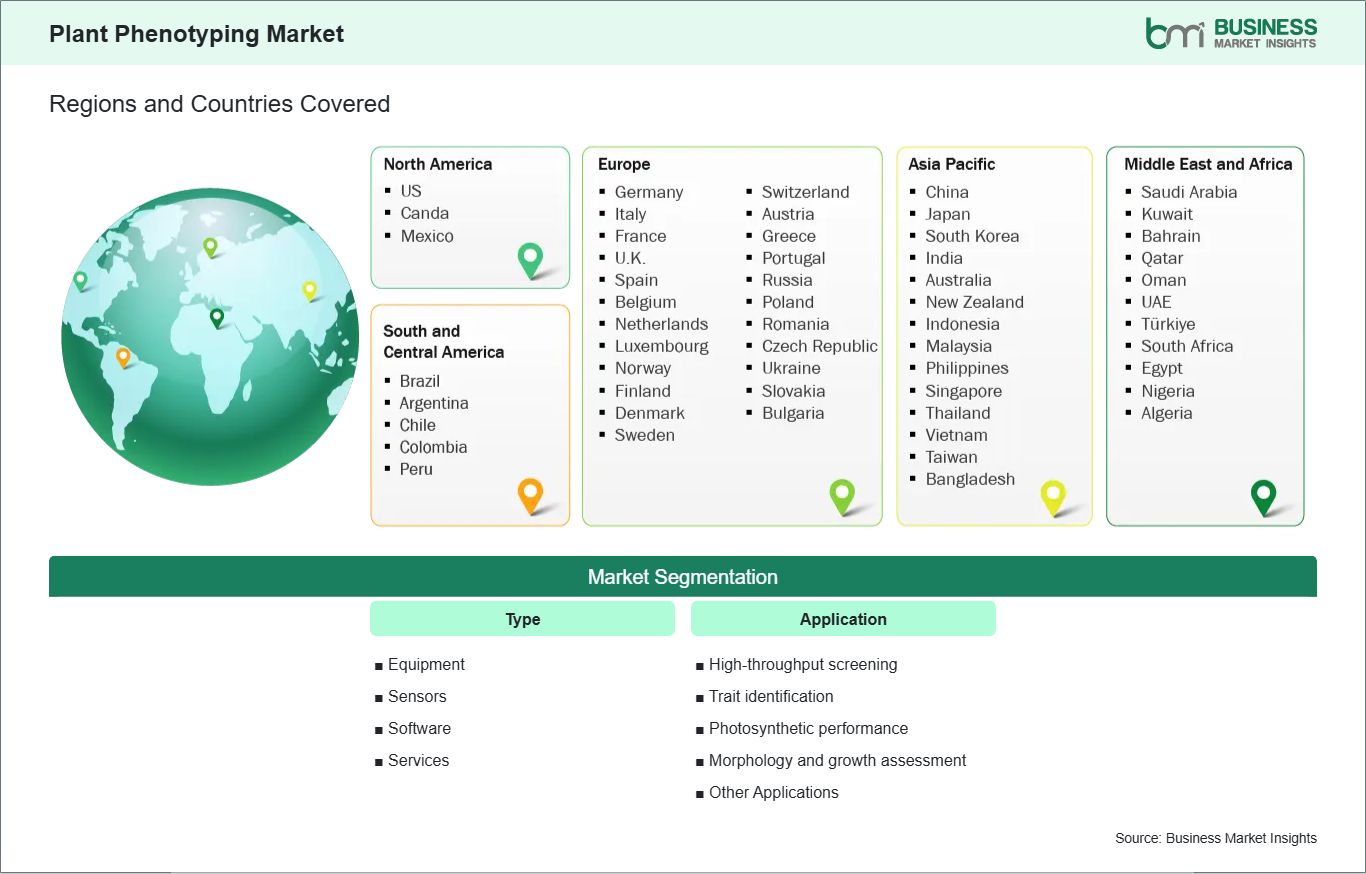
Key segments that contributed to the derivation of the Plant Phenotyping market analysis are type and application.
- By type, the market is segmented into equipment, sensors, software, and services. The equipment segment dominated in 2025.
- By application, the market is segmented into high-throughput screening, trait identification, photosynthetic performance, morphology and growth assessment, and others. High-throughput screening dominated in 2025.
Market Forces
Plant Phenotyping Market Drivers and Opportunities
Rising Need for Crop Improvement
The increasing global population and demand for food, along with climate change, have increased the need for improved crop varieties. Plant phenotyping is a tool that helps breeders of crops measure specific characteristics of plants and determine which will yield the best with respect to yield, disease resistance, and stress tolerance.
Using improved phenotyping systems allows breeders to measure and analyze multiple traits across many plants simultaneously. By providing information that is otherwise unavailable for evaluating plant performance, and speeding-up the breeding cycle and optimizing the selection process, phenotyping is used to minimize the amount of time it takes to produce new, better performing crop varieties.
In addition to the aforementioned reasons, increasing government regulations and sustainable agriculture initiatives are tupping pressure on breeders to produce resilient crops to help ensure food security. Thus, phenotyping has become a critical tool for decision makers in today's agricultural environment, providing data that will allow for improved production efficiency and crop quality when compared with traditional methods of evaluation.
Expansion in Precision Agriculture
Precision agriculture focuses on optimizing farming practices by leveraging detailed plant and environmental data. Plant phenotyping solutions provide the necessary high-resolution data on plant growth, physiology, and stress responses to enable precise irrigation, fertilization, and pest management strategies.
Automated equipment and sensor-based platforms allow farmers to monitor crop performance continuously, improving decision-making and resource utilization. Integration of phenotyping data with AI and predictive models further enhances precision agriculture outcomes, enabling targeted interventions and higher yields.
Additionally, increasing adoption of digital farming and smart agriculture solutions globally presents a significant opportunity for plant phenotyping providers. By offering scalable and easy-to-integrate solutions, vendors can expand into precision agriculture markets, supporting sustainable crop management and efficiency improvements.
Size and Share Analysis
Plant Phenotyping Market Size and Share Analysis
The global Plant Phenotyping market is experiencing steady growth, with market size and share analysis reflecting evolving treatment preferences and competitive dynamics among key players. The report evaluates important subsegments categorized within type and application, highlighting their respective contributions to overall market performance.
By type, the equipment subsegment dominated in 2025, due to widespread use of automated imaging, robotics, and high-precision phenotyping systems that allow large-scale, accurate, and efficient analysis of plant traits, supporting breeding programs and accelerating development of superior crop varieties.
By application, the high-throughput screening subsegment dominated in 2025, because it enables rapid and efficient evaluation of large plant populations, accelerates breeding programs, reduces time for crop improvement, and supports identification of traits for yield, stress resistance, and disease management.
Report Coverage
Plant Phenotyping Market Report Coverage and Deliverables
The "Plant Phenotyping Market Size and Forecast (2022 - 2033)" report provides a detailed analysis of the market covering below areas:
- Plant Phenotyping market size and forecast at the regional and country levels for segments covered under the scope
- Plant Phenotyping market trends, as well as drivers, restraints, and opportunities
- Plant Phenotyping market analysis covering key trends, regional framework, major players, regulations, and recent developments
- Industry landscape and competition analysis covering market concentration, heat map analysis, prominent players, and recent developments for the Plant Phenotyping market
- Detailed company profiles, including SWOT analysis
Geographic Insights
Plant Phenotyping Market Geographic Insights
The geographical scope of the Plant Phenotyping market report is divided into: North America, Asia Pacific, Europe, Middle East & Africa, and South & Central America. North America held the largest share in 2025.
North America dominates the Plant Phenotyping market due to the strong presence of pharmaceutical manufacturers and strict regulatory frameworks in the region. Regulatory authorities require pharmaceutical companies to maintain rigorous quality control processes to ensure product safety. Metal detection systems are widely used in pharmaceutical production lines to detect contaminants and support compliance with industry standards.
The region also benefits from advanced manufacturing infrastructure and high adoption of automated inspection technologies. Pharmaceutical companies in North America invest heavily in quality assurance systems to maintain product integrity and prevent contamination during drug production. Metal detectors help manufacturers monitor production lines and ensure that pharmaceutical products meet strict safety requirements.
In addition, the presence of leading pharmaceutical companies and technology providers contributes to the development and adoption of advanced detection systems. Continuous investment in pharmaceutical research, manufacturing expansion, and quality control technologies supports the growth of the market in the region. These factors help North America maintain its leading position in the global Plant Phenotyping market.
Industry Activity
Recent Developments
The Plant Phenotyping market is evaluated by gathering qualitative and quantitative data post primary and secondary research, which includes important corporate publications, association data, and databases. A few of the key developments in the Plant Phenotyping market are:
- In September 2023, LemnaTec GmbH (part of Nynomic AG) announced in its corporate communications that it is revolutionizing plant phenotyping with expanded digital phenotyping and seed testing solutions, highlighting its leadership in high-throughput image analysis and automated phenotyping systems.
- In May 2023, Phenospex issued a press release noting that the University of Nebraska validated its PlantEye multispectral 3D scanner as a new standard for high-throughput chlorophyll assessment, positioning PlantEye as a benchmark technology in automated crop analysis.
Trust & Transparency
Research Methodology
The market analysis combines proprietary research with secondary data from government agencies, company disclosures, regulatory filings, industry databases and expert interviews. Market estimates are validated through data triangulation, cross-market benchmarking and analyst
review.
View Full Research Methodology
Key Sources Referred:
International Plant Phenotyping Network (IPPN)EMPHASIS (European Infrastructure for Multi-scale Plant Phenotyping and Simulation)Agricultural Research Institutes & UniversitiesCompany WebsitesCompany Annual ReportsCompany Investor Presentations