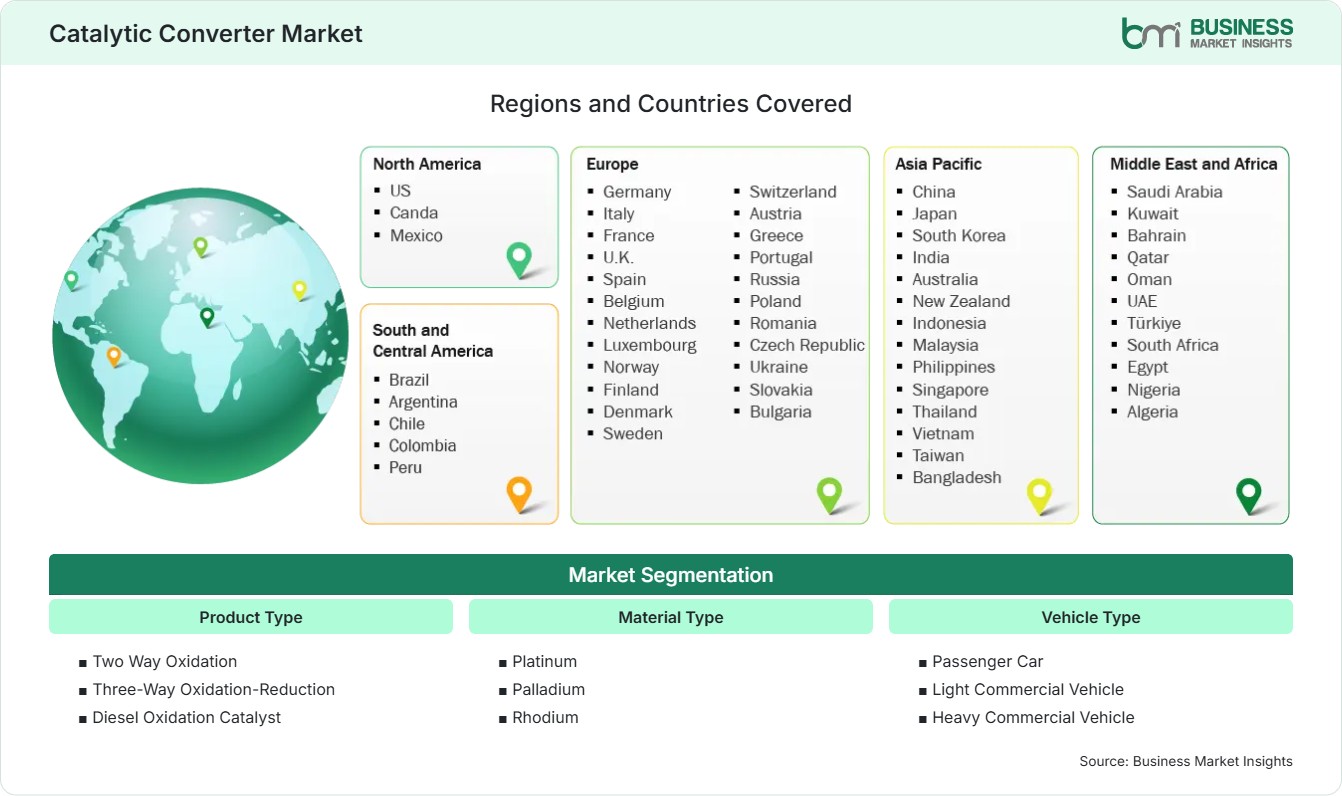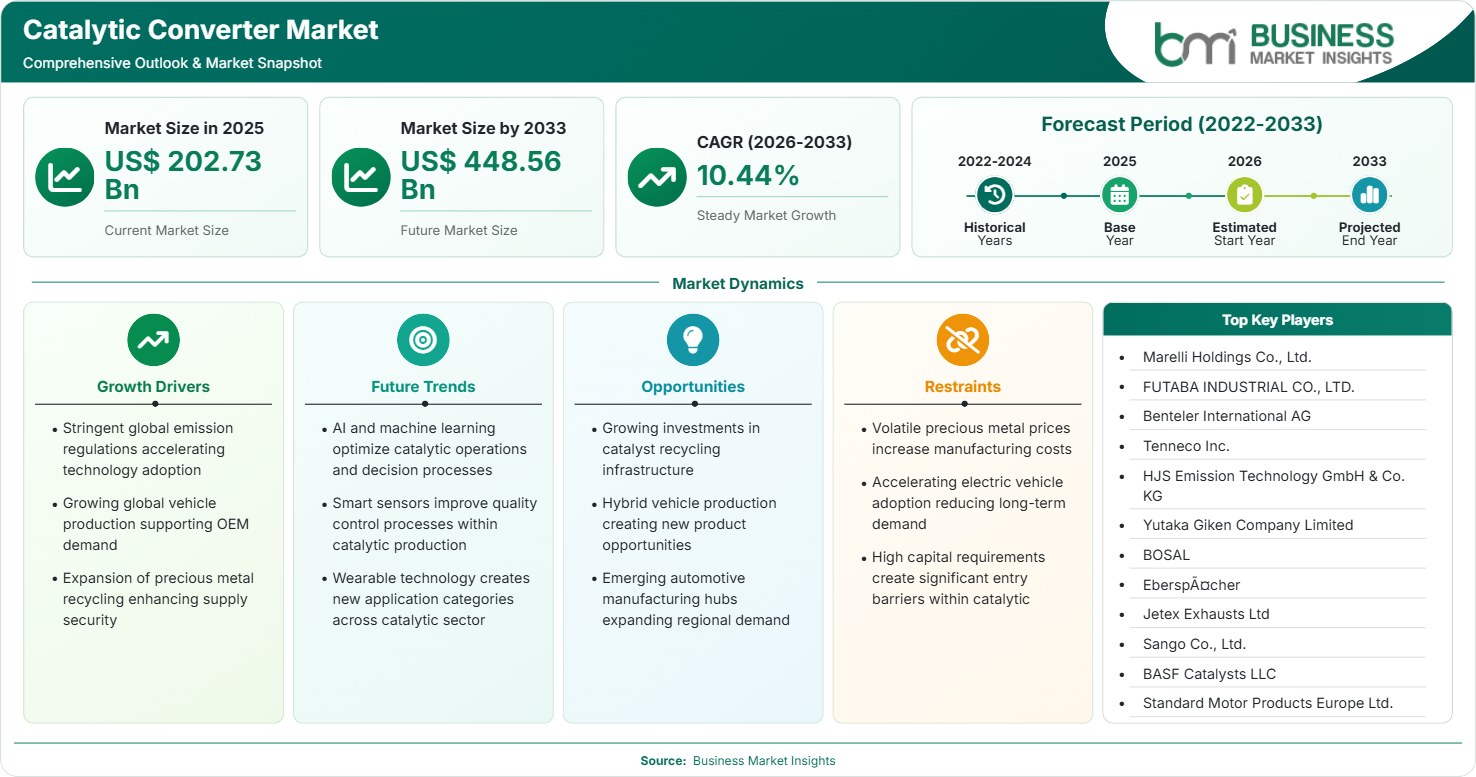
Catalytic Converter Market Regional Highlights
North America Catalytic Converter Market
North America accounted for 30%–33% of the global market share in 2025 and is projected to expand at a 9.2%–9.8% CAGR during 2026–2033. Demand remains supported by stringent emission regulations issued by the US Environmental Protection Agency and Environment and Climate Change Canada. Strong vehicle parc, mature automotive manufacturing, high replacement demand, and growing investments in catalyst recycling continue strengthening regional competitiveness. Increased adoption of hybrid vehicles further encourages manufacturers to develop highly efficient emission control systems with improved precious metal utilization.
- The US and Canada keep spending money on new catalyst recycling plants, thereby cutting down on imports of platinum group metals and promoting sustainable sourcing of raw materials.
- The manufacture of passenger vehicles is the largest application area of catalysts because of the steady demand for spare parts, aging cars, and ongoing requirements for compliance with ever-changing government regulations.
- Manufacturers of auto parts cooperate with catalyst producers in order to increase the efficiency of the substrate, decrease the number of precious metals used, and prolong the life span of the converter.
- Technologies of digital manufacturing, automated testing and coating are improving the efficiency of the production process.
- The Catalytic Converter Market share in North America remains resilient because replacement demand contributes significantly alongside original equipment installations, creating balanced revenue opportunities for component manufacturers and aftermarket suppliers.
US Catalytic Converter Market
The United States represented approximately 79%–83% of North American revenue in 2025 and is anticipated to register a 9.4%–10.0% CAGR through 2033. Federal emission regulations, strong light vehicle production, an established aftermarket ecosystem, and increasing catalyst recycling capacity continue supporting industry expansion. Growing investments in advanced manufacturing technologies, hybrid vehicle production, and domestic supply chain localization further strengthen long-term opportunities for automotive component manufacturers operating across the country.
- EPA emission regulations continue encouraging adoption of high-efficiency catalytic technologies capable of meeting increasingly stringent pollutant reduction requirements across passenger and commercial vehicle categories in catalytic converter market.
- Strong recycling infrastructure enables recovery of platinum, palladium, and rhodium from end-of-life vehicles, improving supply security while supporting circular economy objectives throughout the automotive sector.
- Major automotive manufacturers increasingly source locally manufactured emission control systems to improve supply chain resilience and reduce logistics-related operational risks.
- Expanding investments in research and development continue improving catalyst durability, thermal stability, and conversion efficiency, supporting higher-value product portfolios for domestic manufacturers.
Europe Catalytic Converter Market
Europe captured approximately 25%–28% market share in 2025 and is forecast to expand at a 9.5%–10.2% CAGR during 2026–2033. Strict Euro emission standards, widespread adoption of advanced exhaust aftertreatment technologies, and strong automotive engineering capabilities continue driving regional demand. Germany remains the leading national market, while Central and Eastern European manufacturing hubs experience comparatively faster expansion through increasing automotive investments, supplier localization, and export-oriented vehicle production supported by regulatory compliance initiatives.
- Germany maintains regional leadership through its strong automotive manufacturing ecosystem, advanced catalyst technology development, and significant investments in sustainable mobility solutions.
- Poland, Hungary, and the Czech Republic continue attracting automotive component manufacturing investments owing to competitive production costs, skilled labor availability, and expanding export capabilities in catalytic converter market.
- European recycling companies are scaling precious metal recovery operations, improving raw material availability while reducing environmental impacts associated with primary mining activities.
- Continued implementation of Euro 7 requirements encourages manufacturers to develop catalysts offering higher conversion efficiency, longer operational durability, and optimized precious metal utilization.
- Collaboration between OEMs, catalyst manufacturers, and research institutions accelerates commercialization of next-generation emission control technologies suitable for conventional, hybrid, and alternative fuel vehicles.
Asia Pacific Catalytic Converter Market
Asia Pacific represented approximately 28%–31% of the global market in 2025 and is projected to register the fastest regional expansion with a 12.0%–12.8% CAGR during 2026–2033. China remains the largest revenue contributor owing to its dominant automotive manufacturing base, while India records the highest growth rate supported by Bharat Stage VI implementation, increasing vehicle ownership, expanding component manufacturing, and favorable industrial policies. Japan and South Korea continue strengthening regional competitiveness through catalyst innovation, precision manufacturing, and export-oriented automotive production.
- China is set to retain its dominance in the regional market via its massive production of passenger vehicles, local catalyst production, growing numbers of hybrid vehicles, and stringent China VI emission standards.
- India will offer the quickest growth in the region due to rising vehicle production and efforts by the government to develop cleaner transport technologies and investment in automotive production facilities.
- Japan will be a leader in innovation when it comes to producing advanced catalyst materials, exhaust systems, and metal-saving technologies used in catalytic converter market for automobiles around the world.
- South Korea is set to enhance its export capabilities due to advances in automotive engineering, sustainable production practices, and partnership in the global automotive supply chain.
- Growing numbers of recycling plants in Asia Pacific will help increase the recovery of platinum group metals and decrease raw material imports for the producers in the region.
Rest of World Catalytic Converter Market
The Rest of World region accounted for 13%–16% of global revenue in 2025 and is anticipated to grow at a 10.1%–10.8% CAGR during 2026–2033. South and Central America continue benefiting from modernization of automotive manufacturing facilities and gradual implementation of stricter emission regulations.
Meanwhile, the Middle East and Africa experience increasing adoption of advanced emission control systems through expanding commercial vehicle fleets, infrastructure development, industrial diversification, and growing investments in automotive assembly operations. Brazil leads regional demand, while the United Arab Emirates demonstrates comparatively stronger future growth supported by industrial investments and aftermarket expansion.
- Brazil remains the largest market in South and Central America owing to its established automotive manufacturing sector, increasing vehicle ownership, and progressive implementation of cleaner vehicle emission standards.
- Mexico continues attracting international automotive investments through integrated North American supply chains, competitive manufacturing capabilities, and expanding exports of passenger and commercial vehicles.
- The United Arab Emirates is emerging as a regional growth center due to expanding automotive aftermarket activities, logistics development, and industrial diversification strategies supporting component demand in catalytic converter market.
- South Africa maintains an important position through export-oriented vehicle manufacturing, established supplier networks, and growing investments in modern automotive production technologies.
- Governments across the region continue strengthening environmental regulations and encouraging cleaner transportation solutions, creating favorable conditions for long-term adoption of advanced catalytic emission control technologies.