
Cassava Market Outlook: Size, Share, Trends, Growth Analysis, Competitive Landscape & Forecast, 2026-2033

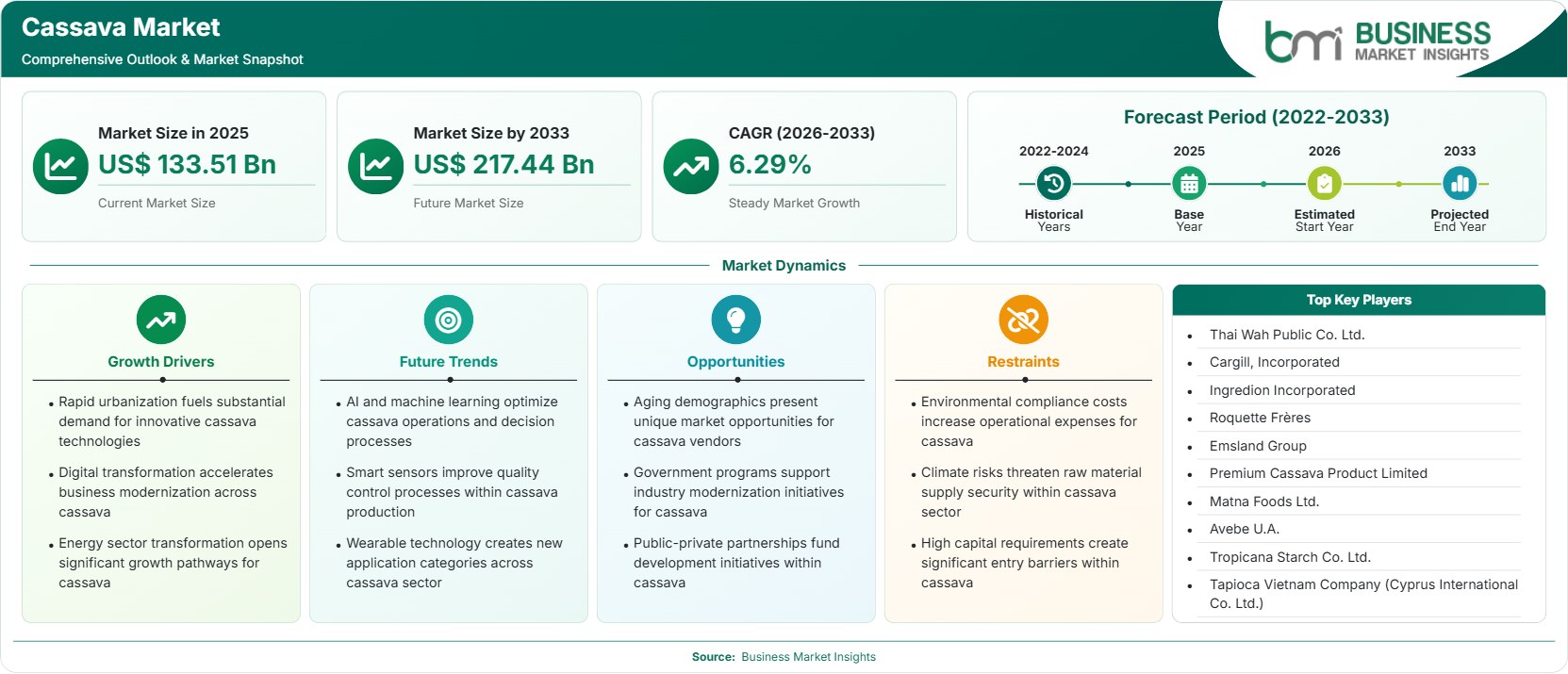
The Cassava Market size was valued at US$ 133.51 Billion in 2025 and is projected to reach US$ 217.44 Billion by 2033, growing at a CAGR of 6.29% during 2026–2033, driven by expanding food processing demand, gluten-free ingredient adoption, industrial starch applications, bio-based materials development, and rising investments across emerging agricultural value chains.

Report Coverage
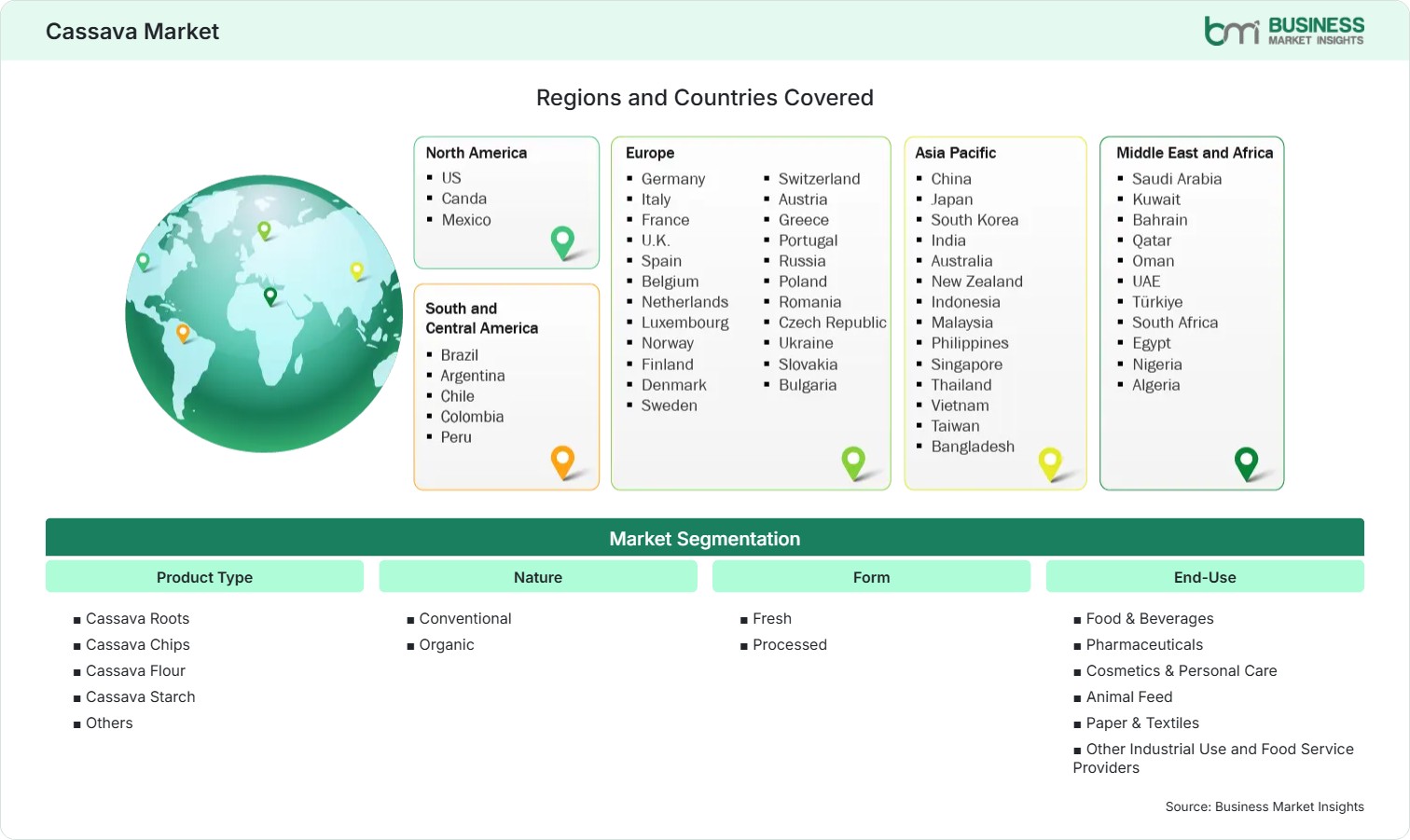
  • Product Type: Cassava Roots, Cassava Chips, Cassava Flour, Cassava Starch, Others
  • Nature: Conventional, Organic
  • Form: Fresh, Processed
  • End-Use: Food & Beverages , Pharmaceuticals, Cosmetics & Personal Care, Animal Feed, Paper & Textiles, Other Industrial Use and Food Service Providers
US$ 133.51 Bn Market size in 2025
US$ 217.44 Bn Market Size by 2033
6.29% CAGR, 2026 - 2033
2026-2033 Forecast Period

AI Overview

Cassava Market Summary

  • North America Region: Holds a market share of 16%–19% in 2025, growing at a CAGR of 5.2%–5.8% during 2026–2033. Demand for clean-label ingredients, specialty starches, sustainable sourcing, and gluten-free food formulations supports expansion across food manufacturing and industrial applications. US market benefits from strong ingredient innovation and packaged-food demand, advancing at 5.3%–5.9% CAGR through 2033.
  • Fastest Growing Region: Asia Pacific accounts for 41%–45% share in 2025 and advances at 7.1%–7.8% CAGR. Abundant cultivation, export-oriented processing capacity, food security programs, industrial starch demand, and increasing investments in downstream derivatives strengthen regional development opportunities.
  • Leading Segment: Food & Beverages commands 44%–48% share in 2025 and grows at 6.1%–6.7% CAGR. Growing bakery production, snack innovation, clean-label preferences, convenience foods, and starch applications across processed foods create extensive commercial demand opportunities.
  • High Growth Segment: Organic holds 14%–18% share in 2025 and records 7.5%–8.3% CAGR. Rising consumer interest in traceable ingredients, premium food products, sustainable farming approaches, and certification-focused supply chains accelerates adoption globally.
  • Key Market Opportunity: Bio-based packaging, industrial adhesives, pharmaceutical excipients, and specialty starch derivatives create attractive value-added opportunities as manufacturers pursue renewable inputs, supply security, and higher-margin application portfolios.
  • Major Market Players: Ingredion Incorporated, Cargill, Incorporated, Tate & Lyle PLC, Archer Daniels Midland Company, Olam Group Limited, Thai Wah Public Company Limited, AGRANA Beteiligungs-AG, Tereos S.A., Bunge Global SA, Psaltry International Company Limited.
Strategic Insights

Cassava Market: Strategic Insights

Cassava Market Strategic Framework
FREE PDF
Request your free sample
Request free sample
Stakeholder View

Key Takeaways

  • The value chain increasingly integrates cultivation, processing, starch extraction, and downstream manufacturing, enhancing supply reliability and product quality while supporting traceability requirements from global buyers.
  • Organic products and high-value industrial starch derivatives present substantial upside as manufacturers seek differentiated offerings with stronger margins and broader end-use applications.
  • Innovation is shifting toward modified starches, clean-label functional ingredients, biodegradable materials, and improved processing efficiency that reduces resource consumption.
  • Asia Pacific offers the strongest investment outlook due to cultivation advantages, export infrastructure, supportive agricultural policies, and growing domestic industrial consumption.
  • Strategic acquisitions, mill upgrades, and supply-chain partnerships are becoming common as companies secure feedstock access and expand specialty ingredient portfolios.
  • Sustainability performance is emerging as a competitive differentiator, influencing purchasing decisions among multinational food, pharmaceutical, and consumer-product manufacturers.
Geographic Outlook

Cassava Market Regional Highlights

North America Cassava Market

North America represented approximately 16%–19% of global demand in 2025 and is projected to expand at 5.2%–5.8% CAGR through 2033. Regional consumption is supported by gluten-free foods, specialty starch ingredients, and clean-label formulations. The Cassava Market share remains concentrated within food processing and ingredient manufacturing. Expanding demand for alternative starches in industrial and pharmaceutical applications contributes to market depth. Supply depends heavily on imports, encouraging strategic sourcing partnerships and investments in diversified procurement channels.

  • Food manufacturers increasingly use cassava-derived ingredients in clean-label and allergen-free formulations.
  • Functional starch demand from processed foods supports long-term procurement agreements.
  • Greater adoption in biodegradable packaging and industrial applications broadens market opportunities.
  • Sustainability and traceability requirements encourage source-certified supply relationships.
  • Ingredient innovation programs strengthen specialty starch product development.

US Cassava Market

The United States accounts for 76%–82% of North American demand and advances at 5.3%–5.9% CAGR. Rising consumption of gluten-free products, ethnic foods, and specialty ingredients supports steady growth. Strong research capabilities, advanced food manufacturing infrastructure, and expansion of premium food categories continue driving commercial adoption. Industrial users are also exploring renewable starch alternatives for selected applications. Regulatory emphasis on transparent ingredient labeling favors naturally sourced starch products.

  • Bakery and snack producers continue reformulating products using alternative starch ingredients.
  • Premium food categories support demand for clean-label functional ingredients.
  • Industrial research explores renewable feedstocks for packaging and adhesive systems.
  • Import diversification strategies improve supply-chain resilience and sourcing flexibility.

Europe Cassava Market

The Europe region had a market share of about 22%-26% in 2025 and is anticipated to grow at a CAGR of 5.7%-6.3%. The growth drivers include developments in food ingredients, sustainability focus, and industrial uses of starches. Germany is the largest consumer in the region, while France is an active processor. Poland, along with some Eastern European markets, represents faster-growing opportunities with CAGR generally exceeding regional averages. Regulatory preferences for plant-based and traceable ingredients continue to support utilization across multiple industries.

  • Germany remains a leading consumer due to advanced food-processing industries.
  • France benefits from strong starch innovation and industrial ingredient expertise.
  • Eastern European markets demonstrate higher expansion rates driven by manufacturing investment.
  • Demand for biodegradable materials supports industrial starch consumption.
  • Clean-label product development remains a major procurement driver.

Asia Pacific Cassava Market

Asia Pacific holds 41% - 45% of the total market share in 2025 and is expected to grow at a CAGR of 7.1% - 7.8%. This region has the highest growth rate. China and Thailand are still considered major consumer and processor countries, whereas Vietnam and Indonesia are growing fast. The Asia Pacific Region is endowed with extensive planting area, an export-focused supply chain, and ample starch processing capacity. Strong domestic demand from food, feed, and industrial sectors provides a robust foundation for long-term expansion.

  • Thailand remains a major processing and export hub for starch products.
  • China drives industrial and food-sector consumption across multiple applications.
  • Vietnam records strong growth through export-oriented processing investments.
  • Indonesia benefits from increasing domestic food and industrial usage.
  • Improved farming productivity enhances raw-material availability.

Rest of World Cassava Market

Rest of World, which includes South & Central America and the Middle East & Africa, accounts for 14%-18% of the market in 2025 and will see 6.4%-7.0% CAGR. Brazil is the dominant South American country, whereas Nigeria is an important producer of cassava in Africa. Market growth is driven by the food security program, agricultural modernization, and local processing capabilities. Increasing utilization across food, feed, and industrial applications strengthens regional value creation and export potential.

  • Brazil benefits from established agricultural production and processing capabilities.
  • Nigeria continues strengthening commercial cultivation and starch-processing investments.
  • Regional governments support crop diversification and agricultural productivity programs.
  • Export opportunities encourage modernization of storage and logistics networks.
  • Industrial applications expand beyond traditional food-sector consumption.
Global Market Geography
FREE PDF
Request your free sample
Request free sample
Segment Analysis

Cassava Market Segmentation

Product Type

Product Type offered the most extensive business reach due to its wide range of applications in the food and industrial sectors. Cassava starch has remained the largest revenue generator. This category holds a share of around 32%–36% in 2025 and is expected to grow at a rate of 6.4%–7.0% CAGR over the forecast period. Cassava Market scope continues to widen through specialty ingredients and industrial derivatives.

  • Cassava Roots: Primary agricultural form supporting food consumption and feedstock requirements for downstream processing facilities across producing regions.
  • Cassava Chips: Widely used in animal feed, export markets, and starch manufacturing due to efficient handling characteristics.
  • Cassava Flour: Growing popularity in gluten-free baking encourages adoption among food manufacturers and specialty product developers.
  • Cassava Starch: Functional performance across food, pharmaceuticals, textiles, and paper applications sustains strong commercial demand.

Nature

Nature segmentation stems from the growing importance of sustainability, traceability, and the sourcing of high-quality ingredients. Conventional products hold an 82%–86% market share in 2025, while this category is anticipated to grow at a 5.9%–6.4% CAGR. Organic products show more promising growth prospects through premium positioning and certification-backed market access.

  • Conventional: Dominates global production due to scale efficiencies, established cultivation networks, and widespread commercial availability.
  • Organic: Consumer demand for natural and certified ingredients supports premium pricing opportunities and market expansion.

Form

The form segment relies on processing capabilities, transportation economics, and application requirements. Processed forms account for 62%-67% of the market share in 2025 and are expected to grow at a CAGR of 6.5%-7.1%. Increasing industrial consumption fosters value-added processing in production areas.

  • Fresh: Essential for local consumption markets where short supply chains support rapid distribution.
  • Processed: Enables longer shelf life, export activity, formulation consistency, and broader industrial use.

End-Use

End-use is varied, with Food & Beverages leading. It held 44%-48% market share in 2025 and is expected to grow at a CAGR of 6.1%-6.7%. The Cassava Market trends reveal growing usage in food innovation, drug formulation, animal feed, and industrial applications.

  • Food & Beverages: Largest application category supported by texture enhancement, gluten-free formulations, and processed-food demand.
    • Bakery & Confectionery: Supports texture, binding characteristics, and gluten-free product development.
    • Snacks: Increasing consumer demand encourages starch and flour utilization in product formulations.
    • Beverages: Functional ingredient usage supports specialized formulation requirements.
  • Pharmaceuticals: Used in tablet binding, excipients, and selected formulation applications.
  • Cosmetics & Personal Care: Utilized for absorbency, texture modification, and natural ingredient positioning.
  • Animal Feed: Provides carbohydrate-rich feedstock and cost-effective formulation flexibility.
  • Paper & Textiles: Supports coating, finishing, binding, and production efficiency improvements.
  • Food Service Providers: Growing menu diversity and ingredient standardization support commercial usage.
Market Forces

Cassava Market Dynamics

Key Market Drivers

Expanding Demand for Gluten-Free and Clean-Label Foods

Consumer preferences for gluten-free and minimally processed products continue to bolster demand across the bakery, snacks, and convenience food categories. Manufacturers are using cassava starches and flour for their favorable taste profiles, texture attributes, and formulation flexibility. Increased production of specialty dietary products in North America and Europe intensifies the need for additional ingredients in food processors' formulations. The growth in retail shelf space for allergen-free food products is further stimulating formulation efforts. This trend increases adoption rates and drives up global procurement demand, supporting long-term commercial development throughout the sector.

Rising Industrial Utilization of Starch-Based Materials

Industrial use is growing across applications ranging from paper and textiles to adhesives, biodegradable packaging materials, and certain types of biomaterials. In line with sustainability goals, the idea is to replace petroleum-based inputs with renewable counterparts wherever possible. Technical advances in processing have made the materials more consistent and easier to use in applications. Growing government focus on circular economy practices further contributes to the interest in renewable feedstock materials. Diversifying end-use applications will help processors and create opportunities for value-added product development throughout the industry ecosystem.

Government Support for Agricultural Productivity

Some producing countries have also been pursuing programs related to farmer efficiency, disease control, crop diversification, and revenue generation from agriculture in rural areas. Improvements in seed technology, irrigation, extension work, and efficient harvesting ensure sustainable production. Improved logistics and storage facilities reduce post-harvest losses and increase market access, ensuring better access to raw materials for processors and exporters. The commercialization of agricultural operations further stimulates investment in manufacturing and integrated supply chain development.

Key Market Opportunities

Specialty Starch Solutions for Pharmaceutical Applications

The increase in pharmaceutical production necessitates high-quality excipients and functional ingredients. High-quality starch-based ingredients can be an interesting option when producing tablets. With investments in processing technologies, product consistency can be improved, enabling producers to enter more valuable applications. The expansion of healthcare manufacturing capabilities in Asia and other developing markets creates additional potential for future consumption. The Cassava Market Forecasts indicate continued demand for specialized ingredients that meet all requirements while supporting supply diversification strategies among pharmaceutical manufacturers.

Growth of Bio-Based Packaging Materials

Companies' environmental goals and sustainability practices continue to stimulate demand for renewable feedstocks used in packaging. The focus on starch-based materials is gaining prominence, as they offer biodegradable properties and align with the evolving strategies of the circular economy. Companies seeking alternatives to traditional raw materials are also considering natural materials for their packaging needs. The increasing regulatory pressure to adopt more sustainable options allows companies with processing capacity to capitalize on business opportunities. Partnerships between ingredient producers and packaging developers are expected to accelerate product commercialization.

Expansion of African Processing Infrastructure

There is plenty of potential for cultivation in Africa and for increased internal demand. There is an opportunity to invest in processing equipment that will not only minimize post-harvest losses but also promote value addition of the produce in their country of production. The development of infrastructure will increase export competitiveness and improve the local manufacturing ecosystem. The public-private partnership projects geared towards agricultural growth will involve ingredient producers, traders, and investors. Increasing commercial cultivation provides a foundation for broader integration into global supply chains and long-term industrial growth.

Market Restraints and Challenges

Production Volatility and Weather-Related Supply Risks

Factor: Crop production remains exposed to weather variability, pest outbreaks, and disease pressures across important cultivation regions. Impact: Supply disruptions can increase raw-material costs, reduce processing utilization rates, and create uncertainty for downstream buyers. Seasonal fluctuations may affect export availability and inventory planning, particularly for manufacturers dependent on imported feedstock. Climate-related risks can also influence agricultural productivity and investment decisions. These challenges require stronger farm-management practices, resilient crop varieties, and diversified sourcing strategies to maintain stable market development.

Infrastructure Constraints in Producing Regions

Factor: Several producing countries continue facing limitations related to transportation networks, storage systems, and processing capabilities. Impact: Inefficient logistics increase costs, reduce competitiveness, and contribute to post-harvest losses. Limited access to advanced processing technology may restrict production of higher-value derivatives and specialty ingredients. Infrastructure gaps can slow market integration and constrain export growth opportunities. Addressing these barriers requires coordinated investment across agriculture, logistics, and manufacturing ecosystems to improve overall efficiency and scalability.

Company Analysis

Competitive Landscape

Cassava Market analysis indicates competition is shaped by integrated sourcing networks, starch-processing expertise, specialty ingredient capabilities, and investments in downstream applications.

Company Name

Overview

Products and Services relevant to this market

Ingredion Incorporated

Global ingredient solutions company with extensive starch research and processing capabilities.

Cassava starches, specialty ingredients, texture solutions, food formulation products.

Cargill, Incorporated

Diversified agribusiness leader with global sourcing and processing operations.

Cassava flour, starch ingredients, food inputs, industrial derivative solutions.

Tate & Lyle PLC

International ingredient manufacturer focused on functional food solutions.

Specialty starches, texturants, formulation ingredients, clean-label products.

Archer Daniels Midland Company

Large agricultural processor serving food and industrial markets worldwide.

Value-added ingredients, starch solutions, supply-chain services, food components.

Olam Group Limited

Integrated agricultural supply-chain company with global sourcing reach.

Agricultural commodities, ingredient sourcing, processing support, value-chain services.

Thai Wah Public Company Limited

Leading Southeast Asian starch processor and exporter.

Cassava starch, flour, food ingredients, industrial starch derivatives.

AGRANA Beteiligungs-AG

European ingredient specialist serving food and industrial customers.

Specialty starches, functional ingredients, formulation support services.

Tereos S.A.

Major agro-industrial group with starch and sweetener expertise.

Starches, ingredient solutions, industrial derivatives, food applications.

Bunge Global SA

Global agribusiness company with ingredient and processing capabilities.

Agricultural ingredients, supply-chain services, food manufacturing inputs.

Psaltry International Company Limited

African processor focused on strengthening regional value chains.

Cassava-based starches, food ingredients, processing solutions.

Trust & Transparency

Research Methodology

The market analysis combines proprietary research with secondary data from government agencies, company disclosures, regulatory filings, industry databases and expert interviews. Market estimates are validated through data triangulation, cross-market benchmarking and analyst review.

View Full Research Methodology

Questions Answered

Frequently Asked Questions

What does the Cassava Market Report typically evaluate?

The Market Report commonly examines market size, regional performance, segmentation trends, competitive positioning, investment activity, demand drivers, and future opportunities.

What industries consume cassava beyond food applications?

Major non-food users include pharmaceuticals, cosmetics, personal care, animal feed, paper manufacturing, textiles, adhesives, and selected packaging applications.

How is organic production influencing industry development?

Organic production enables premium pricing, supports sustainability goals, and attracts consumers seeking certified, traceable, and naturally sourced ingredients.

Which region offers the strongest future growth potential?

Asia Pacific presents the most compelling growth outlook due to extensive cultivation, processing capacity, export infrastructure, and increasing domestic demand.

What factors are driving demand for cassava-derived ingredients?

Demand is supported by gluten-free foods, clean-label formulations, industrial starch applications, pharmaceutical usage, and growing interest in renewable raw materials.

Access the Full Cassava Market Report

Get segment-level forecasts, regional estimates, competitive benchmarking, company profiles and downloadable Excel datasets.

Access the full Cassava Market Report
350 pages PDF & Excel | 2026-08-17
Similar Research

Related Market Reports