
Cassava Starch Market Outlook: Size, Share, Trends, Growth Analysis, Competitive Landscape & Forecast, 2026-2033

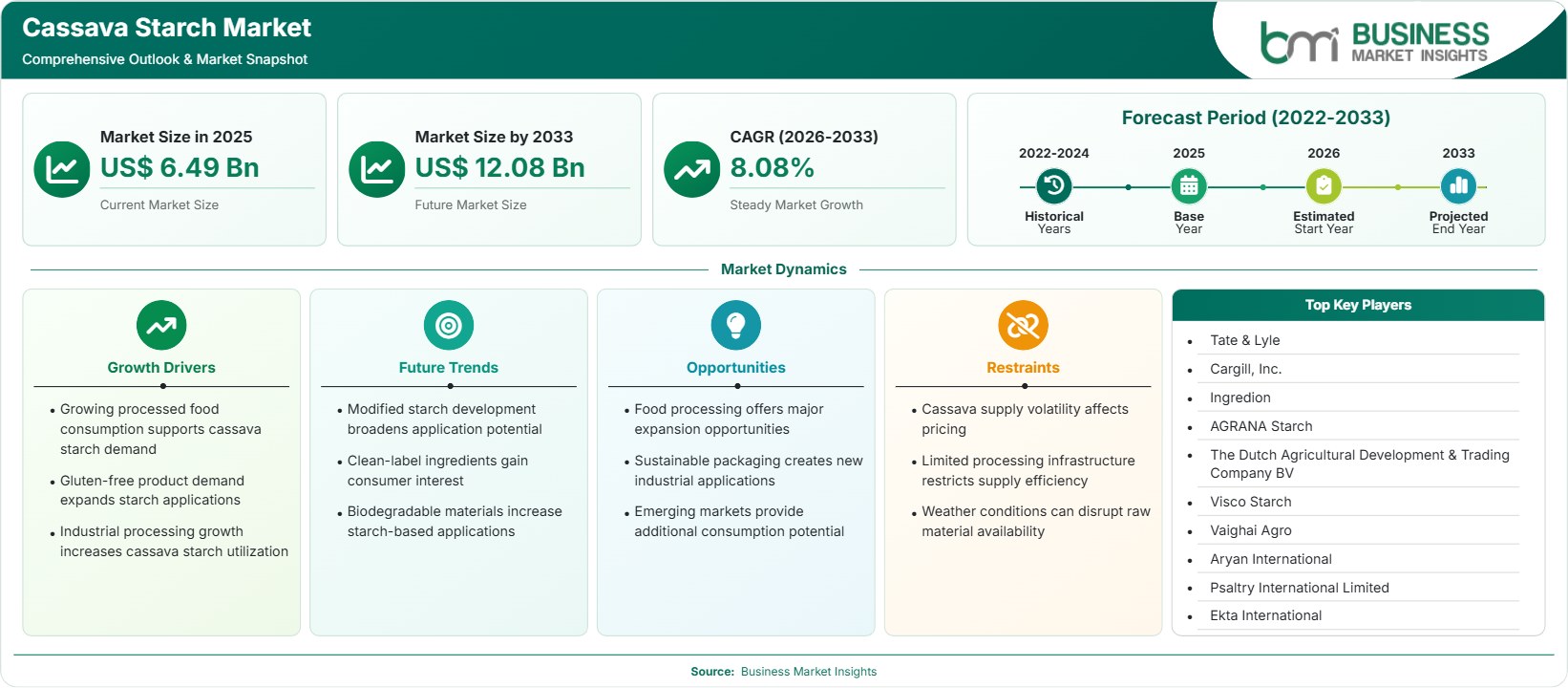
The Cassava Starch Market size was valued at USD 6.49 Billion in 2025 and is projected to reach USD 12.08 Billion by 2033, growing at a CAGR of 8.08% during 2026–2033. Expanding processed food consumption, growing demand for gluten-free ingredients, rising industrial starch applications, and increasing utilization in sustainable packaging solutions continue creating new growth opportunities.

Report Coverage
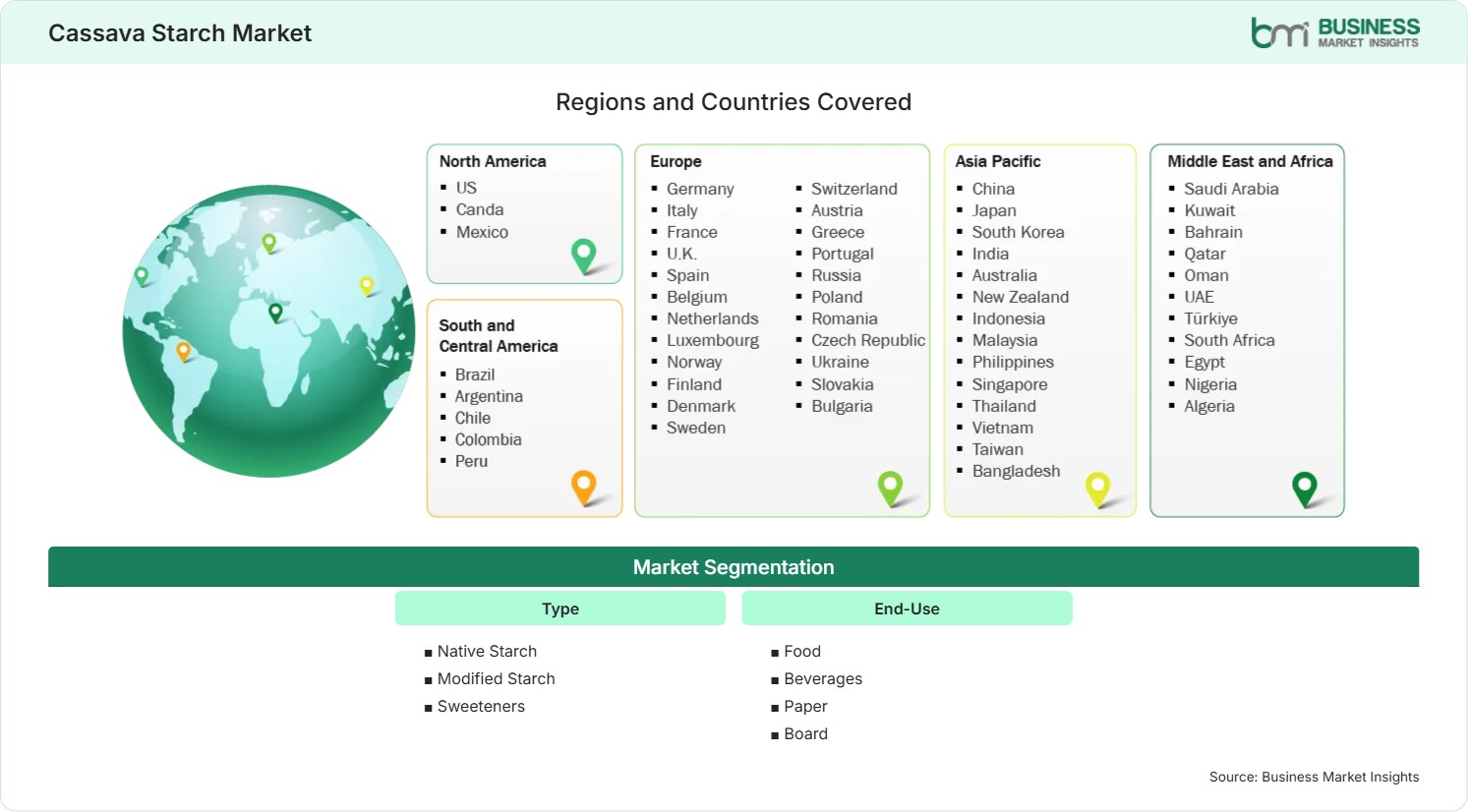
  • Type: Native Starch, Modified Starch, Sweeteners
  • End-Use: Food, Beverages, Paper, Board
US$ 6.49 Bn Market size in 2025
US$ 12.08 Bn Market Size by 2033
8.08% CAGR, 2026 - 2033
2026-2033 Forecast Period

01 AI Overview

Cassava Starch Market Summary

  • North America Region: North America holds 14%–17% share in 2025 and is projected to grow at a 7.1%–7.8% CAGR during 2026–2033. Growing clean-label food demand, increasing gluten-free product consumption, expanding industrial applications, and rising interest in plant-derived ingredients continue supporting cassava starch adoption. U.S. demand is supported by food innovation and specialty ingredient applications, growing at 7.3%–8.0% CAGR.
  • Fastest Growing Region: Asia Pacific accounts for 48%–52% share in 2025 and is forecast to expand at a 8.8%–9.5% CAGR during 2026–2033. Strong cassava cultivation, expanding food processing industries, rising industrial consumption, and growing export-oriented production continue accelerating regional demand.
  • Leading Segment: Native Starch represents 46%–50% share in 2025 and is expected to grow at a 7.8%–8.4% CAGR. Cost competitiveness, broad food applications, and favorable texturizing characteristics continue supporting segment leadership.
  • High Growth Segment: Food & Beverages account for 64%–68% share in 2025 and are projected to expand at a 8.5%–9.2% CAGR. Growing processed food production, clean-label trends, and demand for alternative starch ingredients continue driving expansion.
  • Key Market Opportunity: Development of sustainable starch-based ingredients for food, biodegradable packaging, and industrial applications enables manufacturers to expand value-added product portfolios and strengthen long-term profitability.
  • Major Market Players: Tate & Lyle PLC, Cargill, Incorporated, Ingredion Incorporated, AGRANA Beteiligungs-AG, The Dutch Agricultural Development & Trading Company B.V., Visco Starch Manufacturing Company Limited, Vaighai Agro Products Ltd., Aryan International, Psaltry International Company Limited, Ekta International.
02 Strategic Insights

Cassava Starch Market: Strategic Insights

Cassava Starch Market Strategic Framework
FREE PDF
Request your free sample
Request free sample
03 Stakeholder View

Key Takeaways

  • The value chain increasingly integrates cassava growers, starch processors, ingredient manufacturers, food companies, distributors, and industrial end users to improve supply consistency and application development.
  • Food and beverage applications offer the strongest volume opportunities due to increasing demand for clean-label, gluten-free, and plant-derived functional ingredients.
  • Innovation activities increasingly focus on modified starches with enhanced stability, texture performance, and industrial functionality across diversified applications.
  • Asia Pacific continues presenting the strongest regional investment opportunity due to its production leadership, processing capacity, and export competitiveness.
  • Capacity expansions, processing-facility investments, and strategic sourcing agreements remain important competitive approaches among ingredient manufacturers.
  • Sustainability-driven demand for renewable raw materials is increasing the attractiveness of cassava-based ingredients across both food and industrial markets.
04 Geographic Outlook

Cassava Starch Market Regional Highlights

North America Cassava Starch Market

North America represented 14%–17% Cassava Starch Market share in 2025 and is expected to expand at a 7.1%–7.8% CAGR through 2033. Rising consumer demand for clean-label products, gluten-free foods, and alternative starch ingredients supports regional growth. Food manufacturers increasingly use cassava starch in bakery, snacks, sauces, and convenience foods due to its functional and labeling advantages. Growing industrial applications further contribute to sustained demand across multiple end-use categories.

  • Food producers increasingly adopt cassava-derived ingredients to address rising consumer preference for transparent ingredient labels and allergen-free formulations.
  • Rapid growth in gluten-free food categories continues expanding opportunities for functional starch ingredients with neutral flavor characteristics.
  • Industrial users are exploring cassava starch applications in adhesives, coatings, and specialty manufacturing processes to diversify raw material sourcing.
  • Product innovation focused on texture enhancement and processing efficiency continues increasing adoption among food manufacturers.
  • Supply-chain partnerships are strengthening import availability and ingredient accessibility across North American markets.

US Cassava Starch Market

The United States accounts for approximately 78%–82% Cassava Starch Market share within North America and is anticipated to grow at a 7.3%–8.0% CAGR during 2026–2033. Demand is supported by the expansion of specialty foods, clean-label products, and ingredient innovation strategies. Food manufacturers increasingly utilize cassava starch as a versatile thickening and stabilizing ingredient capable of meeting evolving consumer preferences while supporting formulation flexibility.

  • Bakery and snack manufacturers continue increasing adoption of cassava-derived ingredients for gluten-free product development.
  • Growing demand for natural and minimally processed ingredients supports utilization across premium food applications.
  • Industrial ingredient suppliers continue expanding product portfolios based on alternative starch sources.
  • Strong innovation across food formulation technologies continues enhancing commercial opportunities for cassava starch applications.

Europe Cassava Starch Market

Europe accounted for 18%–21% share in 2025 and is projected to expand at a 7.4%–8.0% CAGR through 2033. Rising demand for clean-label ingredients, increased consumption of gluten-free foods, and growing utilization in food processing support regional growth. Germany remains the largest market due to strong food manufacturing activity and ingredient innovation, while Spain demonstrates accelerated growth supported by expanding specialty food categories. Manufacturers increasingly integrate cassava-derived ingredients into sustainable and premium product formulations.

  • Germany leads regional demand through extensive food-processing capacity, advanced ingredient development, and growing consumer preference for natural food additives and clean-label formulations.
  • Spain and the Netherlands exhibit rising adoption driven by expanding gluten-free and specialty food product portfolios, alongside increasing demand for functional and plant-based ingredients.
  • Food manufacturers increasingly substitute conventional starches with plant-derived solutions to support labeling and functionality requirements while responding to changing consumer preferences.
  • Sustainability objectives encourage broader utilization of renewable agricultural ingredients in food and industrial applications, supporting more resource-efficient and environmentally conscious production practices.
  • Demand for modified starch solutions continues increasing across bakery, confectionery, and convenience-food applications.

Asia Pacific Cassava Starch Market

Asia Pacific represented 48%–52% share in 2025 and is expected to register the fastest growth at 8.8%–9.5% CAGR through 2033. Strong cassava cultivation, extensive processing infrastructure, and expanding food manufacturing industries support regional leadership. Thailand remains a major production and export hub, while India demonstrates strong growth due to rising food-processing investments and industrial applications. Growing domestic consumption and export competitiveness continue strengthening market fundamentals throughout the region.

  • Thailand benefits from established cassava cultivation networks, export-oriented processing operations, strong international trade presence, and well-developed supply chains serving global markets.
  • India records robust growth supported by expanding processed-food demand, increasing industrial starch consumption, and rising investments across food-processing and related manufacturing sectors.
  • Growing investments in starch-processing facilities continue improving production efficiency and product quality, while supporting greater processing capacity and more consistent supply for domestic and international markets.
  • Regional food manufacturers increasingly adopt cassava ingredients across snacks, beverages, confectionery, and packaged-food applications, driven by product innovation and evolving consumer preferences.

Rest of World Cassava Starch Market

Rest of World accounted for 12%–15% share in 2025 and is projected to expand at a 8.0%–8.7% CAGR through 2033. South and Central America benefit from increasing cassava cultivation and food-industry demand. The Middle East and Africa region continues gaining momentum as agricultural development initiatives and food-processing investments increase. Brazil remains the leading regional market, while Nigeria demonstrates notable growth through expanding cassava processing capabilities and value-added product development.

  • Agricultural modernization programs continue supporting cassava cultivation productivity, improving farming practices, strengthening yields, and ensuring more consistent raw-material availability.
  • Food-processing investments are increasing local demand for starch-based ingredients across multiple applications, including processed foods, beverages, bakery products, and other consumer goods.
  • Nigeria continues strengthening its position through processing-capacity expansion, improved agricultural infrastructure, and domestic starch utilization initiatives that support local value creation.
  • Export opportunities are encouraging producers to invest in higher-value starch processing, product diversification, improved quality standards, and expanded access to international markets.
  • Growing awareness of plant-based and allergen-friendly ingredients continues supporting market development.
Global Market Geography
FREE PDF
Request your free sample
Request free sample
05 Segment Analysis

Cassava Starch Market Segmentation

Type

Native Starch accounted for approximately 46%–50% share in 2025 and is projected to expand at a 7.8%–8.4% CAGR through 2034. The Cassava Starch Market scope continues expanding as native starch remains widely preferred across food-processing applications due to its cost-effectiveness, neutral taste profile, thickening functionality, and broad formulation compatibility. Rising demand for minimally processed ingredients further supports segment leadership.

  • Native Starch: Extensively used across bakery, confectionery, beverages, and processed foods because of its natural functionality, texture enhancement, and versatile formulation characteristics.
  • Modified Starch: Increasingly adopted where improved stability, processing performance, and resistance to heat, acidity, or storage conditions are required.
  • Sweeteners: Demand continues growing within food and beverage applications requiring starch-derived sweetening and formulation solutions.

End-Use

Food & Beverages represented approximately 64%–68% share in 2025 and are expected to grow at a 8.5%–9.2% CAGR through 2034. The Cassava Starch Market trends indicate increasing utilization in processed foods, bakery items, dairy alternatives, confectionery, and convenience products. Rising demand for gluten-free and clean-label ingredients continues supporting adoption across global food manufacturing operations.

  • Food & Beverages: Strong demand is supported by texture optimization, product stability, clean-label positioning, and growing consumer interest in plant-derived ingredients.
  • Paper and Board: Manufacturers utilize starch solutions to improve paper strength, coating performance, processing efficiency, and sustainability characteristics.
06 Market Forces

Cassava Starch Market Dynamics

Key Market Drivers

Growing processed food consumption supports cassava starch demand

Increasing consumption of processed and convenience foods continues strengthening demand for starch ingredients that improve texture, stability, and shelf life. The Cassava Starch Market growth outlook is supported by expanding bakery, confectionery, dairy-alternative, and ready-to-eat food production across both developed and emerging economies. The use of cassava starch has gained popularity due to its neutral flavor, high thickening power, and suitability for clean-label products. In addition, food processors keep on using cassava-based ingredients as a response to the ever-changing customer demands while ensuring the quality of their products. Growing urbanization and increasing disposable income levels also add up to the demand for processed foods.

Gluten-free product demand expands starch applications

Growing awareness of gluten intolerance, celiac disease, and specialized dietary requirements is driving demand for alternative starch ingredients. The cassava starch provides functional advantages in gluten-free products through the improvement of texture, viscosity, and stabilization of products. There is an increasing adoption of cassava starch in baking, snacking, pasta-like, and other speciality foods. The preference of consumers for natural and allergen-friendly ingredients is driving the development of starch formulations. The increased availability of gluten-free food products has also boosted the demand.

Industrial processing growth increases cassava starch utilization

Industrial manufacturers continue expanding use of cassava starch across paper, board, adhesives, textiles, and specialty applications. The renewability of the ingredient, process efficiency advantages, and compatibility with many industrial blends ensure widespread use of the ingredient. The rise in production of packaging materials, industrial materials, and sustainable materials offers more ways for consumption. The need for natural ingredients, as an alternative to artificial ones, ensures continuous growth of demand for cassava ingredients.

Key Market Opportunities

Food processing offers major expansion opportunities

The food processing industry continues to offer numerous opportunities for suppliers of cassava based ingredients. Innovations in the development of convenience foods, natural formulations and plant based substitutes have been raising demand for such ingredients. Cassava Starch Market Forecasts indicate growing demand for functional starches that improve texture, stability, and product performance across multiple food categories. Companies investing in advanced processing technologies and customized ingredient solutions can strengthen their competitive positions. The expansion of packaged-food production in emerging economies further increases long-term growth potential.

Sustainable packaging creates new industrial applications

Sustainability initiatives are encouraging research into renewable and biodegradable raw materials for packaging solutions. Cassava-derived starch products are increasingly considered viable components in environmentally friendly packaging systems. Growing regulatory and consumer emphasis on reducing plastic waste is creating opportunities for starch-based materials. Manufacturers capable of delivering performance-oriented sustainable packaging solutions are positioned to benefit from evolving industry requirements. This trend continues generating demand beyond conventional food-sector applications.

Emerging markets provide additional consumption potential

Developing countries still remain lucrative markets because of the growth in the food industry and agriculture. Growth in the population, income, and urbanization have helped in increased consumption of processed foods and industrial products. Investment in the processing of starch has made the area even more capable of supplying its needs. Firms that set up production facilities in developing countries benefit from rising domestic demand and improved exportability.

Market Restraints and Challenges

Cassava supply volatility affects pricing

Factor: Cassava cultivation remains vulnerable to weather conditions, crop diseases, regional agricultural productivity fluctuations, and supply-chain disruptions. Impact: Fluctuations in the availability of raw materials may affect the cost structure of starch manufacturing, price volatility, and future planning for procurement. There is risk of pressure on margins when there is a shortage of supply. There is also risk associated with dependence on the availability of agricultural produce.

Limited processing infrastructure restricts supply efficiency

Factor: Several producing regions continue facing limitations in storage, transportation, processing technology, and industrial infrastructure. Impact: This can lead to inefficiencies that lower the consistency of quality products, higher costs, and hinder the scalability of starch production. There may also be problems with infrastructure that would limit the ability to export and reach the markets. The players within the industry have continued making investments aimed at modernizing and increasing processing capacity.

07 Company Analysis

Competitive Landscape

The Cassava Starch Market analysis indicates competition is driven by sourcing capabilities, processing efficiency, product innovation, food ingredient expertise, and expansion into value-added industrial applications.

Company Name

Overview

Products and Services relevant to this market

Tate & Lyle PLC

Global ingredient company specializing in food and beverage solutions and starch-based ingredients.

Specialty starches, sweeteners, food ingredients, texture solutions, and formulation support services.

Cargill, Incorporated

Multinational food and agricultural company with extensive ingredient-processing operations.

Starch ingredients, sweeteners, food-processing solutions, and industrial ingredient products.

Ingredion Incorporated

Leading ingredient solutions provider serving food, beverage, and industrial industries.

Native starches, modified starches, sweeteners, and specialty ingredient systems.

AGRANA Beteiligungs-AG

International producer of starch products, sweeteners, and food ingredients.

Starch derivatives, functional ingredients, sweetening solutions, and industrial starch products.

The Dutch Agricultural Development & Trading Company B.V.

Agricultural commodity and ingredient supplier with international market presence.

Cassava products, starch ingredients, agricultural commodities, and export services.

Visco Starch Manufacturing Company Limited

Specialized starch manufacturer serving food and industrial applications.

Cassava starch, modified starch, industrial starch solutions, and food ingredients.

Vaighai Agro Products Ltd.

Agricultural processor focused on starch and value-added cassava products.

Cassava starch products, food ingredients, industrial starches, and customized solutions.

Aryan International

Export-oriented supplier of agricultural and starch-based products.

Cassava starch ingredients, commodity exports, and food-sector supply solutions.

Psaltry International Company Limited

Integrated agricultural processing company engaged in cassava value-added products.

Cassava starch, industrial ingredients, food-processing inputs, and agricultural products.

Ekta International

Ingredient and commodity supplier serving domestic and international customers.

Cassava-derived products, starch ingredients, and food-processing raw materials.


10 Trust & Transparency

Research Methodology

The market analysis combines proprietary research with secondary data from government agencies, company disclosures, regulatory filings, industry databases and expert interviews. Market estimates are validated through data triangulation, cross-market benchmarking and analyst review.

View Full Research Methodology

11 Questions Answered

Frequently Asked Questions

What insights does a Cassava Starch Market Report provide?

A Market Report provides information on market size, competitive dynamics, application trends, regional developments, ingredient innovation, and future growth opportunities.

What drives demand for modified starch products?

Modified starch products are increasingly used because they provide enhanced processing performance, stability, and functionality across demanding food and industrial applications.

Which region dominates the market?

Asia Pacific leads the market because of strong cassava cultivation, large-scale processing capacity, expanding food industries, and significant export activity.

Why is cassava starch popular in gluten-free products?

Cassava starch is naturally gluten-free and provides desirable texture, stability, and consistency, making it a preferred ingredient for specialty and allergen-friendly food formulations.

What is cassava starch used for?

Cassava starch is widely used in food processing, bakery products, beverages, confectionery, paper manufacturing, adhesives, textiles, and industrial applications due to its functional and thickening properties.

Access the Full Cassava Starch Market Report

Get segment-level forecasts, regional estimates, competitive benchmarking, company profiles and downloadable Excel datasets.

Access the full Cassava Starch Market Report
350 pages PDF & Excel | 2026-08-20