
Starch and Starch Derivatives Market Outlook: Size, Share, Trends, Growth Analysis, Competitive Landscape & Forecast, 2026-2033

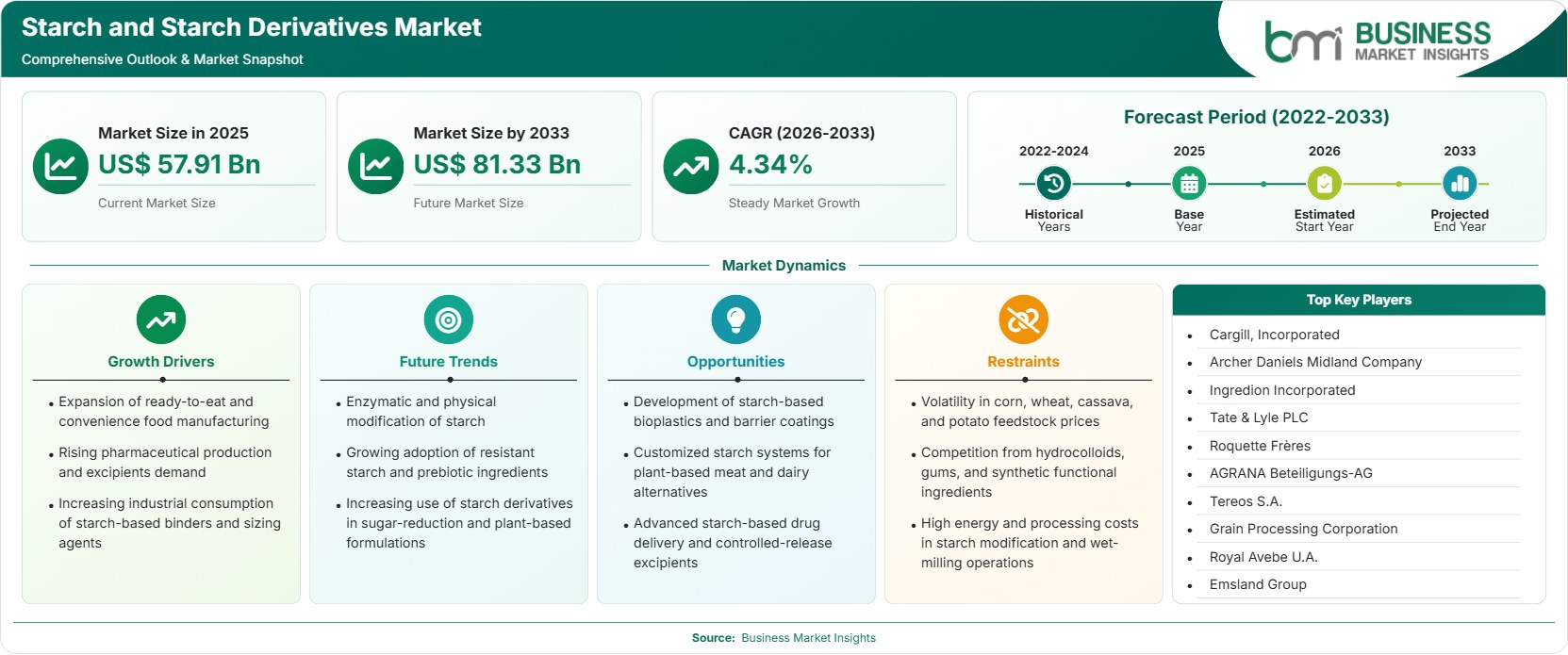
The Starch and Starch Derivatives Market size was valued at US$ 57.91 Billion in 2025 and is projected to reach US$ 81.33 Billion by 2033, growing at a CAGR of 4.34% during 2026–2033. Growth is supported by processed food demand, clean-label ingredients, pharmaceutical excipient adoption, bio-based formulations, industrial applications, and expanding starch processing investments across emerging economies.

Report Coverage
  • Product Type: Glucose Syrup, High Fructose Syrup, Modified Starch
  • Form: Dry, Liquid
  • Source: Corn, Wheat, Tapioca
  • Application: Food & Beverage, Pharmaceuticals, Animal Feed, Cosmetics & Personal Care
US$ 57.91 Bn Market size in 2025
US$ 81.33 Bn Market Size by 2033
4.34% CAGR, 2026 - 2033
2026-2033 Forecast Period

AI Overview

Starch and Starch Derivatives Market Summary

  • North America Region: Holds a market share of 31%–34% in 2025, growing with a CAGR of 3.8%–4.2% during 2026–2033. Key drivers include advanced food processing, sweetener demand, pharmaceutical excipients, sustainable ingredient innovation, and industrial starch applications. The U.S. market benefits from integrated corn processing infrastructure and growing specialty ingredient demand, expanding at 3.9%–4.3% CAGR.
  • Fastest Growing Region: Asia Pacific holds 39%–42% share in 2025 and advances at 5.1%–5.6% CAGR. Rising processed food consumption, expanding pharmaceutical manufacturing, growing disposable incomes, tapioca-based ingredient production, and investment in regional starch processing capacity support growth.
  • Leading Segment: Food & Beverage accounts for 46%–49% share in 2025 and grows at 4.1%–4.6% CAGR. Demand is supported by sweeteners, texture modifiers, shelf-life improvement, convenience foods, beverage formulations, bakery products, confectionery applications, and clean-label ingredient development.
  • High Growth Segment: Pharmaceuticals captures 12%–15% share in 2025 and expands at 5.4%–5.9% CAGR. Drug formulation requirements, tablet binding applications, controlled-release technologies, excipient innovation, healthcare manufacturing expansion, and regulatory-compliant ingredient demand accelerate adoption.
  • Key Market Opportunity: Development of clean-label modified starches, plant-based functional ingredients, biodegradable materials, advanced pharmaceutical excipients, and specialty nutrition products creates significant opportunities for value-added product differentiation and premium pricing.
  • Major Market Players: Cargill, Incorporated; Archer Daniels Midland Company; Ingredion Incorporated; Tate & Lyle PLC; Roquette Frères; AGRANA Beteiligungs-AG; Tereos S.A.; Grain Processing Corporation; Royal Avebe U.A.; Emsland Group.
Strategic Insights

Starch and Starch Derivatives Market: Strategic Insights

Starch and Starch Derivatives Market Strategic Framework
FREE PDF
Request your free sample
Request free sample
Stakeholder View

Key Takeaways

  • The value chain remains highly integrated, linking agricultural producers, wet milling operators, ingredient processors, distributors, and end-use manufacturers across food, pharmaceutical, feed, and industrial sectors.
  • Pharmaceutical excipients and specialty nutrition ingredients offer the strongest long-term upside due to stricter formulation requirements and higher value-added product demand.
  • Enzymatic modification technologies are replacing traditional processing methods, enabling cleaner labels, improved functionality, and enhanced sustainability performance.
  • India, China, Indonesia, and Vietnam present compelling investment opportunities because of expanding food manufacturing and abundant starch feedstock availability.
  • Strategic acquisitions continue to focus on specialty ingredients, regional processing assets, and formulation capabilities that strengthen customer-specific solutions.
  • Supply chain diversification and raw material sourcing optimization are becoming core competitive differentiators amid evolving agricultural market dynamics.
Geographic Outlook

Starch and Starch Derivatives Market Regional Highlights

North America Starch and Starch Derivatives Market

North America accounts for 31%–34% of the Starch and Starch Derivatives Market share in 2025 and is projected to grow at 3.8%–4.2% CAGR through 2033. Extensive corn processing infrastructure, mature packaged food industries, and strong pharmaceutical manufacturing support regional demand. Innovation in specialty sweeteners, modified starches, and clean-label ingredients remains a primary growth catalyst. Large multinational processors continue investing in product optimization, while industrial applications in adhesives and biodegradable materials support additional consumption across the regional ingredients ecosystem.

  • Strong demand from bakery, beverage, confectionery, and dairy manufacturers continues supporting large-scale starch derivative consumption.
  • Advanced ingredient innovation encourages adoption of specialty modified starches designed for texture stability and formulation efficiency.
  • Pharmaceutical companies increasingly utilize starch-based excipients for tablets and controlled-release formulations.
  • Sustainability initiatives encourage development of renewable and bio-based ingredient systems across industrial sectors.

US Starch and Starch Derivatives Market

The United States represents 73%–77% of the North American Starch and Starch Derivatives Market share and advances at 3.9%–4.3% CAGR. Large corn production volumes, sophisticated food manufacturing capabilities, and extensive ingredient development expertise support market leadership. Domestic producers emphasize specialty applications, functional ingredients, and operational efficiency improvements. Growing demand from nutrition products, pharmaceuticals, and clean-label packaged foods reinforces continued investment in advanced starch modification technologies and higher-value product portfolios.

  • Major global ingredient companies maintain substantial production and research facilities across the country.
  • Innovation in reduced-sugar formulations supports demand for alternative syrup and starch solutions.
  • Pharmaceutical manufacturing expansion strengthens excipient consumption across oral dosage applications.
  • Sustainable packaging development creates emerging industrial demand for starch-based materials.

Europe Starch and Starch Derivatives Market

Europe holds 23%–26% Starch and Starch Derivatives Market share in 2025 and records 3.9%–4.4% CAGR through 2033. Regulatory focus on ingredient transparency and sustainability encourages adoption of specialty starch products. Germany leads regional consumption, while Poland exhibits among the fastest growth rates at approximately 4.8%–5.2% CAGR. Food processing, pharmaceutical manufacturing, and personal care applications continue supporting steady demand. Regional processors increasingly invest in clean-label solutions and environmentally responsible production technologies.

  • Clean-label product launches promote wider use of functional starch ingredients across food categories.
  • Germany remains the leading national market due to advanced food manufacturing capabilities.
  • Poland demonstrates elevated growth supported by expanding processing investments and export activity.
  • Pharmaceutical and nutraceutical industries create demand for customized excipient solutions.
  • Sustainability regulations encourage bio-based ingredient development and circular manufacturing initiatives.

Asia Pacific Starch and Starch Derivatives Market

Asia Pacific commands 39%–42% share in 2025 and delivers the highest regional CAGR of 5.1%–5.6%. China leads overall demand while India represents one of the fastest-growing markets with 5.8%–6.3% CAGR. Expanding processed food consumption, pharmaceutical manufacturing growth, rising incomes, and abundant feedstock availability support regional expansion. The region remains a focal point for investments in starch processing facilities, specialty ingredient manufacturing, and export-oriented production capacity.

  • Rapid urbanization increases demand for convenience food ingredients and functional sweeteners.
  • China remains the largest consumer and producer within the regional market.
  • India benefits from growing pharmaceutical production and food processing investments.
  • Tapioca-based derivative manufacturing expands across Southeast Asian economies.
  • Regional companies increasingly focus on specialty formulations and export competitiveness.

Rest of World Starch and Starch Derivatives Market

The Rest of World region accounts for 8%–10% share and grows at 4.4%–4.9% CAGR. South and Central America benefit from strong agricultural production and food manufacturing development. Brazil leads regional demand while Mexico records robust growth. In the Middle East and Africa, expanding packaged food consumption and industrial diversification support adoption. Investments in local processing capabilities and ingredient supply chains gradually strengthen market competitiveness and reduce import dependence.

  • Brazil remains the largest regional market due to agricultural resource availability and processing capacity.
  • Mexico experiences increasing ingredient demand from food and beverage manufacturers.
  • Gulf countries demonstrate rising interest in local food production initiatives.
  • African processed food industries contribute incremental demand for starch derivatives.
  • Investment in regional value chains improves supply security and operational efficiency.
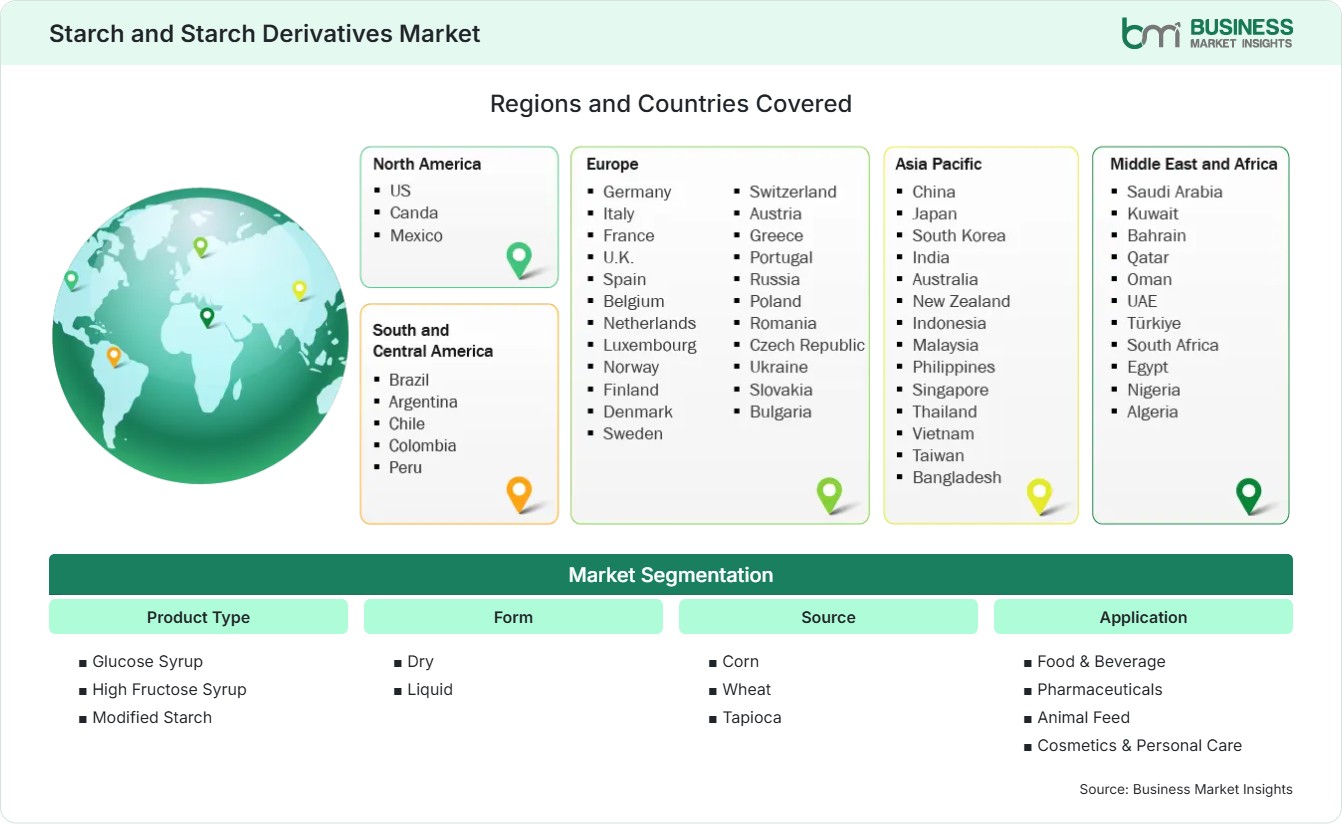
Global Market Geography
FREE PDF
Request your free sample
Request free sample
Segment Analysis

Starch and Starch Derivatives Market Segmentation

Product Type

This segment represents a significant component of industry demand with approximately 32%–35% market share and 4.2%–4.7% CAGR. Product diversification is accelerating as manufacturers develop specialized formulations for food processing, healthcare, and industrial applications. Evolving customer requirements and functional performance expectations continue shaping innovation strategies.

  • Glucose Syrup: Widely used in confectionery, beverages, baked goods, and processed foods because of sweetness, stability, and cost-effectiveness in large-scale production environments.
  • High Fructose Syrup: Maintains important demand across beverages and packaged foods, supported by formulation flexibility, sweetness efficiency, and consistent performance characteristics.
  • Modified Starch: Benefits from increasing application in convenience foods, pharmaceuticals, and industrial formulations requiring enhanced texture, stability, and processing tolerance.

Form

The form category influences transportation, storage, and processing efficiency. It accounts for around 18%–21% market share and advances at 4.0%–4.5% CAGR. Customer preferences vary according to manufacturing requirements, end-use applications, and supply chain considerations.

  • Dry: Preferred for longer shelf life, easier transportation, improved storage stability, and broad applicability across food, pharmaceutical, and industrial manufacturing environments.
  • Liquid: Gains traction where direct process integration, rapid handling, and formulation consistency support operational efficiency and production optimization.

Source

The source segment defines feedstock economics and ingredient functionality, contributing approximately 28%–31% market share with 4.3%–4.8% CAGR. The Starch and Starch Derivatives Market scope continues expanding through diversified agricultural feedstock utilization and regional supply availability.

  • Corn: Dominates commercial production due to abundant availability, established processing infrastructure, and versatile derivative manufacturing capabilities.
  • Wheat: Supports specialty applications requiring distinct functional properties and remains important across European processing operations.
  • Tapioca: Experiences strong adoption in Asia-Pacific owing to abundant cassava availability and suitability for diverse specialty ingredient applications.

Application

Application remains the largest segment, representing 46%–49% share and registering 4.1%–4.6% CAGR. The segment benefits from broad adoption across multiple industries where starch derivatives improve texture, stability, functionality, and manufacturing efficiency. Starch and Starch Derivatives Market trends increasingly favor value-added applications.

  • Food & Beverage: Largest consumer category driven by sweeteners, stabilizers, thickeners, texture enhancement, and shelf-life optimization requirements.
  • Pharmaceuticals: Expands through excipient demand, tablet manufacturing, controlled release systems, and formulation innovation initiatives.
  • Animal Feed: Supports nutrition delivery, pellet durability improvement, and feed processing efficiency across livestock production systems.
  • Cosmetics & Personal Care: Utilized for absorbency, texture modification, sensory enhancement, and formulation stability across multiple product categories.
Market Forces

Starch and Starch Derivatives Market Dynamics

Key Market Drivers

Expansion of Processed Food Consumption Worldwide

Rising consumption of packaged foods, baked products, beverages, and convenience meals continues driving ingredient demand across global markets. Trends in urbanization, an increase in labor force participation, and changing lifestyles have all contributed to sustained demand for starch-based sweeteners, stabilizers, and texturizers. Food processing industries have been needing functional ingredients that can help preserve the consistency, shelf life, and organoleptic properties of the products in their distribution channels. The WHO and FAO consistently point out an increasing availability of processed foods and shifting consumer preferences around the world. This is altogether contributing towards increased demand for derivatives in developed and emerging countries.

Growth in Pharmaceutical Manufacturing Activities

Pharmaceutical companies increasingly depend on starch derivatives in excipient systems, tablet formulations, disintegration processes, and drug delivery technologies. Increased health care access, an aging population, and growing pharmaceutical production create a constant need for such raw materials. Companies have been making efforts to develop innovative functional starches that comply with all regulations and perform effectively. Improved biocompatibility, formulation capability, and production efficiency are attributes that can make them more interesting for health care applications. As there is an expansion of pharmaceutical capabilities in the developing world of Asia and others, there would be more demand for excipient materials.

Shift Toward Clean-Label and Natural Ingredients

Consumers increasingly prefer ingredients perceived as natural, minimally processed, and transparent in origin. Food manufacturers have begun developing their products using clean-label starches, which can ensure functionality. Scientific developments, such as enzyme-based processes, have enabled the development of ingredients with improved functionality while minimizing the need for chemicals. Companies making investments in sustainable production methods are getting a competitive edge over others in the market. Such moves make it necessary to invest more in the innovation of specialty ingredients.

Key Market Opportunities

Development of Bio-Based Materials and Packaging

Increased interest in sustainability provides an opportunity for starch-based products in packaging and coatings. Increasing regulation of plastics results in more use of alternative, renewable products. Companies that can create cost-effective, scalable starch products will be able to meet increased demand. Continued innovation results in improved properties of bio-based materials. Starch and Starch Derivatives Market Forecasts increasingly incorporate sustainability-driven investments, particularly where circular economy initiatives and environmental policies encourage substitution of fossil-based inputs with renewable feedstocks across global manufacturing industries.

Premium Functional Nutrition Applications

Health-conscious consumers increasingly seek products delivering digestive support, balanced energy release, and improved nutritional profiles. The specialized starches facilitate innovation in the field of sports nutrition, nutritional supplements, meal replacement products, and medical nutrition products. Companies can leverage the functional characteristics of starch to develop products that cater to specific consumer requirements. Increasing incidences of diet-induced ailments make the need for better nutrition even more critical. Researching the effects of ingredients and metabolism will provide further opportunities for product innovation and growth.

Expansion Across Emerging Asian Economies

Rapid industrialization, food processing investments, and expanding pharmaceutical manufacturing create favorable conditions across emerging Asian markets. Increases in population and income levels raise the demand for processed value-added products that require complex ingredient systems. Local processors are improving their manufacturing abilities, while international players are setting up new plants and developing alliances. Agricultural feedstock availability makes production more economical and enables localization of the supply chain. There are interesting prospects in countries like India, Indonesia, Vietnam, and the Philippines for expanding capacity and markets.

Market Restraints and Challenges

Raw Material Price Volatility

Factor: Corn, wheat, and tapioca prices remain vulnerable to weather events, geopolitical developments, trade policies, and agricultural supply fluctuations. Impact: The variability of feedstock prices can squeeze process margins and make price management difficult for ingredient manufacturers. It is a common problem for businesses to pass on their increased costs when dealing with competitive customer industries. The volatility can also impact investments and purchasing plans. Ingredient manufacturers now resort to diversifying their sources, making long-term agreements, and becoming more efficient. But the uncertainty in agriculture remains an important issue.

Regulatory and Formulation Compliance Requirements

Factor: Food safety regulations, labeling standards, pharmaceutical compliance requirements, and sustainability expectations vary considerably across markets. Impact: There is an increased cost associated with research, testing, certification, and documentation in running operations internationally. The process of product approval and modification can increase the time for commercialization, hence decreasing the flexibility. There is a need for increased technical capacity to meet regulatory requirements across different governments. Small manufacturers might have difficulties expanding their business. There is a need for continued monitoring as regulations continue to change.

Company Analysis

Competitive Landscape

The competitive environment reflects ongoing investment in specialty ingredients, sustainable processing, and innovation-driven differentiation. This Starch and Starch Derivatives Market analysis highlights leading participants.

Company Name

Overview

Products and Services relevant to this market

Cargill, Incorporated

Global agribusiness and ingredient leader with extensive starch processing operations and integrated sourcing capabilities.

Corn starches, glucose syrups, sweeteners, modified starches, food ingredient solutions.

Archer Daniels Midland Company

Diversified agricultural processor serving food, nutrition, and industrial ingredient markets globally.

Sweeteners, specialty starches, functional ingredients, formulation solutions.

Ingredion Incorporated

Major specialty ingredient producer focused on texture and formulation innovation.

Modified starches, clean-label ingredients, sweeteners, pharmaceutical solutions.

Tate & Lyle PLC

Global ingredient specialist emphasizing healthier formulations and value-added ingredients.

Starches, texturants, sweeteners, formulation optimization services.

Roquette Frères

Leading plant-based ingredient manufacturer with strong pharmaceutical presence.

Pharmaceutical excipients, modified starches, specialty derivatives.

AGRANA Beteiligungs-AG

European ingredient company active across starch, fruit, and sugar businesses.

Native starches, modified starches, specialty ingredient products.

Tereos S.A.

Large agricultural processing group serving food and industrial sectors.

Sweeteners, glucose syrups, starch derivatives, industrial ingredients.

Grain Processing Corporation

U.S.-based processor specializing in corn-derived products and specialty ingredients.

Corn starches, alcohol products, specialty derivative solutions.

Royal Avebe U.A.

Cooperative focused on potato-based ingredients and functional starch technology.

Potato starches, specialty modified starch solutions.

Emsland Group

International producer specializing in potato and plant-based ingredient systems.

Functional starches, food ingredients, industrial starch applications.

Trust & Transparency

Research Methodology

The market analysis combines proprietary research with secondary data from government agencies, company disclosures, regulatory filings, industry databases and expert interviews. Market estimates are validated through data triangulation, cross-market benchmarking and analyst review.

View Full Research Methodology

Questions Answered

Frequently Asked Questions

What does a Starch and Starch Derivatives Market Report typically evaluate?

A comprehensive Starch and Starch Derivatives Market Report assesses supply chains, competitive positioning, regional demand patterns, technology developments, regulations, and growth opportunities across end-use sectors.

Which region offers the strongest expansion potential?

Asia Pacific provides the strongest long-term opportunity due to large populations, expanding food processing industries, growing pharmaceutical production, and abundant agricultural resources.

How are clean-label trends affecting product development?

Manufacturers are increasing investment in enzymatic modification technologies and minimally processed ingredients to meet consumer demand for transparent and natural formulations.

What factor most influences profitability?

Feedstock availability and agricultural commodity pricing significantly influence profitability because corn, wheat, and tapioca account for a substantial portion of production costs.

Which application generates the largest demand?

Food and beverage manufacturing remains the largest demand center because starch derivatives provide sweetening, thickening, stabilizing, and texture-enhancing functionality across multiple product categories.

Access the Full Starch and Starch Derivatives Market Report

Get segment-level forecasts, regional estimates, competitive benchmarking, company profiles and downloadable Excel datasets.

Access the full Starch and Starch Derivatives Market Report
350 pages PDF & Excel | 2026-08-27