
Carotenoids Market Outlook: Size, Share, Trends, Growth Analysis, Competitive Landscape & Forecast, 2026-2033

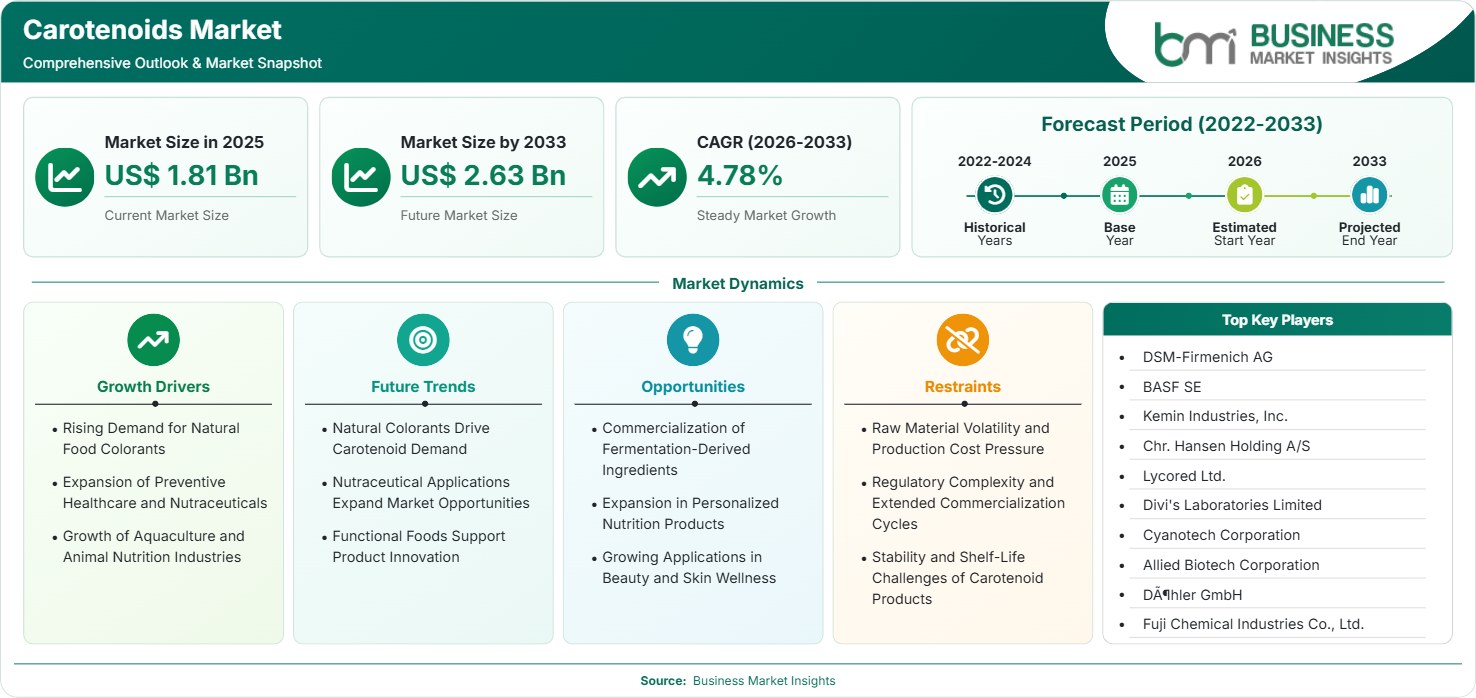
The Carotenoids Market size was valued at US$ 1.81 Billion in 2025 and is projected to reach US$ 2.63 Billion by 2033, growing at a CAGR of 4.78% during 2026–2033, supported by rising demand for natural colorants, expanding nutraceutical consumption, algae-based ingredient innovation, and increasing applications across animal nutrition and cosmetics.

Report Coverage
  • Type: Astaxanthin, Beta-carotene, Lutein, Zeaxanthin, Lycopene, Canthaxanthin, Others
  • Source: Synthetic, Natural
  • Form: Liquid, Powder, Beadlet
  • Application: Animal Feed, Food & Beverages, Dietary Supplements, Personal Care & Cosmetics, Pharmaceuticals
US$ 1.81 Bn Market size in 2025
US$ 2.63 Bn Market Size by 2033
4.78% CAGR, 2026 - 2033
2026-2033 Forecast Period

AI Overview

Carotenoids Market Summary

  • North America Region: North America holds a market share of 34%–37% in 2025, growing with a CAGR of 4.1%–4.5% during 2026–2033. Key drivers include functional nutrition demand, feed additives adoption, and clean-label food innovation. Opportunities emerge from sustainable extraction technologies and premium supplement formulations. The U.S. accounts for 72%–76% of regional demand, supported by nutraceutical expansion, eye-health product consumption, and a projected CAGR of 4.2%–4.6%.
  • Fastest Growing Region: Asia Pacific holds a Carotenoids Market share of 26%–29% in 2025, expanding at a CAGR of 5.6%–6.1% through 2033. Growth stems from expanding middle-class healthcare spending, aquaculture production, dietary supplement penetration, and investments in natural pigment manufacturing across China, India, and Southeast Asia.
  • Leading Segment: Food & Beverages represents a 31%–34% share in 2025 and advances at a CAGR of 4.4%–4.8%. Demand is supported by the replacement of artificial colorants, consumer preference for natural ingredients, beverage fortification, bakery innovation, and increasing regulatory acceptance of plant-derived pigments globally.
  • High Growth Segment: Dietary Supplements account for a 23%–26% share in 2025 in the Carotenoids Market and grow at 5.7%–6.2% CAGR. Expansion is driven by preventive healthcare awareness, aging populations, eye-health formulations, antioxidant supplementation, and increasing online sales of wellness products.
  • Key Market Opportunity: Algae-derived and fermentation-produced ingredients offer scalable supply, improved sustainability metrics, enhanced purity, and premium positioning across nutrition, feed, pharmaceutical, and cosmetic applications over the forecast period.
  • Major Market Players: DSM-Firmenich AG, BASF SE, Kemin Industries, Inc., Chr. Hansen Holding A/S, Lycored Ltd., Divi's Laboratories Limited, Cyanotech Corporation, Allied Biotech Corporation, Döhler GmbH, Fuji Chemical Industries Co., Ltd.
Strategic Insights

Carotenoids Market: Strategic Insights

Carotenoids Market Strategic Framework
FREE PDF
Request your free sample
Request free sample
Stakeholder View

Key Takeaways

  • The industry value chain is shifting toward vertically integrated sourcing models combining cultivation, extraction, formulation, and distribution to improve cost efficiency and supply security.
  • Dietary supplements and premium animal nutrition applications offer the strongest revenue expansion potential due to higher margins and growing health-oriented purchasing behavior.
  • Encapsulation, fermentation-derived pigments, and bioavailability enhancement technologies are becoming critical differentiators for product performance and shelf-life optimization.
  • India, China, Vietnam, and Indonesia present attractive investment opportunities due to expanding food processing sectors, aquaculture growth, and rising supplement penetration.
  • Strategic acquisitions and partnerships increasingly target biotechnology, algae cultivation, and specialty ingredient providers to strengthen sustainable product portfolios.
  • Regulatory momentum supporting natural colorants across food categories continues to create substitution opportunities for synthetic additives in developed economies.
Geographic Outlook

Carotenoids Market Regional Highlights

North America Carotenoids Market

North America accounted for 34%–37% of global demand in 2025 and is expected to expand at a CAGR of 4.1%–4.5% through 2033. The region benefits from strong dietary supplement adoption, advanced food processing capabilities, and widespread utilization of natural pigments. Carotenoids Market share remains highest in functional foods, premium beverages, and animal nutrition. Innovation in algae cultivation, clean-label formulation, and tailored nutraceutical ingredients continues supporting product differentiation and commercial expansion across the regional ecosystem.

  • High consumer awareness regarding antioxidants and eye-health ingredients supports continued supplement demand growth.
  • Food manufacturers increasingly replace synthetic colorants with natural alternatives to satisfy label transparency requirements.
  • Aquaculture and poultry sectors generate sustained ingredient demand for pigmentation and nutritional enhancement.
  • Investment in biotechnology platforms improves production efficiency and supports premium product positioning.
  • Distribution networks across retail and e-commerce channels expand accessibility for health-focused ingredients.

US Carotenoids Market

The United States represents 72%–76% of North American consumption and records a CAGR of 4.2%–4.6% through 2033. Strong nutraceutical spending, aging demographics, and functional food innovation underpin demand. Research into eye health and antioxidant applications continues creating commercial opportunities. Manufacturers emphasize natural sourcing, traceability, and formulation science to differentiate products in mature but innovation-driven end-use sectors.

  • Eye-health supplements containing lutein and zeaxanthin remain among the most commercially important applications.
  • Functional beverage launches increasingly incorporate natural ingredients linked with wellness positioning.
  • Digital sales channels support premium supplement brand expansion and broader consumer reach.
  • Partnerships between ingredient suppliers and consumer brands accelerate commercialization cycles.

Europe Carotenoids Market

Europe captured 28%–31% market share in 2025 and is projected to grow at 4.3%–4.8% CAGR. Strong regulatory emphasis on ingredient transparency and natural formulations supports adoption. Germany leads regional consumption, while Spain demonstrates higher growth prospects driven by nutraceutical and food innovation. Sustainability objectives and consumer demand for plant-derived ingredients continue strengthening long-term market fundamentals.

  • Natural food coloring applications remain a major consumption avenue across processed foods.
  • Germany leads regional revenue contribution, supported by advanced ingredient manufacturing capabilities.
  • Spain records one of the strongest growth trajectories, supported by functional nutrition investments.
  • Personal care brands increasingly utilize antioxidant-rich compounds in premium formulations.
  • Sustainable sourcing initiatives influence procurement and product development strategies.

Asia Pacific Carotenoids Market

Asia Pacific region accounts for 26% to 29% of global revenue and has the highest CAGR, at 5.6% to 6.1%. The reasons behind the region's growth include the expanding aquaculture industry, rising health care awareness, and the booming supplements market. China leads in the region, whereas India shows strong growth potential. Increasing production capacity and cost-competitive manufacturing reinforce regional competitiveness.

  • China dominates regional demand due to large-scale food, feed, and nutrition industries.
  • India demonstrates rapid expansion supported by preventive healthcare adoption and supplement demand.
  • Aquaculture production increases demand for astaxanthin and related pigmentation ingredients.
  • Regional manufacturers continue investing in fermentation and natural extraction infrastructure.
  • Growing e-commerce penetration enhances accessibility of nutraceutical products.

Rest of World Carotenoids Market

Rest of World holds an 8% to 11% market share in 2025 and is expected to grow at 4.8% to 5.3% CAGR. The South and Central America regions are driven by agriculture and feed applications, whereas the MEA region is driven by food fortification initiatives. Brazil is the leading consumer in the region, while the UAE and Saudi Arabia are attractive growth markets in the health segment.

  • Brazil remains the leading market owing to feed production and food processing demand.
  • Gulf countries show rising consumption of premium dietary supplements and wellness products.
  • Food fortification initiatives stimulate utilization across nutrition-focused applications.
  • Expansion of retail health channels strengthens product availability and consumer awareness.
  • Investment in local manufacturing supports regional supply diversification.
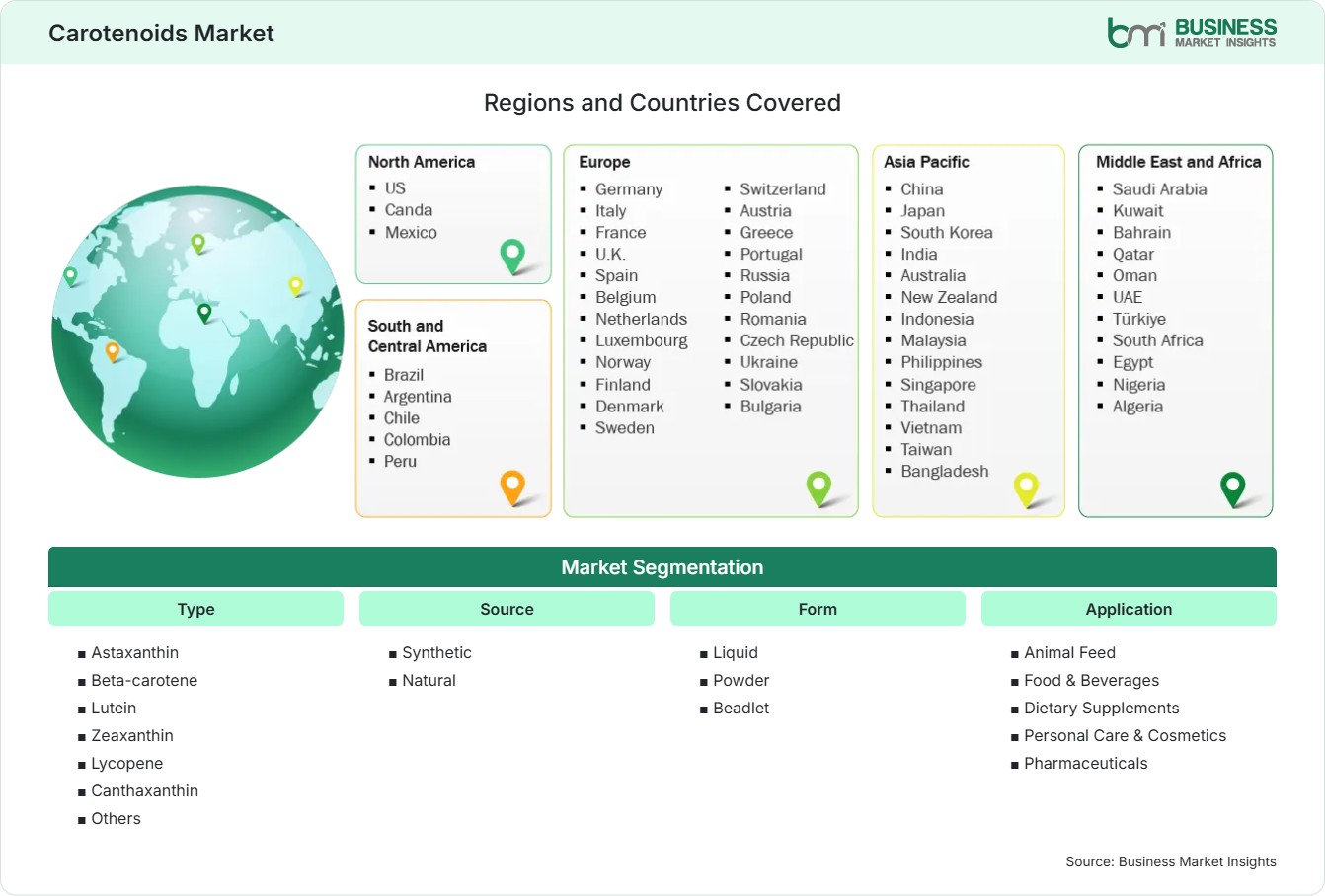
Global Market Geography
FREE PDF
Request your free sample
Request free sample
Segment Analysis

Carotenoids Market Segmentation

Type

Type was characterized by diverse income sources, and both beta-carotene and lutein remained commercially viable compounds. The segment accounts for 32-35% of the total demand concentration for the main products and experiences growth rates of 4.7-5.1% per annum. Product differentiation, formulation towards healthy products, and broad application areas help to support the Carotenoids Market scope across nutrition, feed, cosmetic, and pharmaceutical sectors.

  • Astaxanthin: Widely utilized in aquaculture, premium supplements, and sports nutrition due to strong antioxidant properties and growing consumer recognition.
  • Beta-carotene: Extensively adopted in food coloring, vitamin A fortification, and nutritional products because of multifunctional properties.
  • Lutein: Strong demand in eye-health formulations and aging population nutrition products across developed economies.
  • Zeaxanthin: Increasingly formulated alongside lutein in vision-support supplements and specialty health products.
  • Lycopene: Utilized in heart-health, antioxidant, and wellness applications while benefiting from tomato-derived sourcing.
  • Canthaxanthin: Important in feed pigmentation and specialty animal nutrition formulations globally.

Source

The Source Segmentation trend is affected by consumer preferences for transparency and sustainability. The natural segment receives increased focus, with a 5.0%-5.5% CAGR, while the synthetic segment remains competitive due to cost benefits. The Carotenoids Market trends point towards a preference for natural materials in premium segments and consumer groups.

  • Synthetic: Maintains relevance in high-volume applications requiring consistency, scalability, and competitive pricing structures.
  • Natural: Gains traction through clean-label positioning, sustainable sourcing, and expanding acceptance across food and nutrition products.

Form

Form Selection affects stability, delivery, and application efficiency. This section plays an important role in the commercialization strategy with a CAGR of 4.6%–5.0%. Product innovation includes extended shelf life, increased solubility, and improved bioavailability optimization across end-use industries.

  • Liquid: Preferred in beverages, emulsions, and formulation environments requiring easy dispersion and process flexibility.
  • Powder: Widely utilized in food processing, supplements, and industrial applications because of handling convenience.
  • Beadlet: Increasingly adopted for stability enhancement, dosage precision, and improved ingredient protection.

Application

Applications continue to be the largest category in terms of value creation, with Food & Beverages accounting for 31%-34% market share in 2025 and a 4.4%-4.8% CAGR, while Dietary Supplements is the fastest-growing category, recording a 5.7%-6.2% CAGR. Consumer wellness priorities, clean-label demand, and nutritional fortification continue driving adoption patterns across industries.

  • Animal Feed: Supports pigmentation, animal health, and productivity enhancement across poultry and aquaculture sectors.
  • Food & Beverages: Driven by the replacement of synthetic colors and increasing natural ingredient incorporation.
  • Dietary Supplements: Benefits from preventive health awareness, aging demographics, and premium wellness trends.
  • Personal Care & Cosmetics: Utilized for antioxidant functionality and naturally derived formulation positioning.
  • Pharmaceuticals: Gains value from research into antioxidant and health-support applications.
Market Forces

Carotenoids Market Dynamics

Key Market Drivers

Rising Demand for Natural Food Colorants

Consumer demand for clean-label products encourages manufacturers to replace artificial ingredients with natural ones. Regulatory pressure on the use of synthetic dyes in several countries is also contributing to this trend. Food producers that manufacture beverages, dairy products, confectionery, and bakery products have increased their use of natural ingredients. The increasing popularity of minimally processed foods has driven demand for ingredients, while advances in extraction technologies will aid the scalability of these processes. These developments continue to create durable demand across developed and emerging consumption markets.

Expansion of Preventive Healthcare and Nutraceuticals

There is a global rise in the aging population, coupled with wellness-oriented buying behavior, which drives consumption of antioxidant-containing nutritional ingredients. The ingredients lutein, zeaxanthin, astaxanthin, and beta-carotene are well-positioned in eye health and healthy aging formulas. There has been a growing focus on preventive healthcare, alongside health awareness campaigns through digital channels. The increased availability of retail and online selling platforms has enabled greater market access. Consequently, ingredient suppliers continue investing in clinically supported formulations and premium product development.

Growth of Aquaculture and Animal Nutrition Industries

The world’s aquaculture output keeps on growing, creating ongoing demand for pigment and nutrient additives. Feed producers use specialized ingredients to improve the quality and appeal of their products, especially in salmon and shrimp farming. Other important uses include poultry, where coloring the yolk is used, and performance-oriented formulations. Growth in protein consumption and livestock feeding underlies other demands. Investment in feed efficiency and sustainability initiatives further reinforces long-term demand fundamentals.

Key Market Opportunities

Commercialization of Fermentation-Derived Ingredients

Biotechnological and microbial fermentation technologies can offer a way forward towards scalability, minimal ecological disturbances, and standardized components. Biotech firms are developing sophisticated ecosystems that will reduce dependence on agricultural parameters. This assures premium positioning with supply chain security. As predicted by the Carotenoids Market Forecasts, the fermentation process can offer an investment opportunity to achieve sustainability and purity goals.

Expansion in Personalized Nutrition Products

Customized wellness programs are becoming more personalized, using unique nutritional ingredients tailored to consumers' health goals. There are trends in digital health applications, genetic tests, and supplementation that drive integration into customized formulas. Consumers look for unique products to support their eye health, immunity, healthy aging, and performance. It is possible to gain advantages in the supply chain by developing unique, high-quality ingredients for different demographic groups and health outcomes.

Growing Applications in Beauty and Skin Wellness

The market demand for consumable beauty products, as well as for antioxidant-based cosmetic products, is rising steadily. Pigmentation ingredients are being used in formulations marketed as skin-friendly and natural. Premium skincare brands have begun to value plant-based ingredients in line with sustainability goals and consumer preferences. Cross-categorical innovations between cosmetics and nutritional health offer scope for product diversification.

Market Restraints and Challenges

Raw Material Volatility and Production Cost Pressure

Supplies from natural sources remain subject to crop yields, climate variability, restrictions on algae cultivation, and processing issues. This may lead to uncertainties in the supply and pricing of raw materials. Increased manufacturing costs will reduce profits and, in some cases, undermine the competitiveness of such products compared with cheaper alternatives. Many companies have taken measures to mitigate operational risks, but cost control remains one of the main industry issues.

Regulatory Complexity and Extended Commercialization Cycles

The rules that regulate food ingredients, food claims, feed ingredients, and food approvals vary greatly from one country to another. Many companies have to make significant investments in compliance, safety testing, and documentation. Delays in obtaining approvals for food products may delay their launch, increase development costs, and impede their introduction to new markets. Companies pursuing multiple end-use applications must balance innovation objectives with evolving regulatory expectations to maintain commercial momentum.

Company Analysis

Competitive Landscape

The competitive environment reflects a blend of multinational nutrition companies and specialized ingredient manufacturers. Carotenoids Market analysis indicates increasing emphasis on sustainability, natural sourcing, formulation technologies, and strategic partnerships.

Company Name

Overview

Products and Services relevant to this market

DSM-Firmenich AG

Global nutrition and health leader with extensive ingredient innovation capabilities and worldwide presence.

Beta-carotene, lutein, vitamin solutions, nutritional premixes, specialty carotenoid ingredients.

BASF SE

Diversified chemical company with strong carotenoid manufacturing and global distribution networks.

Beta-carotene, canthaxanthin, feed pigments, nutrition ingredients, formulation technologies.

Kemin Industries, Inc.

Specialized ingredient producer serving feed, food, and health industries globally.

Lutein, zeaxanthin, feed pigments, specialty nutritional ingredients.

Chr. Hansen Holding A/S

Bioscience-focused company supporting natural ingredient and microbial solutions.

Natural color solutions, fermentation technologies, health-oriented formulations.

Lycored Ltd.

Specialist in tomato-derived nutrition and wellness ingredients.

Lycopene extracts, antioxidant ingredients, wellness solutions.

Divi's Laboratories Limited

Major manufacturer of nutraceutical and pharmaceutical ingredients.

Carotenoid intermediates, specialty nutrition compounds, formulation support.

Cyanotech Corporation

Algae cultivation specialist with established microalgae production expertise.

Natural astaxanthin, microalgae ingredients, dietary supplement products.

Allied Biotech Corporation

Taiwan-based manufacturer focused on nutritional and coloring ingredients.

Beta-carotene, lutein, food coloring solutions, nutritional products.

Döhler GmbH

Global ingredient provider serving food and beverage manufacturers.

Natural colors, fruit-based solutions, beverage ingredient systems.

Fuji Chemical Industries Co., Ltd.

Japanese producer known for specialty nutraceutical ingredients.

Astaxanthin ingredients, wellness formulations, nutraceutical solutions.

Trust & Transparency

Research Methodology

The market analysis combines proprietary research with secondary data from government agencies, company disclosures, regulatory filings, industry databases and expert interviews. Market estimates are validated through data triangulation, cross-market benchmarking and analyst review.

View Full Research Methodology

Questions Answered

Frequently Asked Questions

What does the Carotenoids Market Report cover?

The Market Report covers market sizing, segmentation, regional performance, competitive landscape, trends, drivers, opportunities, restraints, and forecast outlook through 2033.

Which region is expected to grow fastest?

Asia Pacific is projected to register the highest growth due to expanding aquaculture production, increasing healthcare expenditure, and strengthening food processing industries.

Why are natural sources gaining popularity?

Natural sources align with clean-label requirements, sustainability goals, and consumer preferences for plant-derived ingredients, helping manufacturers differentiate premium products.

Which application segment offers the strongest future potential?

Dietary supplements present the strongest growth outlook due to aging populations, personalized nutrition trends, and rising interest in eye-health and wellness formulations.

What factors are driving demand for carotenoid ingredients?

Demand is supported by growth in natural food colorants, preventive healthcare products, animal nutrition applications, clean-label trends, and increasing consumer awareness of antioxidant-rich ingredients.

Access the Full Carotenoids Market Report

Get segment-level forecasts, regional estimates, competitive benchmarking, company profiles and downloadable Excel datasets.

Access the full Carotenoids Market Report
350 pages PDF & Excel | 2026-09-22
Similar Research

Related Market Reports