
Burn Care Market Outlook: Size, Share, Trends, Growth Analysis, Competitive Landscape & Forecast, 2026-2033

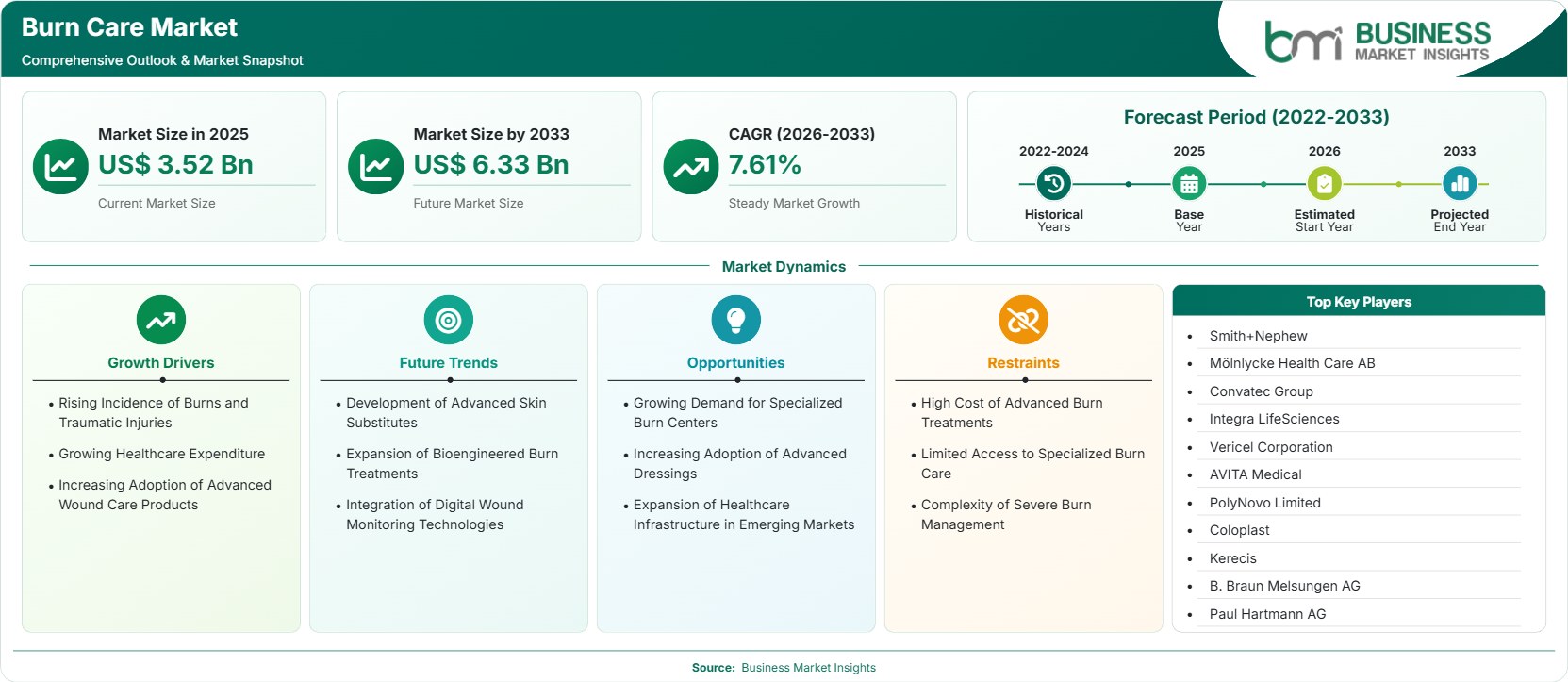
The Burn Care Market size was valued at US$ 3.52 Billion in 2025 and is projected to reach US$ 6.33 Billion by 2033, growing at a CAGR of 7.61% during 2026–2033, driven by rising burn incidence, advanced dressings, regenerative therapies, specialized centers, and expanding healthcare infrastructure.

Report Coverage
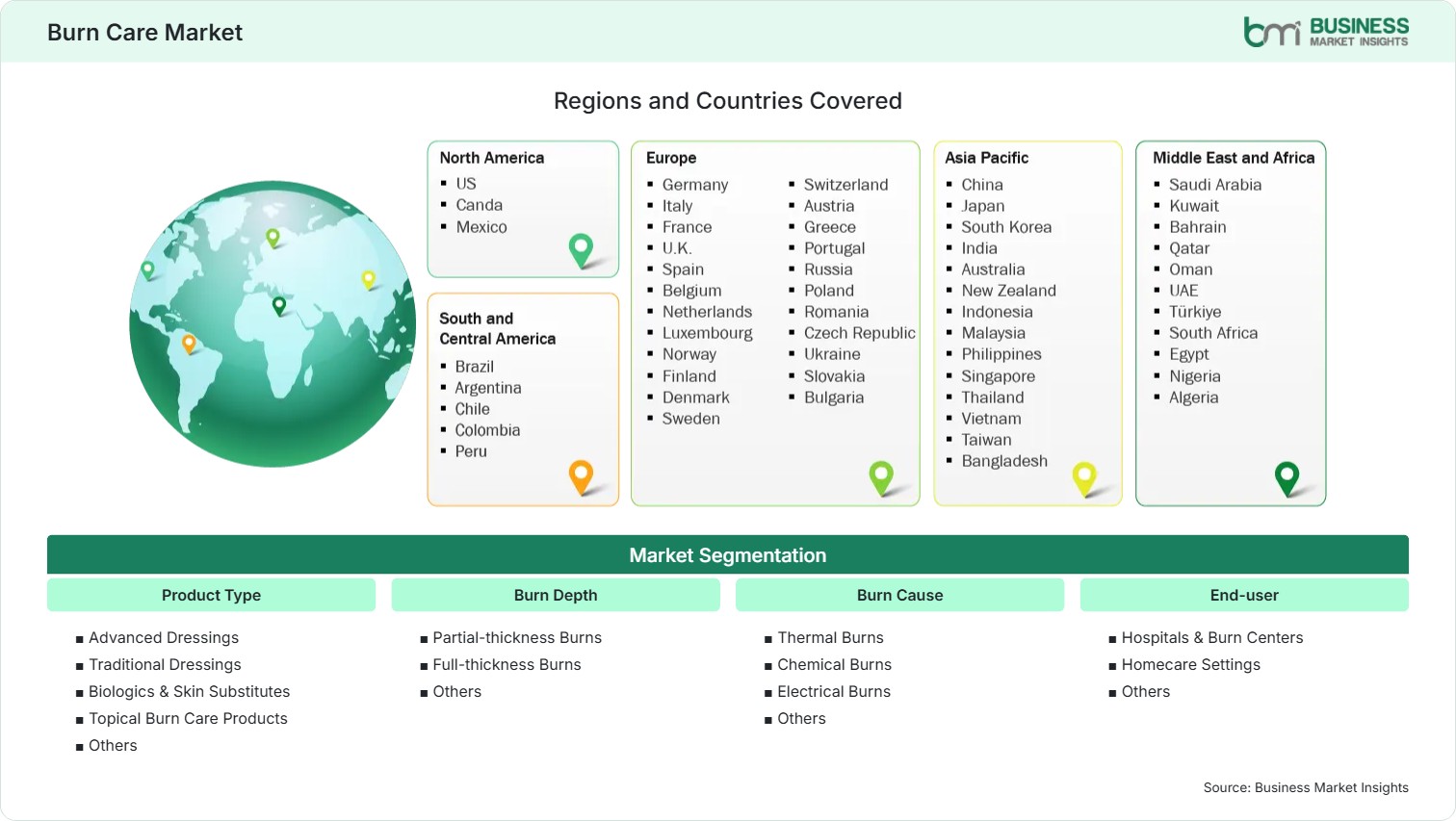
  • Product Type: Advanced Dressings, Traditional Dressings, Biologics & Skin Substitutes, Topical Burn Care Products, Others
  • Burn Depth: Partial-thickness Burns, Full-thickness Burns, Others
  • Burn Cause: Thermal Burns, Chemical Burns, Electrical Burns, Others
  • End-user: Hospitals & Burn Centers, Homecare Settings, Others
US$ 3.52 Bn Market size in 2025
US$ 6.33 Bn Market Size by 2033
7.61% CAGR, 2026 - 2033
2026-2033 Forecast Period

AI Overview

Burn Care Market Summary

  • North America Region: North America holds a market share of 37%–40% in 2025 and is projected to grow at a CAGR of 6.8%–7.5% during 2026–2033. Strong reimbursement systems, advanced burn treatment capabilities, biologics adoption, and innovation in wound management create sustained expansion opportunities. The U.S. dominates regional revenue and is estimated to register a CAGR of 6.9%–7.6% through 2033.
  • Fastest Growing Region: Asia Pacific accounts for 24%–27% market share in 2025 and is anticipated to expand at a CAGR of 8.5%–9.4%. Expanding healthcare infrastructure, improving trauma care access, growing healthcare spending, and rising awareness of advanced wound treatment support accelerated adoption.
  • Leading Segment: Advanced Dressings represent 39%–43% market share in 2025 and are expected to grow at a CAGR of 7.4%–8.2%. Superior moisture management, infection control benefits, reduced dressing changes, and favorable clinical outcomes continue driving utilization.
  • High Growth Segment: Biologics & Skin Substitutes account for 15%–18% market share in 2025 and are forecast to grow at a CAGR of 9.5%–10.4%. Regenerative medicine advancements, severe burn treatment requirements, and improved tissue restoration outcomes support strong adoption.
  • Key Market Opportunity: Expanding access to regenerative therapies, bioengineered skin substitutes, telehealth-enabled wound monitoring, and specialized burn centers presents significant opportunities for manufacturers, providers, and healthcare systems globally.
  • Major Market Players: Smith+Nephew plc, Mölnlycke Health Care AB, ConvaTec Group Plc, Integra LifeSciences Holdings Corporation, Vericel Corporation, AVITA Medical, Inc., PolyNovo Limited, Coloplast A/S, Kerecis ehf., B. Braun Melsungen AG, and PAUL HARTMANN AG.
Strategic Insights

Burn Care Market: Strategic Insights

Burn Care Market Strategic Framework
FREE PDF
Request your free sample
Request free sample
Stakeholder View

Key Takeaways

  • The supply chain includes such participants as dressing producers, biologics companies, tissue engineers, hospitals, and distributors, forming a rather specific environment that is oriented to clinical results and efficiency.
  • Regenerative medicine and skin substitute solutions hold tremendous promise because of increasing need for fast healing, less scar formation, and better treatment for severe burn injuries.
  • Innovation in products is moving towards tissue engineering, antimicrobial dressings, wound monitoring technologies, and personalized medicine based on clinical evidence.
  • The Asia Pacific region offers an excellent investment opportunity in terms of enhanced healthcare infrastructure, availability of treatment, increased healthcare spending, and greater patient awareness.
  • Strategic partnerships, licensing agreements, and acquisitions focused on regenerative medicine and advanced wound care technologies continue shaping competitive positioning across the industry.
  • The development of burn treatment protocols in outpatient settings is opening up prospects for products suitable for home care use without compromising efficacy.
Geographic Outlook

Burn Care Market Regional Highlights

North America Burn Care Market

North America represented a modeled 34%–37% share in 2025 and is projected to grow at a 6.9%–7.5% CAGR through 2033. The region benefits from mature trauma systems, specialized burn centers, advanced reimbursement structures, and broad availability of wound technologies. The US remains the principal contributor, while Canada supports regional demand through hospital-based burn services and advanced wound-care procurement. The Burn Care Market share remains concentrated around technologically advanced products and specialist providers.

  • Adoption of advanced wound care is facilitated through hospital policies which advocate for infection control, exudate handling, atraumatic dressing removal, and effective wound bed preparation in complex burn pathway systems.
  • The United States continues to offer a good commercialization environment for cellular therapy, biosynthetic matrix, antimicrobial dressing, and advanced reconstruction technology.
  • Canada presents a smaller but technologically sophisticated opportunity, particularly for products supporting specialized trauma treatment, postoperative healing, and complex wound management.
  • Evidence-based procurement increasingly favors solutions demonstrating economic value through reduced nursing requirements, lower dressing frequency, and improved healing trajectories.

US Burn Care Market

The US accounted for a modeled 27%–30% of the global market and approximately 79%–82% of North American demand in 2025, with growth modeled at 6.8%–7.4% CAGR. The country has extensive burn-center capacity, sophisticated reimbursement mechanisms, and strong clinical adoption of advanced wound technologies. FDA-cleared regenerative products are expanding treatment options for thermal burns and full-thickness defects.

  • Specialist burn centers provide an established pathway for adoption of advanced dressings, temporary skin substitutes, cellular therapies, hydrosurgery, and biologic wound matrices.
  • Clinical evidence increasingly influences procurement, with hospitals evaluating treatment technologies against length of stay, wound closure, infection prevention, donor-site burden, and total treatment costs.
  • Private healthcare investment and specialist ambulatory services create additional opportunities for products that can shift suitable treatment toward less resource-intensive settings.

Europe Burn Care Market

Europe held a modeled 27%–30% share in 2025 and is expected to expand at a 7.0%–7.6% CAGR through 2033. Germany, the UK, France, Italy, and Spain represent leading established markets, while Poland and selected Central European economies provide comparatively faster expansion opportunities. European procurement increasingly emphasizes clinical effectiveness, antimicrobial stewardship, sustainability, and healthcare-resource efficiency.

  • Germany remains a leading market because of advanced hospital infrastructure, specialist surgical capacity, and established adoption of high-value wound-management technologies.
  • The UK combines specialized burn services with strong health-economic evaluation, encouraging manufacturers to demonstrate clinical effectiveness alongside measurable resource benefits.
  • France and Italy offer attractive opportunities through established reconstructive surgery networks and growing use of sophisticated wound-management protocols.
  • Poland and selected Central European markets can outpace mature Western European markets as specialist infrastructure and advanced wound-care access expand.

Asia Pacific Burn Care Market

Asia Pacific held a modeled 25%–28% share in 2025 and represents the fastest-growing region at an 8.4%–9.2% CAGR. China, Japan, South Korea, India, and Australia form the principal markets, while India and Southeast Asia offer particularly strong expansion opportunities.

  • India has great long-term potential due to the development of specialist burn centers, tertiary hospitals, surgery, and advanced dressings in major cities and regions of the country.
  • China has a large number of patients and is constantly developing modernized hospitals, indigenous medical devices, and interest in wound management techniques.
  • Japan and South Korea provide mature markets where sophisticated wound care, regenerative medicine, and hospital efficiency support premium product adoption.
  • Australia represents a technologically advanced market with established specialist burn services and favorable clinical environments for innovative wound-management solutions.

Rest of World Burn Care Market

Rest of World represented a modeled 9%–12% share in 2025 and is projected to grow at a 6.4%–7.2% CAGR. South and Central America are led by Brazil and Mexico, while Chile and Colombia offer developing opportunities. In the Middle East and Africa, Saudi Arabia, the United Arab Emirates, and South Africa are leading markets as specialist healthcare infrastructure expands.

  • Brazil combines substantial healthcare demand with growing private-sector investment, creating opportunities for advanced dressings, biologics, and specialist burn treatment technologies.
  • Mexico offers an expanding opportunity through private hospitals and specialist providers seeking improved wound-healing efficiency and reduced treatment burden.
  • Saudi Arabia and the UAE are strengthening tertiary and specialist healthcare infrastructure, supporting adoption of premium burn-care products.
  • South Africa provides a regional gateway for advanced wound technologies, although affordability and specialist distribution remain important market-entry considerations.
Global Market Geography
FREE PDF
Request your free sample
Request free sample
Segment Analysis

Burn Care Market Segmentation

Product Type

Advanced Dressings represent the leading product category with a modeled 31%–34% share in 2025 and a 7.7%–8.3% CAGR through 2033. Burn Care Market trends favor products that combine antimicrobial protection, exudate management, conformability, and atraumatic removal. Biologics are gaining momentum as treatment complexity increases.

  • Advanced Dressings: Antimicrobial foams, silicone interfaces, hydrogels, and specialized absorbent materials improve moisture balance, infection control, comfort, and dressing-change efficiency in partial-thickness wounds.
  • Traditional Dressings: Gauze, cotton, and basic absorbent materials remain relevant where affordability and availability dominate procurement decisions, particularly in lower-resource settings and initial treatment.
  • Biologics & Skin Substitutes: Biosynthetic matrices, cellular therapies, fish-skin grafts, and regenerative materials support tissue restoration and reconstruction when conventional dressings cannot adequately address complex wounds.
  • Topical Burn Care Products: Antimicrobial creams, gels, ointments, and cleansing formulations support wound preparation, infection management, moisture control, and adjunctive treatment throughout the healing pathway.

Burn Depth

Partial-thickness Burns constitute the broadest clinical application because they frequently require sophisticated dressing management without immediate definitive reconstruction. This segment holds a modeled 52%–56% share in 2025 and a 7.1%–7.7% CAGR through 2033. Burn Care Market analysis indicates increasing preference for therapies supporting rapid re-epithelialization and minimizing dressing-related trauma.

  • Partial-thickness Burns: Advanced dressings, antimicrobial barriers, hydrogels, and cellular therapies support epithelialization while reducing pain, exudate, infection exposure, and repeated wound disturbance.
  • Full-thickness Burns: Extensive tissue destruction requires surgical excision, grafting, biologic matrices, or regenerative technologies, creating demand for solutions that support reconstruction and donor-site preservation.

Burn Cause

Thermal Burns remain the dominant cause because flames, hot liquids, hot surfaces, and steam represent common mechanisms across household, workplace, and industrial environments. The segment holds a modeled 67%–71% share in 2025 and a 7.3%–7.9% CAGR through 2033. Cause-specific treatment selection influences dressing, debridement, and reconstruction requirements.

  • Thermal Burns: Flame, scald, and contact injuries generate broad demand for antimicrobial dressings, wound cleansing, tissue substitutes, and regenerative therapies across hospital and outpatient pathways.
  • Chemical Burns: Chemical exposure often requires rapid decontamination followed by specialized wound assessment, creating demand for irrigation, topical treatment, protective dressings, and close monitoring.
  • Electrical Burns: Electrical injuries can involve deeper tissue damage than surface appearance suggests, requiring specialist evaluation, surgical intervention, infection control, and reconstruction-focused treatment.

End-user

Hospitals & Burn Centers remain the principal end-user category, supported by complex injuries requiring surgery, intensive monitoring, infection prevention, and specialist wound management. The segment represents a modeled 70%–74% share in 2025 and a 7.2%–7.8% CAGR through 2033. Burn Care Market adoption is gradually extending into homecare as stable wounds become suitable for managed follow-up.

  • Hospitals & Burn Centers: Specialist facilities provide advanced debridement, reconstruction, antimicrobial therapy, biologics, cellular treatment, intensive monitoring, and multidisciplinary rehabilitation for severe burns.
  • Homecare Settings: Home-based treatment supports continuing dressing changes, wound monitoring, scar management, and rehabilitation after clinical stabilization, particularly where products simplify application and reduce trauma.
Market Forces

Burn Care Market Dynamics

Key Market Drivers

Rising Incidence of Burns and Traumatic Injuries

Urbanization, industrial activity, workplace accidents, and household fire incidents continue contributing to the clinical burden. Advanced technology-based wound care solutions that enhance the healing process and decrease the occurrence of complications have started being used by health professionals more commonly. The Burn Care Market growth is driven due to the increasing number of cases being treated in emergency departments, trauma centers, and burn centers. Awareness about the timely treatment and prevention of infection has also contributed to the use of the products.

Growing Healthcare Expenditure

Healthcare spending growth across developed and emerging economies is improving patient access to advanced wound care solutions. Resources in both public and private health care organizations have become more and more directed towards specialty care, facilities for trauma treatment, and state-of-the-art methods of wound management. Increased spending allows purchasing top-class dressings, biologics, and skin substitute products which could be subject to adoption restrictions earlier. An increased availability of insurance coverage and reimbursement also promotes treatment access. Modern hospitals have incorporated evidence-based products that minimize the risk of developing complications and improve healing.

Increasing Adoption of Advanced Wound Care Products

Clinical preference is shifting toward advanced products capable of maintaining optimal wound environments while reducing infection risks and healing times. Foam dressings, hydrofiber dressings, silver dressings, and regenerative therapy are rapidly overtaking traditional dressings across a variety of care environments due to documented patient comfort, efficient exudate management, and a lower incidence of dressing changes. The Burn Care Market trends show increasing acceptance among physicians of biologics and tissue engineering technology used for treating major burns needing sophisticated treatment. There is no shortage of innovation in product development as companies seek to distinguish themselves through solutions that enhance healing, reduce scarring, and deal with issues related to burn wounds.

Key Market Opportunities

Growing Demand for Specialized Burn Centers

Specialized burn centers are becoming increasingly important as healthcare systems seek improved clinical outcomes and more efficient management of complex injuries. The development of specialized centers allows the development of opportunities for advanced dressings, biologics manufacturers, and companies supplying wound monitoring equipment. In addition, these centers tend to utilize new treatment strategies faster compared to general hospitals, thus increasing commercialization prospects. The Burn Care Market growth of infrastructure for specialized treatments in other countries allows suppliers to benefit from ongoing demand.

Increasing Adoption of Advanced Dressings

Advanced dressings present significant expansion potential as healthcare providers prioritize faster healing, reduced infection risks, and enhanced patient comfort. Advancements in antimicrobial technology, moisture control, and bioactivity have been continuously gaining acceptance through innovation. More and more healthcare systems are beginning to see the economic value in the improved efficiency in healing and lesser hospitalizations that result from it. Product offerings are being diversified to cover different types of wounds and healing stages. Increased awareness amongst both doctors and patients further enhances the potential for market penetration.

Expansion of Healthcare Infrastructure

Healthcare infrastructure development across emerging economies creates long-term commercial opportunities for product manufacturers and service providers. Investments in trauma centers, surgery units, emergency care services, and specialty units enable patients to get more exposure to cutting-edge treatments. More governments are focusing on improving the quality of healthcare and increasing the accessibility of treatment options. These factors will positively impact the Burn Care Market Forecasts due to increased addressable patient base and technology adaptation. Development of infrastructure will also encourage development of training programs and standardization of treatment protocols for better utilization of advanced burn care products.

Market Restraints and Challenges

High Cost of Advanced Burn Treatments

Factor: Advanced dressings, biologics, engineered skin substitutes, and regenerative therapies often involve substantial acquisition and treatment costs. Impact: High costs may be a limiting factor when it comes to the application in cost-driven healthcare systems or patient populations that lack insurance. Constraints in budget may force one to prefer conventional treatment methods due to better results from innovative treatments. The issues with reimbursement in some regions may be an additional barrier to usage. Clinicians will have to weigh clinical effectiveness versus cost when making decisions, especially in limited settings.

Limited Access to Specialized Burn Care

Factor: Many regions continue facing shortages of burn specialists, dedicated treatment centers, and advanced wound management resources. Impact: Treatment delay and limited access to specific expertise might impair clinical results and limit the implementation of novel approaches. Rural and disadvantaged regions are especially vulnerable due to the lack of adequate infrastructure and specialists. The period of recovery will be prolonged and more problems might arise due to the lack of necessary treatment methods. The development of specialist networks and health care infrastructure is vital for enhancing the availability of treatments.

Company Analysis

Competitive Landscape

The Burn Care Market analysis indicates a competitive structure combining diversified medical-technology companies, advanced wound-care specialists, regenerative medicine developers, and biologics innovators. Product differentiation increasingly centers on antimicrobial performance, tissue regeneration, ease of use, evidence quality, and economic outcomes.

Company Name

Overview

Products and Services relevant to this market

Smith+Nephew plc

Global medical-technology company with an established advanced wound-management portfolio and dedicated burn-treatment pathway.

ACTICOAT antimicrobial dressings, VERSAJET hydrosurgery, BIOBRANE temporary biosynthetic skin dressing, INTRASITE products, and negative pressure wound therapy.

Mölnlycke Health Care AB

Global wound-care specialist emphasizing patient comfort, wound protection, and efficient treatment pathways.

Mepilex Ag, Mepilex Transfer Ag, Mepitel Ag, Granudacyn, Tubifast, Tubigrip, and burn-focused wound-care solutions.

Convatec Group Plc

Medical-products company focused on advanced wound management and technologies designed to improve wound-care outcomes.

AQUACEL Hydrofiber dressings and Aquacel ConvaFiber, including products cleared for partial-thickness burns.

Integra LifeSciences Holdings Corporation

Medical-technology company with capabilities spanning tissue technologies, wound reconstruction, and regenerative treatment.

Integra tissue technologies, dermal regeneration solutions, wound matrices, and reconstructive products relevant to complex burn wounds.

Vericel Corporation

Regenerative medicine company focused on cell-based therapies and advanced treatment options for severe tissue injuries.

NexoBrid-related burn treatment capabilities and regenerative medicine technologies supporting complex wound management.

AVITA Medical, Inc.

Regenerative medicine company focused on autologous cellular therapies for acute wound treatment.

RECELL Autologous Cell Harvesting Device for thermal burn wounds and full-thickness skin defects.

PolyNovo Limited

Australian medical-device company specializing in synthetic dermal regeneration technology for complex wounds.

NovoSorb BTM, a synthetic biodegradable temporizing matrix used in complex wound reconstruction, including burns.

Coloplast A/S

Global medical-device company with an advanced wound-care business strengthened by its Kerecis acquisition.

Advanced wound dressings and Kerecis biological tissue-regeneration technologies for complex wounds and burns.

Kerecis hf

Specialist tissue-regeneration company using minimally processed intact North Atlantic cod skin for wound healing.

GraftGuide, MariGraft, and other fish-skin graft platforms designed for burns and complex wounds.

B. Braun Melsungen AG

Diversified medical-technology company offering wound-management products and burn-treatment solutions.

Prontosan wound irrigation, Prontosan Wound Gel X, Askina Calgitrol Paste, and infection-prevention solutions for burn care.

PAUL HARTMANN AG

European healthcare supplier with established wound-care and infection-management capabilities.

Advanced and traditional wound dressings, cleansing solutions, fixation products, and wound-management technologies applicable to burn treatment.

Trust & Transparency

Research Methodology

The market analysis combines proprietary research with secondary data from government agencies, company disclosures, regulatory filings, industry databases and expert interviews. Market estimates are validated through data triangulation, cross-market benchmarking and analyst review.

View Full Research Methodology

Questions Answered

Frequently Asked Questions

What does the Burn Care Market Report typically evaluate for strategic planning?

Such a detailed report analyzes innovations, adoption rates, competitors position, regulations, reimbursement, regional differences, and investment potential.

How is home-based burn management changing the industry landscape?

Developments in dressings technology, telemedicine, and wound monitoring services allow an increasing number of people to recover from burns at home rather than in hospitals.

Which region offers the most attractive long-term growth opportunities?

The Asia Pacific region has the brightest growth prospects owing to the development of healthcare facilities, increasing availability of advanced wound care products, higher healthcare spending, and increased awareness about burn treatment.

How are biologics and skin substitutes influencing treatment outcomes?

Biologics and skin substitutes facilitate tissue regeneration, accelerate wound closure rates, lower the risk of infections, and assist in limiting scarring in patients suffering from serious burns.

What factors are primarily driving demand across the Burn Care Market?

Growing incidence of burn injuries, wider adoption of advanced wound care technologies, increasing healthcare expenditure, and greater availability of specialized burn treatment centers are strengthening demand.

Access the Full Burn Care Market Report

Get segment-level forecasts, regional estimates, competitive benchmarking, company profiles and downloadable Excel datasets.

Access the full Burn Care Market Report
350 pages PDF & Excel | 2026-09-15
Similar Research

Related Market Reports