
Intensive Care Unit (ICU) Equipment Market Outlook: Size, Share, Trends, Growth Analysis, Competitive Landscape & Forecast, 2026-2033

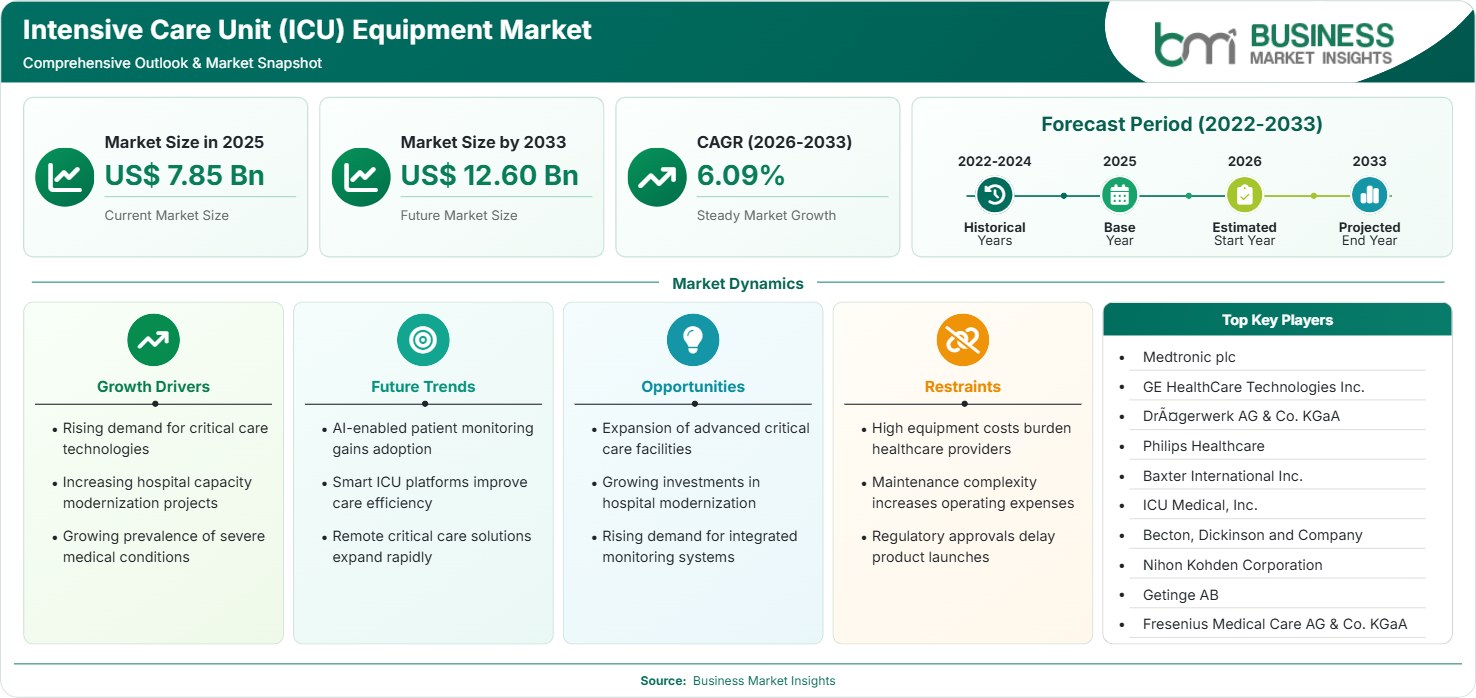
The Intensive Care Unit ICU Equipment Market size was valued at US$ 7.85 billion in 2025 and is projected to reach US$ 12.6 billion by 2033, growing at a CAGR of 6.09% during 2026–2033. Rising demand for critical care technologies, hospital modernization projects, increasing incidence of severe medical conditions, and continuous investment in advanced healthcare infrastructure are supporting long-term market expansion.

Report Coverage
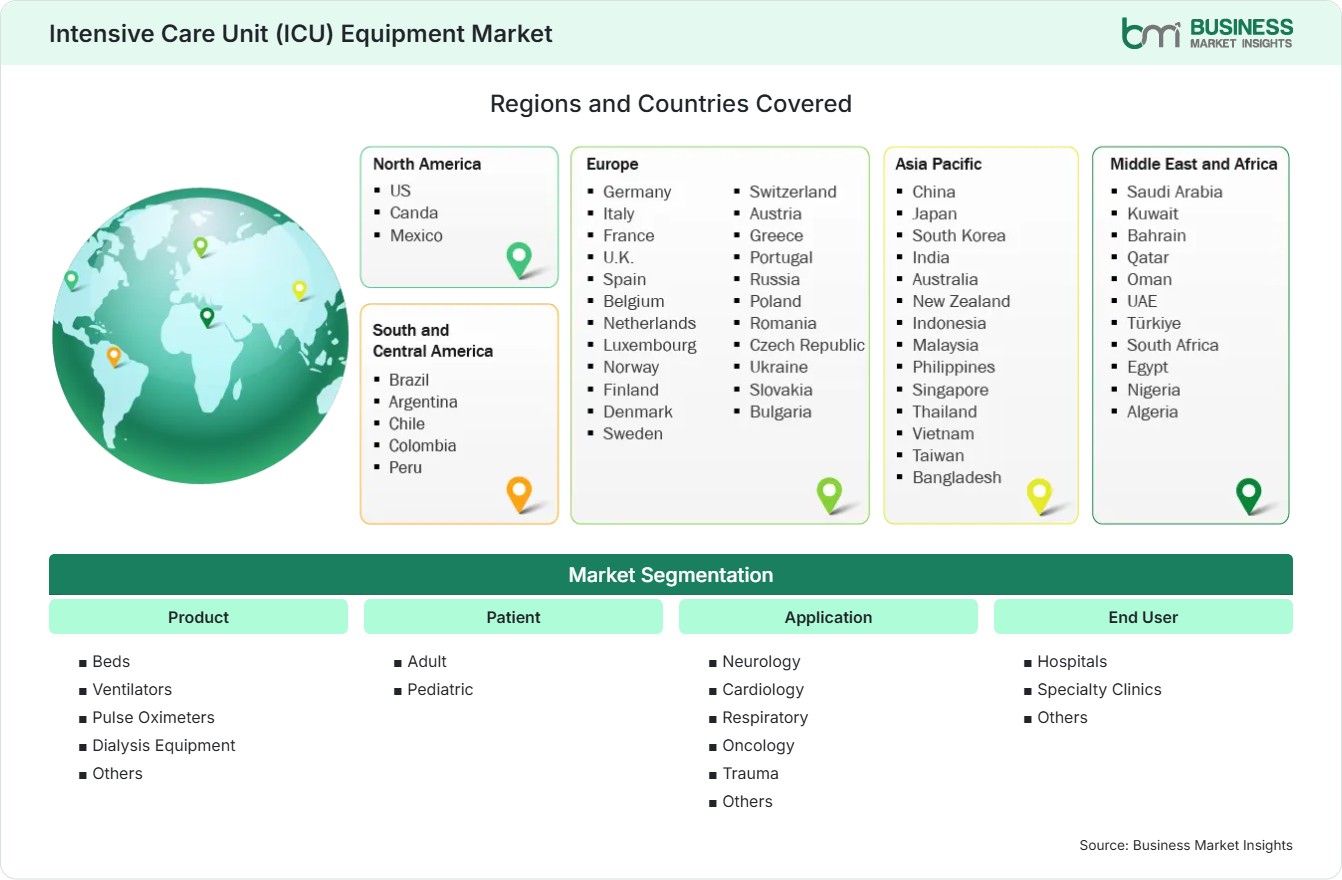
  • Product: Beds, Ventilators, Pulse Oximeters, Dialysis Equipment, Others
  • Patient: Adult, Pediatric
  • Application: Neurology, Cardiology, Respiratory, Oncology, Trauma, Others
  • End User: Hospitals, Specialty Clinics, Others
US$ 7.85 Bn Market size in 2025
US$ 12.60 Bn Market Size by 2033
6.09% CAGR, 2026 - 2033
2026-2033 Forecast Period

AI Overview

Intensive Care Unit (ICU) Equipment Market Summary

  • North America Region: North America holds 37%–40% market share in 2025 and is projected to expand at a CAGR of 5.7%–6.2% during 2026–2033. Market expansion is supported by advanced healthcare infrastructure, strong ICU capacity, favorable reimbursement systems, increasing replacement of critical care equipment, and growing adoption of connected monitoring technologies. The U.S. remains the largest regional market with an estimated 5.8%–6.3% CAGR, driven by continuous hospital investments and digital critical care programs.
  • Fastest Growing Region: Asia Pacific accounts for 26%–29% market share in 2025 and is expected to register a CAGR of 7.3%–7.9% during the forecast period. Expanding hospital infrastructure, improving healthcare access, government healthcare spending, and increasing critical care admissions continue supporting regional growth.
  • Leading Segment: Ventilators represent 28%–31% market share in 2025 and are anticipated to grow at a CAGR of 6.5%–7.0%, supported by increasing respiratory disease burden, emergency preparedness initiatives, and rising demand for advanced life-support technologies.
  • High Growth Segment: Hospitals account for 66%–70% market share in 2025 and are forecast to expand at a CAGR of 6.3%–6.8%. Ongoing investments in ICU expansion, modernization projects, and integrated patient monitoring systems continue driving equipment procurement.
  • Key Market Opportunity: Expansion of intensive care infrastructure, adoption of smart patient monitoring, connected medical devices, and digital clinical decision support systems is creating new opportunities for equipment manufacturers and healthcare providers.
  • Major Market Players: Medtronic plc, GE HealthCare Technologies Inc., Drägerwerk AG & Co. KGaA, Philips Healthcare, Baxter International Inc., ICU Medical, Inc., Becton, Dickinson and Company, Nihon Kohden Corporation, Getinge AB, and Fresenius Medical Care AG & Co. KGaA.
Strategic Insights

Intensive Care Unit (ICU) Equipment Market: Strategic Insights

Intensive Care Unit (ICU) Equipment Market Strategic Framework
FREE PDF
Request your free sample
Request free sample
Stakeholder View

Key Takeaways

  • Demand is shifting toward integrated ICU ecosystems where ventilators, monitoring systems, dialysis equipment, and clinical software operate through connected digital platforms that improve patient management.
  • Hospitals remain the primary purchasing channel as healthcare providers continue expanding intensive care capacity and replacing aging equipment with advanced critical care technologies.
  • Product innovation is increasingly focused on smart monitoring, automation, interoperability, and real-time clinical data integration to improve patient safety and workflow efficiency.
  • Asia Pacific presents the strongest long-term investment opportunity due to expanding healthcare infrastructure, increasing public health expenditure, and rising demand for advanced intensive care services.
  • Strategic collaborations, technology partnerships, and product upgrades are strengthening competition as manufacturers develop comprehensive critical care solutions for modern healthcare facilities.
  • Growing emphasis on value-based healthcare is encouraging hospitals to invest in equipment that improves clinical outcomes while reducing operational costs and equipment downtime.
Geographic Outlook

Intensive Care Unit (ICU) Equipment Market Regional Highlights

North America Intensive Care Unit ICU Equipment Market

North America accounts for 37%–40% Intensive Care Unit ICU Equipment Market share in 2025 and is expected to expand at a CAGR of 5.7%–6.2% during 2026–2033. High healthcare expenditure, established hospital networks, continuous replacement of critical care equipment, and increasing adoption of digital intensive care technologies support regional leadership. Hospitals across the region continue investing in advanced ventilators, patient monitoring systems, dialysis equipment, and connected ICU platforms to improve patient safety and clinical efficiency.

  • Hospitals continue modernizing intensive care departments with integrated monitoring systems, smart ventilators, and centralized patient management platforms that improve workflow efficiency and clinical decision-making.
  • Healthcare providers are replacing aging ICU equipment with digitally connected solutions offering improved interoperability, remote monitoring capabilities, and enhanced patient safety.
  • Medical technology companies continue introducing advanced critical care devices featuring automation, predictive alerts, and cloud-enabled data management for hospital environments.
  • Ongoing investments in healthcare infrastructure and hospital modernization programs continue supporting demand for next-generation intensive care equipment.

US Intensive Care Unit ICU Equipment Market

The United States represents approximately 82%–85% of North American revenue and is projected to grow at a CAGR of 5.8%–6.3% during 2026–2033. Strong hospital investment, high ICU occupancy, technological innovation, and increasing adoption of connected medical devices continue supporting equipment replacement and modernization across healthcare facilities.

  • Hospitals continue expanding digital intensive care capabilities through centralized monitoring and intelligent life-support systems.
  • Healthcare systems increasingly invest in integrated clinical information platforms supporting critical care operations.
  • Equipment manufacturers introduce connected devices that improve patient monitoring accuracy and operational efficiency.
  • Continued emphasis on emergency preparedness strengthens procurement of advanced ICU equipment across healthcare networks.

Europe Intensive Care Unit ICU Equipment Market

Europe holds 25%–28% market share in 2025 and is anticipated to register a CAGR of 5.9%–6.4% through 2026–2033. Healthcare modernization, aging populations, and increased investment in hospital infrastructure continue driving demand. Germany remains the leading regional market, while Spain records one of the fastest growth rates owing to ongoing healthcare infrastructure upgrades.

  • Public healthcare investments continue supporting modernization of intensive care departments across regional hospitals.
  • Demand for advanced monitoring systems and ventilators increases as healthcare providers strengthen emergency preparedness.
  • Medical device manufacturers expand digital integration capabilities across critical care equipment portfolios.
  • Growing focus on patient safety and hospital efficiency encourages adoption of connected ICU technologies.

Asia Pacific Intensive Care Unit ICU Equipment Market

Asia Pacific accounts for 26%–29% market share in 2025 and records the fastest 7.3%–7.9% CAGR during the forecast period. Expansion of hospital infrastructure, rising healthcare expenditure, growing burden of chronic diseases, and increasing investments in advanced medical equipment continue driving regional demand. China leads regional revenue, while India records the strongest future growth potential.

  • Governments continue expanding public hospital capacity and critical care infrastructure to improve healthcare access.
  • Private healthcare providers increasingly invest in advanced ICU equipment and integrated monitoring technologies.
  • Rising chronic disease prevalence supports long-term demand for respiratory and cardiac critical care equipment.
  • Medical technology companies continue expanding regional manufacturing and distribution capabilities.

Rest of World Intensive Care Unit ICU Equipment Market

The Rest of World region accounts for 7%–10% market share in 2025 and is projected to expand at a CAGR of 6.2%–6.7% during 2026–2033. Healthcare infrastructure improvements, increasing government healthcare investments, and rising access to specialized critical care services continue supporting market expansion across Latin America, the Middle East, and Africa.

  • Gulf countries continue investing in modern hospitals equipped with advanced intensive care technologies.
  • Brazil leads Latin American demand through ongoing hospital modernization and healthcare investment.
  • Healthcare providers increasingly adopt integrated patient monitoring and life-support systems.
  • Expanding access to specialized healthcare services supports gradual adoption of advanced ICU equipment across emerging markets.
Global Market Geography
FREE PDF
Request your free sample
Request free sample
Segment Analysis

Intensive Care Unit (ICU) Equipment Market Segmentation

Product

The product segment forms the foundation of intensive care delivery as hospitals continue investing in advanced life-support systems and patient monitoring technologies. It accounted for 44%–47% intensive care unit ICU equipment market share in 2025 and is projected to grow at a CAGR of 6.2%–6.7% during 2026–2033. Increasing adoption of integrated critical care devices and digital monitoring platforms continues to broaden the Intensive Care Unit ICU Equipment Market scope across modern healthcare facilities.

  • Beds: Advanced ICU beds improve patient positioning, pressure injury prevention, mobility support, and caregiver accessibility while integrating with monitoring systems to enhance patient management in high-acuity environments.
  • Ventilators: Demand remains strong as hospitals expand respiratory care capabilities for patients requiring mechanical ventilation, emergency support, and advanced pulmonary management across intensive care settings.
  • Pulse Oximeters: Continuous oxygen saturation monitoring supports timely clinical intervention, improving patient safety during respiratory emergencies, post-surgical recovery, and critical illness management.
  • Dialysis Equipment: Widely used for critically ill patients experiencing acute kidney injury or multi-organ dysfunction, supporting continuous renal replacement therapy in intensive care environments.
  • Others: Includes infusion pumps, patient monitors, defibrillators, suction systems, and temperature management devices that collectively strengthen comprehensive intensive care delivery.

Patient

Patient-based demand continues to reflect changing demographic trends and the growing burden of chronic diseases requiring intensive medical intervention. This segment represented 61%–64% intensive care unit ICU equipment market share in 2025 and is anticipated to register a CAGR of 5.9%–6.4% through 2026–2033. Expanding hospital capacity and increasing admissions continue supporting demand across both patient categories.

  • Adult: Represents the largest patient category owing to higher ICU admissions related to cardiovascular diseases, respiratory disorders, trauma, sepsis, and age-related medical complications requiring advanced life-support equipment.
  • Pediatric: Specialized pediatric ICUs continue adopting compact ventilators, neonatal monitoring systems, and child-specific life-support technologies designed to improve outcomes for critically ill infants and children.

Application

Application-specific demand continues expanding as healthcare providers strengthen specialized critical care capabilities across multiple disease categories. The segment accounted for 36%–39% market share in 2025 and is forecast to grow at a CAGR of 6.3%–6.8% during 2026–2033. Current Intensive Care Unit ICU Equipment Market trends indicate increasing investment in disease-focused intensive care infrastructure supported by advanced diagnostic and monitoring technologies.

  • Neurology: Critical care equipment supports continuous neurological monitoring, intracranial pressure management, and rapid intervention for stroke, traumatic brain injury, and other neurological emergencies.
  • Cardiology: Intensive monitoring systems, ventilators, and life-support equipment remain essential for managing cardiac arrest, heart failure, post-operative recovery, and other acute cardiovascular conditions.
  • Respiratory: Growing respiratory disease prevalence continues supporting demand for ventilators, oxygen monitoring devices, airway management equipment, and integrated respiratory support systems.
  • Oncology: Advanced ICU equipment assists in managing critically ill cancer patients requiring intensive monitoring, organ support, and post-treatment complication management.
  • Trauma: Emergency care centers increasingly utilize comprehensive intensive care equipment to stabilize patients experiencing severe injuries, multiple organ trauma, and complex surgical recovery.

End User

End-user demand remains concentrated in hospitals where intensive care infrastructure continues expanding through modernization initiatives and increased investment in advanced medical technologies. The segment captured 66%–70% market share in 2025 and is projected to grow at a CAGR of 6.3%–6.8% during 2026–2033. Healthcare providers continue prioritizing integrated intensive care environments that improve clinical outcomes and operational efficiency.

  • Hospitals: Account for the largest procurement volume as public and private hospitals expand ICU capacity, replace aging equipment, and integrate connected monitoring systems across critical care departments.
  • Specialty Clinics: Specialized healthcare facilities increasingly adopt intensive care equipment for advanced surgical procedures, emergency stabilization, and short-term critical patient management supported by modern clinical technologies.

Top of Form

Bottom of Form

Market Forces

Intensive Care Unit (ICU) Equipment Market Dynamics

Key Market Drivers

Rising demand for critical care technologies

The growing incidence of severe infections, cardiovascular diseases, respiratory disorders, and trauma cases continues to increase the need for advanced intensive care equipment worldwide. Hospitals are investing in intelligent ventilators, multiparameter monitoring systems, infusion technologies, and integrated life-support equipment to improve patient outcomes. As healthcare providers focus on delivering faster and more accurate critical care, Intensive Care Unit ICU Equipment Market growth continues to benefit from rising investments in technologically advanced medical devices across developed and emerging healthcare systems.

Increasing hospital capacity modernization projects

Healthcare organizations in developed and developing countries are enhancing hospital facilities in order to better prepare for emergencies and provide critical care to patients. The governments and private sector healthcare companies are improving ICU facilities by upgrading outdated machines with new digital machines that can monitor patients and help in making clinical decisions. Advancements in today’s ICU include the implementation of interoperable monitoring systems, nursing stations, and alarm management systems. In addition, these modernizations facilitate efficient resource utilization, faster response times during medical emergencies, and enable hospitals to deal with increasing cases of critically ill patients who need medical intervention.

Growing prevalence of severe medical conditions

The rising burden of chronic illnesses, aging populations, infectious diseases, and surgical complications continues to increase demand for intensive care services globally. Patients requiring advanced respiratory support, renal replacement therapy, neurological monitoring, and cardiac life support often depend on sophisticated ICU equipment throughout treatment. Healthcare professionals are upgrading the facilities of critical care in order to handle growing admissions by ensuring safe standards of treatment. The development in diagnostics and emergency treatment is still impacting the Intensive Care Unit ICU Equipment Market trends and thus, hospitals are being encouraged to purchase equipment that can be used for various critical care applications.

Key Market Opportunities

Expansion of advanced critical care facilities

Tertiary healthcare facilities have become a top choice for many nations that wish to boost investments for specialized critical care units. The installation of a full ICU facility will be necessary in new hospitals and in newly expanded healthcare facilities that will need the installation of ventilators, patient monitors, ICU beds, dialysis machines, and clinical software systems. World Bank reports that there is an ever-growing investment in the healthcare industry in many middle income countries which will help the medical equipment manufacturers. The predictions of Intensive Care Unit ICU Equipment Market Forecasts show a steady stream of business ahead for manufacturers.

Growing investments in hospital modernization

Public health organizations and private hospitals still devote substantial resources to upgrading older facilities with new technologies for their use. The intensive care departments have an increasing need for devices that can easily interoperate, integrate with digital health records, and facilitate patient monitoring. Such upgrades will enhance efficiency in operations while providing quality services to patients. Companies producing technologically advanced and interoperable equipment will greatly benefit from the replacements, considering that the health organizations will seek reliable, low maintenance, and effective devices.

Rising demand for integrated monitoring systems

Healthcare professionals are beginning to gravitate towards monitoring systems that are able to integrate data from multiple critical care monitoring systems into one single platform for clinicians' convenience. This technology allows for simultaneous monitoring of various indicators such as vital signs, ventilation performance, infusion therapy and laboratory data, and is likely to bring many benefits for healthcare professionals. The role of artificial intelligence-powered monitoring, predictive alerts and remote ICUs is getting more and more attention from hospitals in pursuit of efficiency.

Market Restraints and Challenges

High equipment costs burden healthcare providers

Advanced intensive care equipment requires substantial capital investment, particularly for hospitals upgrading multiple critical care units simultaneously. Factor: High acquisition costs for ventilators, monitoring systems, ICU beds, dialysis equipment, and integrated software place financial pressure on healthcare providers, especially smaller hospitals and facilities operating under limited budgets. Impact: Procurement decisions are often delayed, phased over several budget cycles, or limited to essential equipment purchases, reducing the pace of technology replacement and slowing adoption of next-generation intensive care solutions across price-sensitive healthcare markets.

Maintenance complexity increases operating expenses

Critical care equipment requires continuous calibration, preventive maintenance, software updates, and compliance with stringent healthcare regulations throughout its operational lifecycle. Factor: Managing multiple interconnected medical devices demands skilled biomedical engineers, specialized service contracts, and regular performance validation to maintain clinical reliability. Impact: Higher maintenance costs and increased operational complexity place additional financial and administrative burdens on hospitals, particularly facilities with limited technical resources, influencing purchasing strategies and extending replacement cycles for existing intensive care equipment.

Company Analysis

Competitive Landscape

Competition within the market is shaped by continuous product innovation, hospital modernization projects, and the integration of digital technologies into critical care environments. Intensive Care Unit ICU Equipment Market analysis indicates that manufacturers are expanding their portfolios through smart monitoring platforms, advanced ventilators, connected life-support equipment, and integrated patient management solutions. Strategic partnerships with hospitals, investments in research and development, and acquisitions remain central to strengthening market presence across both developed and emerging healthcare markets.

Company Name

Overview

Products and Services Relevant to this Market

Medtronic plc

Global medical technology company offering innovative therapies and advanced medical devices across cardiovascular, neurological, respiratory, and critical care applications.

Mechanical ventilators, patient monitoring technologies, respiratory care systems, medical software, and integrated critical care solutions.

GE HealthCare Technologies Inc.

Leading provider of diagnostic imaging, monitoring technologies, and digital healthcare solutions supporting hospital modernization worldwide.

Patient monitoring systems, anesthesia delivery systems, clinical decision support, healthcare analytics, and intensive care monitoring equipment.

Drägerwerk AG & Co. KGaA

German medical and safety technology company specializing in critical care, respiratory care, and hospital infrastructure solutions.

Ventilators, anesthesia workstations, patient monitors, neonatal care equipment, and integrated ICU systems.

Philips Healthcare

Global healthcare technology company focused on connected care, patient monitoring, diagnostic imaging, and intelligent healthcare solutions.

Multiparameter patient monitors, ventilators, clinical informatics, telemetry systems, and connected critical care platforms.

Baxter International Inc.

Develops essential healthcare products supporting intensive care, renal care, medication delivery, and hospital operations worldwide.

Infusion pumps, renal replacement therapy systems, critical care products, medication delivery devices, and hospital equipment.

ICU Medical, Inc.

Medical device manufacturer specializing in infusion therapy, vascular access, and critical care technologies used across hospital settings.

Infusion systems, IV solutions, vascular access devices, patient monitoring accessories, and critical care consumables.

Becton, Dickinson and Company

Global medical technology company providing diagnostic solutions, medication management systems, and hospital care products.

Infusion technologies, syringe pumps, vascular access products, diagnostic systems, and medication delivery solutions.

Nihon Kohden Corporation

Japanese medical technology company specializing in patient monitoring, neurological diagnostics, and life-support equipment.

Bedside patient monitors, electrocardiographs, defibrillators, pulse oximeters, and central monitoring systems.

Getinge AB

International healthcare company delivering critical care, infection control, and surgical workflow solutions for hospitals worldwide.

Ventilators, ICU pendants, anesthesia systems, extracorporeal life support equipment, and critical care infrastructure solutions.

Fresenius Medical Care AG & Co. KGaA

Global provider of renal care products and critical care technologies supporting hospitals and specialized healthcare facilities.

Dialysis equipment, continuous renal replacement therapy systems, blood purification technologies, and critical care support solutions.

Trust & Transparency

Research Methodology

The market analysis combines proprietary research with secondary data from government agencies, company disclosures, regulatory filings, industry databases and expert interviews. Market estimates are validated through data triangulation, cross-market benchmarking and analyst review.

View Full Research Methodology

Questions Answered

Frequently Asked Questions

What does the Intensive Care Unit ICU Equipment Market Report cover?

The Market Report provides detailed insights into market dynamics, competitive landscape, regional outlook, product segmentation, technological developments, investment opportunities, and future business prospects for industry participants.

Why are hospitals the largest end users of ICU equipment?

Hospitals manage the highest volume of critically ill patients and require comprehensive intensive care infrastructure, including ventilators, monitoring systems, dialysis equipment, and integrated clinical management technologies.

Which region is expected to record the fastest growth during the forecast period?

Asia Pacific is projected to witness the highest growth, supported by expanding healthcare infrastructure, government investment in hospitals, rising healthcare expenditure, and increasing access to advanced critical care services.

Which product segment holds the largest market share?

Ventilators account for the leading product share due to their essential role in managing respiratory failure, emergency care, post-surgical recovery, and critical illness across intensive care units.

What factors are driving demand for intensive care unit equipment?

Growing hospital modernization, increasing prevalence of chronic diseases, expanding critical care capacity, and rising demand for advanced monitoring and life-support technologies continue supporting equipment adoption across healthcare facilities.

Access the Full Intensive Care Unit (ICU) Equipment Market Report

Get segment-level forecasts, regional estimates, competitive benchmarking, company profiles and downloadable Excel datasets.

Access the full Intensive Care Unit (ICU) Equipment Market Report
350 pages PDF & Excel | 2026-08-07